





What's happening to glaciers globally?
Posted on 16 September 2010 by robert way
Although Glaciologists measure year-to-year changes in glacier activity, it is the long term changes which provide the basis for statements such as "Global Glacier Recession Continues". Some Skeptics confuse these issues by cherry picking individual glaciers or by ignoring long term trends. Diversions such as these do not address the most important question of what is the real state of glaciers globally?
The answer is not only clear but it is definitive and based on the scientific literature. Globally glaciers are losing ice at an extensive rate (Figure 1). There are still situations in which glaciers gain or lose ice more than typical for one region or another but the long term trends are all the same.
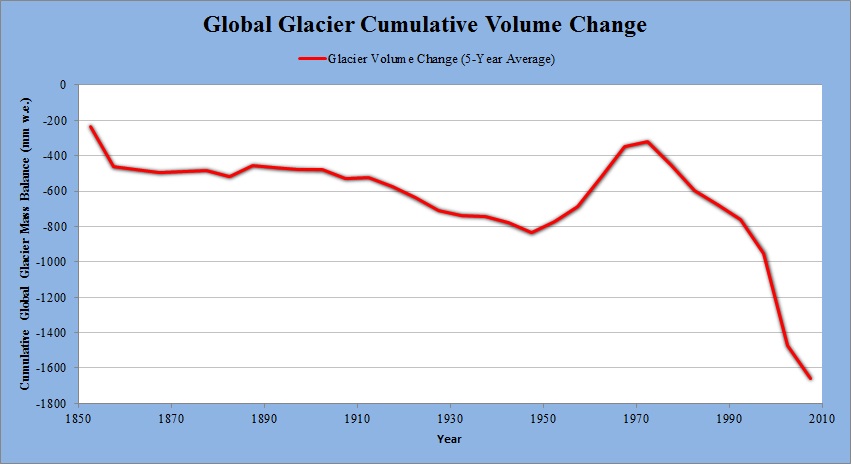
Figure 1: Long term changes in glacier volume adapted from Cogley 2009.
It is also very important to understand that glacier changes are not only dictated by air temperature changes but also by precipitation. Therefore, there are scenarios in which warming can lead to increases in precipitation (and thus glacier ice accumulation) such as displayed in part of southwestern Norway during the 1990s (Nesje et al 2008).
The bottom line is that glacier variations are largely dependent on localized conditions but that these variations are superimposed on a clear and evident long term reduction in glacier volume which has accelerated rapidly since the 1970s.
This post is the Basic version (written by Robert Way) of the skeptic argument "glaciers are growing".

Arguments


I have to be careful how things are interpreted. Changed accordingly.
I thought that precipitation in the form of rain assisted glacier ice to recede not increase. Am I wrong?
Were the precipitation to come down in the form of rain that would be a reasonable assumption. However, the vast majority of the precipitation still comes down as snow, just more of it.
Glacier ice accumulation is a balance between the accumulation and ablation zones of a glacier. Increases in precip in the accumulation zone typically result in glacier advance. However if, due to warming air, the line of equilibrium advances higher up the mountain, the glacier could still have a net mass loss as the percentage of the glacier in the accumulation zone dwindles (even if it is thickening due to increased precip). If the accumulation zone contains less than 60% of the area of the glacier at the end of the melt season, it is in decline (mass loss).
Go to Maury Pelto's site for a very clear explanation.
The Yooper
Like Daniel Bailey said it depends on the form of the precipitation.
Where glaciers gain most of their ice is usually higher up (the accumulation zone) and in these areas it is a lot more likely that precipitation falls as snow. You should also note that increases in wintertime precipitation are the important thing to consider as for most glaciers that is all snow... What it essentially means is warming can increase precipitation during winter at some glaciers, making more snow accumulated during the winter than was melted during the summer... BUT once the winter precipitation subsides or summer temperatures pass a threshold, then more melting occurs than gains.
From what I can tell, more than half that graph is extrapolated from just 30 glaciers, all of which are based in Switzerland.
Can you really do this and come up with a reliable result?
NOAA Glacier Mass Balance
glaciers respond, among other things, to temperature. Recently it has been warming and glaciers are responding to it, whatever its cause might be. Little doubt about this, i guess, and it's what this post is showing.
By the way, who said that there was no ice where and when Otzi died? Could it be so well preserved if not kept at very low temperatures from right after his death?
thingadonta, are you suggesting that glaciers don't move, and that Otzi has been in the same location for the last 5000 years ?
My point still stands though: Is this geographically limited sample sufficient to work out the global picture? I'd feel far more comfortable if those 400+ glaciers were spread around the world (as with the more recent data). For me, this undermines the authority of an otherwise excellent graph, and make it a target for sceptics.
Yet glaciers are still larger today than in 12 other several hundred years long periods during the Holocene, initiated and ended by abrupt changes each time. Ten thousand years could reasonably be called "long term", if not on a true geological time scale, at least compared to the 160 or 40 year flashes you are talking about. We should always pursue the big picture, don't we?
The Holocene, July 2006 vol. 16 no. 5 pp. 697-704
doi: 10.1191/0959683606hl964rp
Multicentury glacier fluctuations in the Swiss Alps during the Holocene
Ulrich E. Joerin, Thomas F. Stocker and Christian Schlüchter
"The radiocarbon ages of tree fragments and peat discs found on proglacial forefields indicate 12 phases of glacier recessions during the Holocene. Locations and type of occurrence of the dated samples show that trees and mires grew where glaciers exist at present and, therefore, glaciers were smaller at that time."
I agree with Grim_Reaper's point that the data plotted in figure 1 of this post are probably not representative of the global trend in glacier mass balance. I give Berényi Péter a hard time about this constantly, in other contexts -- you can't draw reliable conclusions about a global mean from a sample with an ad-hoc spatial distribution like this.
That's not to say that glaciers aren't retreating in most places; they obviously are. But quantifying the global mean trend for that is a difficult undertaking.
Of course, if we haven't already done so we'll certainly be exceeding HTM temperatures soon enough, then exceeding MIS-5e (Eemian) temperatures as well. That doesn't bode well for glaciers. It seems unlikely that the present rapid retreat will be reversing itself any time soon.
UNEP/WGMS put out a joint report (http://www.grid.unep.ch/glaciers/) that has a global graph (Chap 5, Fig 5.9). You could use that. The problem is you have to acknowledge that mass balance loss was as fast in 1945-1955 as it was in the past decade. The final sentance needs to be amended if you want to represent the true picture. I suggest it ends ".....which has returned to the 1940's rate".
Looking at Fig 5.1 suggests to me that any data going back beyond 1940 is really only a European (and to a lesser extent US) record.
I doubt anyone will find difficult "to aknowledge that mass balance loss was as fast in 1945-1955 as it was in the past decade". Indeed, is a good confirmation that the planet is warming, as it has in the first part of the last century and as anyone should aknowledge.
Your skeptic mates, at least the followers of the mantra "it's not warming" or "surface temperature datasets are bogus", would be in trouble instead.
Thanks mspelto for your help. I was amazed at your web site on ice worms, I had thought they were fictional.
although it may sound ovious, I wish to thank you for you invaluable contributions.
There's a sentence in the conclusions of you paper that I, not being a glaciologist, could not fully understand:
"The correlation coefficient in annual balance between each glacier exceeds 0.80, regardless of the extent of accumulation zone thinning, indicating annual balance alone cannot be use."
My trivial picture would say that accumulation zone thinnig alone could be enough to point not just to disequilibrium but to the non-survival of a glacier. What I think I'm missing is some physical mechanism of glacier dynamics that justify the use of more sophisticated parameters. I would be gratefull if you could elaborate a bit on this.
But if we take glacier melting as a signal of global warming then we have to say that temperature in 1945-1955 were similar to 1995-2005. I think some people struggle with accepting that.
25.mspelto
The UNEP/WGMS report does show the mass balance changes were similar in 1945-1955 as 1995-2005 (Fig 5.1). This is with regard to "30 reference glaciers" which I imagine represent good spatial coverage and records. Their "all glacier" record appears to show tha same result although it doesn't extend quite as far back.
Fig5.9 tells me that records began
Europe - late 19th century.
North America - ~1900 but major ramp up ~1945.
Arctic - ~1935
Asia/South America - ~1960's
New Zealand - 1980's
Antarctica/Africa - erm, take your pick
Actually looking at this then maybe the idea that the WGMS data as a true global record has to be qualified. mspelto if you have time could you comment on the WGMS data? And maybe let us know which data Cogley has access to that the WGMS doesn't have?
26.michael sweet
Expertise is a good thing.
Mselto seems to rate Cogley
The United Nations Environment Programme seem to rate The World Glacier Monitoring Service
Both seem to have importantly different stories to tell about glacier mass balance in the mid 20th century. Which should I go with?





