





Home Arguments iPhone App Recent Comments Translations Links Support SkS

Twitter RSS Posts RSS Posts RSS Posts RSS Posts

to support
Skeptical Science
iPhone app

Download
Android app

Download
Nokia app

Download


It's the sun
Climate's changed before
There is no consensus
It's cooling
Models are unreliable
Temp record is unreliable
It hasn't warmed since 1998
Ice age predicted in the 70s
We're heading into an ice age
Antarctica is gaining ice
View All Arguments...


Username
Password
Keep me logged in
New? Register here
Forgot your password?

Latest Posts

Archives


Did scientists predict an impending ice age in the 1970s?

The skeptic argument...

Ice age predicted in the 70s

"The media had been spreading warnings of a cooling period since the 1950s, but those alarms grew louder in the 1970s. In 1975, cooling went from 'one of the most important problems' to a first-place tie for 'death and misery'. The claims of global catastrophe were remarkably similar to what the media deliver now about global warming." (Fire and Ice).

What the science says...

Select a level... Basic Intermediate
The vast majority of climate papers in the 1970s predicted warming.

In the thirty years leading up to the 1970s, available temperature recordings suggested that there was a cooling trend. As a result some scientists suggested that the current inter-glacial period could rapidly draw to a close, which might result in the Earth plunging into a new ice age over the next few centuries. This idea could have been reinforced by the knowledge that the smog that climatologists call ‘aerosols’ – emitted by human activities into the atmosphere – also caused cooling. In fact, as temperature recording has improved in coverage, it’s become apparent that the cooling trend was most pronounced in northern land areas and that global temperature trends were in fact relatively steady during the period prior to 1970.

At the same time as some scientists were suggesting we might be facing another ice age, a greater number published contradicting studies. Their papers showed that the growing amount of greenhouse gasses that humans were putting into the atmosphere would cause much greater warming – warming that would a much greater influence on global temperature than any possible natural or human-caused cooling effects.
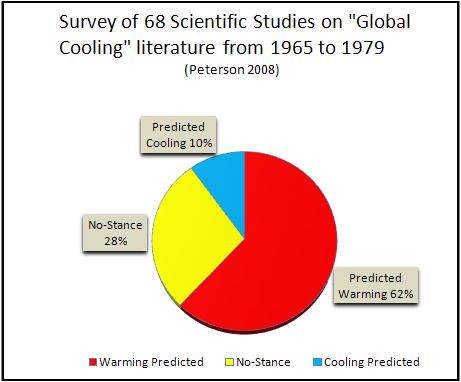
By 1980 the predictions about ice ages had ceased, due to the overwhelming evidence contained in an increasing number of reports that warned of global warming. Unfortunately, the small number of predictions of an ice age appeared to be much more interesting than those of global warming, so it was those sensational 'Ice Age' stories in the press that so many people tend to remember.

The fact is that around 1970 there were 6 times as many scientists predicting a warming rather than a cooling planet. Today, with 30+years more data to analyse, we've reached a clear scientific consensus: 97% of working climate scientists agree with the view that human beings are causing global warming.

Printable Version  |  Link to this page

Further reading

Further viewing

" allowfullscreen="true" allowscriptaccess="always" 4ntw0knenlg&hl="en&fs=1&"" v="" www.youtube.com="" http:="" althtml="

Comments

Comments 1 to 15:

  1. But the idea that we will go into another glaciation is far sounder science than is this new and basically baseless stuff. We always have in the past. This planet is currently hard-wired with a one way catastrophic cooling bias.

    The case that we will have another glaciation is basically cut and dried. We have the capacity to cool the earth. We have no such capacity to warm the earth. In order to avoid another glaciation we ought to be looking at ways to hose down volcanic aerosols or something.

    Certainly we need to build up our nuclear energy production capacity. And our hydrocarbons as well.
  2. Ice ages cannot be explained without the GHG feedback. The same science that tells us this, tells us we are heating up the planet.
  3. The claim by Peterson that there were only 7 papers in the 1970s predicting cooling is just ridiculous. Anyone can check this with a quick look at Google scholar. Here are two examples they have missed, but there are many more.

    Return of the ice age and drought in peninsular Florida?
    Joseph M. Moran, Geology 3 (12): 695-696 (1975)
    Convection in the Antarctic Ice Sheet Leading to a Surge of the Ice Sheet and Possibly to a New Ice Age
    T. Hughes, Science Vol. 170. no. 3958, pp. 630 - 633 (1970)

    What is strange is why people attempt to re-write recent history in this way, when their claims can so easily be disproven.
    Where did all the stories in the papers, TV and magazines come from? Were they all just fabricated? No of course not, they came from scientists who made suggestions (like the above 'possibly to a new ice age') which were then hyped and exaggerated by the media. Much the same thing is happening now with the global warming scare.
  4. Um, for one thing Moran was writing about _Florida_ cooling, not _global_ cooling. I guess you'll need to relax your search criterion for "global cooling" a whole lot to prove that scientists did predict cooling...

    "they came from scientists who made suggestions (like the above 'possibly to a new ice age') which were then hyped and exaggerated by the media. Much the same thing is happening now with the global warming scare."

    Yeah, "much of the same thing" in the sense that the "media" is artificially inflating the voice of the global warming "skeptics".
  5. frankbi
    Read the media articles, they are almost always alarmist. Those that have comment sections often disappear after someone disproves the article. I have seen this on CBS, ABC and LiveScience quite a few times.
    Then there is the BBC.
  6. ScaredAmoeba at 21:26 PM on 20 April, 2008
    PaulM,
    You bemoan people attempting to [quote]‘re-write recent history’. However, reporting the facts does not amount to ‘rewriting history’!
    The people actually responsible for the rewriting of history are not AGW fanatics, but people politically or ideologically aligned to industry and typically funded directly or indirectly by the fossil fuel funded denial industry. Peterson et al. 2008 have merely attempted to establish the facts and set the record straight.

    The fact that you may have identified two additional relevant papers and claimed there are ‘many more’, which may or may not support your pet theory, does not invalidate their research. It seems probable that any additional papers fitting the various search criteria will be distributed in much the same way as the papers already listed, unless there is a very good reason why they should not be included.
  7. ScaredAmoeba at 22:16 PM on 20 April, 2008
    Quietman
    You are repeating the deceitful alarmist allegations made repeatedly by skeptics

    From Scientists add to heat over global warming by S. Fred Singer
    Washington Times, May 5, 1998
    “But this exaggerated concern about global warming contrasts sharply with an earlier NAS/NRC report, "Understanding Climate Change: A Program for Action." There, in 1975, the NAS "experts" exhibited the same hysterical fears—-this time, however, asserting a "finite possibility that a serious worldwide cooling could befall the Earth within the next 100 years."

    The 1975 NAS panel claimed to have good reason for their fears: Global temperatures had been in steady decline since the 1940s. They considered the preceding period of warming, between 1860 and 1940, as "unusual," following as it did the "Little Ice Age," which had lasted from 1430 to 1850.”

    http://www.sepp.org/key%20issues/glwarm/sciaddheat.html

    You will note that the terms ‘exaggerated’, ‘hysterical fears’ and ‘fears’ are used. There are a number of other changes too that render the use of quotes highly questionable.

    1975 US National Academy of Sciences/National Research Council Report
    UNDERSTANDING CLIMATE CHANGE: A program for action

    Strangely,

    From the foreword (by V E Suomi, Chair of the US Committee for GARP):

    "..,we do not have a good quantitative understanding of our climate machine and what determines its course. Without the fundamental understanding, it does not seem possible to predict climate..,".

    From the introduction
    "Climatic change has been a subject of intellectual interest for many years. However, there are now more compelling reasons for its study: the growing awareness that our economic and social stability is profoundly influenced by climate and that man's activities themselves may be capable of influencing the climate in possibly undesirable ways. The climates of the earth have always been changing, and they will doubtless continue to do so in the future. How large these future changes will be, and where and how rapidly they will occur, we do not know".

    Not much evidence of hysteria! It would seem that the allegations of exaggeration and hysteria were complete fabrications introduced by Singer. The measured and cautious language of the National Academy of Sciences has been entirely born out.
  8. Re: "You are repeating the deceitful alarmist allegations made repeatedly by skeptics"
    No, I am not repeating anything. My statement is purely from personal experience. I tried again this morining, after reading your reply, to go back and see if some of the alarmist articles were still there. Most were gone. I checked back through January - gone. What few skeptical articles I had read are still there. I may be ignorant about many subjects but I am not stupid. Those articles were intentionally pulled when proven incorrect. Here are the few that have not been deleted:

    The rhetoric of climate and slavery

    Climate change 2007 - a year in review

    Trees absorbing less CO2 as world warms, study finds

    Acidic seas may kill 98% of world's reefs by 2050

    Deniers of global warming harm us

    Global warming to trigger volcanic eruptions
  9. These articles all present a case for either natural warming or non-CO2 forced AGW, or simply that the alarmist claims don't quite cut it.

    Water Vapor Feedback Is Rapidly Warming Europe

    About the coral reefs: Coral Reefs May Be More Resilient Than Expected

    "The deniers' fallback position is to argue that what is happening is due not to human intervention but some sort of natural cycle." During the last centuries human methane emissions artificially increased CH4 concentrations to approximately 1750 ppbv:
    Current Spike In Atmospheric Methane Mirrors Early Climate Change Events
    NASA Studies How Airborne Particles Affect Climate Change

    "Tropical deforestation currently accounts for roughly one-fifth of the global emissions of carbon dioxide, the most important human-derived greenhouse gas, Gurney said."
    Researchers Propose Way To Incorporate Deforestation Into Climate Change Treaty

    "Whilst rising air temperatures are believed to be the primary cause of recent dramatic disintegration of ice shelves like Larsen B, the new study suggests that the ocean may play a more significant role in destroying them than previously thought."
    Antarctic Ice Shelf Retreats Happened Before
    Antarctic Deep Sea Gets Colder

    My point being that healthy skepticism leads to better understanding of the big picture.
    Response: I'll leave this comment up as there are few links there I wasn't previously aware of. But from now on, I'm taking a zero tolerance policy on comments that post a bunch of links not related to the topic. I know its a bit more work but please post any links on the relevant page.
  10. Sorry John
    I was replying to ScaredAmoeba "You are repeating the deceitful alarmist allegations made repeatedly by skeptics" Attempting to show that not all skeptical arguments are denials or harmful. If you prefer to delete it thats OK by me, it's your blog.
    Response: Nah, I'll leave it up. One of my pet peeves when having online discussion about global warming is when someone just posts a whole bunch of diverse links to a wide range of topics - it essentially shuts down the discussion because it's not practical to post a reply addressing each link. More constructive debate keeps to the topic at hand. I don't think you were necessarily trying to do this but for future reference, those links would be more effective posted on the appropriate page. Plus from my point of view as webmaster, I like the comments section to be relevant and useful to readers.
  11. The side argument over deceit aside, I would like to point out that the scientist who started the cooling fright in the 70s actually has not changed his position.
    Reading his work indicates that there should be an upcoming glacation regardless of any warming but the timing was and still is unknown. The panic was caused by the media reading timing as immediate into his work.
  12. Re #3:

    It's easy to be misled by the titles of papers. The examples you've asserted as supporting a 1970's perspective of global cooling don't actually do so.

    Your second article sounds like it does:

    Convection in the Antarctic Ice Sheet Leading to a Surge of the Ice Sheet and Possibly to a New Ice Age
    T. Hughes, Science Vol. 170. no. 3958, pp. 630 - 633 (1970)

    But it's just a potentially misleadingly worded title. If you read the paper it's got zero relevance to a possibility of a "new ice age" in the near (i.e. "near" from a 1970 perspective). It's about the GENERAL nature of ice Antarctic ice sheet advance that might (within a particular "surge" theory) be linked to the glacial cycles within the Pleistocene. So it's about how glacial periods might in general occur.

    That's very clear from reading the paper. It's also evident just from reading the abstract:


    abstract: "The Antarctic surge theory of Pleistocene glaciation is reexamined in the context of thermal convection theory applied to the Antarctic ice sheet. The ice sheet surges when a water layer at the base of the ice sheet reaches the edge of the ice sheet over broad fronts and has a thickness sufficient to drown the projections from the bed that most strongly hinder basal ice flow. Frictional heat from convection flow promotes basal melting, and, as the ice sheet grows to the continental shelf of Antarctica, a surge of the ice sheet appears likely."

    So it's a theoretical study of a mechanism for ice sheet advance during glacial cycles. It doesn't address the possibility of any such event during the current Holocene, and has nothing to do with 1970's scientific perception of global warming or cooling or any such thing.


    Likewise it's understandable why Peterson et al. didn't include your other paper as a "cooling"/Ice Age" one:

    Return of the ice age and drought in peninsular Florida?
    Joseph M. Moran, Geology 3 (12): 695-696 (1975)

    Although the title (and the rather odd abstract) might suggest that the paper is about the "return of the ice age", the question mark highlights the fact that the author is rather equivocal over such a conclusion.

    Here's how he ends his (very brief) note:

    "While there is an interesting parallel between recent and late-glacial events in the tropics, no clear cause-effect relation has been established between the current hemispheric cooling trend and precipitation trend in peninsular Florida. Also, even if a linkage were established, there is no certainty that the hemispheric cooling trend will not reverse itself in a few years. Rather than portraying a bleak future for Florida’s water supply, therefore, the observations presented here should serve as stimuli for further monitoring and research to promote understanding of the controlling atmospheric phenomena."

    In other words, the paper relates to precipitation trends with potential implications for water supply in Florida, and the author indicates that there isn't any necessary relation between cooling and precipitation trends and indicates anyway that the cooling trend might reverse itself.

    So neither of your suggestions - absolutely not the first one which is totally irrelevant to 1970's perspective on cooling/warming or otherwise, - nor the second one can be taken to support the notion of any 1970's scientific perception of global cooling (by the criterion that Paterson et al. set of a paper with a clear projection of climate change or discussing an aspect of climate forcing relevant to time scales of decades or centuries). Morgan's short note doesn't come to any conclusion - the "cooling" "...might reverse itself in a few years".
  13. I was struck by this week's skeptic article (by David Deming in "The American Thinker"), [http://skepticalscience.com/article.php?a=2327] finding it both laughable and inspiring, and it drew me back to here. One thing that surprised me a bit was Deming's claim that we don't know what causes ice ages. I thought it was Milankovitch cycles mostly (Deming says Ike Winograd disproved that). With the google I only found a Wunsch abstract [http://tinyurl.com/qg3bgw] that says orbital changes only explain 20% of the variance in climate records studies. Anyway, I'm curious to learn more about our understanding of ice ages.
  14. GMG #1:

    You SAY it is 'sounder science', but you ignore all the evidence to the contrary presented in this article and many others on this site.

    No, belief in impending glaciation is NOT 'sounder science'. Nor is it "sounder science" to argue as you do, that it has always happened that way.

    On the contrary: the SOUND science recognizes that things are no longer going to happen "as they always have happened". Now we really have made a large enough change to break the age-old pattern -- for the worse.
  15. This Basic Version is one of the better ones written so far. It has much better flow as we read it. One idea logically follows after the other, leading naturally to a sound conclusion.

    Well and good: but you knew there was a 'but' coming, didn't you;)? That 'but' is: "but the sentences are too long for our target audience".

    To remedy this, I suggest some strategic application of metonymy, synecdoche and ellipsis to tighten things up.

    So, for example, we can do much better than "As a result some scientists suggested that the current inter-glacial period could rapidly draw to a close, which might result in the Earth plunging into a new ice age over the next few centuries."

    We can instead, say "So some scientists suggested that the current inter-glacial could draw to a rapid close, starting a new ice age over the next few centuries". (we really don't need to specify that it is the Earth we are talking about).

    Similarly, "This idea could have been reinforced by the knowledge that the smog that climatologists call ‘aerosols’ – emitted by human activities into the atmosphere – also caused cooling." can also be improved by replacing with:

    "About the same time, climatologist learned that 'aerosols' (small particles resulting from human activities) can cause cooling. This may have have encouraged the idea that a new ice age was coming".

    One final note: here in the States at least, we use "it's" as a contraction for "it is". We never use it for "it has". I don't know about the state of the language Down Under, but if the target audience is here in the US, the use of "it's" to mean "it has" will sound strange to too many in your target audience.

Post a Comment

Political, off-topic or ad hominem comments will be deleted. Comments Policy...

You need to be logged in to post a comment. Login via the left margin or if you're new, register here.

Link to this page

© Copyright 2010 John Cook Links | Translations | About Us | Contact Us






