



 Arguments









Is extreme weather caused by global warming?
What the science says...
| Select a level... |
 Basic
Basic
|
 Intermediate
| |||
|
Global warming amplifies the risk factors for extreme weather events - and that is all that Climate Science claims. |
|||||
Climate Myth...
Extreme weather isn't caused by global warming
"The 30 major droughts of the 20th century were likely natural in all respects; and, hence, they are "indicative of what could also happen in the future," as Narisma et al. state in their concluding paragraph. And happen they will. Consequently, the next time a serious drought takes hold of some part of the world and the likes of Al Gore blame it on the "carbon footprints" of you and your family, ask them why just the opposite of what their hypothesis suggests actually occurred over the course of the 20th century, i.e., why, when the earth warmed - and at a rate and to a degree that they claim was unprecedented overthousands of years - the rate-of-occurrence of severe regional droughts actually declined." (source: CO2 Science)
At-a-glance
Have you experienced an extreme weather event?
The answer to that question first requires a definition for 'extreme' weather. What threshold must be passed for 'bad' weather to take on the distinction of being 'extreme'?
The IPCC Sixth Assessment Report (AR6) defines an extreme weather event as, “an event that is rare at a particular place and time of year”. So we're getting somewhere now, although we're still left with 'rare', which is not a precise term. But we have to be pragmatic about such things. It's fair to say that torrential rain, for example, is common enough seasonally in the world's Monsoon belts but infrequent in deserts, so 'rare' in that latter case is a justifiable word to use.
When those Monsoon-affected parts of the world experience torrential rain sufficient to submerge vast areas of a country beneath flood-waters, we can agree that's pretty extreme, too. Basic physics tells us that for every degree Celsius of extra warmth, air can carry 7% more moisture. So the potential for heavier rains in a warming world is obvious. The IPCC use strictly-defined categories of probability. In AR6, the probability of an increase in heavy precipitation events is given as "Likely on a global scale, over a majority of land regions". That probability is described in terms of their, "increased frequency, intensity, and/or amount of heavy precipitation". 'Likely' means they are 66-100% certain this will happen.
National weather agencies are able to compare weather events against a baseline for which they have good data-coverage. In most countries, such coverage has been in place since the mid 20th Century, but in some, such as the UK, the data go back for another 100 years. So if a record in terms of heat or daily rainfall amount does get broken, that's significant.
In July 2022, for example, the UK saw extraordinarily high temperatures with a daily maximum of 40.3°C recorded at Coningsby in Lincolnshire. This was the first time 40°C had ever been recorded in the UK. But more astonishingly, a total of 46 other weather stations exceeded the previous UK record of 38.7°C. In addition, overnight minimum temperatures widely exceeded anything recorded before. That scorching heat wave, coming on top of drought conditions, had tremendous impacts both in terms of lives lost and fire-related damage. Again, that's significant.
The problem is that in a warming world, 40°C days in the UK can be expected to become more frequent as the decades pass by. In a world where global warming continues unabated, yesterday's extreme becomes next century's normal. The trend of, "warmer and/or more frequent hot days and nights over most land areas", is described in AR6 as, "virtually certain". In the strictly-defined categories of probability adopted by the IPCC, 'virtually certain' can only be used where there is 99-100% probability.
So the take-home is that some, but not all weather-types are liable to be amplified in their severity and frequency by global warming. Heat, drought, fire-weather and long-duration heavy rains: surely that's enough to be dealing with.
Please use this form to provide feedback about this new "At a glance" section. Read a more technical version below or dig deeper via the tabs above!
Further details
Whenever there is an extreme weather event such as a flood or drought, the media will tend to feature it and the question that is often raised is whether that event was caused by global warming. Unfortunately, there is often no quick answer to this question. That is because weather is highly variable and extreme weather events have always happened. The attribution-studies required to determine whether a global warming signal is detectable are complex. They take a lot of time. Detecting trends also takes time, particularly in cases where observational records are rare or even missing in certain regions.
An increase in some categories of extreme weather is nevertheless expected with global warming, because rising temperatures affect weather phenomena in several ways. Appropriately and in a timely fashion, the working group one (WG1) section of the IPCC’s Sixth Assessment Report (AR6) includes a chapter specifically dedicated to discussing weather extremes. That's a first, assessing how such things have changed both regionally and globally, in recent decades. A key conclusion is that it is an “established fact" that human greenhouse gas emissions have “led to an increased frequency and/or intensity of some weather and climate extremes since pre-industrial times”.
How global warming affects weather
Rising temperatures can have several effects on the weather. For example:
- They increase the rate of evapotranspiration, which is the total evaporation of water from soil, plants and water bodies. This can have a direct effect on the frequency and intensity of droughts.
- A warmer atmosphere can hold more water vapour, potentially increasing the severity of intense or prolonged rainfall events. According to AR6, "combined satellite and reanalysis estimates and CMIP6 atmosphere-only simulations (1988–2014) show global mean precipitable water vapour increases of 6.7 ± 0.3 % °C–1, very close to the Clausius–Clapeyron rate (Allan et al. 2020)".
- Changes in sea-surface temperatures (SSTs) also have an effect by bringing about associated changes in atmospheric circulation and precipitation. This has been implicated in some droughts, particularly in the tropics.
These changes don't automatically generate extreme weather events but they change the odds that such events will take place: it has often been said that, "climate trains the boxer but the weather throws the punches". It is equivalent to the loading of dice, leading to one side being heavier, so that a certain outcome becomes more likely. In the context of global warming, this means that rising temperatures increase the odds of certain kinds of extreme events occurring.
Changes in extreme weather events are already being observed
In the US, for example, the Global Changes Research Program published a report in 2018 entitled Fourth National Climate Assessment Volume II: Impacts, Risks, and Adaptation in the United States. It reports the following findings for recent decades:
- Some climate-related impacts, such as increasing health risks from extreme heat, are now common to many regions of the United States.
- Many places are subject to more than one climate-related impact, such as extreme rainfall combined with coastal flooding, or drought coupled with extreme heat, wildfire, and flooding.
- Annual precipitation since the beginning of the last century has increased across most of the northern and eastern United States and decreased across much of the southern and western United States. Over the coming century, significant increases are projected in winter and spring over the Northern Great Plains, the Upper Midwest, and the Northeast.
- The frequency of drought has increased in areas such as the Southeast and the West, and decreased in other areas. Rising temperatures make droughts more severe and/or widespread, and also lead to the earlier melting of snowpacks, which can exacerbate problems in vulnerable areas.
- Atlantic hurricanes have increased both in power and frequency, coinciding with warming oceans that provide energy to these storms. In the Eastern Pacific, there have been fewer but stronger hurricanes recently. More research is needed to better understand the extent to which other factors, such as atmospheric stability and circulation, affect hurricane development.
Similarly, Australia has seen the odds of both heavy rainfalls and droughts (and consequent wildfires) increase, and similar patterns are being observed worldwide, coinciding with rising temperatures over the past 50 years. Heat waves are also occurring more frequently as temperatures shift upwards. The same goes for Europe and parts of Asia.
Carbon Brief has an interesting interactive extreme weather map. It lets you see whether attribution studies have been completed for any single event - well worth a look when you have some spare time.
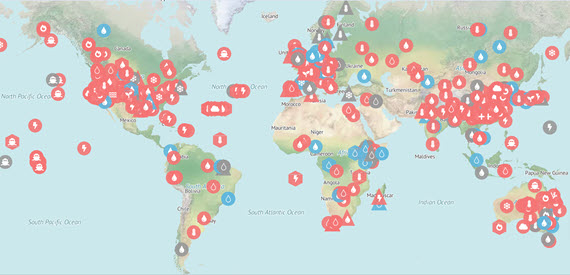
Figure 1: Screenshot of Carbon Brief's interactive map of extreme events. Red icons indicate that human influence was found, blue icons where that is not the case, grey icons where it's inconclusive. Full map with links to the studies available here.
In conclusion, although it isn't possible to state that global warming is causing a particular extreme event at the same time that event is wreaking havoc, it is wrong to say that global warming has no effect on the weather. From the record-breaking “heat dome” of 2021 in the Pacific north-west and the accompanying catastrophic wildfires to the devastating flooding in Europe of July 2021; from the record July 2022 UK heatwave to the disastrous series of atmospheric rivers that struck California from late 2022 to early 2023, extreme weather is occurring all around the planet and records are not just being broken, they are being smashed.
Last updated on 6 August 2023 by John Mason. View Archives







[DB] "I have read"
Norman, please be advised that when making a statement such as this intended to refute someone else's comment (which itself was based on sourced, linked data) you must be prepared to then back up your statement with a verifiable link to a reliable source.
Why do they think AGW causes only cold air, not warm air, to get warmer?
[Sph] blockquote added to clarify intent.