



 Arguments









Comparing past climate change to recent global warming
What the science says...
It warmed just as fast in 1860-1880 and 1910-1940
“In fact, the rate of warming from 1975-2001, at 0.16 °C per decade, was the fastest rate to be sustained for more than a decade in the 160-year record, but exactly the same rate occurred from 1860-1880 and again from 1910-1940, when we could not possibly have had anything to do with it.” (Christopher Monckton)Let’s have a look at some warming rates of the periods of interest from several different temperature records:
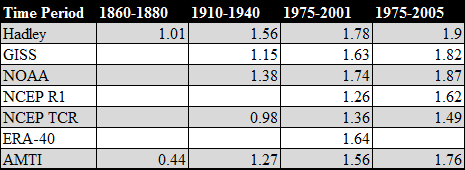
Table 1: Rate of warming for given indices in °C/century.
First we can conclude that Monckton's statement that 1975-2001 was the fastest warming rate for longer than a decade is absolutely wrong as a much higher rate is demonstrated for 1975-2005 in row 5. Secondly, to compare the three periods in Table 2, the only index which covers that period is Hadley, making his 1.6°C per century number wrong for 1975-2001 as it is actually much higher at 1.78°C per century.
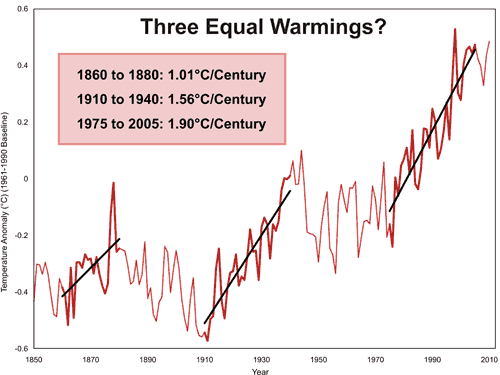
Based upon the evidence presented here, he cannot support his statement that 1860-1880 had a similar warming rate as it was demonstratively lower than the 1975-2001 warming rate and nearly half the 1975-2005 rate. Finally, regarding the 1910 to 1940 warm period, evidence presented here suggests that only 1 out of the 4 major indices indicates a rate of warming within 0.25°C per century and none within 0.2°C. His claim that the rates are similar is dubious at best.
Last updated on 31 January 2011 by robert way.
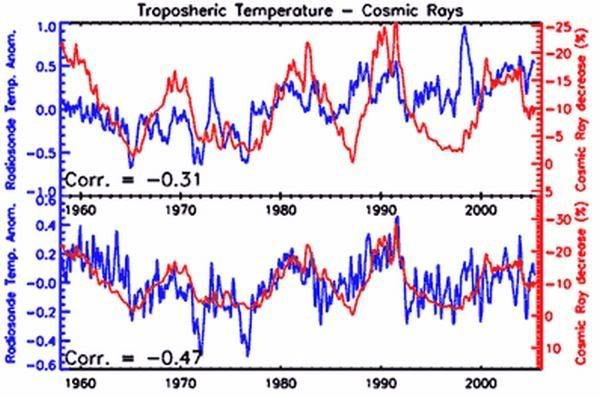 http://icecap.us/images/uploads/SvensmarkPaper.pdf
 My two cents. HTH.
The Yooper
My two cents. HTH.
The Yooper
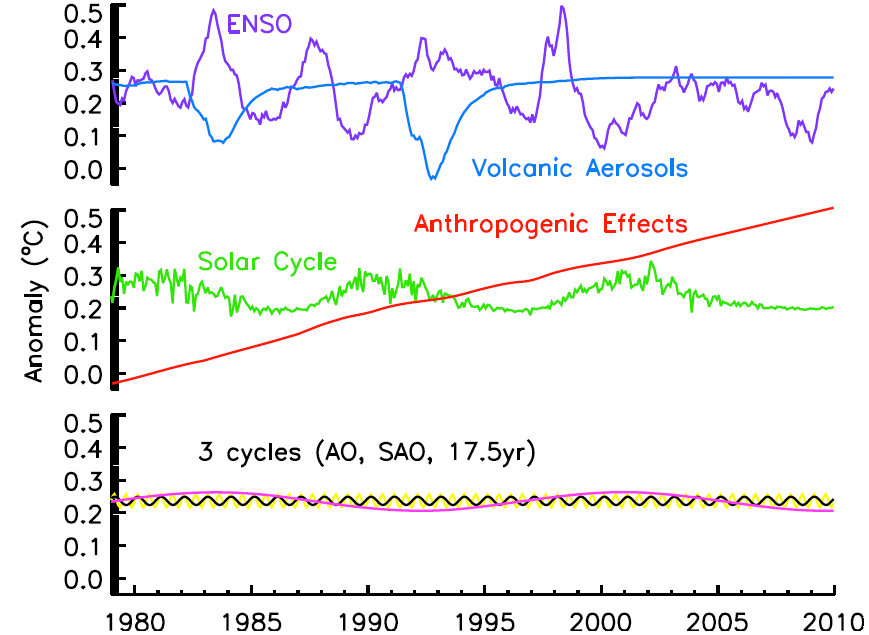 Caption: Contributions to the empirical model of temperature shown in Figure 1 are broken down here: El Niño Southern Oscillation (purple), volcanic eruptions (blue), anthropogenic effects (red), and solar irradiance (green).
[Source]
and compare those data with the SAT data:
Caption: Contributions to the empirical model of temperature shown in Figure 1 are broken down here: El Niño Southern Oscillation (purple), volcanic eruptions (blue), anthropogenic effects (red), and solar irradiance (green).
[Source]
and compare those data with the SAT data:
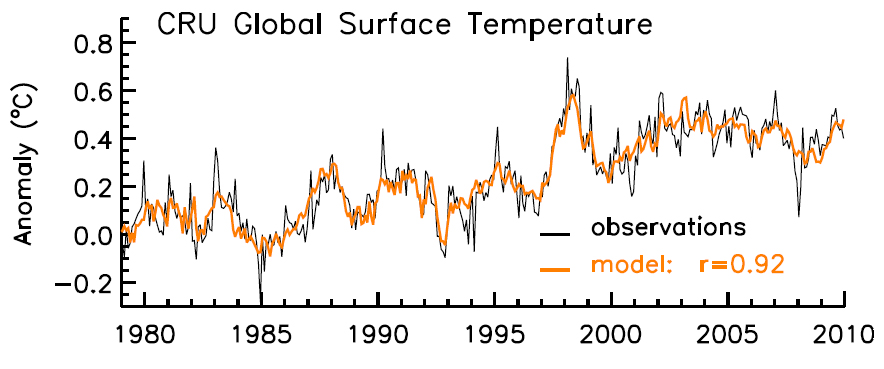 Caption: Global surface temperature from 1980 to 2010 has risen by 0.4 degrees Celsius (0.72 degrees Fahrenheit) according to Climate Research Unit measurements (black) and an empirical model (orange). (Courtesy Kopp and Lean), same source as above.
Not surprisingly, Kopp and Lean conclude that:
"Using this model, Lean estimates that solar variability produces about 0.1°C global warming during the 11-year solar cycle, but is not the main cause of global warming in the past three decades."
Caption: Global surface temperature from 1980 to 2010 has risen by 0.4 degrees Celsius (0.72 degrees Fahrenheit) according to Climate Research Unit measurements (black) and an empirical model (orange). (Courtesy Kopp and Lean), same source as above.
Not surprisingly, Kopp and Lean conclude that:
"Using this model, Lean estimates that solar variability produces about 0.1°C global warming during the 11-year solar cycle, but is not the main cause of global warming in the past three decades."
 Svensmark has a GCR hypothesis, hardly a fully fledged theory. I doubt very much that the paper you linked to demonstrates "Cosmic rays can indeed still be the major cause of warming of the past three decades". But I'll have a look.
I do not understand why you insist on repeatedly making demonstrably false statements.
Svensmark has a GCR hypothesis, hardly a fully fledged theory. I doubt very much that the paper you linked to demonstrates "Cosmic rays can indeed still be the major cause of warming of the past three decades". But I'll have a look.
I do not understand why you insist on repeatedly making demonstrably false statements.







Climate Myth...