It's Pacific Decadal Oscillation
The skeptic argument...
It's Pacific Decadal Oscillation
"The Pacific Decadal Oscillation (PDO) is a temperature pattern in the Pacific Ocean that spends roughly 20-30 years in the cool phase or the warm phase. In 1905, PDO switched to a warm phase. In 1946, PDO switched to a cool phase. In 1977, PDO switched to a warm phase. In 1998, PDO showed a few cool years. Note that the cool phases seem to coincide with the periods of cooling (1946-1977) and the warm phases seem to coincide with periods of warming (1905-1946, 1977-1998)." (The Reference Frame)
What the science says...
| Select a level... |
Basic
|
Intermediate
|
Advanced
| ||||
| The PDO shows no trend, and therefore the PDO is not responsible for the trend of global warming. | |||||||
The Pacific Decadal Oscillation (PDO) is a climate phenomenon that occurs primarily in the North Pacific Ocean. The “oscillation” happens between warm phases (positive values) and cool phases (negative values) that last anywhere from 10 to 40 years. The phases are associated with changes in sea surface temperatures (SST). While the causes of the PDO are still unknown, the primary effects seem to be changes in northeast Pacific marine ecosystems and a changing jet stream path.
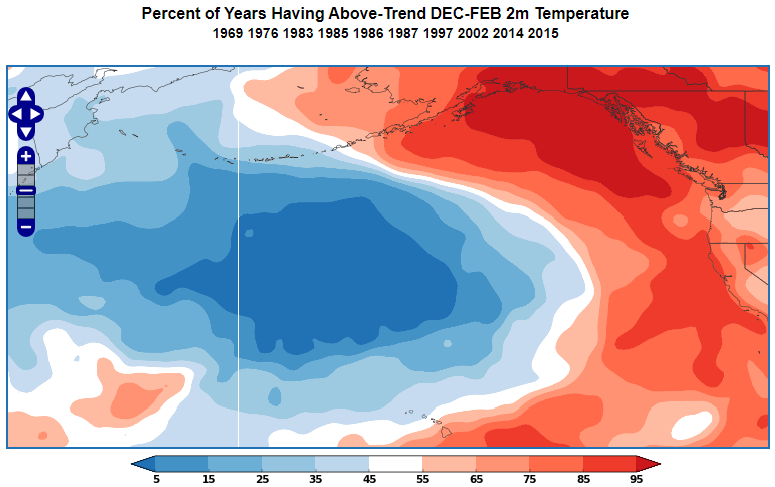
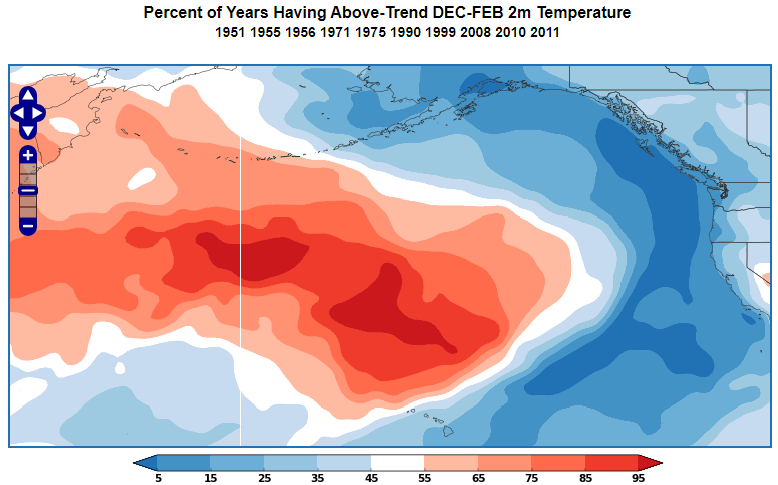
Important to note, however, is that the phases are not set in stone; there are frequently short sets of 1-5 warm years during a cool phase and vice-versa. Secondly, the “warm” and “cool” phases are less descriptive than they would appear. The cool period, for instance, is actually associated with extremely high sea surface temperatures in the Northern Pacific (see image below).
Figure 1: PDO warm phase (left) and cool phase (right). Image courtesy of JISAO.
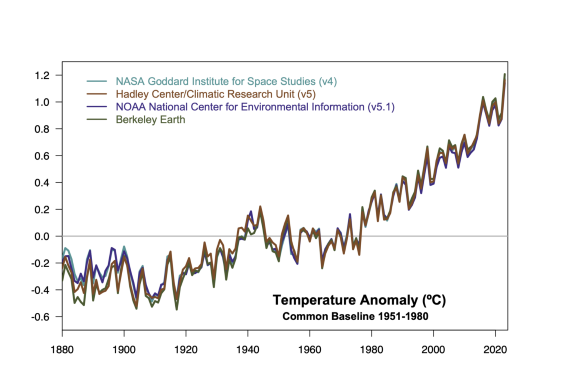
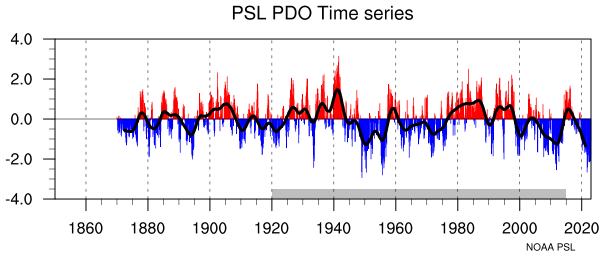
One way to test this skeptic theory is to plot the Global Temperature Anomaly alongside the PDO Index (shown below). What we find is that although the PDO index appears to influence short-term temperature changes, global temperatures have a distinct upward trend, while the PDO Index does not.

Figure 2: Pacific Decadal Oscillation index (blue, University of Washington) versus Global Temperature Anomaly (Red - GISS Temp). Smoothed data (thicker blue and red lines) and trend lines (thick straight line) are added.
Natural oscillations like PDO simply move heat around from oceans to air and vice-versa. They don't have the ability to either create or retain heat, therefore they're not capable of causing a long-term warming trend, just short-term temperature variations. Basically they're an example of internal variability, not an external radiative forcing. If PDO were responsible for warming the surface, the oceans would be cooling, which is not the case.
These results are expected. The long term warming trend is a result of an energy imbalance caused primarily by an increase of greenhouse gases in the atmosphere. In contrast, the PDO is an internal process and does not increase or decrease the total energy in the climate system.
Last updated on 16 September 2010 by Nicholas Berini.

Arguments


Basic
Intermediate
Advanced


Nice job.
This PDO index shows no trend because the globally averaged SST is subtracted out. The globally averaged SST is subtracted out because it is assumed that the PDO is not effecting global SSTs but is rather a mode of variability on top of global SSTs. As far as I know this is not a robust conclusion and therefor I feel that it is misleading to compare the "trendless" PDO to globally averaged surface temperature the way that it is done in the above graph.
"Updated standardized values for the PDO index, derived as the leading PC of monthly SST anomalies in the North Pacific Ocean, poleward of 20N. The monthly mean global average SST anomalies are removed to separate this pattern of variability from any 'global warming' signal that may be present in the data."
If the "global warming" signal wasn't subtracted out of the index there would be an upward trend.
The Pacific Decadal Oscillation does what, by definition? It oscillates! That means it goes back and forth--reverses course, then repeats. Its lack of a non-oscillating component is neither an assumption nor a conclusion, but part of its very definition.
You have misunderstood the skeptic argument that blames the PDO for the "apparent" global warming long trend. That skeptic argument is not that the PDO has a long-term warming trend. Rather, the skeptic argument is that no long-term warming trend exists. At all. The skeptic argument is that the PDO's warm phases have been long and frequent enough that climatologists have mistaken them for long-term warming. The skeptic argument is that if we simply wait a bit longer, we will see PDO cooling phases long enough to wipe out all the warming we've seen since the 1850s.
The counterargument is captured in the figure that you objected to. PDO warm phases are much too short to be responsible for the warming we've observed since the 1850s. There already have been counteracting cool phases.
"You have misunderstood the skeptic argument that blames the PDO for the "apparent" global warming long trend. That skeptic argument is not that the PDO has a long-term warming trend. Rather, the skeptic argument is that no long-term warming trend exists. At all."
Perhaps I have misunderstood the skeptical argument that this post is directly addressing but nevertheless I have indeed heard it argued that the PDO has caused the long term upward warming trend. My problem with this post is that it seems to use the fact that there is no upward trend in the PDO as evidence that the PDO could not have caused an upward trend in temperature. My problem is that this PDO index is trendless for artificial reasons. Like you said, someone defined the PDO such that it would not have a long term trend. This does not seem to be good evidence to dismiss it as a contributor to warming.
Please explain this to me.
Thank you.
I'm not sure how good this 'correlation' actually is (for instance a PDO peak corresponds to a temperature drop ~1994), but in any case correlation does not equal causation. Isn't it equally likely that fluctuations in global temperature drive the PDO? Or that a third factor (e.g. the solar irradiance cycle) is influencing both and producing the partial correlation you think you see?
Since the solar torque cycle is thus also and of course independent of the Earth's atmospheric CO2 levels, the strongest causation is that the Earth's atmosphere (temperatures) respond to the ocean temperatures and not the other way around. Need additional proof? Look at the global atmospheric temperatures and how they responded to the strongest el nino in 1997/1998 (ENSO cycle, that in turn is dependent on the PDO and solar cycle too). That El Nino lasted from march 1997 to march 1998, peaking nov-dec 1997 through jan 1998. In addition, a la nina was already official in may 1998. However the global temperatures lag 6 months: peaking jun-aug 1998 ... Hence global atmospheric temperatures respond to global oceans temperatures.
Now that causality has been established we can dig some more:
I've been looking at the NOI data (SST for EL nino region 3.4) from NOAA available since 1950 and what is striking is that since the el nino from 1958, each peaking el nino has been stronger than the previous one, until the 1997/1998 el nino:
1958: 1.7, 1973:2.1, 1983: 2.3, 1998: 2.5, (2010: 1.8, trend reversal! more about that later)
Doing simple linear regression; the peaks increase by 0.0017/month with an R-square of 0.97. That said, looking at la ninas since the 1950s; these increased in strength until the one in 1974
1950: -1.7, 1956: -2.0, 1974: -2.1
and have since then decreased (the peak la ninas that is) until the most recent one in 2008:
1989: -1.9, 2000: -1.6, 2008: -1.4
Interestingly, the decrease in la nina peaks is also 0.0017/month with an R-square of 0.97. The fact that both the el nino and la nina peaks increased and decreased, respectively, with the exact same slope is due to an underlying causation: the PDO.
Adding PDO events (warm to cold reversals, vice versa, phase shifts, etc) to the NOI data we instantly see the following:
The 2008 la nina coincides exactly with the PDO GPTC
The 1998 el nino coincides exactly with the PDO phase shift from warm to cold
The 1988 la nina coincides exactly with the highest PDO (LPTC) since 1934
The 1977/78 el nino coincides exactly with PDO phase shift cold to warm
The 68/69 la nina coincides exactly with PDO's phase reversal
The 55/56 la nina coincides exactly with the lowest PDO value since 1900
In addition, between 1950 and 1977 there were 126 la nina seasons (months) and 75 el nino seasons: PDO was cold Between 1977 and 1998 there were 53 el nino seasons and 27 la nina seasons: PDO was warm
Hence, it is obvious that the enso cycle is highly correlated with the PDO which in turn is highly correlated to the sun's torque cycle. In addition, we've entered a trend reversal in ENSO strength; the 2009/2010 El Nino was less strong than the 1997/1998 one. Although it's only one data point to confirm this, it makes all sense using the above. Hence, the ocean and atmosphere is going from an el nino dominated 40 yr period that ended in 1998 to a la nina period of several decades that started in 2008.
Now back to the global warming issue. 1998 was the year with the highest recorded temperature: +0.57 and global atmospheric temperatures have dropped since... See a pattern? Follows the PDO exactly. Now 2010 is on track to at least equal 1998, and is currently at +0.54. However, for October the global temperature anomaly is +0.42 deg, which is the lowest monthly temperature anomaly seen in what has been a very warm year: the atmosphere is starting to respond to the developing La Nina and is still in "El Nino mode". Just like I illustrated with the year 1998! In addition, I am sure if we subtract the el nino effect of the warming for 2010 we'll be left with little net warming if any at all.
Taking theories from some "skeptical" website run by an ex-British merchant marine dude vs Climatologists who have spent a lifetime studying and advancing the science itself?
Gee, hmm, tough choice...
Sorry, man. Checked my incredulity at the door.
BTW, you should really double check your sources some. 1998 was perhaps the hottest year in the HadCRUT3 dataset, but the GISS and the NCDC have 2006 as hotter (see here).
Smart money's on the professionals. That's what we've come to know.
The Yooper
It is also beyond a shadow of a doubt that the sun influences the oceans and atmosphere and not the other way around.
It is also beyond a shadow of a doubt that peak el ninos and la ninas have increased and decreased respectively with the exact same and absolutely linear rate; as I have shown, paralleling the PDO cycle.
It is also beyond a shadow of a doubt that ENSO events influence global temperatures. Considering that the ENSO cylce and PDO cycle's events coincide, as I clearly pointed out in my earlier comments, PDO therefore also influences global atmospheric temperatures.
It is also beyond a shadow of a doubt that global (atmospheric) temperatures have increased since the 1970s but that since (1998 or 2006 as you may will) this increase has at least halted. The most important question is thus: what has caused this increase and what has caused the stabilizing to declining trend in the last several years?
Given the above, PDO, ENSO and solar (torque) cycles need to be taken into account when trying to answer these questions. Once taken into account, the impact of ever increasing CO2 levels may maybe not be as dramatic as some make/may believe, which in it self is nothing wrong with.
Finally, what makes you believe I am not a professional? Are you? And in science it is absolutely normal to have utterly different opinions about the same research topic! That's what drives science and our understanding forward. If everybody in the room agrees and all nod there heads; now that's when I, as a scientist, get scared, really scared. But then again self-justification is all about: don't confuse me with the facts, I've already made up my mind. Or as Lord Molson said it best: I will look at any additional evidence to confirm the opinion to which I have already come.
Better yet, Richard Feyman puts it like this: "It doesn't matter how beautiful the guess is, or how smart the guesser is, or how famous the guesser is; if the experiment disagrees with the guess, then the guess is wrong. That's all there is." And that of course goes for the skeptics as well as the non-skeptics!
Different datasets provide different results due to having different base reference periods.
The global temperature rise has not halted. The 2000s were the warmest decade on record, and all indicators show that the Earth is still accumulating heat.
Is global warming still happening? (argument #4)
Would you be scared of an entire room of scientists nodding in agreement that the Earth is a distorted spheroid?
A room full of people agree with the theory of evolution and nod their heads when someone states that the theory is correct. WHATDOWEKNOW gets scared, really scared...
Hence, bringing different facts to the table need to be embraced 100% objectively, open-minded and scientifically. Not instantly dismissed or ridiculed due to opinion.
Continuing, since Biblio and Murphy can only comment on my phrasing and word choice; I assume they agree ENSO and PDO affect to a large extend global atmospheric temperatures. Jeee, the oceans cover >2/3 of our planet... if anything is important to understand climate change it are the oceans.
So the fact thus stays that the global atmosphere responds to PDO and ENSO cycles. More proof needed?
Looking at the GISS data: PEAK monthly index temps since 1990 shows that January 2007 had the highest temperature index (0.89) since 1880, again I apologize for making the mistake of claiming 1998. Almost each and every peak coincides with pre-occuring el ninos.
The GISS temperature peaks between 1990 and 2007 actually increase with 0.0159C/month; exactly the same increase for el nino peaks between 1973 and 1998 (0.0159C/month) when the PDO was in it's warm phase ('77-'98).
The last el nino of 1.8 already shows the trend reversal and with a PDO having shifted from warm to cold in 1998, and the peak 2010 temp is (therefore) also lower than that in 07. Why isn't it much lower? Well, since the 09/10 el nino was 2nd to last in strength since NOI records began in 1950 and since PDO has shifted to cold. Simply because we've been in an el nino dominated phase for the last 40yrs: more net-release of heat than there was heat adsorption (la ninas). Given the latent response properties of the GLOBAL atmosphere this makes perfect sense.
Now this theory will be challenged rather soon with the current developing la nina (still not official since 5 consecutive seasons haven't been below an SST of -0.5C yet).
Do you see the figure which shows "the contrast in trends between PDO and global temperature. Obviously the PDO as an oscillation between positive and negative values shows no long term trend. In contrast, temperature displays a long term warming trend."
And, despite what you may believe, the warming is continuing.
The PDO merely redistributes heat. It is not a heat input into the earth's atmosphere. It's action is complex and/or chaotic. With the state of our current knowledge of the PDO it's very difficult to say what it's behaviour will be as a consequence of climate change, but it does seem to help create temperature extremes (high and low), so is an important noise component in the system. When I looked at the statistical behaviour of the PDO compared to temperature anomaly, I could not draw any conclusions from the simple methodology I employed.
1) First of all you need to de-trend the global temp since it has a has an annual cycle.
2) you then need to de-trend it based on the PDO and ENSO long term cycles (which are multiple cycles in it self and by it self)
3) after that you need to do a trend-reversal analsys to make sure that your data isn't experiencing different signs of slope for certain periods of time.
4) Finally, you can then do simple linerar regression through all the data with the same slopes (so if global temperatures have changes of sign-of-slope, then you can't run linear regression through the entire data set. That's just plain wrong, but done so frequently it's amazing.
5) Now please go and do that and please then come back and tell me how much of the increase in temp since ~1970 can be explained by any and each of the variables: PDO, ENSO, CO2 etc. ps: even the oceanic heat content has a cycle. Can you calculate it?
All the data is freely available and all these statistics are relatively easy to perform for an expert. It will take some data transformation, blood, sweat and tears, but only by doing it yourself can you trust your own analysis.
Please note that I've never said that there is no global warming/climate change (due to excess anthropogenic CO2 emissions). I am only conveying the importance of oceanic long term cycles on the little over a hundred year of direct observations. These cycles should not be dismissed and in fact can only help in explaining the observations. The better we understand our observations, the better we can act if necessary. Any of the trends in ENSO, PDO and global temperatures I've presented so far are solid and a fact! Still they don't say there is no human induced global warming, that's a deducted PERCEPTION. See the difference?
I've done this type of regression analysis on a range of variables (solar variation, volcanic activity, ENSO and CO2 from memory. I found the only statisticaly significant predictors were CO2 and solar variation for annual mean temperature data. The effect of ENSO was miserably small, even in the context that it was not statistically significant, indicating that it's involved in the redistribution of heat, not a sink/store phenomenon. In the early 20th century, solar accounted for the majority of variance, and in the late 20th century, CO2 did. There were also some interesting non-linearities in the system indicating poorer predictive power (underestimating anomaly) with increasing CO2 concentration.
Happy. Feel free to replicate it. The data and some of the R code I used for analysis is here. Disclaimer: I used the methods I'm used to as a social scientist rather than more 'correct' (or convention bound to your taste) methods that an earth scientist would use, so my results, while in good agreement with the peer reviewed literature, are only really worthwhile as an impressionistic analysis. However, given that limitation, they are in good agreement with the published literature.
[Edit:
After much searching, I finally was able to resurrect a cached copy of this post on PDO by Tamino: Exclamation Points !!! as well as this one: PDO: the Pacific Decadal Oscillation.
End edit]
The Yooper
In the examination of any correlation between global temperatures and the PDO, looking for any apparent trends, in both the lead post and the subsequent discussion, all that is being considered is the magnitude of each event.
Whilst that may appear the simplest means of establishing correlation, it should instead be most obvious that magnitude is not the right indicator when looking for trends if there is any understanding at all, of all the processes involved in the redistribution of heat within the system.
What is relevant, and where any trends should be looked for instead is the frequency of the oscillations and the amount of time the index resides in each phase.
In other words, instead of merely looking for trends in how wide the refrigerator door is being opened, it is the frequency of how often it is being opened, and how long that it is being held open, or closed, that is relevant.
From that it is obvious that the PDO just doesn't simply oscillate randomly around 0, and that it has long-term trends at different times scales. (Nothing in nature at [such large scales] happens randomly).
That said, within a cycle are upward and downward trends; Just look at a simple sinus wave with say a wave length of one 1 yr. Between 0-3 months the sinus wave has an upward trend, between 3-6 months it has a downward trend, 6-9 downward and finally 9-12 upward again. Hence; within cycles are up and downward trends. However, on average (doing linear regression for example) over one period a sinus wave with a period of 1 shows a slope of 0... So, one has to look at the appropriate periods to compare trends within cycles.
That said, take a look at the temperature record from 1900 to YTD again: apply the same trend line as what the PDO exhibits (based on the available observations) to the temperature record (yielding an r2 of 0.75... ). That temperature trend line then shows
decreasing temperatures from 1900 to ~1910,
increasing from ~1910 to ~1945,
slightly decreasing from ~1945 to ~1968,
increasing ~1968 to current.
And yes an r2 <1 means not all variation is explained, thus there are other variables involved. But, again I never said the PDO explains everything. But a lot.
Also, I still haven't heard any argument or discussion that can explain or dismiss other than the PDO and solar cycle why el ninos and la ninas have increased and decreased in max strength, respectively, with the exact same rate with an r-square of almost 1 (see post #13) and why the increase of max el nino strength has the exact same rate as the increase of the max temperatures (see post #18) also with an r-square of almost 1 over the last 20yrs?
In addition, there is nothing wrong looking at peaks, as it essentially takes away all the noise and as long as you compare rates.
WDWK's observation of increasing oscillation of longer term cycles (#13) is nicely consistent with this paper from Nature on Early-warning signals for critical transitions. The results from my regression analysis suggest that the most likely causal agent for this increase is CO2, as it overtook solar variability as the most important driver of temperature anomaly some time in the mid-20th century.
Except that wdwk pins his story on Landscheidt's solar cycles (see #25). In this scheme, its the sun and only the sun. Note that in these 'papers', the references are mainly to other papers by the same author; isn't that an odd feature for scientific research?
"results from my regression analysis suggest that the most likely causal agent for this increase is CO2" Excellent -- did you post this?
My analysis is pretty crude, and does not confirm to climate science conventions. However if you're interested you can see it starting here.
The nature reference is very appropriate. I've been thinking of applying economical/stock market data analysis to the global temp, PDO and ENSO data. Such as momentum, RSI, or stochastic indicators like MACD; as all those are used to determine which way stocks are moving to make trading decisions.
For example, Momentum (M) measures the acceleration rate of a stock's price. This positive or negative value is then plotted around a zero line; where positive indicates (future) increasing prices and negative values (future) decreasing prices. In this case it can simply be applied to the rise and fall of global temp.
M = V - Vx ; V is the latest price, and Vx is the closing price x number of days ago. When applied to global temp V is current monthly temp, Vx is say last month's temp. This could maybe give a could idea about the last
This then should be read together with the relative strength indicator (RSI determines the true value of an oscillator: RSI = 100 - (100/(1 + RS)), where RS = Average of x days’ up closes Average of x days’ down closes; which in global temp terms means average of x month's of increasing temps and average of x month's increasing temps)
Applying such indicators to the last decade, for example, should give valuable insight on which direction global temperatures are and will be moving in the near future. This in turn is given the current debate that global surface temps since 1998 or 2007 haven't risen while CO2 levels have a great tool.
ps: there is nothing wrong with crude analyses. Those are excellent for pattern-recognition and then further in-depth analyses.
muoncounter #26: many authors refer to them self in their own papers. The nr of self-references is not an indication on the validity of the data-analyses presented. One of the reasons often is that the author is one of very few within that particular area of research. Just judge the paper on content, quality, argument and validity; not on references.
Yes the PDO cannot cause warming but a long slow increase due to recovery from the LIA or Maunder minimum and a positive long feedback time can. It might even be because of CO2 but it is so slow that there is no catastrophe.
The tops and bottoms of the sine wave causes some climate scientists to arrive at incorrect conclusions like global cooling [Newsweek 1975]. And Catastrophic Global Warming [CAGW] circa 1998.
Here is a chart which shows how the temperature of the earth has varied since the beginning of records. It consists of a ½ ° C per century ramp and a sine wave with a 60 year period. The ramp is because of recovery from the Little Ice Age [or some other cause but it started before mankind emitted significant CO2] and the sine wave is caused by ocean currents. [ADO and PDO]
http://wattsupwiththat.files.wordpress.com/2010/04/orssengo3.png
Here is a peer reviewed study by a different author which comes to the same conclusion.
http://people.iarc.uaf.edu/~sakasofu/pdf/two_natural_components_recent_climate_change.pdf
There is a chart on P7 which explains a lot of “mysteries” of the temperature record much better than a CO2 based explanation does.
When the sine wave went up in 1970 to 1998 the climate scientists went ballistic. They projected that to mean 3 ° C warming by 2100.
When the sine wave started sideways or down in about 2000 they were shown to be wrong.
To me this explains the temperature cycle far better than the "CO2 and Aerosol" theory..
There is no 60 year temperature cycle. Try getting your scientific knowledge from scientific sources rather than popular media like Newsweek.
Akasofu commits many an error (multiple violations of the top 10 in the upper corner of this page). Trenberth has demolished Akasofu's credibility in the past, as shown here.
You grasp at straws, as Bibliovermis details above, and as Stephen Leahy alludes to in his comment here.
The Yooper
Even positing that's true for just a sec, what would cause such a thing?
"the sine wave is caused by ocean currents. [ADO and PDO]"
Which you just said, cannot cause warming.
What's nice about AGW as a scientific theory, other than that it's real, is that it explains observed phenomena. Which is important in science. Otherwise, you're just making stuff up.
How can a conversation with many elements possibly take place ?
I came over to the PDO thread but the recovery from the LIA is part of the story. Carrying on a conversation with both elements is impossible and frustrating.
#33
The warming may even be due to CO2 who cares ? The overall warming is about 1/2 ° C when the periodic cooling is taken into account.
When the maunder minimum was over we started to measure temperature. Thinking all warming was caused by mankind seems contrary to fact. Positive feedback if it exists would multiply solar effects by 3 or more, but it might take time for them to build up.
Notice the sunspots increased slowly until the late 2000's, it is an integration not an instantaneous phenomenon.
http://sidc.oma.be/html/wolfaml.html
The so called skeptical arguments are straw-men which don't cover my reasons for not believing in catastrophe at all. Consequently my posts are O T wherever I post them
Ocean currents can not cause overall arming but they can cause short term [20 - 30 year like the 78 – 98 ] warming which fools the scientist into thinking there is a bigger trend than there is.
Solar variation did not cause the 78 – 98 warming but it can cause the 1880 to 2010 trend when long term positive feedback is factored in. Some treat positive feedback as if it only operates on CO2 caused warming but no scientist really believes that.
By breaking the two arguments apart they are both O T on two different threads.
Is this divide and conquer time ?
Just stick to making rational arguments that are on-topic and you won't have any problems.
For isntance, there is no evidence AFAIK that the PDO and the LIA are directly related, therefore trying to link the two in some sort of "grand unified denier theory" is off-topic.
The truth is that contrarians are forced to resort to the logical fallcy known as "changing the subject," because they do not have arguments that withstand scrutiny, and therefore are forced to flee to another topic whenever they are confronted with the weakness of their position.
My personal suggestion to you is that, if you don't like the moderation on this site, then just stop commenting. Maybe then we'll be able to have more constructive discussion, such as what we should actually do to mitigate the very real effects of AGW.
There's an obvious response to that, but in the spirit of the season, I'll let it slide. I will suggest that you would gain a morsel of credibility if you stopped using the word 'catastrophe' every few sentences.
But here's an example of how to stay on topic: Responding to your comment on solar variation here. Please follow the link.
asteel: "grand unified denier theory" -- I love it!
The article said :
"Until about 1960, measurements by scientists showed that the brightness and warmth of the sun, as seen from the Earth, was increasing. Over the same period temperature measurements of the air and sea showed that the Earth was gradually warming. It was not surprising therefore for most scientists to put two and two together and assume that it was the warming sun that was increasing the temperature of our planet."
And they might be right.
The problem is confusing the fast warming from 1978 with the long slow warming from 1880 to 2010.
Both have happened and proving a single cause can't have caused both is part of the divide and conquer strategy.
The long slow overall warming since the end of the Maunder minimum is in my opinion caused by increasing solar activity and positive feedback which can take centuries. It is a long integration and rapid change like that between 1978 and 1998 is not what it does.
The rapid [1.2 ° C per century ] warming between 1978 and 1998 is certainly not because of solar increase. [nor CO2 IMHO] The ADO and PDO and a huge El Nino were conveniently positive during this period and in my opinion caused most of the warming .
The climate is complicated and proving that neither solar increase or ocean currents could have caused everything is not a reason to exclude them as part of the answer.
I am unsure exactly which argument is the "Climate Time Lag" one. Please re-post the link.
Archi said supposedly quoting me:
"For isntance [sic], there is no evidence AFAIK [???] that the PDO and the LIA are directly related, therefore trying to link the two in some sort of "grand unified denier theory" is off-topic.
If that is what you really think I said you are simply wrong or are trying to distort my position so badly that I can't recognize it.
Yeah, that's confusing all right. Fast warming sure looks different from slow warming.
"nor CO2 IMHO" So we'll go with your opinion, then. Works for me.
"The climate is complicated ... " So maybe we need some actual facts and maybe even one of those easily confused scientists to sort things out?
" ...is not a reason to exclude them as part of the answer." But its absolutely necessary to exclude anthropogenic CO2 as part of the answer. Yeah, that makes sense.
Well, you're the one bringing up the LIA in the PDO thread, not me...
As I said, it's a typical tactic for contrarians to jump from one topic to the next when they get caught in their own contradictions.
(Oh, and BTW, AFAIK means "as far as I know"...)
I have asked politely
I am unsure exactly which argument is the "Climate Time Lag" one. Please re-post the link.
I was told to use the search field. I did this before asking BTW.
Here are the results None look promising!
Search Results
Skeptic arguments matching the search 'Climate Time Lag':
* CO2 lags temperature
* Hockey stick is broken
* It's cosmic rays
* Naomi Oreskes' study on consensus was flawed
* Satellite error inflated Great Lakes temperatures
* Warming causes CO2 rise
* Water levels correlate with sunspots
Plus about 50 blog posts !
Actually I think CO2 is not the cause of the long slow warming from 1880 to 2010 but what if it is ? The rate is so slow that there is no catastrophe is there?
There is periodic fast warming and cooling superimposed on this long term trend.
http://jisao.washington.edu/pdo/
In 1997 after 20 years of positive PDO the Koyoto Protocol 1997 was signed
http://unfccc.int/kyoto_protocol/items/2830.php
After the PDO had been negative for almost 40 years Newsweek published the famous article on Global Cooling. [1975]
Newsweek Article on global cooling
http://denisdutton.com/cooling_world.htm
Is this just a coincidence ?
Why does NASA's Global Land-Ocean Temperature Index differ so much from satellite Weekly Global SST anomaly plots and UAH Global Average Tropospheric Temperature plots?
Specifically, compare 2008 data points. The NASA plot shows (+.42) but both weekly SST anomaly and lower tropospheric measurements were near or below zero in 2008.
We could be headed back down to 2008 levels or lower, considering the switch from El Nino to La Nina, and current -PDO, -NAO, although the SST website says La Nina seems to be bottoming out. The 2010 El Nino was similar to 1998 and contributed to the higher global average in the first half of 2010, just like in 1998.
I tried to provide web links but had trouble getting them to show up properly in the preview. The SST data are from bobtisdale.blogspot.com, Roy Spencer provides the lower tropospheric data, UAH.
Please read this.
And also note the trend in global SATs associated with previous moderate to strong La Nina events (ONI <-1.0. Global SAT anomalies from GISTEMP are for the latter year for each event relative to 1951-1980 baseline:
1949-1950: -0.16 C
1954-1955: -0.10 C
1955-1956: -0.17 C
1964-1965: -0.11 C
1970-1971: -0.10 C
1973-1974: -0.08 C
1975-1976: -0.16 C
1984-1985: +0.04 C
1988-1989: +0.19 C
1998-1999: +0.32 C
1999-2000: +0.33 C
2007-2008: +0.44 C
2010-2011" +0.50 C (?)
Thanks for the link, I like the title "Open Mind," with the Douglas Adams subtitle. Don't really care for the name-calling but I guess it comes with the territory. The GISS baseline of 1951-1980 is during mostly negative PDO, while the UAH 1980-2000 is during mostly positive PDO. The UAH baseline is warmer than GISS which explains some of the differences. Comparing the 12-month running means using the same 1980-2000 baseline, there doesn't appear to be any significant warming since the 1998 El Nino. But the GISS plot in post #39 seems to show an upward trend continuing through 2008. I think that the GISS plot is misleading, which is unfortunate.
Please allow me to review the material more and get back to you. I'm concerned about the integrity of the surface observing sites that GISS et al. uses, possible contamination from urbanization. The satellite data represents better ground-truth, I think. Whenever raw observations are altered (corrected), the data no longer represents ground-truth but are best described an an analysis.
I've had a chance to review the link. I would like to quote from the "Open Mind" link and then comment:
"The biggest difference between the satellite-minus-surface data and PC#2 is that PC#2 shows an additional downward trend. This is mainly because one of the satellite data sets (UAH) shows an overall trend which is decidedly less than that of the other data sets."
I went to the NASA GISS website and found a link to Hansen et al. (2001). Hansen mentions several adjustment to the surface observations, i.e., corrections for time-of-observation bias, station history adjustments, and reclassification of rural, small-town, and urban stations. The surface record in its present form is indeed an analysis and not ground-truth. I prefer to continue relying on the satellite measurements, especially the UAH data becuase the lower trend suggests better representation of the surface record. The higher trend in the surface observation analysis suggests that the history/landuse adjustments did not remove contamination from urbanization.
Thank you for the information regarding questionable integrity of the surface temperature records. I hope we agree that the plot presented in post #39 is misleading. Climate is complicated and the PDO is only one piece of the ever-changing puzzle. Maybe the global trend will continue to rise after this pause, maybe it will go down. Based on the evidence, I don't think that we know for sure either way but pre-cursor indicators suggest that we may be headed into another period of cooling similar to the 60's and 70's.
When I took advanced meteorology classes in 1981 the consensus was that we may be entering into another ice-age. We learned about "instantaneous glaciation" and the possibility of a near global ice-over within 1,000 years. That was my experience, that was what I was taught. Can you blame me for being skeptical about CO2 induced climate disruption? Yes, I'm skeptical but I'm not a denier. I visited the Holocaust Museum in Washington, DC. To label a skeptical scientist a denier is insulting. Stick to the scientific method, stay objective, don't give in to personal bias, that leads to the dark side.
#45 and #46 explains my position, comparing the GISS plot in #39 to the
UAH plot on Roy Spencer's website, the GISS plot shows an annual mean value for 2005 (0.61 C) that's higher than the 1998 El Nino year. The UAH plot shows an annual anomaly of 0.3 C for 2005, 0.54 C for 1998. The descrepancy may be in the addition of the surface record to the GISS data, which I can not comment about in this thread. I'll keep referring to the UAH plot if that's OK? If there's any significant warming in the future, it will show up in the satellite data, correct? As far as peer-review in climate science, that's probably off-topic too and best left unsaid here.