Empirical evidence that humans are causing global warming
The skeptic argument...
There's no empirical evidence
"There is no actual evidence that carbon dioxide emissions are causing global warming. Note that computer models are just concatenations of calculations you could do on a hand-held calculator, so they are theoretical and cannot be part of any evidence." (David Evans)
What the science says...
The line of empirical evidence that humans are causing global warming is as follows:
We're raising CO2 levels
Human carbon dioxide emissions are calculated from international energy statistics, tabulating coal, brown coal, peat, and crude oil production by nation and year, going back to 1751. CO2 emissions have increased dramatically over the last century, climbing to the rate of 29 billion tonnes of CO2 per year in 2006 (EIA).
Atmospheric CO2 levels are measured at hundreds of monitoring stations across the globe. Independent measurements are also conducted by airplanes and satellites. For periods before 1958, CO2 levels are determined from air bubbles trapped in polar ice cores. In pre-industrial times over the last 10,000 years, CO2 was relatively stable at around 275 to 285 parts per million. Over the last 250 years, atmospheric CO2 levels have increased by about 100 parts per million. Currently, the amount of CO2 in the atmosphere is increasing by around 15 gigatonnes every year.

Figure 1: Atmospheric CO2 levels (Green is Law Dome ice core, Blue is Mauna Loa, Hawaii) and Cumulative CO2 emissions (CDIAC). While atmospheric CO2 levels are usually expressed in parts per million, here they are displayed as the amount of CO2 residing in the atmosphere in gigatonnes. CO2 emissions includes fossil fuel emissions, cement production and emissions from gas flaring.
Humans are emitting more than twice as much CO2 as what ends up staying there. Nature is reducing our impact on climate by absorbing more than half of our CO2 emissions. The amount of human CO2 left in the air, called the "airborne fraction", has hovered around 43% since 1958.
CO2 traps heat
According to radiative physics and decades of laboratory measurements, increased CO2 in the atmosphere is expected to absorb more infrared radiation as it escapes back out to space. In 1970, NASA launched the IRIS satellite measuring infrared spectra. In 1996, the Japanese Space Agency launched the IMG satellite which recorded similar observations. Both sets of data were compared to discern any changes in outgoing radiation over the 26 year period (Harries 2001). What they found was a drop in outgoing radiation at the wavelength bands that greenhouse gases such as CO2 and methane (CH4) absorb energy. The change in outgoing radiation was consistent with theoretical expectations. Thus the paper found "direct experimental evidence for a significant increase in the Earth's greenhouse effect". This result has been confirmed by subsequent papers using data from later satellites (Griggs 2004, Chen 2007).

Figure 2: Change in spectrum from 1970 to 1996 due to trace gases. 'Brightness temperature' indicates equivalent blackbody temperature (Harries 2001).
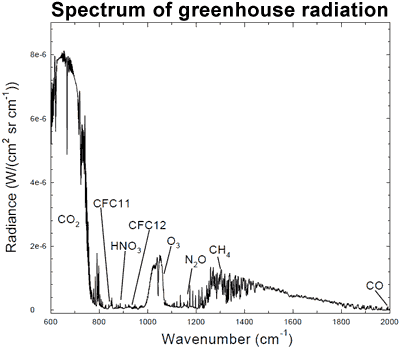
When greenhouse gases absorb infrared radiation, the energy heats the atmosphere which in turn re-radiates infrared radiation in all directions. Some makes its way back to the earth's surface. Hence we expect to find more infrared radiation heading downwards. Surface measurements from 1973 to 2008 find an increasing trend of infrared radiation returning to earth (Wang 2009). A regional study over the central Alps found that downward infrared radiation is increasing due to the enhanced greenhouse effect (Philipona 2004). Taking this a step further, an analysis of high resolution spectral data allowed scientists to quantitatively attribute the increase in downward radiation to each of several greenhouse gases (Evans 2006). The results lead the authors to conclude that "this experimental data should effectively end the argument by skeptics that no experimental evidence exists for the connection between greenhouse gas increases in the atmosphere and global warming."

Figure 3: Spectrum of the greenhouse radiation measured at the surface. Greenhouse effect from water vapor is filtered out, showing the contributions of other greenhouse gases (Evans 2006).
The planet is accumulating heat
When there is more energy coming in than escaping back out to space, our climate accumulates heat. The planet's total heat build up can be derived by adding up the heat content from the ocean, atmosphere, land and ice (Murphy 2009). Ocean heat content was determined down to 3000 metres deep. Atmospheric heat content was calculated from the surface temperature record and heat capacity of the troposphere. Land and ice heat content (eg - the energy required to melt ice) were also included.

Figure 4: Total Earth Heat Content from 1950 (Murphy 2009). Ocean data taken from Domingues et al 2008.
From 1970 to 2003, the planet has been accumulating heat at a rate of 190,260 gigawatts with the vast majority of the energy going into the oceans. Considering a typical nuclear power plant has an output of 1 gigawatt, imagine 190,000 nuclear power plants pouring their energy output directly into our oceans. What about after 2003? A map of of ocean heat from 2003 to 2008 was constructed from ocean heat measurements down to 2000 metres deep (von Schuckmann 2009). Globally, the oceans have continued to accumulate heat to the end of 2008 at a rate of 0.77 ± 0.11 Wm?2, consistent with other determinations of the planet's energy imbalance (Hansen 2005, Trenberth 2009). The planet continues to accumulate heat.

Figure 5: Time series of global mean heat storage (0–2000 m), measured in 108 Jm-2.
So we see a direct line of evidence that we're causing global warming. Human CO2 emissions far outstrip the rise in CO2 levels. The enhanced greenhouse effect is confirmed by satellite and surface measurements. The planet's energy imbalance is confirmed by summations of the planet's total heat content and ocean heat measurements.
For more evidence that humans are causing global warming, check out The human fingerprint in global warming.
Last updated on 26 June 2010 by John Cook.

Arguments


You have both argued that the issue of observed OLR increasing over the critical period of 79 to end of century (#34 Guinganbresil and #49 Ned) can be dismissed on the hand-waving basis that it is the response to increasing temperatures.
However, I do not believe that this can be easily reconciled with CO2 being the primary driver of temperature increase over this period.
For an idealised system the OLR perturbation response to a year-on-year geometric growth in CO2 should be a monotonic decrease in OLR upto the equilibration time and a constant (negative perturbation) value thereafter.
The constant composition experiments reported in IPCC AR4 suggest an equilibration time of in excess of 80 years in all the models. The models, at least for those whose results I have seen, also get close to a radiative equilibrium in the 70s by using atmospheric aerosols as approximately equal and opposite forcings to CO2 in order to match the temperature decrease in the period 40s to 70s.
Hence, if (over the critical 1979 to 1998 period) TSI variation was negligible and there were no other unaccounted forcings, then we would expect to see a decreasing trend in OLR, and not the increase apparently observed.
The increase suggests some combination of (a) CO2 effects were overwhelmed by a SW effect (withdrawal of aerosols or decrease in albedo)(b) the planet was releasing stored energy from somewhere into the atmosphere. In any event, it seems to call into question that CO2 was actually the PRIMARY driver over this period.
a constantly decreasing OLR correspond to a runaway warming. Luckly this is not the case.
The behaviour depends on how fast OLR decreases in the CO2 bands with respect to the increase in the thermal background (proportional to T^4). If CO2 concentration increases at a "pathological" high rate you have a countinuous dcrease of the OLR; this is a runaway warming. If you have, at the other extreme, very slow CO2 increases you get a steady state slightly lower than (almost at) the equilibrium value. In the actual case, you have that CO2 concentration started increasing but the increase of the thermal emission is delayed by it's characteristic response time; so initially OLR decreases but sooner or later thermal emission will try to keep up, untill eventually steady state (not equilibrium) is reached at a value, again, lower than equilibrium. The deviation from equilibrium indicates the rate of increase of the CO2 forcing.
In the so called zero dimension aproximation of the atmosphere/surface system this behaviour can be easily modeled. It's worth a try.
Riccardo #53
Thanks for the response. I don’t actually disagree with anything you have written, but I believe that you need to follow your conclusions to the next logical step.
I wrote initially: “For an idealised system the OLR perturbation response to a year-on-year geometric growth in CO2 should be a monotonic decrease in OLR upto the equilibration time and a constant (negative perturbation) value thereafter.”
I think that you are agreeing with this, but let me expand a little. Consider a single ANNUAL pulse of CO2 and an OLR response function in time, f(t), on (0,te), where te is the equilibration time. This function has the properties:-
f(t) = 0 at t=0
f(t) <0 for all 0 is less than t is less than te, and
f(t) = 0 for all t>=te.
Let us define the integral of this function between 0 and t as F(t). The area subtended by the curve at t=te is the FINITE net energy received by the planet as a result of the single year pulse. Call this absolute value Ea. Or we can write F(te) = -Ea. Ea can be related to an increase in the temperature of the planet at equilibrium via the specific heat of the system.
For a geometric growth model of CO2, the second year pulse yields an identical response to the first year with an energy commitment of Ea, and the third year is the same as the second and so on. In fact, each year we are adding the same energy commitment, for as long as the geometric growth continues. Now consider the multiyear solution obtained by stacking (superposing) the single year solutions. The stacked solution for OLR approximates to F(t) for t is less than te and becomes a constant negative Ea thereafter. (This is an algebraic identity. I won’t prove this here, but you can confirm it numerically for yourself on a spreadsheet in a matter of minutes.) This is not “runaway” warming. It corresponds to a linear increase in planetary temperature after time te - exactly what one would expect given a logarithmic relationship between CO2 and equilibrium temperature and a geometric growth in CO2. Note also that since f(t) all sits on one side of the zero line, the integral form F(t) is MONOTONIC decreasing (or increasing in a negative direction) irrespective of the choice of functional form for f(t).
In the real world, we would not expect to see the monotonic OLR response implied by this solution, but we would expect to see a decreasing trend in OLR if CO2 were the PRIMARY driver of the temperature change - for the reasons I stated in my earlier post. During this period, if CO2 were the primary driver, we therefore should have seen simultaneously a decreasing trend in OLR, a decreasing trend in brightness temperature and an increasing trend in surface temperature. The reason for the opposite signs in brightness temperature and surface temperature come from the increase in downwelling radiation from the continuously added CO2.
I do not believe that one can argue (as you seem to) that thermal emissions have overtaken the effects of CO2 on OLR and at the same time that CO2 is the PRIMARY driver of heating over this period. The two things cannot be readily reconciled and indeed this position probably threatens 2nd Law.
the heat balance equation can be solved analytically for a forcing linear in time F=b*t (Schwartz 2007); neglecting feedbacks:
DT(t) = b*((t-tau)+tau*exp(-t/tau))/l
where tau is the response time (=C/l with C heat capacity) and l is the climate sensitivity. For small deviations from equilibrium, i.e. DT<< Te, the increasing thermal radiation E is proportional to DT, E=c1*DT. If the linear forcing is due to an increasing IR absorption (e.g. exponentially increasing CO2 concentration), the total OLR is:
OLR(t) = E - F = c1*DT - b*t
which, grouping all the constants together for simplicity, can be written as:
OLR(t) = c*((t-tau)+tau*exp(-t/tau))-b*t
The first term in the equation above is linear for t>>tau and one can write:
OLR(t) ~ (c-b)*t - c*tau ; for t>>tau
what governs the slope of the OLR is then the term (c-b) which can be positive or negative. For short times, instead, the slope of the OLR is always negative:
d OLR/dt = c*(1-exp(-t/tau))-b*t ~ -b*t ; for small t
In a few words, with a linear forcing DT will always increase linearly for time much longer than the characteristic response time of the system while OLR may increase or decrease depending on the strength of the forcing. What I (inappropiately) called runaway warming is when you have a continuosly decreasing OLR.
Thanks again. The solution methodology I outlined (superposition) does not have to assume a constant linear forcing with time, but I believe should give an identical analytic answer to Schwartz for this assumption. (I will check this as soon as I have a little time.)
Schwartz was roundly criticised as I recall for underestimating tau. The CMIP models have an effective tau in excess of 80 years.
If you substitute realistic values in Schwartz's derivative term for a tau of 80 years or greater, you should see a negative gradient over the period 70s to end of century assuming a perturbation from quasi- radiative equilibrium, because over this time period t is much less than tau. This is exactly my point.
So why did we see a rising gradient in OLR over this period? Either
(a) the CO2 response was overwhelmed by other SW effects over this period (such as decreasing aerosols, decreasing albedo, etc), in which case CO2 was not the primary driver OR
(b) there was a planetary oscillatory effect of released energy causing a rise in surface temperature, in which case CO2 was not the primary driver OR (c)
that the equilibration period is a lot less than inferred by the IPCC from the AR4 "constant composition" experiments, in which case the climate sensitivty to CO2 has been overestimated OR (d) that there was a historic commitment to a trend of rising OLR following a period of 30 years of decreasing temperatures, in which case the CMIP modeling of quasi radiative equilibrium using aerosol forcing as a matching parameter becomes highly suspect. In any event, it seems to me that one hits a major problem of consistency.
in the comment i responded to you were making a general point on the possibility to have an increasing OLR. What I tryed to show in my comment is that it's actually possible. But we cannot go much further than the overall behaviour with such a crude energy balance model. Even assuming its validity, for example, the position of the minimum in the OLR critically depends on the choice of the parameters involved, not just the actual time response of the system. There's no point in pushing a model beyond its limits.
As for the details you're asking for, well, you know, it's a travesty that we cannot track the details of the energy flow through the climate system ;). Stay tuned, hopefully climatologists will come out with a solution or at least with a better aproximation to the short time variability issue.
P.S.
The easiest "solution methodology" of the energy balance equation I think is to transform the differential equation into an integral equation (see here, for example) which is much easier to solve numerically for any arbitrary forcing.
Just a couple of points:
1) I have never had a problem accepting the possibility of OLR increasing (even if CO2 is having some warming effect at the same time). If you re-read my first post again, you will see that my argument is that you cannot have CO2 as the PRIMARY driver of heating from the 70s, and have the OLR response which is critical to that heating overwhelmed by thermal emissions derived from some other unspecified source of heating - unless, that is, some other basic assumptions are wrong.
2) You wrote:
"Even assuming its validity, for example, the position of the minimum in the OLR critically depends on the choice of the parameters involved, not just the actual time response of the system. There's no point in pushing a model beyond its limits."
I disagree strongly with this statement. For a geometric growth in CO2, the minimum (perturbation) in OLR is always achieved at exactly the equilibration time. This is completely independent of the choice of any other parameters. Small variations away from the geometric model, provided they are fitted to the actual data, will always yield a minimum very close to the equilibration time. This is dictated by simple mathematics and requires only two assumptions: (a) CO2 does not cause planetary cooling at some stage in its affect on the system (but it can be multimodal in its affects) (b) Equilibrium temperature change is linearly proportional to the total heat energy gained/lost by the system (i.e. constant specific heat capacity). If the issue here is that I did not adequately explain the maths behind this, then please let me know and I will be happy to provide a more formal proof of this.
my bad, not willing to be bothered by the constants i screwed up everything, or better, i didn't notice that the two constants c and b were the same. For the sake of this retraction, below I'll re-formulate the equations. Strange enough, I'm kind of happy that I did this error because before finding it I could not resolve some inconsistencies of the model results. :)
As for the problem at hand, i'd like first to point out what the value of the response time τ should be. In the heat balance model, it is defined as the ratio of the relevant heat capacity (of the oceans, mainly) and the climate sensitivity. The oceans do not have a single response time for sure so we're forced to admit that it is the one relevant to the time span considered. In the Schwartz 2007 paper quoted above he gives numbers between 5 and 16 years based on two different approaches. The former looks definitely too small and is probably due to some error. So, in a time span of a some decades and in the presence of a linear forcing one would exepect a essentially zero OLR slope.
A positive OLR slope indicates a negative change the in slope of the radiative forcing and viceversa. Looking at the radiative forcings provided by GISS, there has been a slowing down of the GHG forcing around 1990 which could have produce an increasing OLR. But the OLR data are in my opinion too noisy for any definitive assessment (see for example the annual global averages here). In any case, GHGs can still be (and in fact are) the primary (not the only!) forcing but some other effect may just have slowed down the overall forcing.
========
Correct equations from my comment #56
the temperature change is as before
ΔT(t) = β*((t-τ )+τ *exp(-t/τ ))/λ
OLR(t) = β *((t-τ)+τ*exp(-t/τ))-β*t
for t > > τ :
OLR(t) ~ -β*τ
d OLR/dt = β*(1-exp(t/τ))-β = -β*exp(-t/τ)
Thanks again.
With regard to your second paragraph above, Schwartz produced an updated paper where he re-estimated the climate system response time at 8.5 years. I agree with you that if one accepts this equilibration time (or a similar time) , there is no problem explaining a flat or increasing OLR over the period of interest. On the other hand, this equilibration time is an order of magnitude smaller than that assumed in the IPCC model suite.
With respect to the Schwartz formulation, I have two fundamental problems with the underlying assumptions, and need to spend some further time on it. One problem is easy to explain:- the ingoing and outgoing fluxes are both defined at TOA, but the estimate used for outgoing then becomes S-B applied at the SURFACE; since we are interested in transient affects before equilibrium, this introduces an error. The second is more complicated and I really have to spend more time thinking about it, but basically the assumption of a linear change in F with time gives rise to a bizarre animal when we start asking what CO2 profile could bring about such a profile in TOA forcing. A geometric growth model in CO2 goes flat at equilibrium time (F = constant) and temperature then becomes linear with time. To get F to continue to increase after equilibration time requires a doubling of the rate of growth of CO2, and then a quadrupling after twice the equilibration time, and so on. Equally bizarrely, for t < equilibration time, the impulse response function which stacks into a linear relationship between F and t is a Fourrier step or uniform distribution on (0,te), and this does not seem very physical. I will invest a few more neurons.
I think that you should think at the response time as a sort of weighted average. There are several processes at play operating at different time scales, from years to several centuries, so it's not well defined. Depending on the time span you're looking at you're testing one or a few of them.
I see many problems in using the simple heat balance equation for quantitative analysis. It's nice, simple and useful to understand the general behaviour of the system but, as said before, we should not push it to the quantitative comparison with actual data.
To have a linear forcing you need an exponential growth of CO2 concentration (the former is roughly logarithmic with the latter), which is about what we're experiencing now. The result correctly is a constant imbalance and a linear increase in temperature.
I plotted out the GISS model data you referenced, and agree that it shows a small change in the gradient of GHG forcing after 1990.
However, even with this small gradient change, the modelled GHG forcing is still MONOTONIC INCREASING, suggesting that, all else being equal, OLR should be decreasing unless overwhelmed by other factors. If we look at the total forcing, we see that it INCREASES over the period fairly steadily if one ignores a couple of spikey excursions associated with volcanic events, but that it is always less than the GHG forcing. Hence, (excluding GHGs) all of the other forcings combined are negative in aggregate effect, and thus reduce the heating effect of the putative GHG forcing. Given this, I would guess that this model run would consistently underestimate observed OLR. But perhaps you have the integrated OLR output from the run to prove me wrong?
if the system reached the saturation level of the OLR any change in slope of the forcing, not a reduction, will produce a temporary rising/lowering of the OLR. More, any deviation from perfect linearity of the forcing will produce a trend in OLR as well.
The only LW output from climate models i can remember right away is in Forster and Taylor 2006.
As promised, I have considered the Schwartz model in a little more detail and think I now understand where the confusion is arising.
You need to consider carefully what the forcing term, F, actually means in the Schwartz 2007 paper, because I think it is misleading you (as it did me before I tried to reconcile my results with Schwartz).
Consider Equation 6. The F term here is NOT equal to F(t) = Q-E. (If F = F(t)=constant, the temperature could not asymptote to a constant as t becomes large; temperature would continue to increase linearly with constant F(t). F(t) in reality must decrease to zero over time as equilibrium is restored.) It is clear from this, and also from the definition of climate sensitivity that the F in this equation is actually equal (only) to the instantaneous imposed forcing at time t = 0.
Now consider Equation 11 for F = bt. Equation 11 is the solution of the convolution integral for Equation 6. In other words, it is the continuous summation in time of a series of Equation 6 terms in order to stack temperature changes. F = bt therefore can be thought of as the continuous stacking of NEW forcings. Or perhaps easier to visualize, d F/dt = b is the rate at which new forcings are added in time. Since the effect of the forcing added at time t1, say, has declined by tn, the actual net forcing at TOA at time tn is therefore NOT equal to F=b*tn. Once again F = bt is NOT equal to Q-E.
In conclusion, your attempts to derive an expression for OLR were based on a misunderstanding of the F term, I believe. Your statement that a linearly increasing net forcing (or linearly decreasing OLR for constant TSI) corresponds to a geometric growth in CO2 is incorrect. However, it would be correct to say that a geometric growth in CO2 would give rise to a constant rate of addition of new forcings and a linearly increasing temperature at t>>tau. To highlight how different these statements are – note that the linearly increasing temperature implies a constant dH/dt i.e. a constant net forcing of Q-E even though the F term in the Schwartz model is linearly increasing!
Thanks for the Forster and Taylor reference. I am still digesting, but it looks as though the GISS models along with all of the other models overestimate LW positive feedback and hence underestimate OLR in the observational period. The information here is not definitive, but sometimes if something looks like a duck and quacks like a duck...
Thanks again.
actually what you call the "Schwartz model" is just the standard energy balance equation, widely used even in the scientific litterature. I think that you are confusing the equation written for absolute temperature with the one for temperature anomaly. You'll find a step by step explanation in the page i linked before. Indeed, it should be clear from the solution given by Schwartz that he's not solving dT/dt ∝ F(t); after linearization the equation is instead
dΔT/dt ∝ F(t)−λΔT.
My evaluation of the OLR comes from the assumption that the forcing is only due to an increased IR absorption which directly influences the OLR. A linear increasing forcing then comes from an exponential growth of CO2 concentration, given the aproximate but quite reasonable relation F=5.35*ln(C/Co) W/m2 where Co typically is the pre-industrial CO2 level.
Sometimes, if you find yourself in a hole, it pays to stop digging. Your comment is wholly irrelevant to the question of what the F term means in the Schwartz model. Unfortunately, I am starting to suspect that you know that already.
The site you referred me to for a "step-by-step explanation" appears to be some sort of junk science site, but in any event it is clear that the author of that site is not well trained in basic science. He is making the same conceptual mistake as you are in misunderstanding what the F term means in the Schwartz model, but he manages to “propagate” the error even further without making any attempt to question his own sometimes silly assertions.
I quote from the site:
Quote
Now suppose that prior to our starting time, climate forcing was constant and equal to zero, and temperature departure was constant and equal to zero. After time t0, climate forcing increased to 1 W/m^2 and stayed there. Then the solution turns out to be:
Theta(t) = (1 – exp(-lamda*t/C))/lamda
Endquote
It is hopefully evident to you that Theta (t), the temperature change from the forcing, must asymptote mathematically from this expression to a constant 1/lamda at large values of t. So now ask yourself the question whether it is possible in terms of first law of thermodynamics to have an imbalance of TOA radiative energy for an infinite time which results in a finite (constant) change in planetary temperature. If you can truly answer yes to this question , then I think that I am going to sign off, since I am wasting my time here.
the guy that runs that site is a scientist that regularly publish on climate. If you wish to give up learning some rather simple science or if you think you have a better knowledge than climate scientists, feel free to waste your time elsewhere.
PaulK, you may well end up wasting your time here if you swerve an iota further into such remarks as "junk science", shiny dog whistle though the term may be.
If you show me a mathematical expression that says A=B and then argue that a respected climate scientist says that A= 2B, then I am not likely to be convinced by the argument just because he is a respected climate scientist. My questions and assertions are strictly science-based. I may well be wrong, but someone needs to demonstrate that I am wrong in terms of physics and mathematics - whoever he is. I am asserting (#68) that "the guy who runs that site", respected scientist or not, is making a statement which is demonstrably false in terms of basic physics. It is founded on his misunderstanding of what the F term means in Schwartz 2007. I spent some time in post #65 explaining what the F term does mean to give the Schwartz model (or energy balance model if you prefer) some meaning. It is the stacking of instantaneous impulse forcings. As such F(t) in this model does not equal Q(t) - E(t). The respected scientist assumes that it does, which is what leads him to a statement that is demonstrably false.
For my part, I would be grateful for you to invite (Dr?) Tamino or anyone else if they can contribute to the science questions raised here.
I genuinely do not understand your second sentence. I was using the term "appears to be some sort of junk science site" only to describe the blogsite to which Riccardo referred me, not this site. I used this description because the article on that site appears to contain, well, junk science.
And I have no idea what the "shiny dog whistle" metaphor refers to. Please clarify if it is helpful. Otherwise, I would prefer to stick to the science arguments.
I think if you have sufficient force of your conviction behind you, you ought to hie yourself to Tamino's site, tell him you think he's presenting junk science and is insufficiently trained and then do your best to prove it. You delivered the insult, now you should defend it.
You have no earned reputation for reliability whereas Tamino does, so really the onus is on you to establish yourself as a superior intellectual force. Failing that, I don't find your reliance on such remarks as "the author of that site is not well trained in basic science" at all persuasive and you are indeed wasting your time here.
In reality, if you tried to extend this equation to infinite time, you would have to consider that the 1 W/m^2 forcing would disappear at some point. After that point the temperature will obviously go back down, and the first law of thermodynamics will remain unbroken. As long as we are dealing with timeframes << the lifetime of the sun (as we typically do), the equation is perfectly valid as is.
a constant forcing held forever will indeed results in a constat rise in temperature. When the forcing is applied and the temperature starts to increase the earth wiil progressively increase its thermal emission untill balance is reached again and the temperature stops increasing.
Mathematically it is expressed by the term λΔT in the heat balance equation:
C dΔT/dt = F−λΔT
sooner or later this term will balance the forcing.
Never overlook the stronger and faster negative feedback! :)
I have now discovered that "Tamino" is the blog pseudonym of the author of the site to which Riccardo referred me.
You wrote: "I may be wrong but as far as I know Tamino has never been found wrong w/regard to posts he's made on his site." I am then especially honoured to have been the very very first to have done so. Thank you.
Riccardo,
You introduced the reference to Schwartz to counter my arguments about the difficulty of reconciling various assumptions to an observed increase in OLR. Can we now agree that one cannot derive an expression for OLR from the Schwartz model in the way you attempted and return to the main thrust of the conversation? This is a serious, not a provocative, question. The impatience I expressed in #68 was because I suspected that you already understood the implications of my comments on interpretation of the F term in Schwartz, but you did not wish to acknowledge this. However, this may not be true, and hence, my question. Do I need to expand further on this subject? Do you question my interpretation of the Schwartz model? Or can we agree and move on?
To expand a little on Riccardo's comment. The physics says that if one applies a positive impulse forcing to a system in steady state (input power equals output power), then the system will heat up. As the system heats up, it will increase its power output until the temperature restabilises at a new constant value.
The small issue I have with Riccardo is definitional. If the input power is I(t) and the output power is O(t), then at time t0, in steady-state, we have I(t0)-O(t0) = 0. If one defines the net forcing over time, F(t), as the difference between input and output power, i.e. F(t) = I(t)-O(t), and one applies an impulse forcing F(t0) to the system, then to restore steady-state, F(t) must then decay to zero after a period of time as temperature restabilises.
However, the expression used for F(t) in Riccardo's heat balance equation (C dΔT/dt = F−λΔT) is not a net forcing over time. Instead, it is equal to the difference between the input power at time t and the output power at time, t0. For this expression to make sense, mathematically, F(t) = I(t) - O(t0) - equivalent to a series of stacked impulse forcings applied to the input side of the power equation.
indeed F(t) is not equal to I(t)−O(t). No one ever said it is, Tamino even wrote it explicitly. Let's see if you like a different wording more:
I(t) = Ie+F(t)
O(t) = Oe+λΔT(t) (to first order)
I(t) − O(t) = Ie + F(t) − Oe − λΔT(t) = F(t) − λΔT(t)
with Ie and Oe equilibrium values.
Straightforward, I'd say.
I was attempting to address this comment from PaulK > "Quote
Now suppose that prior to our starting time, climate forcing was constant and equal to zero, and temperature departure was constant and equal to zero. After time t0, climate forcing increased to 1 W/m^2 and stayed there. Then the solution turns out to be:
Theta(t) = (1 – exp(-lamda*t/C))/lamda
Endquote
It is hopefully evident to you that Theta (t), the temperature change from the forcing, must asymptote mathematically from this expression to a constant 1/lamda at large values of t. So now ask yourself the question whether it is possible in terms of first law of thermodynamics to have an imbalance of TOA radiative energy for an infinite time which results in a finite (constant) change in planetary temperature. If you can truly answer yes to this question , then I think that I am going to sign off, since I am wasting my time here. "
I'll admit I probably misunderstood what you were trying to say Paul. I don't see what is wrong with Tamino's solution for Θ(t) in his scenario. To repeat what you said in your recent post: "As the system heats up, it will increase its power output until the temperature restabilises at a new constant value." Isn't this exactly what Tamino was showing in his solution for temperature departure Θ(t) in his scenario? How does this violate the first law of thermodynamics?
You are the only person here who is NOT confused.
There is nothing wrong with Tamino's solution for Θ(t) given his assumptions and approximations. My question was directed at Riccardo, who I believed had a conceptual misunderstanding of the F-term in Schwartz, based on his attempts to derive an expression for OLR from this model. (See my post #65 for context.) I'll address the reason for why I believed this in a separate post for Riccardo.
The solution I proposed for OLR in posts #52 and #55 is mathematically exact, and makes very few assumptions. The solution is based directly on a flux response function which varies as a function of time, and therefore represents a generalized solution to a wide variety of energy balance models.
Because it makes very few assumptions, the conclusions about the shape of the OLR response are mathematically robust but have low information content. I would prefer to use this model directly as a basis to discuss observed OLR response, rather than a more informative model, but with questionable assumptions.
However, in response to the points I made about the geometry of the OLR response, you referred me to the Schwartz paper and you attempted to abstract a solution for OLR from that model (your posts #56 and #60). I did the same thing, initially mistakenly assuming that F was a net forcing in time (Q(t) – E(t)), since Schwartz rather loosely describes F as a Delta(Q-E). When I reexamined the solution form, however, it was apparent that F has to be an impulse forcing in Schwartz, as more conventionally applied. So I again recalculated OLR and found that I had a solution that was different from (both your original and) your corrected OLR solution. I concluded, since we had been talking originally about net flux response functions, that you were misunderstanding the F term in Schwartz.
It is apparent from your last post that this is not the case. Therefore, I now believe that it is either your maths or mine which are wanting.
For the case F=bt, I obtain the following result for OLR, using the Schwartz model and Schwartz nomenclature:-
C * d(Deltat)/dt = CdT/dt = dH/dt =Q(t) – E(t) = net flux in time
For constant input Q(t) = Q(0) for all t.
We “transfer” the forcing to the output side as follows:
Net flux in time = Q(0) –(E(t)-F(t)) = Q(0) – OLR(t) = C*d(Deltat)/dt
Hence OLR(t) = Q(0) - C* d(Deltat)/dt
But Deltat = b((t-tau) + tau*exp(-t/tau))/lamda and
Therefore d(deltat/dt) = b(1-exp(-t/tau))/lamda
Substituting into the solution for OLR we obtain :
OLR(t) = Q(0) – Cb(1-exp(-t/tau))/lamda
Note that at time t=0, we obtain OLR(0) = Q(0), and for t>>tau, OLR tends to a constant = Q(0)-Cb/lamda = Q(0) –b*tau. If we note that b can be written as F(tau)/tau, then this asymptote is equal to Q(0) – F(tau). All of this seems reasonable to me within the context of the assumptions made.
The above solution may be compared with your corrected solution (post#60) :
OLR(t) = β *((t-τ)+τ*exp(-t/τ))-β*t
Clearly, the structural forms are very different.
I emphasise that I am not wedded to the Schwartz model, but I believe that we need to get this out of the way if there is any hope of having a sensible conversation on the subject of whether an observed rise in OLR can be rendered compatible with common assumptions.
"Clearly, the structural forms are very different."
They are not. Indeed they're identical apart from the term Q(0) which comes from working with T instead of ΔT and the use of C/λ which is τ. It's just simple math.
@Doug
sorry to disappoint you. It was not much fun, just trivial math. :)
Well, erm, OK. I guess if my bank manager were to say he were going to repay only the interest instead of capital and interest, you could describe that as structurally identical.
I think what you are saying is that you wrote "OLR" when you intended to write "Delta OLR", where you would/could define the latter as OLR(t)minus the radiative input or output prior to the forcing being imposed.
I think you are also suggesting that in context, I should have been smart enough to figure out what you meant rather than what you wrote. In this, I think you are right. I should have spotted what you intended to say. However, by a remarkable non-coincidental coincidence, the expression you wrote for OLR actually corresponds to the radiative imbalance perturbation function for the boundary condition of constant TSI - the thing I was focused on in the first instance, and which I would like to return to. This really did throw me off.
Given that we do now (I believe) have a common understanding of Schwartz, what I would like to do is to take the general solution I offered in #55 and demonstrate that (a)it works perfectly when applied to Schwartz if one accepts the same (restrictive) assumptions as Schwartz and (b) that it is a lot more versatile in its ability to accept realworld data in order to assess how OLR should be moving.
Unfortunately, I don't have time immediately, but I will post on (a) as soon as I do.
I promised a post proving that the general solution I offered in #55 is easily reconciled with Schwartz if one accepts his assumptions.
Generalised heating model:
dH/dt = Q(t) – E(t) = absorbed SW (flux) – Outgoing LW(flux) at TOA
Assume that at time t = 0, the system is in steady-state equilibrium: Q(0) = E(0). Now, keeping everything else unchanged, consider a positive impulse forcing F1 = constant which results in a perturbation, f(t), of the OLR. We can write:
OLR(t) = Q(0) + f(t) ; Q(t) = Q(0) = constant ; dH/dt = -f(t)
At this stage, we don’t know what f(t) looks like, but we do know some things about it:
• Minus f(t) is positive definite on the open interval (0,te), where te is the equilibrium time. (Otherwise the (constant impulse ) forcing would have to cause a net cooling at some stage in its effect).
• As the system restabilises at the equilibrium time, te, f(t) must go to zero.
• It is both closed and integrable, since the area bounded by the curve represents the finite energy commitment associated with the impulse forcing, F1.
This system can be solved for the total perturbation (and hence for OLR) by superposition. This permits one to model combinations of input and output forcings over time. But let us consider the simple case first of where we have an exponential or annually geometric growth in CO2, translated into a forcing which is linear with time: F(t) = bt. The solution is analytic for this condition, but for convenience later, we will choose a superposition timestep of 1 year.
We set the first year forcing F1 = b. All subsequent years are then also equal to F1 to satisfy F=bt. This is equivalent to superposing each year the same perturbation function f(t) to obtain the total perturbation to the system. The solution is then
OLR(t) = Q(0) + integral of f(t) from 0 to t for all t< te
OLR(t) = Q(0) + integral of f(t) from 0 to te (i.e. a constant) for all t>=te
Note then that independently of the choice/calculation of the perturbation function (f(t)), OLR is monotonically decreasing until the equilibration time, and stays constant thereafter for this case of F(t) = bt which is proxy for a geometrically increasing CO2 concentration. This is an analytic result.
So, does the above solution work for the Schwartz model?
In Schwartz, the equilibration time strictly speaking is infinity (NOT tau).
The perturbation function for a constant impulse forcing F1 in Schwartz is given by f(t) = -F1*exp(-t/tau) = -b*exp(-t/tau)
Substituting into the generalised solution for OLR above, we obtain:
OLR (t) = Q(0) + integral of f(t) from 0 to t = Q(0) + b*tau*(exp(-t/tau) – 1) for all t less than te = infinity.
You should then find that this is compatible with the solution we obtained directly from manipulation of Schwartz.
Next stage is to better understand the difficulties of reconciling the increasing OLR with IPCC assumptions.
I'm not sure about the importance of the discrepancy you mention as a dilemma, I'm off to see what's up in the recent observational department on that but it's certainly pleasant to see such detailed treatment.
I see PaulK's point w/regard to his formal look at the situation but something's not quite closing the circle; we can quibble about splicing etc. but it's pretty hard to simply say -all- OHC and atmospheric temperature measurements for the past 40 years are wrong and that temperature has not changed in that time, meanwhile both models and observations indicate an imbalance. Hmmm. A puzzle.
*EARTH’S GLOBAL ENERGY BUDGET, K. E. Trenberth, J. T. Fasullo, J. Kiehl, Bull. Am. Meteorol.
Soc. 90, 311 (2009) Full text here.
Looking back at my posts, my attack on the article in the Open Mind site was completely ill-founded, and I retract my comments unreservedly. I claim temporary insanity since I was in the grip of an obsession that led me to believe incorrectly that Riccardo was using the Open Mind article to support an invalid definition of the forcing term as used in the Schwartz model. The author's reputation for infallibility remains untarnished - at least by me.
the process you describe is just an integration, which we already know. In some cases, like for example the linear forcing, we have the analytic solution. For a more general forcing we need to do it numerically. And we agree on this.
But then you confuse the forcing with the OLR and never in you analysis does the net balance appear. Indeed you write dH/dt=-f(t); here f(t) should be the net energy (im)balance but then it cannot be equal to the OLR. You need to have both the forcing and the thermal radiation. I'd suggest to first write and solve the heat balance equation for ΔT (sorry if i keep using variations, why bother with the equilibrium values?). After that we can try to see who's that guy we call OLR.
Not to sink into an opera of tearful counter-apologies but for my part my knee jerk estimation after reading your remark on Tamino was that I was seeing the emergence of another unreasonably intractable person. Sorry about that!
Thanks for the kind words.
Re your post #89, I am certainly not saying that the temperature and OHC measurements for the past 40 years are "wrong", although they do carry some hefty measurement uncertainties. We have undoubtedly seen planetary heating over a long timeframe. The key issue here, for me at least, is climate sensitivity and, ultimately, the cause and attribution of the heating.
A careful reading of the Trenberth and Fusillo paper reveals that they do not claim anywhere that the satellite measurements of radiative imbalance match the climate models. On the contrary, they state that they do NOT, and then use the error statistics on the satellite measurements to show that the satellite data can be adjusted within the error bars so that it is “not incompatible with” the residual imbalance inferred from climate models. This however then leaves Trenberth’s question of where the missing heat energy was going in the period from around 2002 to 2008, when OHC showed a flat/cooling trend (Willis, Levitus, Cazenave). For me the jury is still out on OHC from the Schuckman paper, which is not only an outlier relative to the three papers I mention, and has not been reconciled to the shallower data, but would also mean that all previous reconciliations of energy balance (which did not account for Schuckman’s variation in deep ocean heat content) were fundamentally flawed.
But back on topic, in practical terms the relative error statistics on the radiative imbalance from satellite measurements are very large (error analysis on the difference between two large numbers always reveals poor statistics); the measurement noise on the difference turns out to be almost an order of magnitude greater than the signal we are interested in!
On the other hand satellite measurements for OLR can be quite PRECISE, but INACCURATE in absolute terms. This implies that the relative errors on trends in the measurements should be smaller than the error in absolute magnitude of the measurement, and very much smaller than the (even larger) relative error in the difference between the measurements. It is quite possible - likely even - that we can then deduce more from the trends in individual measurements than we can from the absolute differences between those measurements.
So, is it important if a climate model (from a simple analytic model to a CGCM) doesn’t match the observed trends in OLR? Well, it obviously depends on what information one is trying to abstract from the model. But if one is talking about attribution studies, I happen to believe that it is crucially important.
Your first paragraph (#91) raises a profound question, which I believe requires a separate post to deal with.
Before I can get to it, however, your second paragraph suggests to me that we still have a gulf of understanding to bridge. You wrote:
“But then you confuse the forcing with the OLR and never in you analysis does the net balance appear. Indeed you write dH/dt=-f(t); here f(t) should be the net energy (im)balance but then it cannot be equal to the OLR. You need to have both the forcing and the thermal radiation. I'd suggest to first write and solve the heat balance equation for ΔT (sorry if i keep using variations, why bother with the equilibrium values?). After that we can try to see who's that guy we call OLR.”
Let me deal with this sentence by sentence to see if we can bridge the gap:-
“You confuse forcing with OLR”. I don’t believe that I do anywhere. Can you be more specific about where this confusion occurs and I will try to address it.
“...never in your analysis does the net imbalance occur. Indeed you write dH/dt= -f(t);...”
The net imbalance IN FLUX is the basis for the analysis. I wrote
dH/dt = Q(t) – E(t) = absorbed SW (flux) – Outgoing LW(flux) at TOA
This IS the net imbalance at TOA. I also wrote:-
Assume that at time t = 0, the system is in steady-state equilibrium: Q(0) = E(0). Now, keeping everything else unchanged, consider a positive impulse forcing F1 = constant which results in a perturbation, f(t), of the OLR. We can write:
OLR(t) = Q(0) + f(t) ; Q(t) = Q(0) = constant ; dH/dt = -f(t)
The net imbalance here is Q(t)-E(t), but Q(t) = Q(0) and E(t) after the forcing is equal to Q(0) + f(t). Hence the net imbalance is equal to Q(t)-E(t) = Q(0) – (Q(0)+f(t)) = -f(t). This is also by definition equal to the rate of change of energy entering or leaving the system, so we also have:-
dH/dt = -f(t).
“Here f(t) should be equal to the net energy imbalance.” No. It should not. The perturbation f(t) has the dimensions of FLUX. The negative form –f(t) is equal to the net FLUX imbalance for this boundary condition of constant input flux. This function represents a perturbation of OLR for a single pulse of CO2. It would have to be integrated w.r.t. time to give a net energy imbalance.
“...but then it [f(t)] cannot be equal to the OLR. “ You are right. It is not equal to the OLR. It represents a perturbation of the OLR for a single impulse forcing . The OLR for this forcing (and a boundary condition of constant absorbed SW) = Q(0) +f(t) as stated.
“You need to have both the forcing and the thermal radiation.” Agreed. They are both built into the perturbation.
“I'd suggest to first write and solve the heat balance equation for ΔT.” Well as perhaps we will eventually get to, I am not sure what this should be in the real world. On the other hand if you want a solution for ΔT based on Schwartz-like assumptions, then you immediately have one from the solution I proposed by writing CdT/dt = C dΔT/dt = dH/dt. Since we know dH/dt, we can trivially calculate ΔT.
This post is already too long, so I will answer the more difficult question that you posed in your first paragraph (Why use this new numerical solution when there is one already available?) in a separate post, when I get a little more time. But one thing which you said did strike me. I may be wrong, but I get the impression that you think I backed out the solution for OLR from Schwartz. I did not. I solved the superposition equation from the generalised definition, and then set all of the perturbations equal to each other for equal superposition timesteps. A “Chinese box” proof then demonstrates that the superposition solution is analytic for this boundary condition of F=bt. I then applied this solution to the more restrictive assumptions of Schwartz.
It is possible that you are getting confused over the dimensionality of the solution I offered. Because the term for OLR involves an integral of flux, it may appear like there is confusion between energy and flux. There is no such confusion. The integral term is here effectively divided by time, but the superposition timestep equals 1 year. Hence the integral term here has the dimensionality of a flux. More later when I have a minute.
maybe I didn't understand your notation.
Is your f(t) the same as what people usually call F(t)−λΔT? In other words, did you include both the forcing and the response to the forcing into f(t) so that it's not not just f(t) but f(t,ΔT(t))?
Effectively, yes. Or at least it would be the same if one were to accept the assumptions in your version of the heat balance equation (and change the sign convention on the perturbation). With these assumptions, it is ALSO equal to -F*exp(t/tau) - the perturbation from a single impulse forcing.
Erratum. I should have written
ALSO equal to -F*exp(-t/tau).
(A Taylor expansion of this form and then curtailment of the higher order terms yields your form of the heat equation.)
it's not clear to me what you mean by "the assumptions in your version of the heat balance equation". Which assumptions did "I" make? Did you find something wrong?
I understand we're back to the beginning but I'm a bit lost with this discussion.
I have a question? In the section, co2 traps heat, you quote Evans 2006:
The results lead the authors to conclude that "this experimental data should effectively end the argument by skeptics that no experimental evidence exists for the connection between greenhouse gas increases in the atmosphere and global warming."
Yet the opening sentence in the link you provide, Evans states:
"The earth's climate system is warmed by 35 C due to the emission of downward infrared radiation by greenhouse gases in the atmosphere (surface radiative forcing) or by the absorption of upward infrared radiation (radiative trapping)."
It is the use of the conjunction "or" that I am querying. Which is it? Is it surface radiative forcing, or is it radiative trapping?
I am *not* suggesting the above statement in some way invalidates Evans' proof, but it does cast doubt on the mechanism responsible for the warming.
For completeness, I must point out that this sentence does not appear in the linked article - only the abstract.
A little from column A, a little from column B. Greenhouse gases both absorb upward infrared radiation which warms the atmosphere, and also scatter or reemit infrared radiation in all directions, some of which heads back to Earth.
But that is not what Evans said. He said it is one *or* the other. He didn't say it's a bit of both. Also, the sentence makes no sense if we substitute "or" for "and", so it is unlikely a typo. However, "caused by" would fit.