CO2 lags temperature - what does it mean?
The skeptic argument...
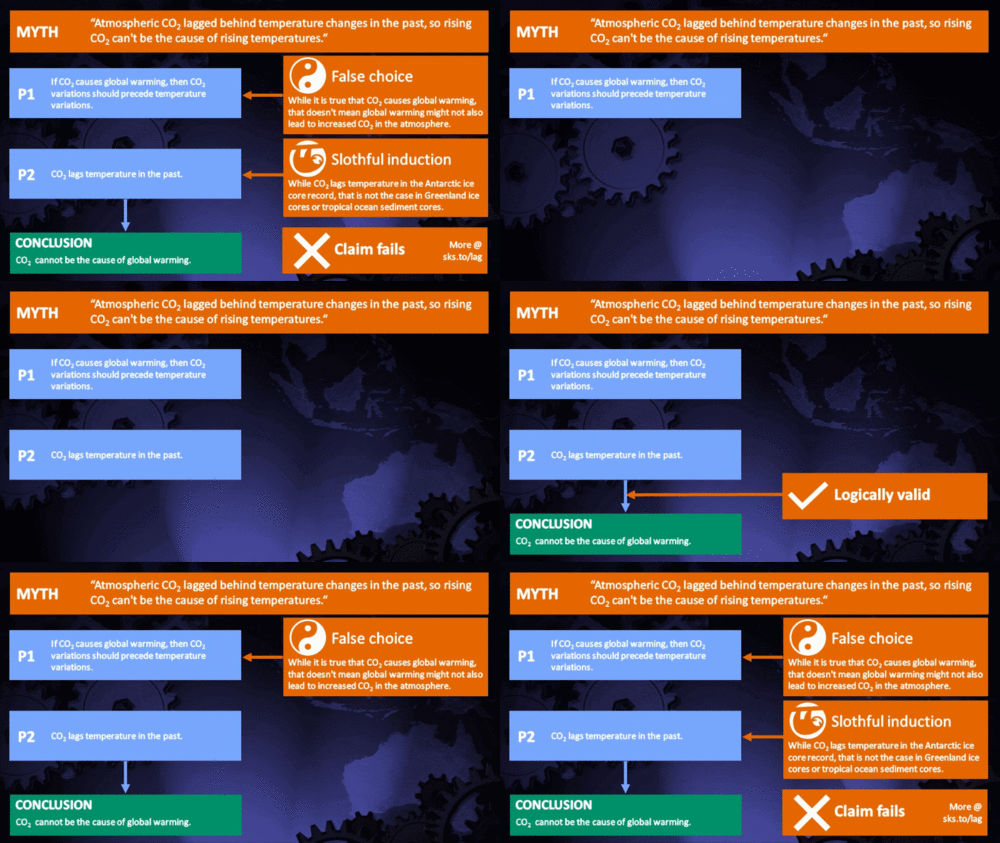
CO2 lags temperature
"An article in Science magazine illustrated that a rise in carbon dioxide did not precede a rise in temperatures, but actually lagged behind temperature rises by 200 to 1000 years. A rise in carbon dioxide levels could not have caused a rise in temperature if it followed the temperature." (Joe Barton)
What the science says...
| Select a level... |
Basic
|
Intermediate
| |||
|
CO2 didn't initiate warming from past ice ages but it did amplify the warming. In fact, about 90% of the global warming followed the CO2 increase. |
|||||
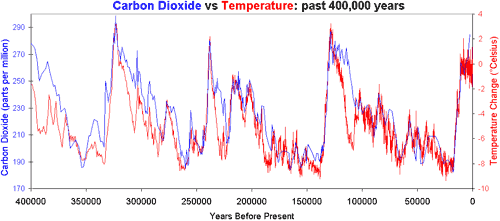
Earth’s climate has varied widely over its history, from ice ages characterised by large ice sheets covering many land areas, to warm periods with no ice at the poles. Several factors have affected past climate change, including solar variability, volcanic activity and changes in the composition of the atmosphere. Data from Antarctic ice cores reveals an interesting story for the past 400,000 years. During this period, CO2 and temperatures are closely correlated, which means they rise and fall together. However, based on Antarctic ice core data, changes in CO2 follow changes in temperatures by about 600 to 1000 years, as illustrated in Figure 1 below. This has led some to conclude that CO2 simply cannot be responsible for current global warming.

Figure 1: Vostok ice core records for carbon dioxide concentration and temperature change.
This statement does not tell the whole story. The initial changes in temperature during this period are explained by changes in the Earth’s orbit around the sun, which affects the amount of seasonal sunlight reaching the Earth’s surface. In the case of warming, the lag between temperature and CO2 is explained as follows: as ocean temperatures rise, oceans release CO2 into the atmosphere. In turn, this release amplifies the warming trend, leading to yet more CO2 being released. In other words, increasing CO2 levels become both the cause and effect of further warming. This positive feedback is necessary to trigger the shifts between glacials and interglacials as the effect of orbital changes is too weak to cause such variation. Additional positive feedbacks which play an important role in this process include other greenhouse gases, and changes in ice sheet cover and vegetation patterns.
A 2012 study by Shakun et al. looked at temperature changes 20,000 years ago (the last glacial-interglacial transition) from around the world and added more detail to our understanding of the CO2-temperature change relationship. They found that:
- The Earth's orbital cycles trigger the initial warming (starting approximately 19,000 years ago), which is first reflected in the the Arctic.
- This Arctic warming caused large amounts of ice to melt, causing large amounts of fresh water to flood into the oceans.
- This influx of fresh water then disrupted the Atlantic Ocean circulation, in turn causing a seesawing of heat between the hemispheres. The Southern Hemisphere and its oceans warmed first, starting about 18,000 years ago.
- The warming Southern Ocean then released CO2 into the atmosphere starting around 17,500 years ago, which in turn caused the entire planet to warm via the increased greenhouse effect.
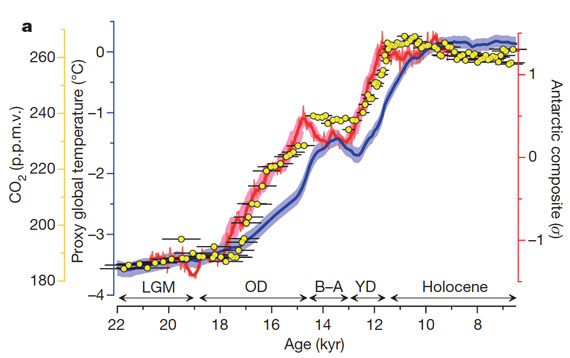
Overall, about 90% of the global warming occurred after the CO2 increase (Figure 2).
Figure 2: Average global temperature (blue), Antarctic temperature (red), and atmospheric CO2 concentration (yellow dots). Source.
Last updated on 9 April 2012 by dana1981. View Archives

Arguments


Basic
Intermediate


I get the Milankovitch cycles and how it changes the gross heat entering the earth, and am happy with CO2 radiation absorption and vapour pressure causing oceans to release CO2 as they heat up which then absorbs more heat, which causes positive (but not runaway) feedback.
I also get the difference between CO2 lagging temperature because it is a feedback mechanism, and the current man-made CO2 increase which is acting as a forcing mechanism.
What I am missing is why the extra man-made forcing is such a critical factor for earth's climate.
I don't mean for the effect on large numbers of species that may/will go extinct because they can not change or migrate fast enough, and I am not considering the serious issues associated with innundation of low lying areas cause by 1-2m sea level rises. But it seems from the cycles over the last 500k years, that there is some sort of feedback system that always strongly brings the temperature back down despite maximum CO2 levels for some time after the temperature starts falling.
I would expect the gross heat effect from the Milankovitch cycles to be a maximum when closest and least when furthest (with smaller variations caused by tilt and wobble), so would expect the temperature, even with feedback mechanisms when both heating and cooling, to be cyclical, with the fastest change occurring somewhat after the closest and furthest approach, and the maximum and minimum to occur half way between. What I don't understand is why the change here so linear, either relatively constant cooling, followed by faster but also relatively constant heating. If there is something that can trigger such rapid (less than 1/8th cycle) changes, it must have a far more significant and powerful effect (at the turn around points) than the known feedback mechanisms I have read about so far. I assume it is either powerful (tectonics?) and/or fast (geologically) to have such a profound sudden affect.
Please don't respond "it's not sudden if you expand the timescale of the graph", without explaining why the relative rate compared to the length of the cycle is not significant. All the feedback systems I know produces cyclic variations where the highest rate of change is mid cycle with lowest rate of change at the peaks - these graphs definately do not follow that norm. I would also appreciate not being asked to propose an alternative cause to CO2 (which I accept is a greenhouse gas); apart from the fact that lack of a suitable alternative idea does not validate a claim, I am here because I am not the one with the expertise. If I appear defensive, please forgive me, but these two (I believe invalid) counter arguments have been used the few times I thought this question may get adressed in the discussion.
Seondly, I am confused by the label on the temperature axis for the first graph. The label says temperature change, but I assume it just means temperature, otherwise zero would be nearer the middle?
I'll answer your post in parts, because it is so long. I'm not entirely sure I understand all of what you're saying, because you seem to include some misunderstandings in there.
First, the simple and most important point:Because the amount of carbon available to the system has been well constrained in the last 800,000 years to pretty much stay below 300 ppm, even at peak. There simply wasn't enough carbon to go around for feedbacks to keep adding CO2 beyond that.
It took man, digging up 337 Gt of carbon (and counting) that had previously been sequestered underground in fossil form to provide a source of carbon that would allow levels to rise above 300 ppm.
A large portion of the temperature rise from glacial to interglacial is due to CO2 feedbacks due to the 100 ppm increase. So why wouldn't a further 100 ppm, 200 ppm or more greatly influence temperatures?
The earth does not get warmer or colder due to distance from the sun. It actually doesn't get very much warmer or colder at all due to the variations in orbit.
All that changes is the length and intensity of the seasons in each hemisphere. Because the northern hemisphere is mostly land, particularly in that sensitive area around the poles (Siberia, Canada), while the southern hemisphere is mostly water, then the length and duration of the northern hemisphere summer becomes key.
If summer is too short and cool, then ice sheets can grow and expand in the NH. These reflect a lot more of the incoming sunlight than either open water, tundra or vegetation covered land. That actually changes the temperature of the planet and cools it off.
Conversely, when the axial tilt and other factors conspire to lengthen/strengthen the NH summer, the ice sheets will have longer to melt and less time to grow back in winter. The earth will absorb more sunlight/energy (instead of reflecting it back into space). This will warm the earth, and add to the retreat of the ice sheets.
Then CO2 adds its punch on top of that.
To translate what I just explained... there are basically tipping points. Once the ice sheets start to grow, that continues and the planet falls into a glacial state. It will remain there until a variety of orbital factors combine to toggle the system in the other direction. The rise is then fast once the change has been kick-started.
I'm unsure exactly why the opposite is so gradual, except that it is really sort of the natural state of the planet (to be partially ice-covered, that is), but it takes a very, very long time to draw down CO2 once it has been increased. That CO2 blanket keeps the planet warm and the ice sheets from expanding even though otherwise the orbital configuration "wants" the planet to be in a glacial state.
And with all of that said, the next orbital configuration to really get us into a true glacial state isn't supposed to be for another 10,000 to 20,000 years (it's not that easy to compute), so that at least is not really worth discussing.
On the graphs, "temperature change" means increase or decrease from a chosen baseline (our current climate).
The data is from this paper by Petit (2000) and is done by proxy (O18 isotope levels), and as such is relative to current O18 isotope levels (which are indicative of current temperatures). This is why it is presented as "difference from today" rather than an absolute value, because what is being used to present the data is a difference, not an absolute, in something else.
[It's rather like measuring the change in the tide. You can see how much the water level has risen by looking at a marker on a pole, without necessarily knowing how deep the water is beneath the pole. You can confidently say the water has risen X inches -- the change -- but it doesn't really make sense to bother to try to make that into an absolute depth.]
Just to state it a little more directly (as to why the rise is fast, but the decline is slow)... it's a lot easier to melt the ice sheets and thereby increase CO2 and heat the planet, than it is to reduce the CO2, and thereby cool the planet and create new ice sheets.
The two processes are not exact, diametric opposites. Hence the difference.
With that said, per Tzedakis et al 2012, “glacial inception would require CO2 concentrations below preindustrial levels of 280 ppmv” (for reference, we are at about 396 right now…and climbing). With the millennial atmospheric lifetime of CO2, no glacial epochs will be occurring the next million years…
357: So it relative to a nominal temp, thanks. Change (as I understand it) just didn't make sense (to me anyway).
That seems a bit disengenuous - it is the closeness of the orbit that is causing the longer NH summer and shorter NH winter which increases the icemelt and reduces the ice growth which leads to temperature change which amplifies the ice sheet change.
I believe from what you said that the amount of cooling/heating is related to the size of the ice sheets - larger ice sheets, more reflection.
Similarly the length of NH summer/winter is related to the closeness of the orbit adjusted on a shorter period cycle by tilt and wobble - closer orbit, longer summer, reduced ice sheets, more cooling.
Lastly the temperature also changes the CO2 level (in the past) and warmer oceans release more C)2 which increases the warming and reduces the ice sheets, etc.
So these three factors combine cause increasing warming the warmer the planet gets.
So at the end of a glacial period we have minimum CO2, and maximum ice sheets, while the orbit is getting closer at a cyclic rate - why isn't there balance and a slow shift to warming? Is there something that causes the ice sheets to start melting quickly despite only small change in NH winter/summer, extensive ice sheets and sustained high CO2? That is what I can't reconcile.
Do any of the linked reports have graphs which include the Milankovitch cycle, or anywhere that has the Milankovitch cycle data which I can then combine with that from Petit (2000) to generate my own analysis? In fact I think that is what I will need to do, to lok closely at the rate of change which appears to spike massively at the 'tipping points'.
Sorry, it was not the relative rate of warming to cooling I was raising, but the fairly constant (albeit different) rate in both. Unusual in a cyclic system where rates are less at the peaks and maximum at the mid points.
But since you raise it, why is it easier to melt than freeze - is it because melt water runs off exposing more of the cold ice sheet and maintaining a larger temperature incline at the sheet compared to when it is growing as water freezes it heats the local air reducing the temperature incline and so rate of growth? Possibly also because it can welt whenerver the temperature is high enough, while to grow it needs an equivalent cold temperature and water.
I'm heading out, but no, it is not the closeness of the orbit. There are multiple factors, including axial tilt, precession, shape of the orbit (ellipse versus circular), and others. Distance changes very little.
I'll explain more later.
Even then you are only partially correct. There are a number of factors which effect the strength of NH summers, of which the most important is the obliquity of the Earth, ie, the tilt of its axis. Because of the tilt of the Earth's axis, incoming sunlight is closer to the zenith in around June and July in the NH, resulting in greater insolation even though the Earth is further from the sun at that time. Thus axial tilt is a dominating factor in determining the timing of the seasons (at least currently).
Where orbital eccentricity the primary factor, then NH and SH would experience summer at the same time.
In addition to obliquity (axial tilt) and eccentricity (how close the Earth approaches the Sun at its closest approach each year) the other important factor is correlation between the two. The LGM was ended because precession resulted in the NH summer coinciding with perihelion (closest approach), and hence with particularly warm NH summers. Currently the axial tilt is such that NH summers more or less coincide with aphelion (furthest distance).
Ignoring all three relevant factors, of failing to specify that what is modified is NH summer insolation, so that it is the configuration during the NH summer that is relevant can only lead to confusion.
Finally, I refer you to this excellent article for further discussion.
The problem is that you're still stuck on "closeness."
Let me explain the orbital factors a little more clearly.
First, consider the seasons. The reason that there is a summer and a winter is primarily not that the earth is closer to the sun in the summer... if so, then how come both hemispheres don't have their summer at the same time?
The reason is axial tilt. Sunlight hits the northern hemisphere more directly, and so more strongly and for longer days, in the summer, and the opposite in winter.
But this axial tilt doesn't stay the same. Over time it changes, both in direction relative to the sun and in degree (sometimes more straight up, and possibly a few degrees more tilted than now). So does the overall shape of the orbit.
Consider, too, that even if the earth were closer to the sun during one season, it would be further in another... the net sunlight received by the Earth would vary very little in total.
When you abandon your too simplistic view of closer/farther you realize that multiple factors must all align to knock the system out of "glacial mode."
Read this post.
The main factors are CO2, seasonal insolation and albedo.
Think about it. I am (really) heading out now. I'll explain in more detail when I return.
Sorry, I am obviously mistaken in my understanding of the Milankovitch cycle and how it affects global temperature, I need to read up more on it. I wasn't meaning to imply you were dishonest above, just that it appeared you weren't addressing my question - this appears to be caused by my misunderstanding of the Milankovitch cycle - my fault all round.
@Tom 364:
As mentioned, my understanding of Milankovitch needs to be repaired (starting with your link), so my lack of immediate response is not ignoring you, I am paying attention, but think it best I shut up and lurk at least until I have done some more research on it (and stop confirming I am a fool). :)
Thank you all for your comments, you have given me some very useful avenues of research, I will definitely be back. This is the most informative factual site I have found on the topic so far.
Cheers
@362, in fact the response of global temperatures to the Milankovitch Cycle is far more typical than you believe. Compare the chart of insolation at 65 degrees North in the NH summer below to the temperature increases other than at 30 to 90 degrees North in the following chart:
As you can see, tropical and SH temperatures do follow the changes in NH summer insolation, although they are significantly lagged. What is more, SH temperatures are following NH insolation patterns, while NH extratropical temperatures do not. Clearly something very complicated is going on here, and Shakun et al offer a partial explanation.
Given that, I recommend you read the SkS article on Shakun et al carefully, and follow up questions on this point there.
You have enough to chew on for now about Milankovitch cycles, but to give you one very direct and easy to understand example as to why de-glaciation is fast, while re-glaciation is slow, consider simply the surface area of a sphere, or more importantly, the circumference. For understanding purposes only, imagine two cases, one with ice that covers the entire northern hemisphere all the way down to the equator (our oversimplified and exaggerated "glacial" state) versus one with ice that extends only as far south as the northern coast of Greenland.
Look at a globe. If you were to change the seasons in a way that the ice in the first case retreats 5 degrees further north, and in the second case extends 5 degrees further south...
Each scenario affects temperature by changing the overall albedo of the planet. But the effect near the equator is much, much greater, through the combination of (a) covering far more surface area (and in that way changing the total energy reflected by a greater amount) and (b) changing the albedo in a more important place (i.e. year round 12 hour days of very direct light at the equator versus half a year of long days and half a year of no daylight and with very indirect light at the pole).
So you have an asymmetric situation, one in which a change from glacial-to-interglacial (retreat of ice from the equator, far south) produces a much stronger feedback than the change from interglacial-to-glacial (advance of ice from the pole, far north).
Note that I'm not saying that this is the reason or even necessarily a factor. I'm just pointing it out to give a clear example as to how the two transitions are asymmetric and therefore do not need to parallel each other like the motion of a bouncing ball or a yo-yo.
Abstract is at http://www.sciencedirect.com/science/article/pii/S0921818112001658 but the full text is behind a pay wall.
"Ice cores show atmospheric CO2 variations to lag behind atmospheric temperature changes on a century to millennium scale, but modern temperature is expected to lag changes in atmospheric CO2, as the atmospheric temperature increase since about 1975 generally is assumed to be caused by the modern increase in CO2."
HIghlights "...►Changes in ocean temperatures appear to explain a substantial part of the observed changes in atmospheric CO2 since January 1980. ► CO2 released from use of fossil fuels have little influence on the observed changes in the amount of atmospheric CO2, and changes in atmospheric CO2 are not tracking changes in human emissions."
Has this paper gone through peer review and what do SKS regulars think of it. What's the issue or explanation?
For a relatively thorough treatment of this subject I'd recommend this SkS post: Climate Change Cluedo: Anthropogenic CO2
Where does Humlum think all human carbon dioxide emissions are disappearing to anyway?
"Changes in ocean temperatures appear to explain a substantial part of the observed changes in atmospheric CO2 since January 1980." - Based on ice core evidence, it takes 500-800 years for CO2 to respond to ocean temperature changes, and the 100 ppm change seen between glacial and interglacial periods is associated with 5-6C of temperature change. Since 1980 (32 years) we've seen 0.5C of warming and more than 50 ppm increase.
Those numbers just don't support their conclusions.
Even more damning, ocean CO2 is increasing as the oceans acidify. They cannot be the source of CO2 increase.
Given those basic issues wherein the facts contradict this papers conclusions, I suspect the paper as a whole is not a contribution to science.
1) They appear to be ignoring Shakun et al, 2012 on the issue of CO2 lag;
2) They are absurdly wrong on the relation between CO2 increase and anthropogenic emissions (I also recommend Climate Change Cludoe: Anthropogenic CO2 on this issue); and
3) Arguments that ocean warming has called recent temperature rise generally start by assuming all ocean warming is natural, and then establishing a correlation between ocean temperature rises and global temperatures rises. As the ocean constitutes 705 of the Earth's surface, unsurprisingly they find a large correlation; but the argument is entirely circular. They assume what they set out to prove when they assume the ocean temperature increase is not caused by global warming. All three authors have a past history of exactly that sort of argument, so I do not expect anything different this time around.
When a paper is hidden behind a pay wall it is difficult and frustrating since there is no way to evaluate it. If this is really suspect then how can a paper like this be accepted in a journal? Here's a graph from the study (similar to ones I've seen on skeptic sites:
It seems to be tracking changes in sea and air temperature and "global CO2". Is there some other process that would present the same seeming correlation and timing but which the authors are missing?
As a non-expert it is difficult to counter message like on Watts today without understanding what is going on. Thanks
They ignore many things:
1: what is causing ocean temperature to rise?
2: why is ocean pH decreasing, if CO2 is being released from the oceans (which should cause pH to rise)?
3: Where is all our CO2 going? We release ~30GT per year, yet annual CO2 rise is only half that. [the truth is that it is going into the oceans, acidifying them.]
4: As linked above, the chemical signature of the CO2 is that from FF-derived carbon, shown by several independent lines of evidence.
So lots of suspension of disbelief required before you can accept the Humlum paper. In fact, I suspect I'll find the suspension of disbelief when watching The Hobbit later this year a whole lot easier!
If someone de-trends the data, as Humlum did in that graph, they are no longer examining the trends, and therefore cannot conclude anything about them.
This is actually a fairly common mistake - any number of papers have filtered out the trends, and then attempted to state conclusions about the very data they have excluded from analysis. Very sad...
KR @381 So if I understand the graph then he's just showing that (sometimes) if the measured CO2 increases a bit more quickly year over year, then the temperatures increase a bit more compared to the previous year, and if the CO2 increase from year to year is a bit more modest the temperature increase is a bit less (or could actually be a decrease since the y-axes have different zero-lines). Whatever is causing the variability from year to year (even noise?) could then affect both measures in a similar manner. And none of this has anything to do with why either measure is trending upwards. Is that close?
skywatcher @379 so would effects of ENSO and volcanic activity account for the seeming lag in the graphs where temperature differentials from the previous year appear to increase or decrease 12 months or so before measured CO2 differentials from the previous year?
During La Nina the oceans accumulate more energy - as heat is buried in the sub-surface ocean, and during El Nino this heat wells to the surface and is smeared across the central and eastern equatorial Pacific. Due to these characteristics, and the surface air-sea exchange of heat, the Earth is cooler-than-average during La Nina, and warmer-than-average during El Nino.
But there's more to the story, there are two large competing effects on carbon exchange during ENSO. In a La Nina phase upwelling of acidified deep water along the western coast of North & South America out-gasses CO2 to the atmosphere. But this is more than compensated by the wetter-than-average rainfall which falls over the continents and particularly the tropical river basins of the world. More rainfall over such a vast land area generally means more plant growth and a draw down of atmospheric CO2.
During El Nino the much of the continental land surfaces are drier-than-average. This is because the upwelled heat on the Pacific equatorial ocean surface draws moisture away from the continents, and rainfall is focused over the ocean. CO2 out-gassing may shut off, but again this is more than compensated for by land vegetation. As drought sets in on the continents, vegetation dies and CO2 is released back to the atmosphere. Warming air temperatures also elevate respiration which, again, releases more CO2 back to the atmosphere.
These natural short-term CO2 fluxes dwarf human fossil fuels emissions, but unlike fossil fuel pollution they do not increase incrementally year after year.
It is, of course, more complicated than that. For example the distribution of rainfall is vitally important, but that is the general picture. Armed with that knowledge you can now under see that Humlum & co aren't telling us something we don't already know. They just lack understanding of the physical mechanisms which drive this and, allied to ideological bias, therefore come to conclusions unsupported by the evidence.
As for large volcanic eruptions - they can reduce atmospheric CO2 because they stimulate enhanced plant growth on a global scale. This is accomplished by the volcanic aerosols high in the stratosphere increasing light-scattering which more readily penetrates the leaf canopy. In the absence of other limiting factors, more sunlight equals more growth and hence draw down of atmospheric CO2. You can see this in the graph you presented - after the Mt Pinatubo eruption (1991) even the El Nino of 1991-92 saw a decline in atmospheric CO2 - the opposite of the normal response.
1. Interannual extremes in the rate of rise of atmospheric carbon dioxide since 1980 - Keeling 1995
2. The Carbon Cycle Response to ENSO: A Coupled Climate–Carbon Cycle Model Study - Jones (2001)
https://troyca.wordpress.com/2012/08/31/comment-on-the-phase-relation-between-atmospheric-carbon-dioxide-and-global-temperature/
(1) re: Figure 1 of the Topic post - what is the current thinking on the mechanism for cooling which seems to precede CO2 decreases?
(2) re: Figure 2 - I understand the trigger for warming being able to precede CO2 increase and then the feedback, but why does the Antarctic temp continue to (seemingly) precede CO2 increases even though the GMT lags it?
To perhaps save time, I am a skeptic and still officially uncertain on the big picture. But consider myself a true one (i.e. inquiring, open mind rather than with preconceived ideas either way).
Atmospheric CO2 levels do not just magically rise and fall on their own... something has to cause them to do so. Temporal causality holds that this cause must precede the effect. Ergo, in the past CO2 levels have risen and fallen in response to orbital solar forcings as described in the article above.
Your second question, about Antarctic temperatures, is also covered in the article;
"The Earth's orbital cycles trigger the initial warming (starting approximately 19,000 years ago), which is first reflected in the the Arctic.
This Arctic warming caused large amounts of ice to melt, causing large amounts of fresh water to flood into the oceans.
This influx of fresh water then disrupted the Atlantic Ocean circulation, in turn causing a seesawing of heat between the hemispheres. The Southern Hemisphere and its oceans warmed first, starting about 18,000 years ago.
The warming Southern Ocean then released CO2 into the atmosphere starting around 17,500 years ago, which in turn caused the entire planet to warm via the increased greenhouse effect."
All this per Shakun et al 2012, which is obviously a very new study and requiring further confirmation. However, there is nothing surprising about some parts of the planet warming faster than others. The solar forcings of the Milankovitch cycles impact specific hemispheres and only have a net effect because of the differing amounts of land in the two hemispheres. CO2, on the other hand, is well mixed throughout the atmosphere and thus impacts the entire planet 'global mean temperature' (presumably your 'GMT').
So, to clarify, in reference to the first question/response am I correct in saying that there is a solar-related forcing to trigger the upswing, and a (obviously different) solar-related forcing to trigger the downswing? The warming trigger is enough to break the equilibrium and then the temp/CO2 feedback/forcing continues to a higher equilibrium via the process described in the Topic (as you describe also). The cooling trigger is then enough to break from the higher equilibrium and the equal but opposite (?) feedbacks occur until a lower equilibrium is reach.
Re: the second question, I both read and understood the Topic, my thinking was more about:
(a) after the initial trigger why does the Antarctic temp continue to rise faster than the global average? Once the CO2 kicks in (well-mixed globally as you note) why the continued difference between hemispheres?
and
(b) the fact that there are (seemingly) a couple of separate warming events or stages - one at 18k yr ago and then another at about 13k yr ago (after a bit of a plateau. In both cases it looks like the Antarctic Temp increase precedes the CO2 increase. Are these actually separate events with separate triggers, or is it just a break in the forcing/feedback cycle, or just not significant given the data/time-scales?
I'm not sure what you mean about 'breaking the equilibrium'. By definition if you have a forcing you don't have equilibrium. When the 'sign' of the forcing changes the feedbacks do so as well. There is no 'barrier' which needs to be broken in order for this to happen.
There are several reasons Antarctic temps rose faster than the global average. First, it was experiencing warming due to the shutdown of Atlantic circulation (which basically pulls cold water North) plus global warming from rising CO2 levels... A+B > B alone. Second, there is less water vapor in colder climes and thus increased CO2 levels have a greater warming impact in those areas than they do in warm areas. Third, melting ice exposes darker land and ocean beneath... which absorbs more sunlight and thus warms faster than areas which had exposed land/ocean to begin with.
As to the 'warming plateau', this period is generally called the Younger Dryas and there are a number of theories on its cause. All involve some other forcing coming in to play and temporarily offsetting the ongoing solar forcing / CO2 & ice feedback trend. It is anomalous compared to most previous interglacial periods and thus generally considered some kind of random (rather than regularly recurring) event... asteroid impact, increased volcanism, huge freshwater Lake Agassiz suddenly draining into the ocean, et cetera.
So the warming trend was really a 'single ongoing event'... just temporarily interrupted by something else.
http://www.woodfortrees.org/plot/esrl-co2/isolate:60/mean:12/scale:0.25/plot/hadcrut3vgl/isolate:60/mean:12/from:1958
I see that the 5 year trends have been removed, but don't know how to interpret this. CO2 lags temps in the modern day?
El Nino's Effect on CO2 Causes Confusion
That particular graph has had all long term trend removed (the 'Isolate' command), and has a total range of -0.15 to +0.25 ppm - whereas annual growth of CO2 concentrations is ~2.07 ppm currently, or roughly an order of magnitude greater than these small variations.
In other words, it's a graph of noise. Whoever created it was (IMO) on a search for something to confirm their preconceptions, or to mislead others. It's right up there with plotting recent temperature changes on a scale of Kelvin degrees starting at zero - visually convincing of 'skeptic' points, but once you get a good look at the dimensions, well, it's nothing to speak of...
That's the real data, the actual information hidden by the rather (IMO) deceptive graph you were shown. There are in fact a few people at WUWT who seem to specialize in those misleading graphs, such as Smokey, as discussed at Tamino's blog.