



 Arguments







Climate Skeptic Fool's Gold
Posted on 19 August 2011 by dana1981
Over the past 40 years, global climate models have become dramatically more advanced and complex in their representations of the Earth's climate system. In the 1970s, when our understanding of the global climate (and our computing power) were still relatively rudimentary, some simple climate models nevertheless yielded global warming predictions which have turned out to be very accurate. In the 1980s, climate models and computing technology improved, and so did climate scientists' predictions using those models. Today's climate models are so advanced in their representation of the Earth's complex climate, that they run on some of the world's fastest supercomputers. As climate models are able to represent the climate more and more accurately, their predictions will continue to improve as well.
Some climate "skeptics" tell us that climate model predictions are worthless because they're just that - models. It's true that like all models, climate models will never be perfect, but that doesn't mean they can't be useful. Climate models have already proven that they can make accurate predictions.
The reason that even simple climate models nearly four decades ago were able to accurately predict the ensuing global warming was that they're based on physics. For example, we've known since British physicist John Tyndall's laboratory experiments in 1859 that greenhouse gases like carbon dioxide trap heat. In 1896, Swedish scientist Svante Arrhenius calculated how much the planet would warm in response to a doubling of the amount of carbon dioxide in the atmosphere, and his estimates were not far off from climate scientists' today. Because it's based on solid fundamental physics, climate science has aged like a fine wine.
Nevertheless, some scientists distrust the conclusions drawn from modern climate models, and have taken to creating simple models of their own. The most well-known of these climate model "skeptics" is Roy Spencer from the University of Alabama at Huntsville. Dr. Spencer has become notorious for frequently using variations of a simple climate model - not too dissimilar from those climate scientists were using in the 1980s - to make wild claims that mainstream climate science is wrong, and man-made global warming is nothing to worry about.
The real problem is that while most climate modelers constrain the possible values of their variables based on physical reality, Dr. Spencer does not. One example of these variables is the ocean mixed layer (the upper part of the ocean where, due to the wind blowing at the surface and stirring the upper layers, the ocean has about the same temperature and salinity). Measurements have shown that the ocean mixed layer ranges from about 25 to 200 meters below the ocean surface, and for a model as simple as Dr. Spencer's, the value should be around 100 meters.
However, intead of constraining his variables using physical measurements and then running his model to see if it fits observations, Dr. Spencer just runs his model without limits and tweaks the parameters until it matches the data. This is a practice known as "curve fitting" or "cooking a graph". In one instance where he concluded the climate is not sensitive to changes in greenhouse gases, Dr. Spencer's results used a mixed layer depth of 700 meters. In a recent study in which he concluded that more heat is lost to space than climate models show, amongst numerous other problems, Dr. Spencer's model used a mixed layer depth of 25 meters. In other cases, Dr. Spencer has used models with as many as 30 fully adjustable, unconstrained parameters. With so many variables and apparently no desire to match physical reality, Dr. Spencer's model could spit out literally any answer. As the famous mathematician, John von Neumann said,
"With four parameters I can fit an elephant, and with five I can make him wiggle his trunk."
And as Dr. Barry Bickmore added,
"give me more than 30 parameters, and I can fit a trans-dimensional lizard-goat and make rainbow monkeys shoot out its rear end."
Dr. Spencer is not the only scientist to conduct this sort of curve fitting exercise in recent months. Two other climate "skeptic" scientists, Craig Loehle and Nicola Scafetta, published a paper arguing that the majority of the global warming over the past 40 years has been caused by the 60-year astronomical cycles of Jupiter and Saturn. These scientists failed to explain physically how Jupiter and Saturn's orbital cycles could have such a large influence on the Earth's temperature. Instead, they just tried to see how well they could fit global temperature measurements over the past 150 years using a very simple model with 60-year cycles.
Loehle and Scafetta's model was so simple, in fact, that it only consisted of one short formula that I was able to plug into a spreadsheet and run in about five minutes. I ran the model backwards in time to see how it would compare to past temperature reconstructions, including one that Loehle himself created in a previous paper. The 60-year cycle was nowhere to be seen, even in Loehle's own temperature reconstruction, and after a few hundred years, the model diverged dramatically from the data.
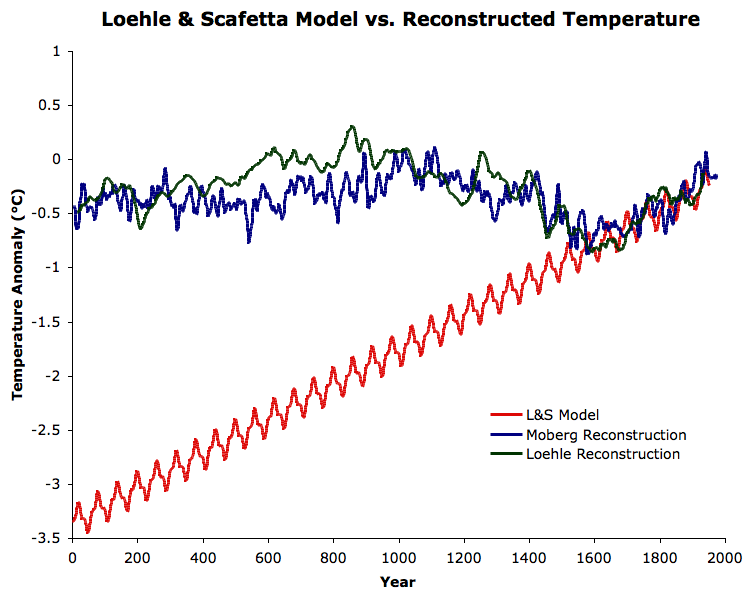
Their model is just too simple to accurately re-create global temperature changes, and unlike real climate models (even the simple versions in the 1970s), Loehle and Scafetta's model is not based on physical reality.
Nevertheless, these curve fitting exercises have drawn a lot of attention. Forbes magazine ran a story on Spencer's study, written by James Taylor of the right-wing think tank Heartland Institute. The article exaggerated Dr. Spencer's findings, and managed to cram the words "alarmist" and "alarmism" into his eight-paragraph article fifteen times. Despite Forbes' long history of misrepresenting climate science resesarch, the popular search engine website Yahoo decided to re-publish the biased Forbes article. Many other media outlets ran stories on Spencer's study.
The other problem is the media's exaggeration of these studies' impacts. The man-made global warming theory is based on many, many lines of evidence. It seems as though every "skeptic" paper is touted as the silver bullet which is going to disprove the entire theory. It's actually very rare for a single study to overturn a scientific theory. In most cases, when a paper arrives at the opposite conclusion of all other studies in the field, it's because there are fundamental flaws in the paper. This is quite clearly the case for the Spencer and Loehle & Scafetta papers, and yet predictably, they're being touted as silver bullets by those who don't know any better, but want to believe the man-made global warming theory is wrong.
This is why an independent inquiry found that even the BBC has been giving climate "skeptics" too much air time. We should certainly pay attention to any good scientific research, but we shouldn't assume that a study's results overturn the body of scientific evidence just because we want it to be true. How many times must "skeptic" silver bullets turn out to be fool's gold before we stop assuming that they've disproven the robust man-made global warming theory?


 0
0  0
0






Comments