CO2 lags temperature - what does it mean?
What the science says...
| Select a level... |
Basic
|
Intermediate
| |||
|
CO2 didn't initiate warming from past ice ages but it did amplify the warming. In fact, about 90% of the global warming followed the CO2 increase. |
|||||
Climate Myth...
CO2 lags temperature
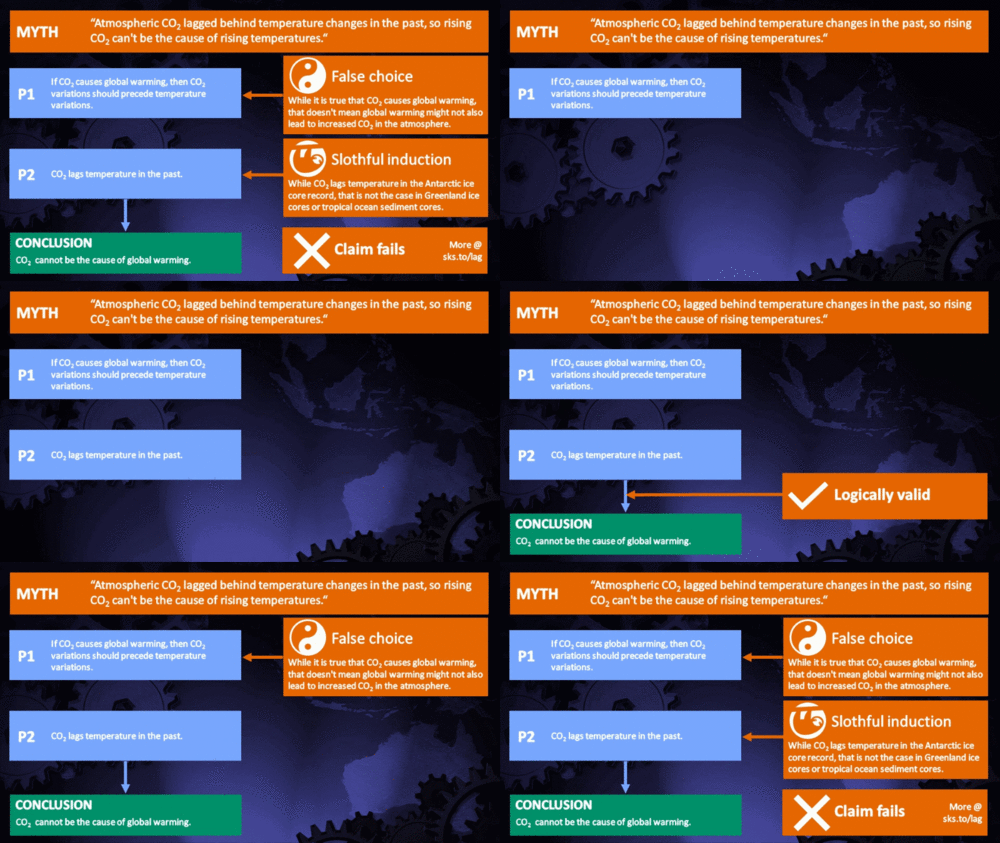
"An article in Science magazine illustrated that a rise in carbon dioxide did not precede a rise in temperatures, but actually lagged behind temperature rises by 200 to 1000 years. A rise in carbon dioxide levels could not have caused a rise in temperature if it followed the temperature." (Joe Barton)
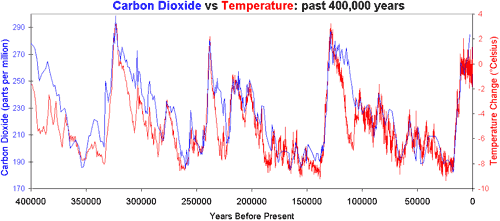
Earth’s climate has varied widely over its history, from ice ages characterised by large ice sheets covering many land areas, to warm periods with no ice at the poles. Several factors have affected past climate change, including solar variability, volcanic activity and changes in the composition of the atmosphere. Data from Antarctic ice cores reveals an interesting story for the past 400,000 years. During this period, CO2 and temperatures are closely correlated, which means they rise and fall together. However, based on Antarctic ice core data, changes in CO2 follow changes in temperatures by about 600 to 1000 years, as illustrated in Figure 1 below. This has led some to conclude that CO2 simply cannot be responsible for current global warming.

Figure 1: Vostok ice core records for carbon dioxide concentration and temperature change.
This statement does not tell the whole story. The initial changes in temperature during this period are explained by changes in the Earth’s orbit around the sun, which affects the amount of seasonal sunlight reaching the Earth’s surface. In the case of warming, the lag between temperature and CO2 is explained as follows: as ocean temperatures rise, oceans release CO2 into the atmosphere. In turn, this release amplifies the warming trend, leading to yet more CO2 being released. In other words, increasing CO2 levels become both the cause and effect of further warming. This positive feedback is necessary to trigger the shifts between glacials and interglacials as the effect of orbital changes is too weak to cause such variation. Additional positive feedbacks which play an important role in this process include other greenhouse gases, and changes in ice sheet cover and vegetation patterns.
A 2012 study by Shakun et al. looked at temperature changes 20,000 years ago (the last glacial-interglacial transition) from around the world and added more detail to our understanding of the CO2-temperature change relationship. They found that:
- The Earth's orbital cycles triggered warming in the Arctic approximately 19,000 years ago, causing large amounts of ice to melt, flooding the oceans with fresh water.
- This influx of fresh water then disrupted ocean current circulation, in turn causing a seesawing of heat between the hemispheres.
- The Southern Hemisphere and its oceans warmed first, starting about 18,000 years ago. As the Southern Ocean warms, the solubility of CO2 in water falls. This causes the oceans to give up more CO2, releasing it into the atmosphere.
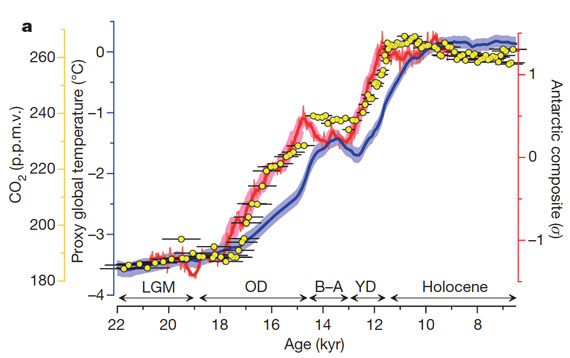
While the orbital cycles triggered the initial warming, overall, more than 90% of the glacial-interglacial warming occured after that atmospheric CO2 increase (Figure 2).
Figure 2: Average global temperature (blue), Antarctic temperature (red), and atmospheric CO2 concentration (yellow dots). Source.
Basic rebuttal written by dana1981
Update July 2015:
Here is a related lecture-video from Denial101x - Making Sense of Climate Science Denial
Last updated on 8 January 2016 by pattimer. View Archives
Arguments


Basic
Intermediate


One might of course notice that in the most recent "burst" CO2 gets well above the temperature curve, unlike the previous cases.
Does anyone know what in the past produced the "fast" T and CO2 growths?
Marco
When I first saw this at an ACS function nearly 20 years ago these curves were presented as proof of CO2 caused warming; despite the obvious fact that the graphs, even then, showed that the temperature change was not following but rather was leading the CO2 change. Now we are trying to explain away T changing first invoking creative models. It appears the fundamental premise that CO2 causes warming is simply not supported by the paleo record. It may still be true, but what evidence do we have in the climate record that supports this hypothesis?
Here is another question: If ice ages are on 100,000 year cycles because the Earth's orbit is more elongated on 100,000 year cycles why is the Earth's orbit so round now? Shouldn't it be nearing maximum excentricity?
Caillon 2003 constrains the CO2 lag to 800 ± 200 years (but again, no error bars):
Stott 2007 finds similar results - a CO2 lag of 1000 ± 300 years. Stott does include 200 year uncertainty on the benthic ages (in fact, Stott's graph includes everything but the kitchen sink):
Are we sure about that? I am sure the original data from way back then was actually from Greenland ice cores, showing that temperature was rising before CO2, there as well as in the Antarctic. The Antarctic data was not yet around. If CO2 is rising first in Greenland than your hypothesis may be correct. I know CO2 is supposed to cause warming, and I think I understand why. But, the data still seems to scream corelation does not equal cause and effect.
The presenter after having this error spotted by a lowly physics type grad student was not well recieved in the question session by the roomful of chemistry PhD's that were present. None the less his hypothesis that CO2 causes global warming is still widely discussed. :)
Without knowing which older studies you're talking about, the most recent studies with up to date (and dare I say the most accurate) data (Monnin 2001, Caillon 2003) paint a similar picture of Southern warming -> CO2 rise -> Northern warming. But if you do know of any pertinent older papers, it'd be great if you could post the links here. And kudos for sticking it to the man :-)
"It has been said that democracy is the worst form of government except all the others that have been tried. "
Of course there are another two quotes from him that I think very much apply to the GW debate:
"The best argument against democracy is a five-minute conversation with the average voter. "
&
"A lie gets halfway around the world before the truth has a chance to get its pants on."
Well, enogh quotes. On a more serious note, sadly enough, the whole field of Climate Science and Global Warming has become just like Finance. There is so much easy money flowing around that there is a great number of people with all sorts of backgrounds and levels of knowledge that have no relation to climate/physics or anything distinctly related (although by all means I am not saying we should only used established scientists' work as a guideline) that would make most outrageous claims/predictions with arbitrary certainty backed up many low-quality science booklets/papers/reports, posh presentations and heavy media support to streer more funds their way. In general, what I'm refering to is the so-called "press release science", unfortunately endemic to so many other fields besides climate.
And finally, refering to the following quote from your bio section:
"I'm still yet to meet a skeptic argument that is even vaguely convincing."
I would suggest looking at some arguments that come from people that don't exactly fit the typical skeptic stereotype you describe, for example take a look at this list
http://www.warwickhughes.com/hoyt/climate-change.htm
and the following scorecard on the same website
http://www.warwickhughes.com/hoyt/scorecard.htm
So, I wasn't really asking about the lags, but whether we can even begin to consider that these lags mean anything. As far as the error bars, I was asking for the errors of the reconstruction models that create those curves on the graphs you show. The lines only follow the positions of the 50% quantile of each model output point but tell us nothing about its possible range (due to original measurement errors and other uncertainties).
What everyone needs to appreciate is that we have fundamental physics and really, really extensive laboratory analysis of the absorption spectra gases alone and in combination, at all sorts of temperatures and pressures. You can look up the raw data on HITRAN at http://www.cfa.harvard.edu/hitran/ and you can read the conclusions drawn from this raw data about the greenhouse effect at, e.g. Ray Pierrehumbert's free access draft of his "Climate Book" http://geosci.uchicago.edu/~rtp1/ClimateBook/ClimateBook.html
This is a university level physics textbook, not aimed at the general public. If you need more basic accounts of how GHGs absorb infrared, you can check out www.realclimate.org where Dr. Pierrehumbert is an active contributor. I'm linking to the academic text just to point out that belief in CO2 being a greenhouse gas, able to *cause* warming as well as respond to warming, is built on over a century of physics and lab analysis, and really, really NOT just on a few graphs taken from ice cores and put up on the screen by Al Gore.
Way too much online discussion has treated this as if the whole line of reasoning rested solely on the paleo graphs and nothing else.
To sum it up: temperature changes do indeed drive CO2 changes, *and vice versa*. The positive feedback between the two accounts for how ice age terminations get moving so much faster than the very gradual Milankovic forcings. The feedbacks don't run away forever because, for one, the carbon dissolved in the ocean is not infinite, the ice albedo feedback runs out when the glaciers and sea ice have retreated, etc.
Also you say that it is not fully understood how oceans give up CO2. What about the reverse, the removal of CO2 from the atmosphere when the Milankovitch cycle drives the temperature down ?
Hope you have time to answer these.
If we allow for the accumulation and decumulation of joules in the planet and the oceans then it is the factor of TIME ALONE that needs to be taken into account and not this sideshow of CO2-feedback.
We ought to be looking at a model which relies on STRATA AND HEAT BUDGETS.
Not on WPSM. The WPSM model is a first draught that people came up with looking through telescopes. They couldn't see anything else so they imagined the whole thing could be determined by spectroscopy alone. But what we are talking about is the accumulation and decumulation of joules.
Another thing that these WPSM models fail to take into account is the distance travelled through the atmosphere.
The stratosphere ends about 50km up in the air. But that doesn't mean that a "ray" of light hitting the stratosphere has to travel only 50km.
This is only true at the equator and at high noon. And this is important since the climate guys talk as if only greenhouse gas and ozone can attenuate this radiation. But all gasses inhibit radiation and a lot of this radiation has a very long way to go.
Not taking into account of this and failing to think about ACCUMULATION and DECUMULATION of joules over many decades and years is a fatal flaw to these climate models.
The armchair thinking goes like this:
If the colour of CO2 is such that it absorbs a little bit of the infrared spectrum then industrial-CO2-release ought to substantially warm things up on a global scale.
Now the fact is that there isn't a scrap of evidence for this thesis. One-step inductive armchair inferences don't always turn out to be true. This one has failed all experimental tests.
CO2 might well COOL the temperature of the earth in the long run. An armchair inference with billions of dollars behind it is still an armchair inference.
I am familiar with this book, it is really a university level physics textbook, under which I mean "entry level". One needs to realize that the explanation of GH effect inherently relies upon so-called "atmospheric lapse rate", to link the height of "effective emission layer" with surface temperatures. One really needs to realize that so-called "lapse rate" must be an average of all atmospheric structures and weather patterns over the whole globe and from ground up to the whole troposphere. One needs to realize that the atmospheric patterns include turbulent boundary layer, global circulation patterns (Hadley, Ferrel, and polar cells), jet streams, hurricanes and other tropical depressions. More importantly, the lapse rate is strongly affected by moisture, which, in turn, is strongly affected by sea temperature. What is more important is that the moisture tends to condense into clouds under certain atmospheric/aerosols conditions. The laps rate ("moisture adiabate") tends to DECREASE with higher moisture content providing a negative feedback. Clouds also provide negative feedback by reducing insolation.
Needless to say that all of listed processes occur under strong non-isotropic turbulent conditions, and are way beyond the reach of any direct computer modeling. As result, either a hand-made parameterizations have to be used, or parameterizations of experimental data. Given the spatio-temporal complexity of atmospheric patterns, data from few weather balloons cannot be seriously considered as a good representation of average atmospheric structure. The reference to HITRAN/MODTRAN serves no purpose for this discussion since the code uses a pre-selected fixed MODEL of atmospheric profile. In MODTRAN, there are 84 different models for atmospheric profiles; each gives different result for amount of OLR and surface temperature. So, what would be your selection of models across the globe to include into a global greenhouse model? How objective or subjective it could be? As you see, the "fundamental physics" of absorption spectra or two-stream Schwarzschild equations are not all the sophistications you need to build a model of GH effect and calculate its amplitude.
No matter what the atmosphere is doing, if you add heat you get warming. You don't need a PhD to understand that.
The main outcome of the above research is to suggest that heating of the planet causes more carbon dioxide in the atmosphere (with some delay). We already know that increased carbon dioxide causes warming, so this means that the warming will be amplified by increased CO2 emission from the oceans.
GMB, everything you are saying has already been taken into account in the current climate models.
Climatologists have been out of their armchairs for decades now; where are you sitting?
There is no heat being added unless you are talking about variation in Solar output. The warming is supposed to be the result of Earth holding on to more heat and releasing it more slowly. The Earth is not a Black body radiator, but that doesn't even matter because CO2 isn't a big absorber of black body radiation at this temperature.
Or this comment "We already know that increased carbon dioxide causes warming, so this means that the warming will be amplified by increased CO2 emission from the oceans."
This is simply not correct. We think it should work this way, we have some theoretical reason to believe it should. But, it has rather badly failed the experimental test so far. In addition if your assertion were true this would be a positive feedback loop that is clearly not present in the Earth's paleo record. If the climate really worked this way the Earth would be vastly warmer than it is and would never have had any ice ages because once the CO2 got high, as it has many times in the past, it would cause a warming spiral.
The idea that you can "take into account" in models affects that we simply don't understand is absolutely silly.
'How do we know that the planet isn't returning to Earth Normal or Earth Mean temperature?'
Are you seriously proposing a new theory - that the Earth has a memory? Do you have a mechanism? Or a 'setting' to which this 'memory' is adjusted? Is there any peer-reviewed literature as a source?
CO2 clearly cannot be meaningless, it has long been known to be infra-red active and remains resident in the atmosphere for a long time, from memory ~33% remains after one hundred years and 20% after a thousand years, but there is a long tail meaning that some will remain for tens of thousands of years, causing significant warming. Inevitably, this alone will affect the net heat balance of the Earth. Of course CO2 is NOT the only GHG and as temperature increases, so does the water vapour, which acts as a positive feedback amplification. But while water vapour is a stronger GHG than CO2, it does not remain in the atmosphere for long.
The source of the excess CO2 is explained by the shifting isotopic ratio of the atmospheric carbon. From this it is known to originate from non-biological sources - i.e. fossil carbon: coal, oil & gas.
Regarding CO2, the Mauna Loa CO2 readings overlap ice core data during the period 1959-1978. The CO2 readings obtained match perfectly during the overlap. AFAIK, the oldest ice cores are ~ 1000 ky old.
Here's one with the source data and references - so that YOU can check its authenticity!
http://www.globalwarmingart.com/wiki/Image:Carbon_History_and_Flux_Rev_png
And another:
http://www.globalwarmingart.com/wiki/Image:Carbon_Dioxide_400kyr_Rev_png
Sorry, but I couldn't locate a version in the p/r literature. I've seen them before, it's just that I couldn't find any.
We are clearly performing a global experiment and no-one can be absolutely certain as to the precise outcome, but if it does all go dreadfully wrong, the trouble is that we are INSIDE the test-tube!
It would therefore be a really good idea to heed the scientists and stop trying to light the Bunsen burner!
Let's cut-back on the use of fossil-fuels, through improved technology, energy conservation & efficiency and renewable energy generation.
The economic argument that carbon taxes will damage the US economy is bogus.
“As Congress prepares to debate new legislation to address the threat of climate change, opponents claim that the costs of adopting the leading proposals would be ruinous to the U.S. economy. The world’s leading economists who have studied the issue say that’s wrong”
http://www.cis.yale.edu/opa/newsr/08-03-19-02.all.html
We owe it to the next generation and generations to come to hand over the Earth in the same condition as it was when we received it. Sadly, this will not be the case.
Another thought: Those graphs in my previous post show a rapid upward acceleration of CO2 in recent decades, one that matches the accelerated warming. If what you suggest were true: namely that Earth is [your hypothesis] 'returning' to 'normal', then one would expect an ever decreasing asymptotic approach. Instead, what is seen in the second graph is a rapid departure upwards from the upper bound historic values - the exact reverse of what is expected.
http://www.globalwarmingart.com/wiki/Image:Carbon_Dioxide_400kyr_Rev_png
Oops! your theory is shot full of holes!
1. I said "what IF. (food for thought). There is a CO2 feedback effect and a contribution by AGW regardless.
2. Not one single graph that I have seen matched the rise in CO2 to the rise in temperature without some serious manipulation.
Show me a graph of rising surface temperaturs that is based solely on rural weather stations and a chart of CO2 with a matching slope. You won't be able to.
Re: "The economic argument that carbon taxes will damage the US economy is bogus."
This is an unknown. It could go either way depending on exactly who is taxed and how much as well as who is hired and how many. If we are heavily taxed to pay for green products made in India we loose. If we are lightly taxed for production within the US by non-illegals we win. Can you assure us that the latter will be the case rather than the former?
Very astute observation. Another look at those graphs will also show that temperatures fell dramatically when CO2 was at it's peak.
http://www.geocraft.com/WVFossils/Carboniferous_climate.html
In fact I am told the reverse has actually been observed. Doesn't this suggest that something other than CO2 has driven most or all of the warming of the last 30-40 years?
Or is it possible to say with some confidence that one of these two data sets is better than the other? (Although even the "supportive" data set is not able to disprove the null hypothesis of no greenhouse effect from what you say.)
[Apologies if this was the wrong page on the site to have raised this subject - at the time I began I didn't realise how extensive the site was].
I've tried to understand how the paleo ice records are anything more than anecdotal. Problem is I've seen counterveiling studies that show that light oxygen - a direct proxy for water vapor - shows a more-consistent correlation with paleo temperatures than CO2.
The ice ages hit an arid maximum and the thaws always saw a large increase in humidity as ice-locked water was returned to the hydrological cycle.
It makes sense that CO2 played a role in the interglacials but the discontinuities I see in the record seem to disprove an absolute temperature-driving record for CO2.
I mentioned the same thing on Watts' blog:
The world's leading economists? Have they mentioned the imbroglio brewing over in Europe, the ongoing rebellion in Britain?
In the EU the Europeans are looking at their carbon tax overheads and realizing that they could lose their steel firms to Asian steel makers. This is b/c of the market-distorting effect of carbon taxes levied on developed nations that are not levied on developing ones.
In England the additional green taxes saw "Red Ken" get ousted from the mayoral seat of London, where Ken Livingston saw the election as largely a green referendum. It was alright, an anti-green one. Labour is hammering Brown to relinquish some of the additional green taxes on trucking firms, etc.
Only three countries in Western Europe have met their Kyoto targets, Sweden & France using nuclear power and Switzerland from hydro.
And Japan - one of the most energy-efficient countries in the world - has simply said it cannot afford the Kyoto targets.
You will be fascinated to read Freeman Dyson's review of Norhaus' economic model of the next century of consequences to various GW solutions, taking GW as given.
Among other intriguing findings: Kyoto makes little net difference; Gore's solutions are the Full Monte disaster; and the optimum is a "low-impact backstop" alternate carbon-free technology.
Enjoy!
http://www.nybooks.com/articles/21494
Nordhaus.
And a comment: I think what falls out of this is that CO2 is simply irrelevant, except insofar as it supports increased plant growth, and costs resources in a futile attempt to control it. If it made any difference, maximizing it to prevent Global Cooling would be a good idea, but ...
"The CO2 record confirms both the amplifying effect of atmospheric CO2 and how sensitive climate is to change."
Then how can the downturns of the cycle, cooling, be explained in the presence of the elevated and lagging CO2?
The hypothesis:
Milankovitch cycles warm the oceans, and release C02 which amplifies the warming. That explains why C02 lags initial warming, and also causes the overall increase.
However, this does nothing to explain the temperature decrease. With so much C02 driven temperature increase, how could temperature possibly decrease in the cycle? What is the feedback mechanism?
The arguments above explain only half the model, and describe a system that would spiral to out of control heating until leveling. These arguments fail to explain the cycle's cooling phase.
Without a convincing answer to that, the assertion that C02 has a causal relationship to temperature is false.
I'm not saying this is THE cause, but it is a factor to be considered and allows CO2 to lag T and then decline as forests develop (800 - 1000 years grows an awful lot of woody material)until (possibly!) CO2 levels begin to fall.
Also we should stop talking about variations in insolation being irrelevent. They aren't. The direct physical effect may be small...but the consequencies of that small effect may well be pretty big.
Astute observation. Much more credible than the "consensus" view as Methane actually is a GHG with more potential than CO2. But another factor is ocean and air currents that differ depending on location of the continents and locations of internal thermal forcing which I refer to as vulcanism (old habits die hard) that cause upwellings in the oceans constantly altering currents.
Oceanic currents, atmospheric currents are simply means of distributing/modulating heat flow; the whole system is a thermal model Heat in - Heat out which is modulated by a variety of factors ( and I don't like the use of the word 'forcing' because it carries other overtones) which we do not (yet) fully understand.
Incidentally, domesticated ruminants are estimated to produce 36Mtonnes of methane annually; the New Zealand government is introducing a 'emissions' tax on livestock farmers .........
The AGW argument here is based on the fact that TSI stopped following the temp curve in 75 or 76. And they are right on that account, it did. So we know solar forcing has the capability but what happened in 1975-76?
The single major event was a full (once in a lifetime) solar alignment. It won't happen again for a very long time. The results were not immediate but started within a few years of the event. The earth became active, plate movement increased speed, new volcanos appeared and old ones became active, large earthquakes, tsunamis and stronger ocean oscillations which are caused/controlled by vulcanism/tectonic activity.
In Dr. Fairbridge's hypothesis on gravity affecting the sun we can surmise that the effect would be strong enough to affect the earth as well, stirring things up, so to speak. This explains why only the northern pole is a problem and not the southern pole. It also explains the South Atlantic Magnetic Anomaly and why we had glacial melts. If you take into account all the anomalies since 1975 you start to see the pattern.
As an aside: The moon causes tidal waves in all earth's material phases, and that effect is constantly modulated by the sun all the other planetary bodies.
I would not care to try and model that either!
Nevertheless, thank you everyone for a thoroughly scientific and impersonal debate on this topic. Its refreshing to read a thread like this minus all the politics and high emotion that usually comes with it
Unfortunately some threads here are also a bit heated but it is still much better than RealClimate.
The relationship as stated and accepted by the IPCC may indeed be false, I agree. But there is a feedback that has a minor effect and can be viewed as symptomatic. Spencer gives a good explanation for this, the sensitivity to CO2 is lower than the sensitivity of other drivers/forcings and easily overcome which is indicated in the current cooling trend. The idea that CO2 caused AGW therefore is rather meaningless since it is not strong enough to have driven climate change from 1975 through 2007. Recent articles on ocean oscillations and plate tectonics/vulcanism indicate that "The solar jerk" is at work.
Ok, now I am confused. I thought we were discussing CO2 here. But a reduced sensitivity to GHGs in general would also explain less sensitivity to water vapor would it not?
You each dismiss the possibility of feedbacks to CO2-induced warming, without really explaining your problem. In each case this seems to relate to the observation that during Milankovitch cycles associated with glacial-interglacial-glacial transitions, the earth's temperature drops while atmospheric CO2 levels remain high for a while. But isn't that exactly what's expected if the CO2 rise and fall is itself a feedback from the primary (Milnkovitch-induced) warming?
Obviously atmospheric CO2 levels will lag behind temperature levels on both the rising and falling parts of the cycle. It's a question of relative magnitudes of forcings, and the timescales for various re-equilibration to changes in forcings. If the solar (insolation) dominates (as we consider to be the case), then it will "dominate" the effects of CO2, feedbacks and all.
We could make an analogy with the day night cycle. Right now atmospheric CO2 levels are the highest they've been for many millions of years and the Earth is warming. However last night while CO2 levels were extraordinarily high (382 ppm or whatever the current value is), when the sun went down, it got a bit cooler. In fact as the air cooled last night some of the water vapour precipitated out and it rained....
Now that scenario doesn't indicate that raised atmospheric CO2 doesn't have an associated positive water vapour feedback. It clearly does (we can measure this in the real world). It just means that the insolation effect dominates the CO2 effect, feedbacks and all.
The associated thing that needs to be considered is the timescale of the effects. The CO2 feedback to warming is very slow (and likewise to cooling). Once atmospheric CO2 levels are raised they stay that way for a long time. But both the warming effect of CO2 and its water vapour feedback are a consequence of an interaction with the insolation. If the insolation drops, then the greenhouse effect of the raised CO2 and water vapour will drop immediately. And a reduction in the feedbacks will follow on different timescales. The water vapour feedback will drop quickly (days to months following reduced warming resulting from reduced insolation)....the atmospheric CO2 levels will remain high for a very long time following the temperature drop and will drop much, much more slowly in response to the cooling. In fact in the cooling part of the cycle the secondary feedback on the warming cycle (water vapour following the CO2 rise) will seem to reduce much more quickly than the primary feedback (the raised atmospheric CO2).
Another way of thinking about this is to recognisie the truism that the earth's equilibrium temperature will fluctuate (by internal variations of the climate system) around a level that is "set" by whatever level of greenhouse gas concentrations and insolation that happens to pertain. However the rates at which these equilibria are attained depends on the rates at which various feedbacks respond. So what might seem to be anomalous phenomena, are not unexpected at all....
YES!!!
YES!!!
ASSUMPTION!!!
On the other hand it's not obvious why you consider a truism to be an assumption! It's been known since the middle of the 19th century that the earth's temperature is defined by the insolation from the sun (which gives the Earth a black body temperature near -15 oC) and the greenhouse effect arising largely from water vapour and CO2 that supplements the black body temperature by around 30 oC.
That's pretty much a truism. One cannot pretend that the greenhouse effect doesn't exist! So the solar and greenhouse contributions effectively set the earth's equilibrium temperature, and stochastic and cyclical variations in the climate system (wind and ocean currents) and volcanic effects, give rise to fluctuations around the equilibrium temperature. Occasionally rather horrible impacts from extraterrestrial sources or catastrophic tectonic events generate major abrupt perturbations. But otherwise it's the sun and the greenhouse effect.
...and indeed the major independent variable with respect to the greenhouse effect is the atmnospheric CO2 (and methane somewhat, especially in the deep past) concentration, since as we all know very well, atmospheric water vapour concentrations rather passively follow the atmospheric temperature (and pressure).
What did you have in mind?