



 Arguments








How are the poor impacted by climate change?
What the science says...
Those who contribute the least greenhouse gases will be most impacted by climate change.
Climate Myth...
CO2 limits will hurt the poor
"Legally mandated measures for reducing greenhouse gas emissions are likely to have significant adverse impacts on GDP growth of developing countries, including India." (Pradipto Ghosh, as quoted by Associated Press)
The central question of climate change is, How will it affect humanity? This question can be examined by estimating which regions are most vulnerable to future climate change (Samson et al 2011). The researchers then compared the global map of climate vulnerability to a global map of carbon dioxide emissions. The disturbing finding was that the countries that have contributed the least to carbon dioxide emissions are the same regions that will be most affected by the impacts of climate change.
To estimate the impact of climate change on people, James Samson and his co-authors developed a new metric called Climate Demography Vulnerability Index (CDVI). This takes into account how regional climate will change as well as how much local population is expected to grow. They incorporated this index into a global map and found highly vulnerable regions included central South America, the Middle East and both eastern and southern Africa. Less vulnerable regions were largely in the northern part of the Northern Hemisphere.
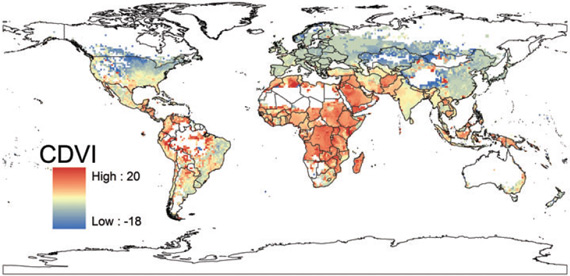
Figure 1: Global Climate Demography Vulnerability Index. Red corresponds to more vulnerable regions, blue to less vulnerable regions. White areas corresponds to regions with little or no population (Samson et al 2011).
Next, they created a map of national carbon dioxide emissions per capita. They found the countries most severely impacted by climate change contributed the least to greenhouse gas emissions. It is quite striking that blue, less-polluting regions in the CO2 emissions map correspond to the red, highly vulnerable areas in the vulnerability map.
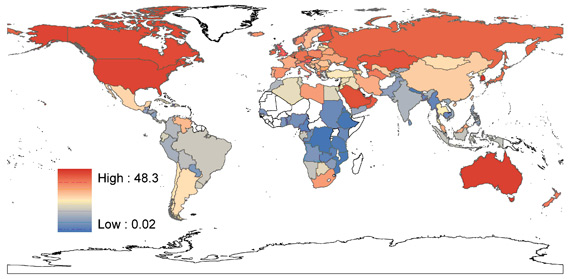
Figure 2: National average per capita CO2 emissions based on OECD/IEA 2006 national CO2 emissions (OECD/IEA, 2008) and UNPD 2006 national population size (UNPD, 2007).
The study didn't delve into the question of which countries are least able to adapt to the impacts of climate change. But it doesn't take a great leap of the imagination to surmise that the poor, developing countries that emit the least pollution are also those with the least amount of infrastructure to deal with climate impacts. So we are left with a double irony - the countries that contribute least to global warming are both the most impacted and the least able to adapt.
This research put into perspective those who try to delay climate action, arguing that "CO2 limits will hurt the poor". This argument is usually code for "rich, developed countries should be able to pollute as much as they like". This presents us with a moral hazard. If those who are emitting the most greenhouse gas are the least affected by direct global warming impacts, how shall we motivate them to change?
Basic rebuttal written by John Cook
Update August 2015:
Here is a related lecture-video from Denial101x - Making Sense of Climate Science Denial
Last updated on 5 August 2015 by MichaelK. View Archives







Ray, (replying from here) Your characteriztion of "western powers" seems seriously at odds with what I see. If you dont mitigate emissions, then the studies show climate change will affect the poorer countries much harder than the west. Kyoto didnt apply to undeveloped nations. Negotiation have focussed on reduction of emissions in west so poorer nations can grow and on the west (who are historically responsible for almost all of the extra GHG currently in atmosphere) funding ways for growth in these countries in ways that doesnt damage the climate. Can you interpret Doha in any other way??
For a look at historical emissions and what would be an equitable distribution, look at the opening of MacKay's "Sustainable energy without the hot air", specifically here.
One other thought from discussions with rabid libertarians that objected to any kind of international agreement on grounds that it was one set of nations interfering with liberty of another. The usual addendum to complete freedom of action is the assumption of full responsibility for the consequences of action. I have no problem with this. So if we scrapped any international negotiation, how happy would you be with apportioning the full costs of adaptation whereever they occur (since you cant keep you emissions within your boundaries) on the basis of accumulative emissions that caused the problem? That would include countries taking their share of refugees?
On that basis, USA, UK and Germany would bear the brute of adaptation costs. Since studies show adaptation more expensive than mitigation, I woiuld mitigate real fast to avoid the liability.
scaddenp. Have you actually looked at the takeup of the Doha meeting? The major polluters are noticable by their absence. US, Canada, China, India. 37 countries signed onto the Doha agreement. These countries are responsible for 15% of the global emissions. Not exactly a stunning result by our leaders in view of the stated seriousness of climate change. But what was the opinion of concerned groups?
Asad Rehman head of climate and energy at Friends of the Earth had this to say "A weak and dangerously ineffectual agreement is nothing but a polluters charter – it legitimises a do-nothing approach whilst creating a mirage that governments are acting in the interests of the planet and its people," "Doha was a disaster zone where poor developing countries were forced to capitulate to the interests of wealthy countries, effectively condemning their own citizens to the climate crisis. The blame for the disaster in Doha can be laid squarely at the foot of countries like the USA who have blocked and bullied those who are serious about tackling climate change. His sentiments encapsulate my own thinking
Kumi Naidoo, executive director of Greenpeace International accused delegate as being out of touch. He said " "We ask the negotiators in Doha: Which planet are you on? Clearly not the planet where people are dying from storms, floods and droughts. Nor the planet where renewable energy is growing rapidly and increasing constraints are being placed on the use of dirty fuels such as coal. The politicians and negotiators have lost touch with climate reality – sadly their failure will be paid for in lives and livelihoods,"
As is apparent these guys, who are a lot closer to the action than either of us, are a lot less enamoured of Doha than you seem to be.
Apologies Ray - your comment was clearly engendered by my comments are whether you were in the ideological camp or not. It is my response to you that would have been off topic and so I have brought it here.
Ray, the climate negotiations go nowhere because US in particular dont commit to reductions. Without that happening (and Europe) obviously no progress is made, but the intent of Doha is reductions by rich nations without restricting the growth of poorer nations. Not even the US denies this aim. And Kyoto clearly gives lie to your ascertain that idea that western powers are trying to restrict the growth of the poor. Rehman statement says that is it the failure by the west to reduce their emissions (and thus inflicting climate change on the poor) that is the problem.
However, I now I might have misread you. Your statement was "my political views are that I find it difficult to accept that the major western powers are trying to enforce, on countries which are much poorer than they are, actiions that will disadvantage the citizens of those countries in their efforts to attain the standards of living approaching those of the developed world."
By this I understood you mean that thought the west was trying to restict growth of emissions in the 3rd world (actions that will disadvantage), where as I realise that you might have meant that they are forced to accept inaction by the west and thus limited by climate change in trying to improve their standard of living. If this was your meaning, then I apologise.
If you agree that western powers need to drastically reduce emissions so that poor nations can grow without harming their climate, then we have no disagreement.
skept.fr @1 I share your objection. The fact that CO2 rise and the resulting global warming impacts will disproportionately harm the poor is clear, but that is not inconsistent with the the notion that emissions reductions/limitations/caps will disproportionately harm/burden the poor. So there is a very uncomfortable balancing of policy considerations to be done.
I understand that carbon budgets proposed for climate mitagation tend to be more generous for developing countries, as they ought to be from both an equity/fairness standpoint (atmospheric CO2 being for all intents and purposes cumulative, rich countries have already heaped on way more than our fair share to keep the total within acceptable limits), and a utilitarian standpoint (people in subsaharan Africa, for example, obviously stand to improve their lives a lot more by emitting a little more CO2 than we stand to be burdened by emitting a lot less CO2).
Obviously it wouldn't benefit the most disadvantaged for richer countries to continue BAU, unless you buy into some kind of global trickle-down benefit that they will get from our marginally greater prosperity and thus greater charity/aid/whatever.
But it seems to me that the question remains to be addressed here whether mitigation of future harms from CO2 outweighs the benefits to today's poor of allowing them to rapidly industrialize by the cheapest means possible.
Above I say "there is a very uncomfortable balancing of policy considerations to be done."
By that I don't mean to imply that I think the right course is unclear, necessarily. If it's between slowing (not halting, mind you) the alleviation of the worst poverty in the world by only allowing/helping those regions to industrialize mostly if not exclusively through non-emitting energy sources like wind/solar/hydro/geothermal/yet-to-be-perfected fourth generation nuclear/current riskier nuclear, on the one hand, and on the other hand destroying the stability of the climate to the point where mass extinction is a near certainty and the very survival of humanity is in question, obviously it is a no-brainer - we should choose not to destroy the planet.
It would be even more of a no-brainer if alleviation of poverty can be done just as rapidly and effectively without fossil fuels (using all those other energy sources) as with fossil fuels, though I doubt that is the case.
So I guess my question is, how much agreement is there as to the so-called "tipping points" that would highly likely lead to mass extinction / survival of civilization being in question? To the extent that it is "speculative," does that even matter, considering we should err very much on the side of caution when the planet is at stake?
A dissenter/denier/contrarian/whatever friend of mine keeps bringing up the issue of forgoing fossil-fuel based industrialization being a lost opportunity to alleviate the world's worst poverty. (We generally have these discussions on my Facebook timeline.) He also brings up the whole gamut of meritless "scientific" arguments (solar activity, Milankovitch cycles, cosmic rays, nameless "natural cycles," platitudes about "uncertainty/complexity") as well as the usual conspiracy theories about AGW theory being a commie plot to bring down the west, etc., all of which made it hard for me to take his poverty argument seriously for a long time.
I'm not even sure that alleviation of poverty argument is a good argument against aggressive emissions reductions. It's just that I haven't been able to find any satisfying discussion of it on the web. This may be because the kind of analysis I would ideally like to see would probably take a lot of experts a long time to put together: I would like to see analysis of an emissions pathway that at least a majority of scientists would consider prudent (i.e., at a bare minimum avoiding any significant risk of a "Hell on Earth" scenario within the next X number of years - 100? 150?, such as requiring mass evacuations of coastal cities and low-lying island nations, etc.) in terms of what increase in power generation per capita can feasibly be distributed to the poorest regions of the world within the constraints of that emissions pathway by X date, what the difference is (if any) between that increase and the increase that would be feasible by X date in a free-for-all scenario with no emissions restrictions, and what that difference implies in terms of a sacrifice in quality of life (if any) that today's poor will have to make for the sake of avoiding climate catastrophe. I have no idea what that kind of analysis would entail, or whether it might take so long or depend on so many political unknowns (for example) that it wouldn't be worth doing, but I would like to see somebody take a stab at it.
Of course, there is another elephant in the room, which is that if our rate of consumption of global resources across the board already far exceeds Earth's ability to replenish them (see "Earth Overshoot Day," "Ecological Debt Day," which the Global Footprint Network says that we hit this year on August 20), then it's frightening to think what would happen if every country in the world had a population that consumed like America's or Europe's populations. This doesn't change the fact that some people live on appallingly little and consume far less than their fair share of resources, but it would be crazy to pursue policies aimed toward making sure that everybody in the world overconsumes to the same degree as I do in America. They have a right to scale up consumption, but not to our current level, and I have no right to remain at my current level of consumption. Reducing inequality is a noble goal, but if the Global Footprint Network is anywhere close to right, then reducing inequality will have to involve meeting somewhere in the middle or we are screwed.
I am just now noticing that the discussion of socioeconomic considerations of mitigation is a little more robust over at this thread:
http://www.skepticalscience.com/global-warming-too-hard.htm
"Those who contribute the least greenhouse gases will be most impacted by climate change."
This is what destroyed my enthusiasm for wind and solar energies in 2010. I attended a green jobs workshop in which a representative of Apollo Alliance made the above statement. When I asked him about that, he mentioned that the people contributing the least to climate change were also poor. I am not sure where Apollo Alliance found that guy.
Coolbreeze - I am having trouble understanding why statements that people contributing least to climate change were also poor would destroy your enthusiam for wind and solar?? Doesnt make sense. I think the statement is true - the countries with lowest emissions (especially lowest emission per capita) are also among the poorest.
@ scaddenp: Because , stating that people contributing the least to climate change are poor does not give low/no emission technology (wind and solar power) a reputation of economic prosperity.
I still dont follow. The people who need to install wind/solar are the rich countries. I'm not quite sure why you link low/no emission tech and economic prosperity. The two dont seem linked to me, except that if we dont move to a low/no emission power generation then the costs of adapting to climate change will do economic damage (and a great deal worse to poor countries). The poor contribute less to emissions, not because they use low emission technology, but because they use less energy.
Cool breeze - There is no contradiction, and I don't see why that statement should disillusion you.
The global poor contribute the least to AGW due to their low per capita energy use, and due to their thinner margins for agriculture, water, and the income with which to adapt, they will be the most impacted by climate change.
This connects to an inverted position really puzzles me - Roy Spencer, for example, has been going on about mitigation efforts harming the poor, when it's really the Business As Usual (BAU) approach that he promotes that will do the most damage to the poor he seemingly champions... He seems to live in a backwards Bizzaro world.
I see what you are saying, scaddenp and KR. But the following combination below is more likely to make me sing the praises of a fossil fuel burning economy and the lavish lifestyles it can support, rather than an economy based on wind and solar.
The lesson from this is to have money if you want to be insulated from climate change effects. In this country, the petroleum corporations have provided a good living for a lot of people. Meanwhile, the "green energy" lobby courts the government to build it up, using climate change as a motivator.
While wind and solar are viable sources of supplemental power, they just have not been the economic stimulator that petroleum has been in the U.S. The mountains of money generated by the petroleum industry still persuade much more strongly than the climate change talk of green energy companies, even after environmental costs have been weighed.
Coolbreeze - So in your opinion your own self-interest justifies you saying "screw you" to those who will suffer directly due to that self-interest and your actions? That seems the very definition of irresponsible.
Some notes:
I'll just note that solar (growing 50-60% compounded annually over the last five years) and wind (30% growth rate over last decade) are, contrary to your assertion, economic stimulators.
I am somewhat stunned by your approach. I am sure that you would object if someone setup next to you and made lots of money while dousing you and your family in toxic emissions. If you reject the idea of taking responsibility of harm caused to others by your actions, then I cannot see how you can expect your views to be respected.
By your logic, the world should still be mining and using asbestos. The US economy grew strong on homegrown or cheap imported oil but I would say the 7bbl/day imported now is certainly not helping the US economy.
I also dont your logic. People are not poor because they dont use much fossil fuel - they dont use much fossil fuel because they are poor. I would strongly agree that you having a strong economy is good but its doesnt follow that the energy to drive it has to come from fossil fuel.
" even after environmental costs have been weighed." So can you point us to a study which supports this (and contradicts all the other studies saying the opposite).
Coolbreeze @16:
1) You are assuming that those who will suffer more will suffer more because of their poverty. That is only partly correct. Even if they had the same wealth as us, however, they would still suffer more on average because, as it turns out, the geographical locations in which the rich people live who have caused nearly all of the problems just happen to be the the geographical locations in which the largest detrimental impacts will be felt (on average).
2) That wealth will buffer (not insulate) you from the effects of climate change does not mean you will not suffer from climate change. Put differently, that the poor will suffer more does not imply the rich will not suffer. In fact, if things turn out poorly it is possible that even the rich will suffer sufficiently that the global economy will collapse. At that point the rich, who depend most on that economy, will suffer most. That is not a likely outcome with BAU (<33%), but it is a sufficiently plausible outcome that it should be included in our planning with regard to further fossil fuel use.
3) If all people in the world used fossil fuels at the rate of the EU (let alone the USA), climate change would be almost gaurantteed to collapse the world economy and would be a plausible risk of driving the Earth to near universal extinction. As it is a basic principle of morality "to do unto others as we would have them do unto us", it becomes unethical to use fossil fuels into the future at rates which cannot be sustained globally. It is even more unethical given the balance of benefits and risks. Not only do we preclude the poor from becoming rich through fossil fuel use by our rate of consumption, but we actively harm them by that consumption.
4) There is a strong relationship between energy use and wealth in a society. Cheap fossil fuels have allowed western society to become wealthy to a level beyond the imagination of all prior ages. That fossil fuel use, however, is a short term thing, even without climate change. Fossil fuels are a limited resource. Therefore it is incumbent on us to use the huge wealth gained from fossil fuel use to establish a sustainable energy economy. If we fail to do so, we condemn near future (<300 years) generations to an energy economy not much greater than that durring the renaisance - a level unable to sustain the rate of scientific research and investment needed to switch to a sustainable high energy economy.
Because of global warming, the time to begin the sustained switch from a FF to a sustainable high energy economy was 25 years ago. Even ignoring global warming it will occure within 30 years. Sing the praises of fossil fuels as much as you like, but they were always (and at most) a scaffold to the future. Don't make the mistake of thinking the scaffold is the tower it is used to construct - and absolutely do not invest so heavilly in the scaffold that you are left unable to lay the foundation of the tower.
A lot of good input, Tom Curtis.
Scaddenp: You are correct that poverty would more likely cause low fossil fuel use, rather than the other way around. It is still not inspiring to me, however, for a representative of Apollo Alliance to state that those emitting the least suffer the most, and that they are poor too. It does not really sell people on good behavior.
And KR. I am aware, by the way, that solar and wind are growing markets, although they still don't drive the economy on the scale of petroleum.
When I watch the automobile traffic, I think of how petroleum is enabling soccer moms to quickly transport kids in three different directions in the afternoon. When I buy parts for my bicycle, I know that petroleum powered vehicles got those bike parts distributed efficiently to stores near me. And I see the comfortable life my brother and his wife provide for their kids from their petroleum company salaries.
In the future, more people may be drawing the big bucks from wind and solar too. That would be great. But the sales force for wind and solar should consider leaving out statements about those emitting the least getting the brunt of it.
And I notice, KR, that you mention my self interests and actions and throw in the word irresponsible. Careful! This forum is not about my actions or yours; you are unfamiliar with my life anyway.
Sorry - "It does not really sell people on good behavior." What is that supposed to mean? Low emitters that are likely to be disproportionately affected by climate change are subsidence farmers like on the great river deltas (Eg Ganges, Niger, Mekong etc). In what way is their behaviour bad and why is reducing your emissions so they dont suffer uninspiring to you? You seem to be implying that poor is immoral.
I am sure people got comfortable lives from their asbestos and tobacco shares too. Doesnt mean they should. Fortunately, Tesla and other are showing the way for you to continue energy-extravagant lifestyles without petroleum.
This topic is to some extent about your or my actions. The Myth is:
"Curbing emissions will hurt the poor". Hurting the poor is assumed to be morally bad; ergo curbing emssions is immoral. This argument only matters to be people whose actions are guided by morally.
The article points out the premise is false; not curbing emissions will hurt the poor more.
CoolBreeze @20, when they are trying to persuade others, people try to use the points that they think the others will find persuasive. Thus we can deduce from the Apollo Alliance's sales pitch that they think their customers will be motivated by basic notions of equity, and will consider a situation in which they are profiting at the expense of others (ie, by using fossil fuels, the greatest harms of which will afflict the poorest globally) undesirable. Apollo Alliance's sales team seem to assume that the knowledge of that unfair situation will motivate its customers to do what they can to reduce the unfairness of the situation, at least to the extent of buying their products. They are probably right about most of their potential customers, though certainly not all of them. I would be greatly saddened to learn that aspect of the sales pitch was counter-productive overall because it would indicate wide spread lack of concern with equity in their marketplace.
As I have provided clear reasons to not treat the fact that the globally poorest will suffer most from climate change as a reason to not reduce fossil fuel use, we are now only discussing whether or not mentioning the disproportionate impact of global warming on the poor is more or less likely to persuade people to modify their behaviour and reduce emissions. If we do not consider you as an example of people who would be dissuaded from reducing emissions (with the corrollary that you have limitted interest in basic fairness), then what we have is a discussion about whether you or Apollo Alliance have best gauged the motivations of your fellow citizens. As you present no evidence on the topic (unless you wish to present yourself as an anecdotal counter example), you have no case to argue. Possibly neither do Apollo Alliance, but companies tend to very carefully examine the effectiveness of their sales pitches so that their belief is at least likely to be empirically based.
I love Tesla roadsters; I saw one in Portland. I would have paid into the waiting list for one a few years back, if only I had the clams to do it.
F.Y.I.: I didn't say that the behavior of subsidence farmers was bad. I did mention good behavior, in reference to a low emission lifestyle.
Being poor is not immoral, and I would not imply such a thing. But being wealthy is certainly advantageous, and I encourage wealth. I tell people that the way to help those vulnerable to climate change is to extend opportunity to the poor; wealth puts people in the position to do so.
We all know that there is an environmental impact to burning fossil fuels. But my concern about that is limited, particularly when people of high-impact lifestyles are making significant contributions back to humanity. One way people give back here in the state of Oregon is participating in habitat restorations. Another way is by helping the poor. Getting out of poverty makes people more resilient to climate change (an ongoing phenomenon which was occurring even before fossil fuels came about).
I will gladly continue pointing out how attached people are (in my nation of the U.S. at least) to the luxuries that fossil fuels bring.
Not what fossil fuel bring - but what energy brings and FF aren't the only way to do it.
I would applaud efforts to improve the environment, but an ounce of restoration does not offset a pound of damage. It might salve a conscience but is meaningless in the larger picture of future impacts.
Good for you if you can get Bangladeshi farmers out of poverty - where are they going to live? Frankly this is fine words with no meaningful action. Back your assertion with some actual studies. You will find plenty of more somber studies to the contrary in the IPCC AR2.