



 Arguments









Plants cannot live on CO2 alone
What the science says...
| Select a level... |
 Basic
Basic
|
 Advanced
| |||
|
More Carbon Dioxide in the atmosphere is not necessarily good for plants. |
|||||
Climate Myth...
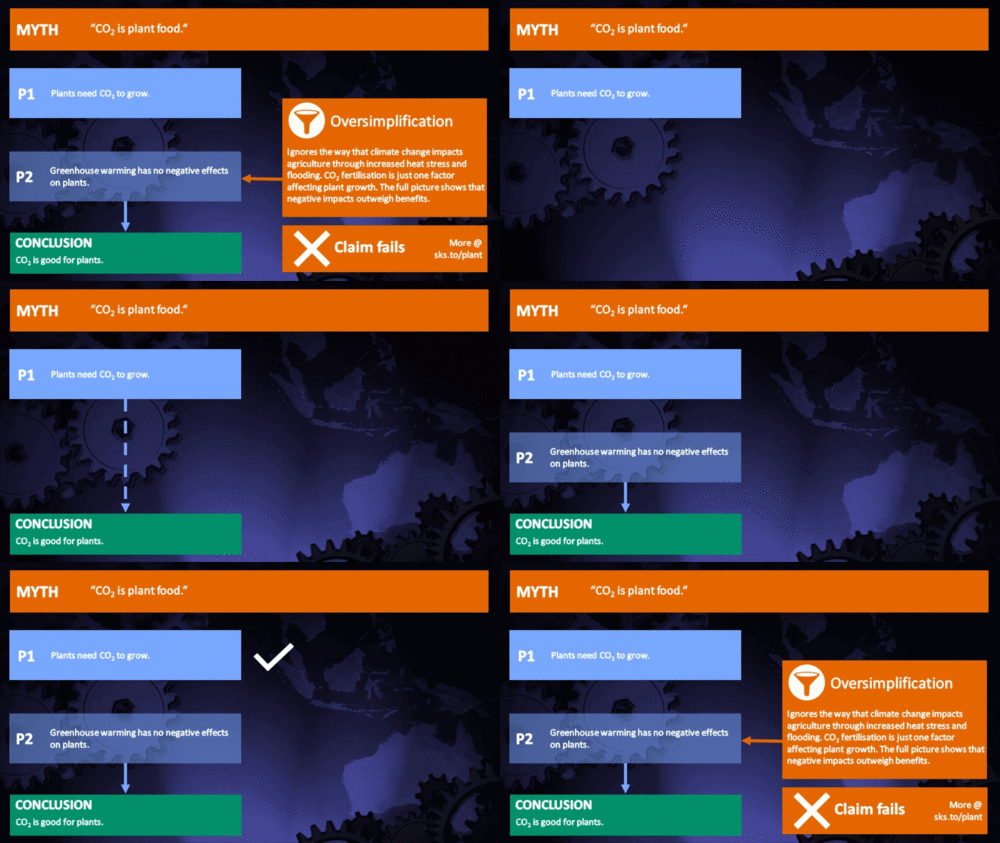
CO2 is plant food
Earth's current atmospheric CO2 concentration is almost 390 parts per million (ppm). Adding another 300 ppm of CO2 to the air has been shown by literally thousands of experiments to greatly increase the growth or biomass production of nearly all plants. This growth stimulation occurs because CO2 is one of the two raw materials (the other being water) that are required for photosynthesis. Hence, CO2 is actually the "food" that sustains essentially all plants on the face of the earth, as well as those in the sea. And the more CO2 they "eat" (absorb from the air or water), the bigger and better they grow. (source: Plants Need CO2)
At a glance
Have you ever tried growing vegetables in a container? If you are a newbie who wants to give it a try, you will quickly become familiar with the following point. With many species and varieties, it's a lot easier to grow them in a well-tended bed than in a bucket.
Most vegetables grow best in a bed of mature, nutrient rich soil that has had regular addition of compost over the years. The only things you need to do are watering them when it's dry and picking off the slugs. But in a bucket, even with a lot of compost from the garden centre, plants often struggle without the help of regular feeds of liquid additives to boost things along. Such feeds include various nitrogen compounds, phosphorus, potassium, iron, zinc and other essential trace-metals.
The purists among us prefer not to expend hard-earned cash on such feeds because they are expensive - defeating the whole object of grow-your-own which is to produce good vegetables cheaply. Managing that precious commodity, topsoil, so that it is productive year upon year is what we do instead. To be a successful gardener, looking after your soil is probably the most important skill to gain and apply.
But what about the person who thinks like the myth-provider in the box above? They seem to know about photosynthesis. Photosynthesis is the process by which plants extract carbon dioxide from the atmosphere and, using the energy received from sunlight, make it react with water in their cells. The products of that reaction are sugar and oxygen. Oxygen is released back to the atmosphere and the plants stash away the reserves of sugar within their stems, tubers or roots, depending on the species. But our myth-provider seems to think that because photosynthesis only requires CO2 and water, then high levels of both are all that's required for happy plants. How will their garden grow?
Well, basically they are going to find their attempt to grow vegetables immensely frustrating. Increasing the plants' CO2 supply alone and ignoring all the other essential compounds for plant health is a shortcut to unhealthy crops - if they produce any appreciable crop at all. That's the difference between being a good gardener and a hopeless one. The good gardener acts on the basis of the whole big picture, not just one part of it.
Please use this form to provide feedback about this new "At a glance" section. Read a more technical version below or dig deeper via the tabs above!
Further details
An argument made by those who prefer to see a bright side to climate change is that carbon dioxide (CO2) being released by the burning of fossil fuels is actually good for the environment. This conjecture is based on simple and appealing logic: if plants need CO2 for their growth, then more of it should be better. We should expect our crops to become more abundant and our flowers to grow taller and bloom brighter.
However, this "more is better" philosophy is not the way things work in the real world. There is an old saying, "Too much of a good thing can be a bad thing." For example, if a doctor tells you to take one pill of a certain medicine, it does not follow that taking four is likely to heal you four times faster or make you four times better. It's more likely to make you sick.
It is possible to boost growth of some plants with extra CO2, under controlled conditions, such as inside a greenhouse. Based on this, deniers make their claims of beneficial botanical effects in the world at large. Such claims fail to take into account something of critical importance. Increasing the availability of one substance that plants need is insufficient. All other nutrient supplies need to be adjusted correctly too, for benefits to occur. In addition, the claim fails to take into account that a warmer earth will see an increase in deserts and other arid lands, reducing the area available for crops.
Plants cannot live on CO2 alone. A complete, healthy plant metabolism depends on a number of major and trace elements. Just as increasing the amount of starch alone in a person's diet won't lead to a more robust and healthier person, for plants additional CO2 by itself cannot make up for deficiencies of other essentials.
What would be the effects of an increase of CO2 on agriculture and plant growth in general?
-
CO2 enhanced plants will also need extra water both to maintain their larger growth and to compensate for greater moisture evaporation from their tissues as the heat increases. Where will the water come from? In many places rainwater is not sufficient for current agriculture and the aquifers they rely on are running dry (Zwarteveen et al. 2021; overview of the global situation at Encyclopedia of Earth here.
On the other hand, precisely as predicted by climate research, we are experiencing more intense storms with increased rainfall rates throughout much of the world. One might think that this should be good for agriculture. But no: when rain falls in short, intense bursts it does not have time to soak into the ground. Instead, most of it quickly runs off into creeks, then rivers, and finally out into the ocean, often carrying away large amounts of soil and fertiliser in the process.
-
Unlike Nature, conventional agriculture does not self-fertilise soils by recycling all dead plants, animals and their waste. Instead we need to add artificial fertilisers to the soil all the time. Those chemicals are produced by energy-intensive processes mostly fed by hydrocarbons, especially natural gas. Increasing the need for such fertilisers competes for supplies of natural gas, creating friction between other needs and the manufacture of fertilisers. This will ultimately drive up the price of food.
-
Although the situation is complex and varies from one plant-group to another, too high a concentration of CO2 may cause a reduction of photosynthesis (Long et al. 2004). There is also evidence from the geological past of major damage to a wide variety of plant species from a sudden rise in CO2 (Currano et al. 2008; Delucia et al. 2008; Fig. 1). Higher concentrations of CO2 also reduce the nutritional quality of some staples, such as wheat (Bloom et al. 2010).

Figure 1: Fossil leaf damage from the early Eocene series, around 55 million years ago. At that time, Earth experienced a rapid jump in global CO2 levels that raised temperatures across the planet. Now, researchers studying plants from that time have found evidence that the rising temperatures boosted the foraging activity of insects. As modern temperatures continue to rise, it is considered likely that the planet will see increasing crop damage and forest devastation. Source: Science Daily; Feb. 15, 2008 and Currano et al. 2008).
-
The worse problem by far is that increasing CO2 will raise temperatures. This will make the world's arid climatic zones shift towards the poles. However, soil conditions at higher latitudes will not necessarily support productive agriculture. Extensive and intensive management will be required. Long-term research has also looked at how plants respond to a high-CO2 environment. While some plants exhibit a brief and promising burst of growth, other effects such as the "nitrogen plateau" soon truncate this benefit.
-
Plants raised with enhanced CO2 supplies and strictly isolated from insects behave differently than if the same approach is tried in an otherwise natural setting. For example, when the growth of soybeans is boosted out in the open, this creates changes in plant chemistry that makes these specimens more vulnerable to insects, as Fig. 2 shows.
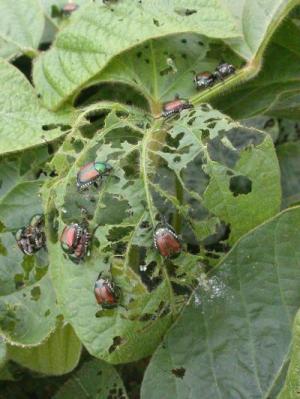
Figure 2: Plant defences go down as carbon dioxide levels go up. Soybeans grown at elevated CO2 levels attract many more adult Japanese beetles than plants grown at current atmospheric carbon dioxide levels. Science Daily; March 25, 2008 and Delucia et al 2008. (Credit: Photo courtesy of Evan Delucia)
In conclusion, even assuming there are any positive impacts on agriculture in the short term, such impacts are highly likely to be overwhelmed by the negative impacts of climate change. Added CO2 will likely shrink the geographical range available to plants while increasing the size of deserts. It will also increase the requirements for water and soil fertility, both things already coming under pressure. It will increase plant damage from insects. Increasing CO2 levels would therefore only be beneficial within highly controlled spaces with other nutrient requirements adjusted accordingly.
Last updated on 24 December 2023 by John Mason. View Archives








There is a refreshingly excellent article on Mongabay.com, quoting scientists who specialize in tropical forests, countering a recent study's disinterpretation as meaning that CO2 rise will result in more tropical rainforests.
Given the information presented in the following article, an update of this rebuttal may be in order.
Climate change making food crops less nutritious, research finds
High
CO2 levels significantly reduces essential nutrients in wheat, rice, maize and soybeans, Nature paper reveals
Damian Carrington, The Guardian, May 7, 2014
Hey guys, CO2 is not plant food. It is a reactant along with water for photosynthesis. The food of plants, as well as everything other living organism, is glucose which it makes itself through photosynthesis. More CO2 in the atmosphere would increase photosynthesis, however a plant only gives off oxygen during the light dependent reactions. It uses oxygen during cellular respiration 24 hours per day. Therefore, the increase in oxygen in the atmosphere from an increase in CO2 would be more than offset by the increase in the consumption of oxygen when a plant undergoes cellular respiration which happens 24 hours a day.