



 Arguments







Crux of a Core, Part 1b
Posted on 3 March 2011 by Rob Honeycutt
Crux of a Core, part 1b: J Storrs Hall on WUWT
I would like to thank Dr Hall for taking the time to post a response at WUWT to my article, Crux of a Core part 1. But I need to take the time to point out some errors. Thanks go out to the WUWT readers who also pointed out these errors in the comments section.
In my original article I made a point to steer clear of any ad hominem remarks, an act that was not reciprocated in Dr Hall's response. Any perceived intent to cast him as a lesser scientist than Dr Alley was unintentional. That said, I do need to point out that Dr Alley has authored over 170 published papers related to the cryosphere and climate change. He is, undoubtedly, one of the most eminent authorities on paleoclimate, so I find him a useful resource. But, again, any attempt to cast Dr Hall in a lesser light in my original article was not intentional.
Point 1) Al Gore uses single ice core records too
Dr Hall posts a photo from Al Gore's film An Inconvenient Truth and says that other people also use single ice core records as a proxy for global temperature.
As we are all aware, Al Gore is not a scientist. I never referenced Al Gore. And Al Gore is presenting the relationship between CO2 and temperature over the past 800,000 years, which would be an appropriate use of an Antarctic ice core record. He is not specifically presenting it as a global temperature proxy except in the broadest sense.
Point 2) Quotes from abstracts of papers by GISP2 authors
Hall provides a range of quotes from various abstracts on papers related to GISP2 stating that GISP2 is a record of climate.
Hall opens his response saying first that my most substantive point was that GISP2 was a local record, but here he flip-flops into referencing GISP2 as a climate record. In none of my remarks did I ever question that GISP2 was not a robust record of climate. I merely point out that it is not a global temperature proxy.
Point 3) Comparison between Vostok and GISP2 data
Hall presents his own diagram of the Vostok, GISP2, and NGRIP records superimposed on each other, claiming they correlate with each other.
This is a real zinger. First, Dr Hall has completely altered the data. The temperature scale is only for GISP2, but he rescales the other temperature records to try to over-fit the graphs in order to show correlation. This is a epic no-no. If Hansen had so randomly rescaled a data series, the folks at WUWT would, rightfully, have a field day.
In clear fact, these records only correlate at a very coarse level. Glacial-interglacial cycles for GISP2 range nearly 20°C while Vostok range only about 7–8°C. As pointed out by one reader, many of the individual events are actually anti-phased between the two poles (D-O events). But, glacial-interglacial cycles tell us very little about temperature changes during the Holocene. In the Holocene you still need to identify similar anti-phasing, called Bonds events. More about this in Crux of a Core, Part 2.
Additional Error: Incorrect dating of the original chart
I passed on this mistake in my original piece but I think it is appropriate to point out now.
In the original post that came out on WUWT, Dr Hall makes a serious error dating the end of the graph. The GISP2 data ends at "0.095 thousand years BP (before present)." Hall erroneously makes the assumption that this means 1905, likely based on the publication date of Alley 2000. In truth, BP is dated to the standard 1950 used for radiometric dating, thus the graph actually ends in 1855. The "hockey stick" in Dr Hall's graph (yes, he does actually call it a "hockey stick") is completely preindustrial.
So, just what is the current temperature of the Greenland summit?
Dr Hall alludes in his original article that the "temperature continues up another half a degree during the 20th century." But Greenland is not the world! This is made quite obvious by the mere fact that, unlike in Greenland, the whole world is not on average -20°C.
According to research from Dr Jason Box the current temperatures at the Greenland summit are more than 2°C higher than the late 1800's. This places the current temperature at the summit nearly as high as most of the peak high temperatures seen during the Holocene, and nearly the warmest seen in the entire GISP2 50,000 year temperature record. Since Greenland is Greenland, this is the appropriate temperature comparison.
Is current warming unprecedented?
Dr Hall's closing statement is "The 20th-century warming was hardly unprecedented, and doesn’t call for unusual explanations."
This statement is completely unsupportable by the evidence Dr Hall is presenting. It would require that he perform a much more detailed study of a wide range of records to make such a statement. It is impossible to determine this from GISP2 alone.
As pointed out in my article, Miller et al 2010 section 12.2 states that, looking at a wide range of proxies, the past 6000 years have shown a gradual "neo-glaciation." So, yes, we absolutely need explanations for why we find such a sharp reversal of this trend in global temperatures.
Furthermore, it is completely misguided to attempt to use paleoclimate data to suggest that current warming is not anthropogenic. We don't believe warming is anthropogenic because it's "unprecedented", we believe it's anthropogenic because of well-established physics (see: How We Know Recent Warming is not Natural).
There are reasons that we look to the top experts in various fields. They are the people who have a deep understanding of the areas of science on which they are commenting. I am quite confident that Dr Hall commands great respect in his own field. I would never presume to denigrate Dr Hall on matters of nanotechnology, AI or microprocessor design. But with all due respect, expertise in one field does not make one an expert in all fields of science. This is made abundantly clear in Dr Hall's original article, as well as his rebuttal.


 0
0  0
0 Arctic Warming Overtakes 2000 Years of Natural Cooling
At least for the last 2000 years and averaged over broader Arctic region, recent warming is very much unprecedented, and as we know, this conclusion can be extended to northern hemisphere average with fairly high confidence.
Arctic Warming Overtakes 2000 Years of Natural Cooling
At least for the last 2000 years and averaged over broader Arctic region, recent warming is very much unprecedented, and as we know, this conclusion can be extended to northern hemisphere average with fairly high confidence.

 This focuses on the last 400 thousand years. The top image is from Antarctica (Dome C), while the bottom is a detail of the above drill data. The blue line is the calculated temperature based on known forcings with a climate sensitivity of 3.
 Focusing still closer, we have the and of the last Glacial, and the Holocene. On the left had side, blue is Vostok, Green is Dome C, and red a closer detail of the deep sea data. On the right, the three lines represent three different ocean basins.
 In the second two graphs, ice core data is scaled by multiplying by 0.5, and deep sea cores by multiplying by 1.5. This is justified, in part in that the ocean depths do not exhibit as much temperature variation as the surface, and the poles exhibit more than the tropics, and hence the global average. Of course, you may wish to argue that the antarctic data should not be scaled so drastically. Just remember that you will need to scale the climate sensitivity with the antarctic data. Thus if you insist the Antarctic data is representative of global temperatures without need to scale, then you are committing yourself to a climate sensitivity of 6.
All graphs come originally from Hansen and Sato 2011.
In the second two graphs, ice core data is scaled by multiplying by 0.5, and deep sea cores by multiplying by 1.5. This is justified, in part in that the ocean depths do not exhibit as much temperature variation as the surface, and the poles exhibit more than the tropics, and hence the global average. Of course, you may wish to argue that the antarctic data should not be scaled so drastically. Just remember that you will need to scale the climate sensitivity with the antarctic data. Thus if you insist the Antarctic data is representative of global temperatures without need to scale, then you are committing yourself to a climate sensitivity of 6.
All graphs come originally from Hansen and Sato 2011.
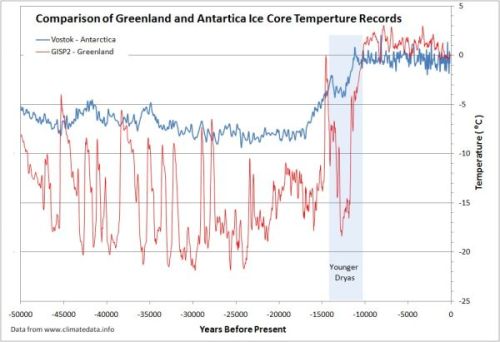 You can see how there is a very broad correlation between the two but for the most part only in terms of timing for when we come out of the last glacial. The temperature swings in the GSIP2 record are extreme compared with the Vostok record. By stretching the Vostok record to fit the GISP2 scale Dr Hall is hiding a tremendous amount of information about how these two records relate to each other.
If you look closely at the early holocene you can see that one huge jump in the GISP2 data is clearly antiphased with an equally profound response in the Vostok record.
So, the one event in the GISP2 record that shows a greater temperature trend that the current warming has a counter response in Antarctica. I'm still looking into Bond events, but I believe that is specifically called Bond event 5 at 8200 years BP.
You can see how there is a very broad correlation between the two but for the most part only in terms of timing for when we come out of the last glacial. The temperature swings in the GSIP2 record are extreme compared with the Vostok record. By stretching the Vostok record to fit the GISP2 scale Dr Hall is hiding a tremendous amount of information about how these two records relate to each other.
If you look closely at the early holocene you can see that one huge jump in the GISP2 data is clearly antiphased with an equally profound response in the Vostok record.
So, the one event in the GISP2 record that shows a greater temperature trend that the current warming has a counter response in Antarctica. I'm still looking into Bond events, but I believe that is specifically called Bond event 5 at 8200 years BP.
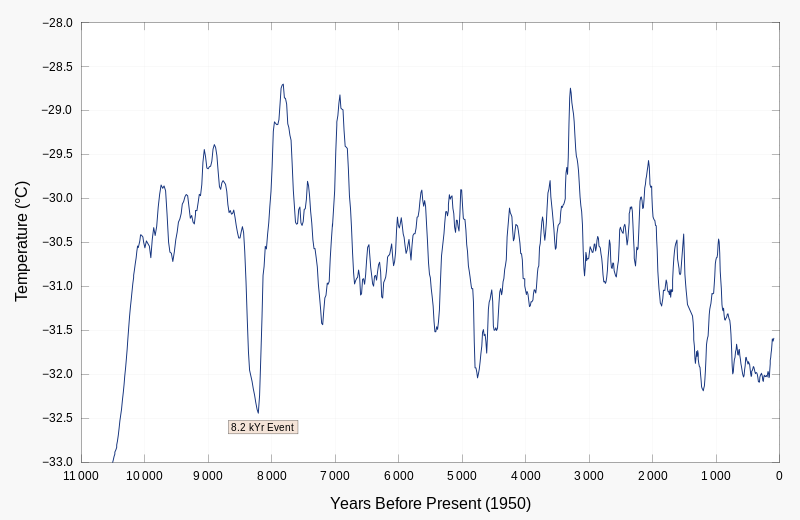
 And for completeness, ice cores over the Holocene for a Greenland, a Northern Chinese (Northern Hemisphere), two Andian (Tropcical), and two Antarctic (Southern Hemisphere)to give some idea as to the extent of regional variability involved:








Comments