



 Arguments









The albedo effect and global warming
What the science says...
| Select a level... |
 Basic
Basic
|
 Intermediate
| |||
|
The long term trend from albedo is of cooling. Recent satellite measurements of albedo show little to no trend. |
|||||
It's albedo
"Earth’s Albedo has risen in the past few years, and by doing reconstructions of the past albedo, it appears that there was a significant reduction in Earth’s albedo leading up to a lull in 1997. The most interesting thing here is that the albedo forcings, in watts/sq meter seem to be fairly large. Larger than that of all manmade greenhouse gases combined." (Anthony Watts)
At a glance
What is albedo? It is an expression of how much sunshine is reflected by a surface. The word stems from the Latin for 'whiteness'. Albedo is expressed on a scale from 0 to 1, zero being a surface that absorbs everything and 1 being a surface that reflects everything. Most everyday surfaces lie somewhere in between.
An easy way to think about albedo is the difference between wearing a white or a black shirt on a cloudless summer's day. The white shirt makes you feel more comfortable, whereas in the black one you'll cook. That difference is because paler surfaces reflect more sunshine whereas darker ones absorb a lot of it, heating you up.
Solar energy reaching the top of our atmosphere hardly varies at all. How that energy interacts with the planet, though, does vary. This is because the reflectivity of surfaces can change.
Arctic sea-ice provides an example of albedo-change. A late spring snowstorm covers the ice with a sparkly carpet of new snow. That pristine snow can reflect up to 90% of inbound sunshine. But during the summer it warms up and the new snow melts away. The remaining sea-ice has a tired, mucky look to it and can only reflect some 50% of incoming sunshine. It absorbs the rest and that absorbed energy helps the sea-ice to melt even more. If it melts totally, you are left with the dark surface of the ocean. That can only reflect around 6% of the incoming sunshine.
That example shows that albedo-change is not a forcing. That's the first big mistake in this myth. Instead it is a very good example of a climate feedback process. It is occurring in response to an external climate forcing - the increased greenhouse effect caused by our carbon emissions. Due to that forcing, the Arctic is warming quickly and snow/ice coverage shows a long-term decrease. Less reflective surfaces become uncovered, leading to more absorption of sunshine and more energy goes into the system. It's a self-reinforcing process.
If you look at satellite images of the planet, you will notice the clouds in weather-systems appear bright. Cloud-tops have a high albedo but it varies depending on the type of cloud. Wispy high clouds do not reflect as much incoming sunshine as do dense low-level cloud-decks.
Since the early 2000s we have been able to measure the amount of energy reflected back to space through sophisticated instruments aboard satellites. Recently published data (2021) indicate planetary albedo, although highly variable, is showing an overall slow decrease. The main cause is thought to be warming of parts of the Pacific Ocean leading to less coverage of those reflective low-level cloud-decks, but it's early days yet.
Albedo is an important cog in the climate gearbox. It appears to be in a long-term slow decline but varies a lot over shorter periods. That 'noise' makes it unscientific to cite shorter observation-periods. Conclusive climatological trend-statements are generally based on at least 30 years of observations, not the last half-decade.
Please use this form to provide feedback about this new "At a glance" section. Read a more technical version below or dig deeper via the tabs above!
Further details
"Clouds are very pesky for climate scientists..."
Karen M. Shell, Associate Professor, College of Earth, Ocean and Atmospheric Sciences, Oregon State University, writing about cloud feedback for RealClimate.
Earth's albedo is the fraction of shortwave solar radiation that the planet reflects back out to space. It is one of three key factors that determine Earth's climate, alongside the evolution of both solar irradiance and the greenhouse effect. Back in the 1990's, the evolution of Earth's albedo was by far the least understood of the three key factors. To address that uncertainty, it was proposed to measure Earth's albedo continuously over at least one full solar cycle. The long data series thereby obtained also helped scientists to explore potential correlations between varying solar activity and albedo change.
Thus was born the Earthshine project. It began in the Big Bear Solar Observatory (BBSO) in California in the mid-1990's. Measuring Earth's albedo was done by making observations of the illumination of the dark side of the Moon at night by light reflected off the dayside Earth. This method was pioneered in 1928 by French astronomer Andre-Louis Danjon (1890-1967).
Trial Earthshine observations were made in 1994–1995 and regular, sustained data-collection commenced in 1998. Data-collection continued until the end of 2017, representing some 1,500 nights spread over two decades.
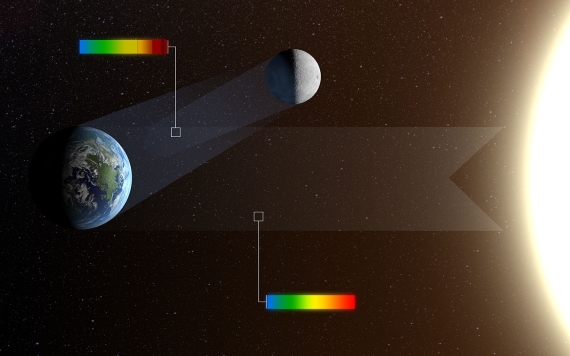
Fig. 1: When the Moon appears as a thin crescent in the twilight skies of Earth it is often possible to see that the rest of the disc is also faintly glowing. This phenomenon is called earthshine. It is due to sunlight reflecting off the Earth and illuminating the lunar surface. After reflection from Earth the colours in the light, shown as a rainbow in this picture, are significantly changed. By observing earthshine astronomers can study the properties of light reflected from Earth as if it were an exoplanet and search for signs of life. The reflected light is also strongly polarised and studying the polarisation as well as the intensity at different colours allows for much more sensitive tests for the presence of life. Image and caption credit: ESO/L. Calçada.
In 2005, a new automated telescope was installed in a small, dedicated dome at the BBSO. The two telescopes, new and old, were then run together from September 2006 through to January 2007, for calibration purposes. Observations made with the more accurate automated telescope were then made through to the end of 2017.
Since the early 2000s, scientists have also been measuring planetary albedo with a series of satellite-based sensors known as Clouds and the Earth’s Radiant Energy System, or CERES. These instruments employ scanning radiometers in order to measure both the shortwave solar energy reflected by the planet - albedo in other words – and the longwave thermal energy emitted by it. The overall aim is to monitor Earth's ongoing energy imbalance caused by our copious greenhouse gas emissions.
The Earthshine project and the CERES satellite-based measurements (2001-present day) both record great variation in albedo. That is as might be expected, because cloudiness is such an important albedo-controlling factor and varies so much. However, a slightly decreasing trend was detected (fig. 1, Goode et al. 2021).
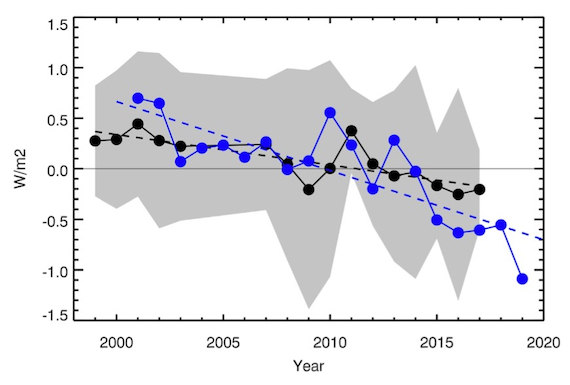
Figure 2: Earthshine annual mean albedo anomalies 1998–2017 expressed as reflected flux in Wm. The error bars are shown as a shaded grey area and the dashed black line shows a linear fit to the Earthshine annual reflected energy flux anomalies. The CERES annual albedo anomalies 2001–2019, also expressed in Wm, are shown in blue. A linear fit to the CERES data (2001–2019) is shown with a blue dashed line. Average error bars for CERES measurements are of the order of 0.2 Wm/2. From Goode et al. 2021.
The data cover two solar maxima, in 2002 and 2014, plus a solar minimum in 2009. Recorded variations in albedo show no correlation with the 11-year solar cycle, the cosmic ray flux or any other solar activity indices. Therefore, the data do not support any argument for detectable effects of solar activity on the Earth's albedo over the past two decades.
In comparison with the CERES data, both show a downturn in recent years, even though they cover slightly different parts of the Earth (Goode et al. 2021 and references therein). To put some numbers on things, in the earthshine data the albedo has decreased by about 0.5 Wm, while for CERES data, 2001–2017, the decrease is about 1.5 Wm. CERES data shows the sharp downturn to have begun in 2015.
The explanation put forward for the difference in albedo decrease between Earthshine and CERES has been further investigated and calibration-drift, a known issue with satellites, has been discounted. Instead, a recent and appreciable increase in sea surface temperatures off the west coasts of North and South America has been cited. The increase has led to reduced overlying low level cloud-deck cover. That would certainly cause significant albedo-decrease. The sea surface warming is attributed to a flip in the Pacific Decadal Oscillation (PDO), beginning in 2014 and peaking during the 2015–2017 period. It began to decline before the end of the decade.
However, a lot of this is very new, as pointed out by Gavin Schmidt at Realclimate in 2022. The role played by, for example, aerosols is not quantified in any great detail yet. But qualitatively, these developments demonstrate how impacts to the long-wave radiation combined with cloud feedbacks can lead to big shifts in short-wave reflectivity. Needless to say, this complex area is the firm focus of much ongoing investigation and will be for the foreseeable future.
Last updated on 3 March 2024 by John Mason. View Archives





Climate Myth...