





Latest summary confirms death of Chacaltaya glacier, and acceleration of global glacier shrinkage in the 2000s
Posted on 17 December 2011 by MarkR
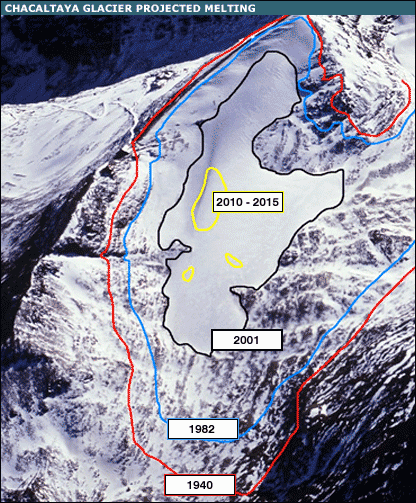
Figure 1 - Map of Chacaltaya glacier, past changes and future expected changes from a 2007 BBC article. The glacier was expected to last until around 2015, but the last of it melted in 2009.
In 2009 some news outlets reported that Bolivia’s 18,000 year old Chacaltaya glacier ‘bit the dust’ 6 years ahead of projections.That finding has now been confirmed by the World Glacier Monitoring Service (WGMS) in its recently released Glacier Mass Balance Bulletin 08/09.
In some places warming leads to more snowfall because warmer air holds more moisture, but as a rule glaciers should shrink as the climate warms. Whilst Chacaltaya might make a spectacular poster child for global warming, one glacier is not a strong piece of evidence for or against global warming. We must look at global patterns, and this is what the WGMS does.
Because of the volume of data and the time needed to analyze it, the just released bulletin covers the 2008-2009 time period.
The Glacier Mass Balance Bulletin reports on the state of glaciers regularly visited and measured by scientists. Satellites and aircraft measure thousands of glaciers worldwide but to make sure we can trust these measurements, and to get more detail, there’s no substitute for boots on the ground.
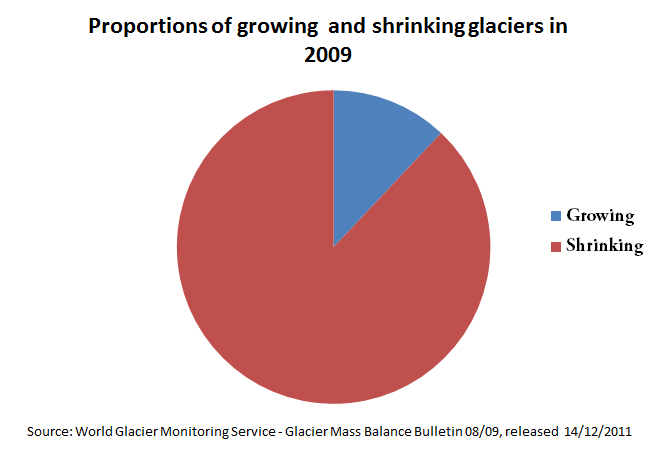
Measurements of 136 glaciers from Antarctica to Canada and from Bolivia to Japan feature in this edition, although N America and Europe are best represented. Almost 90% are shrinking.
A group of 37 reference glaciers which have been measured continuously for decades were used to provide some statistics. On average, glaciers lost around 60 cm (~ 2 feet) of thickness in each of 2008 and 2009, close to the average for this decade but faster than the '90s, and much faster than the '80s.
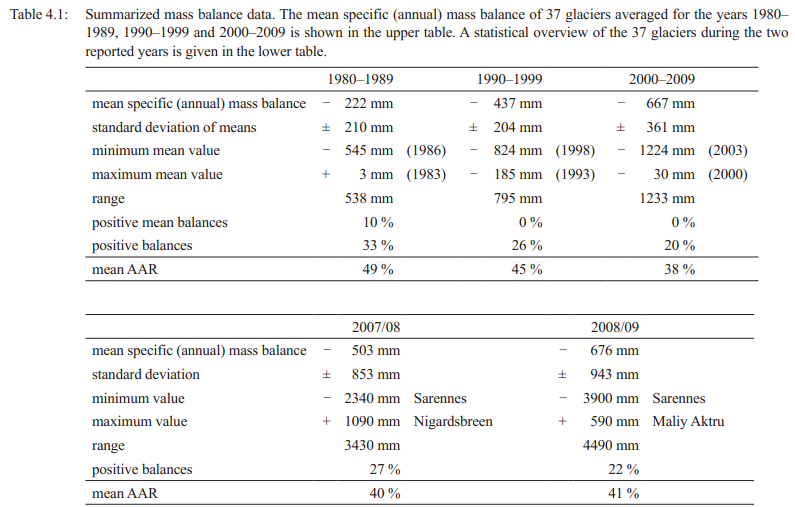
The table shows these statistics; where the 'mass balance' is reported in 'mm of water equivalent' change per year. This is the depth of water that would be left if the ice melted and wasn't allowed to drain away: 222 mm of water equivalent is about 24 cm or 9 inches of ice.
The world's glaciers are, on average, continuing to lose weight, and are doing it more quickly than previous decades. They're certainly convinced that warming is happening.
Note: this post has been used to update the rebuttals to Glaciers are growing

Arguments


The "flow-on" effect (forgive the pun) of glacier retreat whilst not particularly on the topic is an interesting one. I guess it is where science will inform policy.
I'm aware that one of the howling points raised by the doubters has been the IPCC's assessment of numbers of people who could be affected by loss of melt water from glaciers.
There is a recent paper:
Contribution potential of glaciers to water availability in different climate regimes
that attempts to correlate dependence on melt water with population density:
"Although reliable figures are often missing, considerable detrimental changes due to shrinking glaciers are universally expected for water availability in river systems under the influence of ongoing global climate change. We estimate the contribution potential of seasonally delayed glacier melt water to total water availability in large river systems. We find that the seasonally delayed glacier contribution is largest where rivers enter seasonally arid regions and negligible in the lowlands of river basins governed by monsoon climates. By comparing monthly glacier melt contributions with population densities in different altitude bands within each river basin, we demonstrate that strong human dependence on glacier melt is not collocated with highest population densities in most basins."
This sort of study will hopefully help the IPCC sharpen its pencil in this area.
Last time I was in Chile, the issue of reducing glacial run off from the Andes was becoming very important for agriculture as it accounts for most of the irrigation required on the coastal plain to the west. I would guess it has similar effects to the east where glaciers feed the headwaters of some of South America's major rivers. A good summary here.
"Although reliable figures are often missing, considerable detrimental changes due to shrinking glaciers are universally expected for water availability in river systems under the influence of ongoing global climate change. We estimate the contribution potential of seasonally delayed glacier melt water to total water availability in large river systems. We find that the seasonally delayed glacier contribution is largest where rivers enter seasonally arid regions and negligible in the lowlands of river basins governed by monsoon climates. By comparing monthly glacier melt contributions with population densities in different altitude bands within each river basin, we demonstrate that strong human dependence on glacier melt is not collocated with highest population densities in most basins."
Most needs to be defined, but that says that most people don't rely on glacier melt water.
And where it does if it does, it all boils down the difference in melt rate between ice and snow.
It's worth pointing out that in the area I mentioned at #3 -- the coastal region between the foot of the Andes and the Pacific, which is over 2,000 miles long and ~100 miles wide (and the reason Chile is called 'El Spaghetti' by the locals) -- meltwater from the Andes is vital for agriculture in the warmer central and northern areas. Without this water the area would suffer major drought, as in some places the annual rainfall is only 120mm.
The rivers flowing off the Andes are dammed and the meltwater is fed through a series of reservoirs, canals and channels to irrigate the entire plain. Though the plain is not densely populated in places, the food grown there is vital both for feeding the population in the cities and for growing produce for export.
The reduction in the size of glaciers is greatly concerning the South American countries that rely on this source of water.
In other words, taking ground water and evaporation into account, the water available to be dammed up and fed through the various reservoirs, canals & channels for irrigation is the sum of total precipitation in the watershed plus or minus the glacier melt or ice build-up.
Countries that rely on water from watersheds that contain glaciers as a source will enjoy more water than supplied by precipitation as long as the glaciers continue to melt. They can't continue to melt forever, the recession will either stop or the glaciers will disappear, either way the volume of water currently available will decrease.
An aspect that isn't made clear here is that if the retreats are due to reduced snowfall ...
The IPCC tells us:
For a future warmer climate ... Globally averaged mean water vapour, evaporation and precipitation are projected to increase.
Note the use of the word future in your IPCC quote. Note also the words globally averaged mean water vapour. Clearly glaciers are not a global mean occurrence.
Yes, but -- as Kiwiiano writes -- what farmers need is steady flow in rivers throughout the year -- not seasonal floods and droughts.
...what farmers need is steady flow in rivers throughout the year -- not seasonal floods and droughts.
This discussion if allowed to proceed will wind up comparing the difference in melt rates between snow and ice.
Yes, that's true. Total precipitation is expected to increase. But as temperatures rise, regions currently near 0C will go above 0C, so see less snow.
Also, the Hadley cells are expected to expand, meaning an extension of the try zones above and below the equator. So it depends on where you are!
If you read the first link I provided in #3 you will see a photo of the mountainside with the Chacaltaya glacier and snow almost completely gone. There's then this unequivocal quote...
“Here you have precipitation only part of the year,” said French glaciologist Patrick Ginot as he stood at 16,500 feet next to Zongo glacier last year. “But it’s stored on the glacier and then melting throughout the year, and so you have water throughout the year. If you lose the glacier, you have no more storage.”
The critical factor in the demise of Chac' was cloud cover reduction since about 1980. No cloud means no snow replacement during the short snow season but crucially it means no shade from the intense tropical sunlight which, at that altitude drives very rapid sublimation of ice to water vapour. Sunlight warming peripheral rocks of the glacier would also have caused more melting than in earlier times.
There isn't a weather station in the Chac' valley but near-by monitoring stations showed only margin warming and certainly not enough to melt ice significantly.
One has to be careful to read widely and take into account all the variables and even then it is hard to draw solid conclusions.
Sorry I've lost the link to this information now but it was from Bolivia,-The Monday Morning Newsletter or something like that and mostly written in Spanish.





