



 Arguments









Is Mars warming?
What the science says...
| Select a level... |
 Basic
Basic
|
 Intermediate
| |||
|
Mars is not warming globally. |
|||||
Mars is warming
"Some people think that our planet is suffering from a fever. Now scientists are telling us that Mars is experiencing its own planetary warming: Martian warming. It seems scientists have noticed recently that quite a few planets in our solar system seem to be heating up a bit, including Pluto.
At a glance
You really have to hand it to climate science deniers. In the one breath, they claim global warming on Earth is all down to poor/badly-sited weather-station coverage. Then in the next, they assert that Mars is warming. How many weather stations are there on Mars? In that sense, this claim serves to point out the absurd depths that climate science deniers plumb at times.
But in another sense, it offers the opportunity to explore why the climates of Earth and its neighbour differ so much. For, in times long past, Mars had an atmosphere and running water in abundance. Not any more. It is a cold, dry and - so far as we know - dead planet.
We know there was water there on Mars from the layered, river- or lake-deposited sedimentary rocks there, examined by robotic landers. What happened to it? The answer lies in the Red Planet's global magnetic field. It collapsed billions of years ago.
Why Earth still retains a strong global magnetic field but Mars does not is still the subject of much research. What we do know is that on our planet the spinning, liquid metal outer core acts as a powerful dynamo. Our thus-generated global magnetic field works as a vital planetary shield against the Solar wind and cosmic rays. In contrast, Mars has little such protection any more: long ago, once it lost that shield, the vast majority of its atmosphere was stripped away by those Solar winds.
No atmosphere, no greenhouse effect as such. Mars instead experiences extremes of heat and cold (from -153 to +20 C according to NASA) depending on what part of the planet is facing the Sun - and constant drought. Long lived, sometimes planet-wide dust-storms can occur when the dry ground becomes especially warm, even on a planet whose atmosphere has a density of just 1% of Earth's. Because of that very low density, atmospheric pressure on the Martian surface is a fraction of that on Earth and winds are much lighter, but combine a stiff breeze, plentiful dust and the fact that hot air rises (hence dust devils, observed by those robotic landers) and you have the mechanism for getting that dust up.
In turn, the dust blocks some sunlight from getting down to the surface, so here we have a temperature regulating mechanism. But even the biggest dust-storms - that can be viewed with telescopes here on Earth - end at some point. Mars therefore has no long-term temperature trend but its inhospitable climate nevertheless varies - but for completely different reasons than here on Earth.
Please use this form to provide feedback about this new "At a glance" section. Read a more technical version below or dig deeper via the tabs above!
Further details
The motive for making inaccurate claims about other planets also experiencing warming is not hard to imagine: it's yet another variant of the "it's the Sun" family of arguments. All members of this group of myths depend on Solar irradiance steadily going up and up through time. Yes that does happen, hence the Faint Young Sun paradox, but there we're talking about a trend only detectable over geological timescales, not centuries.
As fig. 1 shows, in fact from around the mid 1970s onwards, global temperatures have risen while total Solar irradiance has declined. So that puts the "it's the Sun" family of arguments straight to bed.
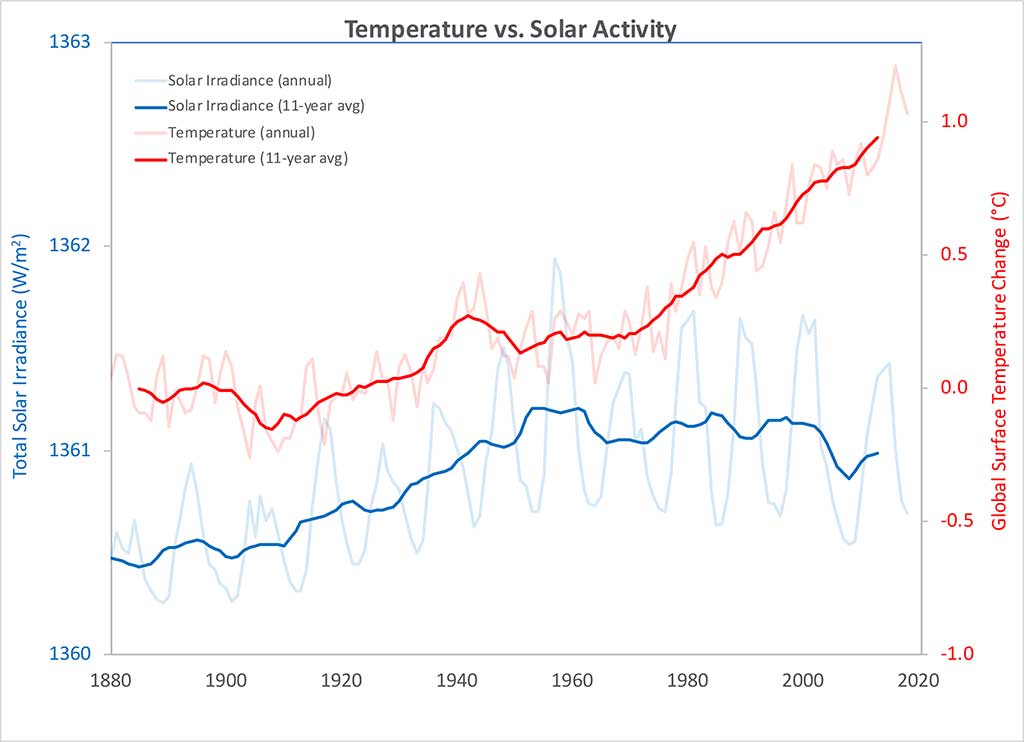
Figure 1: Annual global temperature change (thin light red) with 11 year moving average of temperature (thick dark red). Temperature from NASA GISS. Annual Total Solar Irradiance (thin light blue) with 11 year moving average of TSI (thick dark blue). TSI from 1880 to 1978 from Krivova et al. 2007. TSI from 1979 to 2015 from the World Radiation Center (see their PMOD index page for data updates). Plots of the most recent solar irradiance can be found at the Laboratory for Atmospheric and Space Physics LISIRD site.
With specific regard to Mars, it can readily be counter-argued that we know so little about Mars - compared to Earth - that we cannot yet talk about things like temperature trends. We just don't have the details, even though the orbiters and robotic landers are providing valuable and fascinating insights into some aspects of the Red Planet. Yet even this so far small amount of data can be misinterpreted, in terms of causal complexity and significance. And that's a funny thing about climate science denial. Its practitioners cast all sorts of aspersions regarding temperature measurements here on Earth, but in the case of Mars, all of a sudden their expectations are somewhat lowered, so this time they base their claims on limited spatial coverage and direct measurements taken over only a few decades.
There are, however, a few general points about the climate on Mars that are worth listing:
- Planets do not orbit the sun in perfect circles. Sometimes they are slightly closer to the sun, sometimes further away. This is called orbital eccentricity and it contributes far greater changes to Martian climate than to that of the Earth.That's because the Martian orbit varies in eccentricity by over five times more than the Earth.
- Mars has no oceans and only a very thin atmosphere, which means there is very little thermal inertia – the climate is much more susceptible to change caused by external influences. Because of that very thin atmosphere, the planetary greenhouse effect is also of negligible importance.
- The whole planet is subject to massive dust storms, and these have many causal effects on the planet’s climate, aspects of which we don't understand yet. However we do know that on Earth dust-clouds can reduce the sunlight (and therefore heat energy) reaching the surface.
- We have virtually no historical data about the climate of Mars prior to the 1970s, except for drawings (and latterly, photographs) that reveal changes in gross surface features (i.e. features that can be seen from Earth through telescopes). It is not possible to tell if current observations reveal frequent or infrequent events, trends or outliers.
The 'global warming on Mars' argument had at least some of its roots in a paper written by a NASA team, entitled, "Global warming and climate forcing by recent albedo changes on Mars" (Fenton et al. 2007). But this paper is about changes in Martian albedo - the property of light surfaces to reflect incoming sunlight, Variations in brightness of parts of the Martian surface have been recorded ever since we have had telescopes powerful enough to look at the planet in detail.
The study compared pictures of the Martian surface taken in 1977 by the Viking spacecraft to a 1999 image compiled by the Mars Global Surveyor. The pictures revealed that in 1977 the surface was brighter than in 1999, and from this Fenton et al used a general circulation model to investigate further.
Results indicated the presence of relatively enhanced wind stress in recently darkened areas and decreased wind stress in brightened areas. This produced a positive feedback system in which the albedo changes strengthen the winds that generate the changes. The simulations also predicted a net annual global warming of surface air temperatures by ∼0.65 K over that 22-year period (the abstract was a bit confusing on this point - see corrigendum here), enhancing dust lifting by increasing the likelihood of dust devil generation. The increase in global dust lifting by both wind stress and dust devils may, they thought, affect the mechanisms that trigger large dust storm initiation, a poorly understood phenomenon, unique to Mars. They suggested that documented albedo changes affect recent climate change and large-scale weather patterns on Mars, and thus albedo variations are a necessary component of future Martian atmospheric and climate studies.
Let me repeat part of the last but one sentence above: "unique to Mars". That's right there, in the abstract. Neither the Martian atmosphere, environment nor climate are remotely like anything on Earth. Yes, albedo-change is important on Earth but is a feedback driven by other forcings unrelated to Martian goings-on. Furthermore, a 22-year long study-period with two endpoints and nothing much in between is not robust in terms of a climatic trend.
Indeed in a recently published paper (Scariah et al. 2023), analysis of the seasonal variation of evening temperature over Gale Crater and its surroundings from Martian years MY 12 to MY 35 (equivalent Earth years 1976–2020) was carried out using data from different orbiter missions. The data showed variability (including significant drops in temperature during MY 26 and MY 32) but a trend? No.
To conclude: Mars' cold, arid climate is primarily driven in the long term by orbital eccentricity and in the short term by changes involving dust and albedo, not solar variations. In any case, we know the sun is not heating up the planets in our solar system because we can accurately measure the sun’s output, both here on Earth and in nearby space.
Last updated on 29 October 2023 by John Mason. View Archives








Climate Myth...