



 Arguments







Hurricane Sandy and the Climate Connection
Posted on 1 November 2012 by dana1981
Hurricane Sandy was an unprecedented storm in modern times, arriving late in the hurricane season, making landfall abnormally far to the north on the US east coast, with an exceptionally low pressure, and a record-breaking storm surge. The hurricane also had among the most kinetic energy of all tropical cyclones on record at 222 trillion Joules (the equivalent of 3.5 Little Boy Hiroshima atomic bombs) - more energy than Category 5 hurricanes like Katrina despite Sandy just being Category 1, because Sandy was spread over a much larger area.
Given the unprecedented nature of this event, many people are asking whether it was caused by or its impacts amplified by global warming, and many others are of course trying to deny any hurricane-climate links. There is actually a fairly simple answer to this question: human-caused climate change amplified the hurricane's impacts.
Higher Sea Levels Cause Bigger Storm Surges
One reason we can draw this conclusion is that as Michael Mann noted, sea levels around the New York area are now close to 1 foot higher than they were a century ago. For example, Figure 1 shows the annual mean sea level rise since 1900 for Battery Park, New York from tide gauge data.
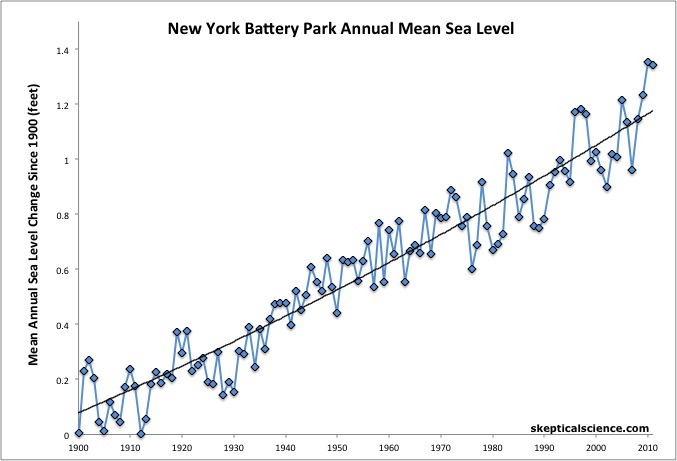
Figure 1: Annual mean sea level rise in Battery Park, New York from Permanent Service for Mean Sea Level (PSMSL) tide gauge data.
While Battery Park represents just one tide gauge, there are many other tide gauges in the region which tell a very similar story, as you can see at the PSMSL site. And of course we know that the global sea level rise (approximately 0.6 feet since 1900, on average) is predominantly caused by melting land ice and the thermal expansion of the oceans. As Church et al. (2011) found, approximately 40% of the average global sea level rise since 1972 is due to thermal expansion, and approximately 60% due to land ice melting (Figure 2), both of which in turn are predominantly driven by human-caused global warming.
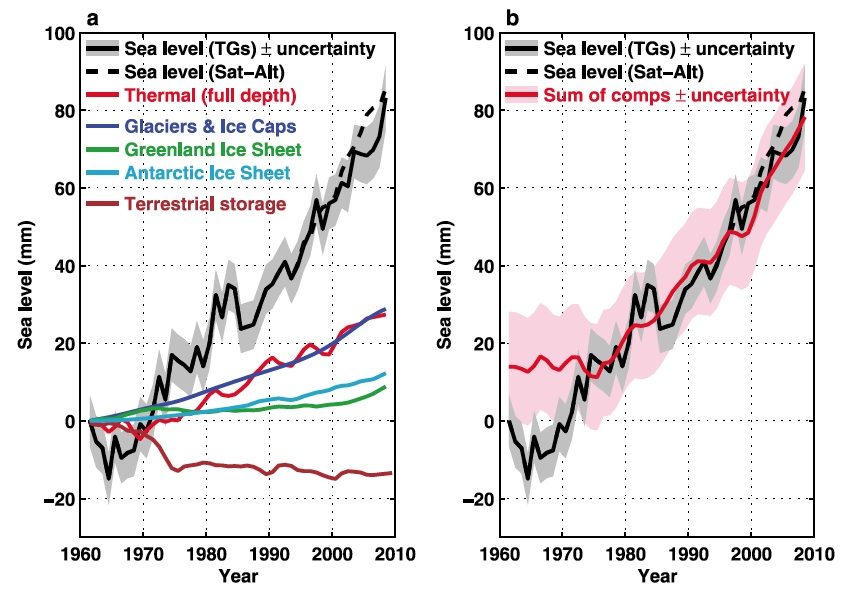
Figure 2: The global sea level budget from 1961 to 2008. (a) The observed sea level using coastal and island tide gauges (solid black line with grey shading indicating the estimated uncertainty) and using TOPEX/Poseidon/Jason?1&2 satellite altimeter data (dashed black line). The two estimates have been matched at the start of the altimeter record in 1993. Also shown are the various contributing components. (b) The observed sea level and the sum of components. The estimated uncertainties are indicated by the shading. The two time series are plotted such that they have the same average over 1972 to 2008. From Church et al. (2011).
Looking into what we can expect for the impact of future sea level rise on hurricanes, Lin et al. (2012) found that:
"The combined effects of storm climatology change and a 1 m [sea level rise] may cause the present NYC 100-yr surge flooding to occur every 3–20 yr and the present 500-yr flooding to occur every 25–240 yr by the end of the century."
So this human contribution to the Sandy-related damage is quite straightforward. This is what we know:
- Humans increased the greenhouse effect.
- The greenhouse effect caused the planet to warm.
- The warming planet caused land ice to melt and the oceans to expand.
- Melting land ice and thermal expansion caused average sea level to rise.
- Higher sea level made the storm surge worse than it would have been in the past, thus causing more flooding.
Warmer Oceans Fuel Hurricanes
As Katharine Hayhoe noted, Atlantic sea surface temperatures (SSTs) are also significantly warmer than they were a century ago as a result of human-caused global warming. Figure 3 shows global surface temperature anomalies for the period 2000 to 2011 compared to 1900 to 1910. SSTs over most of the Atlantic ocean warmed 0.5 to 1.0°C over that timeframe.
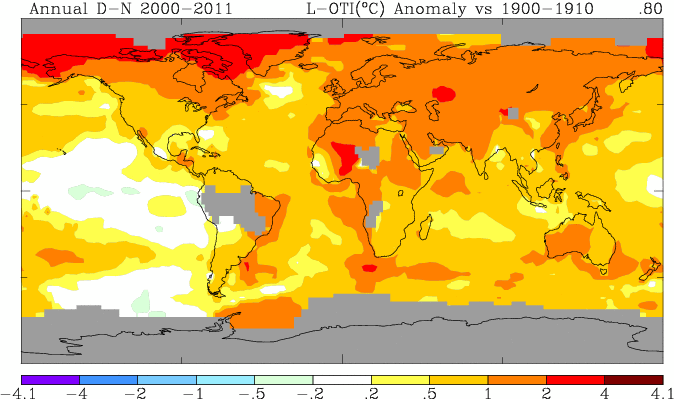
Figure 3: Surface temperature change (°C) from 1900-1910 to 2000-2011, from NASA GISS.
MIT hurricane expert Kerry Emanuel first proposed in Emanuel (1987) that warmer SSTs should lead to stronger hurricanes. Emanuel (2005) confirmed that hurricanes have grown stronger over the past several decades, in part due to human-caused global warming. As he put it in Emanuel (2012),
"In the North Atlantic region, where tropical cyclone records are longer and generally of better quality than elsewhere, power dissipation by tropical cyclones is highly correlated with sea surface temperature during hurricane season in the regions where storms typically develop"
As a result, hurricane strength and damage are projected to increase in a warming world (Figure 4).
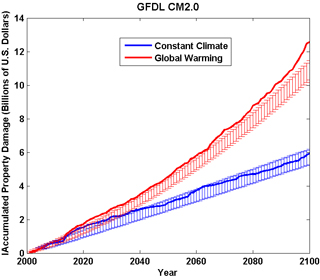
Figure 4: Accumulated damage from 2000 to the year on the x-axis using the the GFDL CM2.0 global climate model with climate held fixed at its 1981–2000 mean condition (blue) and under the global warming scenario associated with IPCC SRES Scenario A1B (red). The error bars shows one standard deviation up and down from the ensemble mean. From Emanuel (2012).
Elsner et al. (2012) confirmed that warmer SSTs feed stronger hurricanes, finding when mean seasonal SSTs are above 25°C
"a significant trend trend with increasing SST indicating a sensitivity of 7.9 ± 1.19 m s-1 K-1"
Elsner et al. and Knutson et al. (2010) also find that hurricanes will become stronger in a warming world.
"higher resolution modelling studies typically project substantial increases in the frequency of the most intense cyclones, and increases of the order of 20% in the precipitation rate within 100 km of the storm centre."
Again we have a very clear connection between human-caused global warming and impacts from Hurricane Sandy.
- Humans increased the greenhouse effect.
- The greenhouse effect caused the planet (including oceans) to warm.
- Warmer oceans feed stronger hurricanes.
However, note that during the hurricane event, SSTs along the coast were approximately 3°C above average, whereas global warming has increased SSTs by closer to 0.6°C. Thus as Kevin Trenberth notes, while global warming contributed to the hurricane intensity, so did natural variability.
More Atmospheric Moisture Causes More Rainfall
Kevin Trenberth notes that due to global warming there is now more moisture in the atmosphere than there was a century ago, which contributed to the flooding in the impacted areas, as Trenberth described:
"With every degree F rise in temperatures, the atmosphere can hold 4 percent more moisture. Thus, Sandy was able to pull in more moisture, fueling a stronger storm and magnifying the amount of rainfall by as much as 5 to 10 percent compared with conditions more than 40 years ago. Heavy rainfall and widespread flooding are a consequence."
This conclusion is consistent with the findings of Trenberth et al. (2005), which found that
"recent trends in precipitable water are generally positive and, for 1988 through 2003, average 0.40±0.09 mm per decade or 1.3±0.3% per decade for the ocean as a whole"
We have another fairly simple causal relationship here:
- Humans increased the greenhouse effect.
- The greenhouse effect caused the planet (including atmosphere) to warm.
- A warmer atmosphere can hold more water vapor.
- This allows hurricanes to pull more moisture from the atmosphere.
- More rainfall during the hurricane causes more widespread flooding.
Changing Weather Patterns Resulting from Arctic Warming
Francis and Vavrus (2012) found evidence that that the decline in Arctic sea ice and snow cover are linked to extreme weather, for example through more frequent blocking patterns. Liu et al. (2012) also found that "the decrease in autumn Arctic sea ice area is linked to changes in the winter Northern Hemisphere atmospheric circulation," which results in more frequent episodes of blocking patterns.
An atmospheric blocking pattern over Greenland, which may potentially be linked to this year's record low Arctic sea ice extent (though we can't say for certain), helped force the storm to make a left turn into the United States mainland. As Dr. Francis stated in an interview with Justin Gillis,
"While it’s impossible to say how this scenario might have unfolded if sea-ice had been as extensive as it was in the 1980s, the situation at hand is completely consistent with what I’d expect to see happen more often as a result of unabated warming and especially the amplification of that warming in the Arctic"
Extreme Weather on Steroids
The bottom line is that while global warming did not cause Hurricane Sandy, it did contribute to the "Frankenstorm" at least by causing higher sea levels (and thus bigger storm surges and flooding), warmer sea surface temperatures (and thus a stronger hurricane), and more moisture in the atmosphere (and thus more rainfall and flooding).
More importantly, as Francis noted and as many impacted residents are coming to realize, this type of extreme weather has and will continue to become more commonplace as the planet continues to warm. We know that many types of extreme weather events have already been linked to global warming, including hurricane intensity. A warmer world will "load the dice" and make extreme events, including strong hurricanes, more likely to occur. It's important not to lose sight of the long-term trends in arguing about whether or not climate change contributed to any single extreme weather event. As Dave Roberts notes,
"There is no division, in the physical world, between “climate change storms” and “non-climate change storms.” Climate change is not an exogenous force acting on the atmosphere. There is only the atmosphere, changing. Everything that happens in a changed atmosphere is “caused” by the atmosphere, even if it’s within the range of historical variability."
And as Stephan Lewandowsky put it,
"We are living with climate change.
It is happening now.
Debating the extent to which Frankenstorm Sandy was put on steroids by climate change is a distraction.
Nearly all weather events now have a contribution from climate change and it is up to us to manage and reduce that risk with mitigative action."
We often come back to the words of Lonnie Thompson, who said that climate change will result in some mix of mitigation, adaption, and suffering. So far we have failed to achieve significant mitigation of greenhouse gas emissions, and as a result, extreme weather events on steroids like Hurricane Sandy will cause more suffering than they would otherwise have, and we will have to adapt to a future in which these types of events occur more frequently. Unfortunately, as we saw in North Carolina, some science-denying policymakers are not even willing to implement the necessary adaptation measures. This type of denial will maximize future suffering.
Imagine a world where this type of extreme weather event happens once per decade instead of once per century. That's one small part of what we're talking about when we discuss the impacts of climate change.
Also see a similar good post on this subject by Joe Romm at Climate Progress.
Note: this post has been incorporated into the rebuttal to the myth Hurricane Sandy had nothing to do with global warming. It also has a convenient short URL sks.to/sandy


 0
0  0
0 As most of the Earth's ocean surface lies in the Southern Hemisphere, SH temperatures would be a better predictor of sea level rise due to thermal expansion. SH temperatures would also be a better predictor of glacial retreat in the Andies, NZ and or course Antarctica as well.
Having said that, the rate of sea level did peak during the warm years of of the 30s and 40s, indicating that the NH roller coaster in temperature did have some impact.
As most of the Earth's ocean surface lies in the Southern Hemisphere, SH temperatures would be a better predictor of sea level rise due to thermal expansion. SH temperatures would also be a better predictor of glacial retreat in the Andies, NZ and or course Antarctica as well.
Having said that, the rate of sea level did peak during the warm years of of the 30s and 40s, indicating that the NH roller coaster in temperature did have some impact.
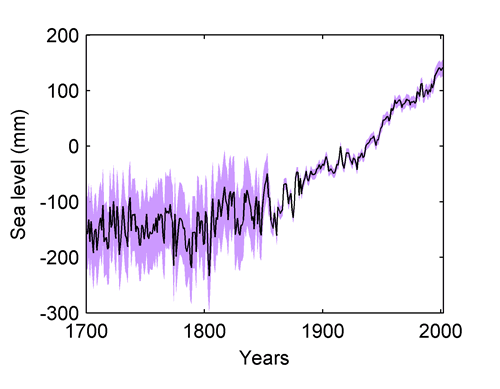 The initial increase was due to the end of the Little Ice Age, brought about by a period with unusually few large equatorial volcanoes, a slight increase in solar radiation, and (almost certainly) a reduction in the Earth's albedo due to black carbon from the rapidly ongoing industrialization of Europe and America. (It must be remembered that in the 19th and early 20th century, trees in Europe and the NE US were so blackened with soot that the normal light form of the Peppered Moth was almost entirely replaced by the black form.)
However, the ongoing rise in sea temperatures is undoubtedly due to the onging rise in temperatures which is almost entirely due to anthropogenic factors.
The initial increase was due to the end of the Little Ice Age, brought about by a period with unusually few large equatorial volcanoes, a slight increase in solar radiation, and (almost certainly) a reduction in the Earth's albedo due to black carbon from the rapidly ongoing industrialization of Europe and America. (It must be remembered that in the 19th and early 20th century, trees in Europe and the NE US were so blackened with soot that the normal light form of the Peppered Moth was almost entirely replaced by the black form.)
However, the ongoing rise in sea temperatures is undoubtedly due to the onging rise in temperatures which is almost entirely due to anthropogenic factors.







Comments