



 Arguments









What were climate scientists predicting in the 1970s?
What the science says...
| Select a level... |
 Basic
Basic
|
 Intermediate
| |||
|
The vast majority of climate papers in the 1970s predicted warming. |
|||||
Ice age predicted in the 70s
"If you go back to Time Magazine, they actually were proclaiming the next ice age is coming, now it's become global warming… How do you believe the same people that were predicting just a couple decades ago that the new ice age is coming?" (Sean Hannity)
At a glance
If you are aged 60 or over, you may remember this particular myth first-hand. For a brief time in the early to mid-1970s, certain sections of the popular media ran articles describing how we were heading for a renewed ice-age. Such silliness endures to the present day, just with a different gloss: as an example, for the UK tabloid the Daily Express, October just wouldn't be October without it publishing at least one made-up account of the impending 100-day snow-apocalypse.
There were even books written on the subject, such as Nigel Calder's mischievously-entitled The Weather Machine, published in 1974 by the BBC and accompanying a “documentary” of the same name, which was nothing of the sort. A shame, because the same author's previous effort, The Restless Earth, about plate tectonics, was very good indeed.
Thomas Peterson and colleagues did a very neat job of obliterating all of this nonsense. In a 2008 paper titled The myth of the 1970s global cooling scientific consensus, they dared do what the popular press dared not to. They had a look at what was actually going on. Obtaining copies of the peer-reviewed papers on climate, archived in the collections of Nature, JSTOR and the American Meteorological Society and published between 1965 and 1979, they examined and rated them. Would there be a consensus on global cooling? Alas! - no.
Results showed that despite the media claims, just ten per cent of papers predicted a cooling trend. On the other hand, 62% predicted global warming and 28% made no comment either way. The take-home from this one? It's the old media adage, “Never let the truth get in the way of a good story”
Please use this form to provide feedback about this new "At a glance" section. Read a more technical version below or dig deeper via the tabs above!
Further details
In the thirty years leading up to the 1970s, available temperature recordings, with a poor global coverage compared to today, implied at times there might be an ongoing cooling trend. At the same time, research was continuing into the building levels of carbon dioxide and their effects on future climate, but the science world of that time was somewhat disconnected, compared to the modern age of instant communication, Zoom and so on.
There were also some notably cold winters scattered through that time, such as the UK one of 1962-63. As a result of these various goings-on, some scientists suggested that the current interglacial period could rapidly draw to a close, which might result in the Earth plunging into a new ice age over the next few centuries.
We now know that the smog that climatologists call ‘aerosols’ – emitted by human activities into the atmosphere – caused localised cooling closest to the areas where most of it originated. Smogs constitute a deadly health hazard and governments acted quickly to clean up that type of pollution: highly visible (unlike CO2), it was hard to ignore. Once largely removed, its effects no longer influenced Northern Hemisphere temperatures, that have steadily climbed since around 1970.
In fact, as temperature recording has improved in coverage, it’s become clear that the cooling trend was indeed localised – it was most pronounced in northern land areas. Other places around the world revealed a different story. Furthermore, at the same time as some scientists were suggesting we might be facing another ice age, a significantly greater number - approximately six times more - published papers indicating the opposite - that we were warming. Their papers showed that the growing amount of greenhouse gases that humans were putting into the atmosphere would cause much greater warming – warming that would exert a much stronger influence on global temperature than any possible natural or human-caused cooling effects.
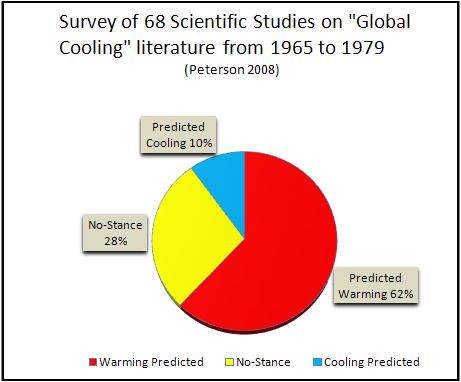
By 1980, with northern hemisphere smogs a distant memory, the predictions about ice ages had ceased, at least among those working on the science, due to the overwhelming evidence for warming presented in the scientific literature (Peterson et al. 2008). Unfortunately though, the small number of predictions of an ice age were far more 'sticky' than those of global warming, so it was those sensational 'Ice Age' stories in the 1970s popular press that so many people tend to remember. Sticky themes sell papers. Today of course, with 40+years more data, far better coverage and a far bigger research community, we've reached a clear scientific consensus: 97% of working climate scientists agree with the view that human beings are causing global warming.
Last updated on 8 March 2024 by John Mason. View Archives








Climate Myth...