





Lindzen Illusion #3 and Christy Crock #5: Opposing Climate Solutions
Posted on 3 May 2011 by dana1981

Recently, "skeptic" climate scientist John Christy testified before U.S. Congress, and both Christy and fellow "skeptic" Richard Lindzen have been interviewed on an Australian radio talk show regarding the country's proposed carbon tax.

In each situation, these two scientists spoke out against efforts to address climate change by reducing carbon dioxide (CO2) and other greenhouse gas (GHG) emissions.
Tragedy of the Commons Once Again
Their main argument seems to be becoming a favorite amongst "skeptics": "CO2 limits will make little difference." In his radio interview, Christy applied the argument to California (which is attempting to implement a carbon cap and trade system), Australia (with the aforementioned proposed carbon tax), and in his congressional testimony, to the USA:
"We’re talking about less than a hundredth of a degree [if California cuts emissions by 26% by 2016]. It’s just so miniscule; I mean the global temperature changes by more than that from day to day. So this is what we call in Alabama “spitting in the ocean”."
"On the climate front, [Australia cutting its emissions by 5% by 2020] will be imperceptible or minuscule compared to what the rest of the world is doing."
"you're looking at most at a tenth of a degree [reduction in global temperature] after 100 years [if USA imposes CO2 limits]"
Lindzen attempted to apply the argument globally:
"The evidence is pretty good that even if everyone [cut emissions] in the whole world it wouldn't make a lot of difference."
We have previously addressed this argument as applied to Australia by Chris Monckton and David Evans, and applied to the USA by David Montgomery. However, given that the USA is the largest historical CO2 emitter, the second-largest current emitter, and high on the list in terms of per capita emissions, it may be worthwhile to evaluate these claims. Let's run the numbers using CO2 emissions data from the U.S. Energy Information Administration.
Current global CO2 emissions total approximately 30 billion tons (Gt) per year, with the USA contributing approximately 20% (5.8 Gt per year). US emissions have risen approximately 15% since 1990, so let's assume in a business as usual scenario, they will continue to rise at that rate. In this case, total US CO2 emissions between now and 2050 will total approximately 275 Gt. The IPCC projects that in business as usual, global CO2 emissions will total approximately 2,200 Gt over that period.
If the USA were to follow through with proposals to reduce CO2 emissions 83% below 2005 levels by 2050, the result would roughly cut the country's emissions over that period in half, to 140 Gt, reducing global emissions to approximately 2,060 Gt.
Approximately 55% of human CO2 emissions currently remain airborne (the remainder is absorbed by carbon sinks), and each 7.8 Gt CO2 emitted corresponds to roughly 1 part per million by volume (ppmv) increase in atmospheric CO2 concentration. Thus the US cuts would reduce the atmospheric CO2 concentration to approximately 540 ppmv compared to 550 ppmv in business as usual in 2050.
Assuming the IPCC most likely climate sensitivity value of 3°C for doubled CO2 (incorporating only fast feedbacks - remember, long-term sensitivity is even higher) is correct, these US emissions cuts by themselves would reduce the amount of equilibrium warming by 0.08°C, from roughly 2.9 to 2.8°C surface warming above pre-industrial levels. And of course Australia and California's cuts would have even less effect on global temperatures, as they have smaller populations and thus lower total emissions. So Lindzen and Christy have a point here, right?
Well, no. In particular, Lindzen claims that global emissions cuts "wouldn't make a lot of difference." But let's say international negotiations succeeded in convincing countries all around the world to reduce global CO2 emissions by 50% below 1990 levels by 2050. Now suddenly instead of 2,200 Gt CO2 emitted in the next four decades, it's only about 820 Gt. Now instead of 550 ppmv in 2050, we're looking at about 450 ppmv.
Instead of committing ourselves to 2.9°C warming above pre-industrial levels as in business as usual, we're only committed to 2°C, which keeps us right at the cusp of the global warming "danger limit." Plus rather than blowing past the danger limit with CO2 levels continuing to rise rapidly, we'll have set up the technologies and infrastructure necessary to continue reducing emissions to safe levels. Remember, the last time atmospheric CO2 was at current levels, global temperatures were 3 to 4°C warmer than pre-industrial, and sea levels were around 25 meters higher than current sea level. So we really should aim to eventually stabilize atmospheric CO2 at no higher than 350 ppmv, and the more CO2 we emit now, the more difficult that will be. We're currently adding another 2 ppmv CO2 to the atmoosphere per year, continually moving further away from that 350 ppmv target.
So clearly Lindzen is wrong that global emissions cuts won't make a difference. And the only way we're going to achieve large global emissions cuts is if major emitters like the USA and Australia lead the way in reducing their emissions. And the USA is more likely to proceed if states like California demonstrate that CO2 limits can be implemented successfully. Thus although these individual cuts won't have a significant direct impact on global temperatures, they can have a major indirect effect by triggering more widespread emissions cuts.
Costs vs. Benefits
In his Australian radio interview, Lindzen also claimed that the costs of CO2 limits would outweigh the benefits.
"[CO2 limits are] a heavy cost for no benefit, and it's no benefit for you, no benefit for your children, no benefit for your grandchildren, no benefit for your great-great-great-great-grandchildren. I mean, what's the point of that?"
Christy made a similar argument both in his US Congressional testimony and his Australian radio interview.
"this issue has policy implications that may potentially raise the price of energy a lot, and thus essentially the price of everything else."
"I would think a couple of things will happen [if Australia cuts its emissions by 5% by 2020]. One is that your energy prices will rise and your economy then will begin to turn downward. And you will provide opportunities for other nations to take up the slack that Australia used to provide the world."
It's true that carbon limits would likely cause a modest rise in the market price of energy. However, the funds from selling carbon emissions permits could be used to offset this price increase through improved energy efficiency and other measures. Economic studies showed that the proposed CO2 limits in the USA would have virtually no impact on average electricity bills, for example. It's important to distinguish between prices and bills – an increase in the former doesn't necessarily cause an increase in the latter, if other measures are taken to prevent bills from rising.
Moreover, the true cost of coal energy, on which Australia and the USA rely heavily, is approximately triple the market price, which does not account for factors like impacts on public or environmental health. Thus a carbon price more accurately reflects this true cost in the market price, and also aids in the transition to other energy sources whose true cost is actually lower than fossil fuels. So although market prices may rise, the total cost paid by Australians, Americans, etc. will actually fall.
This is one of the reasons that contrary to Lindzen's claims, the benefits of carbon limits outweigh the costs several times over. This is something that economic studies and economic experts consistently agree about. You could even call it an economic climate consensus. A recent survey of 144 of the world's top economists with expertise on climate change found that 88% agreed that the benefits of carbon pricing outweigh the costs, and over 94% agreed the US should reduce its GHG emissions if other major emitters also commit to reductions (which many already have, particularly in Europe):
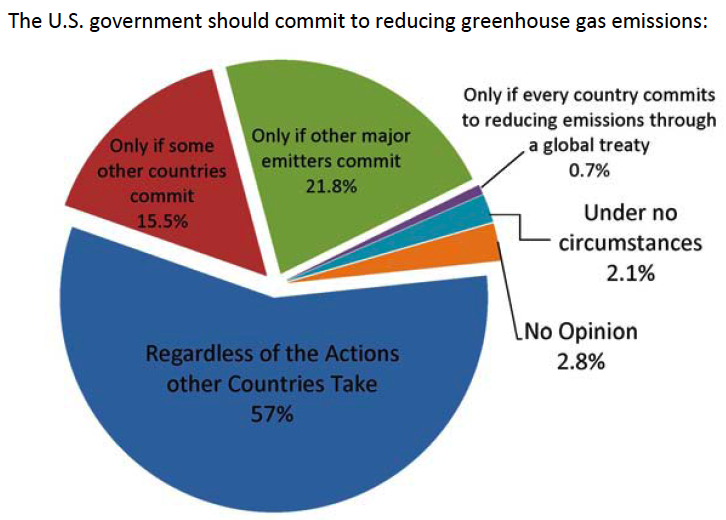
NYU IPI survey results when asked under what circumstances the USA should reduce its emissions
Stick to What You Know
In their comments dissuading Australian and American efforts to address the threats posed by global warming and climate change, Lindzen and Christy made a number of erroneous and false statements. Perhaps these climate scientists should leave the economic arguments to, you know, economists. And they should certainly stop promoting the Tragedy of the Commons. If the USA can argue that its emissions cuts won't make a difference, then every country can make the argument. And if everyone makes it, we'll fail to achieve even modest emissions cuts, and as a result we will all doom ourselves to increasingly dangerous global warming and climate change.
A good scientist should not encourage us to play Russian Roulette with the climate, all the while adding more and more bullets to the chamber.

Arguments


Aye, there's the rub.
Vacuous comments are not constructive.
You need to please read this post, and the overwhelming scientific literature that supports a sensitivity of near +3 C warming for doubling CO2, and then re-read the article.
The aim is to delay.
The trends since 1979 indicate a rate of warming at 1.5 K per century (1.7 for GISS, 1.3 for CRU).
I'm having a hard time justifying the 3 spot from there.
[dana1981] As other commenters have noted, atmospheric CO2 has not yet doubled. In fact if you read Lindzen Illusions #1 and #2, you'll see that the warming over the period in question is indeed consistent with 3°C sensitivity (as will be discussed in LI #4).
3K seems about right. Your comments are rather hard to justify, though.
Why? Just because? Or do you have some inside information that you'd care to share?
The current trend of 0.15C per decade is consistent with 2-3deg/doubling of CO2. Considering the NH warming rates are more than twice the global and the global temperature graph is concave up, worse is yet to come.
However: we're at 390 ppm, pre-industrial levels were 280, and we won't have doubled CO2 until we reach 560 ppm. At that time the best estimates are of a 3C temperature increase for short term, rather more for long term as ice and CO2 feedbacks kick in.
Hence a 1.5-1.7K per century, rate increasing, (~0.8C so far) for the GHG increase we have induced so far is just about right for the various IPCC estimates.
For example, they could say, "If you want to trade with us, either follow our lead on CO2 reductions, or we'll tax your imports." Either country might suffice to get the ball rolling, but if the EU, China, and the US forged an agreement, the rest of the world would have little choice but to follow suit.
If the US told China to apply a carbon price, or they'd tax all imports, what would China do? Considering that if they chose to play hardball, the US would almost certainly cave (given that a large portion of the US economy now depends on goods from China, and China is also the largest holder of US foreign debt, they're really over a barrel).
On the other hand, if China chose to impose a carbon price, I don't think the US would have any real choice but to go along.
Another complication is whether the WTO would regard a carbon tax on imports (from countries that don't have a carbon tax) as a form of protectionism. I'd hope they were smarter than that, but it's hard to say.
China's economy is growing fast, and so are its emissions.
But unlike the US, they're investing heavily in renewables too.
The US is being held hostage of FF lobbyists. It's perhaps an important weak point of their democracy, and it's making them lead the world's denialism and delayed action. Which is ironic, given the fact that a lot of the climate science, research and monitoring is US made.
China does not seem interested in a carbon tax, AFAIK. They're doing the transition from a central command, just because the government saw it strategically fit. The US and EU, as large consumers, could impose efficency and environmental standards to exporters. This could be a big impulse for cleaner practices. The carbon tax could play an important role here, making these cleaner energy and goods more attractive to the internal consumer.
But the US is choosing to lag behind. This will not look good in future history.
And in a competitive economy what measures would those be?
Bankrupcy??
This is alarmism of the worst kind, and the crux of the problem with those who fiercely resist the science and the solutions. This panicked fear that costs must be extreme, to the point of destroying economies, is absurd.
First, no one is very easily going to give up comforts, let alone necessities. No one is going to sit idly by while all of civilization crumbles. That only happens when the economy spirals out of control through greed and mismanagement (see 1929, 1987, 2007).
Second, a transition to alternate energy sources does not represent a net loss to society as a whole. The infrastructure of society is constantly being renewed. Nothing lasts. Manufacturing and transportation equipment, roads, rail lines, power lines, power plants, everything is constantly being maintained or replaced.
So if we simply change what we use to replace the old... newer, better techniques using renewable energy sources rather than fossil fuels... there is no net loss to the economy. The loss is only to those who would profit from purely fossil fuel solutions. In the long run, there is a net gain for society.
All economies benefit.
In fact, the only losers will be those who desperately cling to the old, inefficient and uneconomical ways, as the smarter, more adaptable economies move forward and embrace change.
Alarmism and panic are not helpful.
For only the most simple example:
If energy costs go up 50% and I install more insulation so that my energy use goes down 60% I save money and have lower total bills. Your suggestion of bankruptcy is alarmism of the worst kind and is easily shown to be untrue.
If I install a ground source heat pump I save money, even if energy costs go way up, and it expands the economy since I have to pay to have the heat pump manufactured installed.
Absolutely, it is a simple concept at the highest level; it is more complicated as you get into the details. I concur on everything you said, FF industry, US indebtedness to China, US in historical view (nevermind when the world's hungry turn their baneful eyes from their own leaders to the US), etc. IMHO, it would be foolish for the US to try to strong-arm China. It is to be hoped that we have a rational leadership when talks resume.
No, I would guess that China is not interested in a carbon tax. A tax is how governments steer a free market, and China's market is not as free as the US's. Any agreement would have to focus more on emissions reductions rather than the mechanism for how those reductions were achieved. Pity that CO2 satellite did not make it in to orbit.
My main point is that, despite the rather un-democratic nature of it, it might be more effective to pursue an emissions agreement amongst the top few economies rather than pursue one that is acceptable to 100 or more at the start. At this point, I, personally, would accept a non-democratic solution over no solution.
I have noticed this "alarmism against mitigation" for some time now. Dan Moutal mentioned an interesting similar pattern by the time of the CFC problem: people claimed that prices of apliances would skyrocket, poor countries would be denied access to these conveniences, manufacturers would go bankrupt, and so on. Of course, the world survived the Montreal protocol quite well.
Political backlash is a problem in a democracy. If the elected officials make an agreement that puts what the average person sees as a competitor on a level playing field, those officials are likely to lose the next election and have their agreement tossed out. Maybe the US debt to China can be leveraged to enforce an agreement, a calling of the debt if the US fails to comply. That would not save the officials, but it might save the agreement.
I don't know; politics is not my strong point.
China plans to establish a carbon cap and trade system by 2015, by the way. It will be incredibly embarrasing if they beat the US to it.
I would not suggest to strongarm China. The US is a huge importer. It's in the position to demand efficiency standards, for example. This would affect the US consuption directly. Chinese consumers would end up having access to the same goods, and that woul eventually affect their overall efficiency as well. American an European standards tend to be copied elsewhere in the world overtime, so I do believe this kind of role model leadership would have a practical effectiveness.
Our Brazilian automotive emission laws only happened because developed countries did it first, then our bureaucrats thaought it would be a good idea to adopt it too.
Those restrictuions could maybe include emission standards for the manufacturer. Also if the US had a more aggressive reneweable energy research (like say Germany), the costs of these sources would drop more rapidly, stimulating the migration without so much cohersion.
I don't think the influence of the US as a world leader should be underestimated, even if it's not as hegemonic as it was years ago. The American influence on this issue has been negative so far. I'm convinced an American positive influence would make a large difference.
Bankruptcy??"
Of course, this is a text book argument from the Contrarian Movement. As has already been pointed out, the additional cost of carbon-rich energy, when taxed, will be applied to the *unit* cost of the energy (in MJ or kw-h), not to the total bill. In the last 10 years, I've seen my electricity tariffs rise by 8c/kw-h (due almost entirely to privatization & inflation), yet I'm currently paying about $40 per month *less*-on my total electricity bill-than what I was 10 years ago, simply by halving my daily use (purchasing energy efficient appliances & light globes, less reliance on stand-by modes & swapping my electric hot water system for a continuous flow gas hot water system). Now it's true that I spend about $20/month for my gas hot water, but that still leaves me $20/month better off than 10 years ago-& I can probably improve my position further by getting insulation installed to reduce my energy use for heating & cooling-so claims that reducing our CO2 emissions will send us *bankrupt* are just complete nonsense. Businesses & Industry also have plenty of room for reducing their CO2 emissions *and* reducing their total energy use. For example, the cement industry generates about 1t of CO2 for every tonne of cement made. Now I've seen evidence to suggest that this can be significantly reduced by measures like (a) recycling of old cement, (b) use of aluminium silicate instead of Calcium Carbonate, (c) capturing the CO2 from baking Calcium Carbonate & converting it to algal biomass, (d) using bio-gas, rather than natural gas, to bake the calcium carbonate. Of course, if the industry also captured its waste heat & converted it to electricity, then they could offset the costs of a carbon tax via the sale of electricity (co-generation). So we see that, yet again, a Carbon Tax represents an *opportunity*, more than it does a *burden*.
Use of PV Solar panels with huge taxpayer subsidies is not one of them - and State Govts in Australia are winding back or abandoning such costly schemes.
Solar hot water, ground heat pumps, insulation, low energy bulbs all make some economic sense at current energy costs.
Some consumption is inelastic - putting up the price won't reduce usage much because there are not any short term alternatives. Diesel or petrol for a transport operator to earn a living is a good example.
Part 1 is to decry the "evil" subsidies enjoyed by the still relatively young renewable energy industry, whilst remaining deafeningly silent about the much larger direct & indirect subsidies still enjoyed by the *mature* fossil fuel industry. What's the matter, Ken, afraid of having to operate on a more *level* playing field?
Part 2 is the claim that "some consumption is inelastic" because there are "no short term alternatives". Well if there is any truth to that, its because the fossil fuel industry-with the help of complicit governments-have worked very hard to make sure that there *aren't* any alternatives available. In strict technical terms, though, there are numerous options for reducing the current consumption of fossil fuels-be it switching to alternative fuels (algae derived bio-diesel, diesel-electric vehicles, blended fuels & transporting of freight via trains instead of by road). Price signals will definitely help put pressure on government agencies, vehicle & fuel suppliers to get off their collective *you-know-whats* & start making these alternatives more readily available.
This claim is long on propaganda, but very short on fact. The subsidies for PV solar panels are actually quite small-compared to many other subsidies provided to Middle Class families in Australia. Also, the WA & NSW currently provide an overly generous solar energy subsidy for *all* electricity generated, & so these 2 governments are currently looking at bringing them in line with the schemes provided by most of the other States-namely a subsidy *only* for the energy fed into the grid-a move I happen to agree with. Also, wherever they are in place around the world, feed-in tariff subsidies were *never* designed to be permanent. As their goal of making renewable energy more cost competitive with fossil fuels is increasingly achieved, the feed-in tariff subsidies were always designed to be *phased out*-unlike the very generous subsidies that still remain for the fossil fuel industry.
On the one hand you post that Lindzen and Christy are wrong about whether cutting emissions will make a difference.
"...So Lindzen and Christy have a point here, right?
Well, no. In particular, Lindzen claims that global emissions cuts "wouldn't make a lot of difference." But let's say international negotiations succeeded in convincing countries all around the world to reduce global CO2 emissions by 50% below 1990 levels by 2050. Now suddenly instead of 2,200 Gt CO2 emitted in the next four decades, it's only about 820 Gt. Now instead of 550 ppmv in 2050, we're looking at about 450 ppmv."
Where you point out that if everything went right and everyone followed along , globally we might cut emissions to 450ppm
And in your very next post you tell us that 450ppm means disaster.
"Prior to these developments atmospheric CO2 concentration of 450ppm was equated as limiting average global temperature to 2°C above pre-industrial levels by 2100. This can no longer be maintained. Hansen and Sato (2011) using paleoclimate data rather than models of recent and expected climate change warn that “goals of limiting human made warming to 2°C and CO2 to 450 ppm are prescriptions for disaster”."
It seems Lindzen and Christy were right afterall. Or 450ppm doesn't spell disaster. Pick one.
Well, now we are both laughing. I'm sure Dana, and others, are going to have much fun with your post @29.
Bad analogy, Tom. Casy Jones died.
And so following on with your anaogy, we all pull the brakes on CO2 emissions ...and then apparently all die in the upcoming "disaster" anyway.
OK, then, you've got yet another argument for doing nothing. What new heights of illogic will we find along this path? A crash at 60mph will kill you, so why not go 100 mph?
What you and I believe have different drivers. My driver is having a sustainability based focus with and mitigating actual risk associated with "weather" by doing things like building pipelines and dams, avoiding floodplains where possible and so on. This is where I'd spend my money.
Your drivers are focussing on reduction of CO2. This is where you'd spend your money.
@34 I fail to see how my not living in a flood plain will save the Great Barrier Reef from destruction, the Amazon from turning into grassland, or the Arctic from melting. All of these are probably consequences in a plus 2 degree world.
The thing is Tom, the two SkS articles have suggested thats where we're heading with or without global reduction in CO2. So my approach actually helps whereas yours doesn't. Apparently.
Now what about risks to water cycle (floods/drought)? Costed those?
I've yet to see a report that makes realistic assumptions about climate change effects that suggests adaptation would be cheaper than mitigation. I'm all ears if you have a link though.
Because I believe I have a better sense of perspective than most people. The cities of today are radically different to those of 100 years ago. And the same will be true in 100 years time. We dont need to change it all at once, we do it over many generations and we wont even notice the costs.
Do you think we've been hit with exorbitant costs over the last 100 years from sea level rise? I mean it rose and we dealt with it didn't we?
I doubt you've even thought about previous rise and the associated costs because its not a worry to you.
Floods happen. Droughts happen. We're better off building infrastructure to manage those events than to pretend we can make them go away by reducing CO2 emissions.
I am 100% correct in saying building better infrastructure will help protect us from future weather events. Your probability is much lower by focussing on the reduction of CO2 emissions.
Your problem, I think, is that like many contrarians you adopt an unrealistically panicked and alarmist approach. You equate simple, effective action now (to replace fossil fuels) with some sort of crazy, anarchist surge to completely wipe civilization and our modern economies from the face of the earth.
That sort of cartoon view of the actions that we should be taking hamstrings your ability to consider mitigation from a rational perspective.
The irony is that as an AGWer this is your job, not mine. I also agree we should move away from fossil fuels towards sustainable energy sources but notice I said "sustainable" rather than "polluting" which is your mantra.
Unfortunately for that hypothesis, rampant denialism has turned even the most minimal attempts into political punching bags. Look at the controversy over US EPA mileage reduction proposals -- even as watered down as they are, even though they will save consumers money in the long run, the deniers oppose them because it they smell of 'carbon tax.' Thanks for that result.
Nobody likes being told what they can and cant do.
Ultimately price will bring the US back into line with regards their fuel usage, car sizes and associated efficiencies but they've got a long way to go to get down to say, Europe's fuel prices.
Ah, & like a true Denialist, TTTM believes he knows better than everyone else-how *typical*. Also, it is the Denier Camp who keep moaning & whining about how "Rooned" our economy will be if we adopt a more efficient, zero-carbon economy. Of course, what the Denialists are *really* saying is "better tax payers be forced to pony up the cost of adapting to climate change than the fossil fuel industry should lose even a single dollar of profits". I'd say that pretty much sums up your entire attitude TTTM.
Sorry, but what is an AGWer exactly? Do you mean someone who has a very realistic idea of how bad things will get if we don't start adopting some key CO2 mitigation strategies ASAP? Now contrast that with the Denialists, who would seem to suggest that even 1kw-h of electricity *not* derived from fossil fuels somehow represents the end of civilization as we know it-which is about as panicky & alarmist as you can possibly get.
Now if we weaned off CO2 emissions so that we could be confident that ONLY 1m sealevel was going to happen and that sealevel would stablise again, then I think we could live with it. Otherwise,1.5-2m in the next century means abandoning my city.





