Linking Extreme Weather and Global Warming
Posted on 18 June 2011 by Anne-Marie Blackburn
Whenever there is an extreme weather event, such as a flood or drought, people ask whether that event was caused by global warming. Unfortunately, there is no straightforward answer to this question. Weather is highly variable and extreme weather events have always happened. Detecting trends takes time, particularly when observational records are rare or even missing in certain regions. An increase in extreme weather is expected with global warming because rising temperatures affect weather parameters in several ways. Changes in the frequency of extreme events coinciding with global warming have already been observed, and there is increasing evidence that some of these changes are caused by the impacts of human activities on the climate.
How global warming affects weather parameters
Rising temperatures can have several effects on the factors involved in weather. For example:
-
They increase the rate of evapotranspiration, which is the total evaporation of water from soil, plants and water bodies. This can have a direct effect on the fequency and intensity of droughts.
-
A warmer atmosphere can hold more water vapour. The atmosphere now holds 4% more water vapour than it did 40 years ago as a result of increasing temperatures. This increases the risk of extreme rainfall events.
-
Changes in sea-surface temperatures (SSTs) also have an effect by bringing about associated changes in atmospheric circulation and precipitation. This has been implicated in some droughts, particularly in the tropics.
These changes don't automatically generate extreme weather events but they change the odds that such events will take place. It is equivalent to the loading of dice, leading to one side being heavier, so that a certain outcome becomes more likely. In the context of global warming, this means that rising temperatures increase the odds of extreme events occurring.
Changes in extreme weather events are already being observed
In the US, the Global Changes Research Program published a report in 2009 entitled Global Climate Change Impacts in the US. The National Climate Change chapter reports the following findings for recent decades:
-
Heavy rainfall events have increased both in frequency and in intensity by 20%, and are the main cause behind the increase in overall precipitation in the US. The Northeast and Midwest have seen the greatest increase in such events.
-
The frequency of drought has increased in areas such as the Southeast and the West, and decreased in other areas. Rising temperatures make droughts more severe and/or widespread, and also lead to the earlier melting of snowpacks, which can exacerbate problems in vulnerable areas.
-
Atlantic hurricanes have increased both in power and frequency, coinciding with warming oceans that provide energy to these storms. In the Eastern Pacific, there have been fewer but stronger hurricanes recently. More research is needed to better understand the extent to which other factors, such as atmospheric stability and circulation, affect hurricane development.
Similarly, Australia has seen the odds of both heavy rainfalls and droughts increase, and similar patterns are being observed worldwide, coinciding with rising temperatures over the past 50 years.
In conclusion, although it isn't possible to state that global warming is causing a particular extreme event, it is wrong to say that global warming has no effect on the weather. Rising air and sea temperatures have a number of effects on the water cycle, and this increases the odds for more extreme weather events.
NOTE: this is the Basic rebuttal to "Extreme weather isn't caused by global warming"

Arguments


Not being a climate scientist, I say quite freely to anyone willing to listen that it's all because of global warming and I don't believe I'm wrong in that. The science can catch up in due course :D
Nothing wrong with the article, I just don't see why it is a point of contention. It isn't a great mystery, there is more energy in the system and the weather patterns, which driven by energy, are changing.
Spatially, when hurricanes pass over warmer waters, they tend to intensify. But it is a mistake to assume a spatial relationship applies to a temporal one.
The theory is that AGW decrease vertical stability. But what of the the tropical upper tropospheric hot spot? It doesn't seem to be occurring, but if it were, this would increase stability.
But the energy of tropical cyclones is really an astounding example of the conservation of angular momentum. The rush of air toward the cyclones could not take place without convection, but at the same time, that convection owes it's energy to the air converging inward. The stability measures within tropical cyclones are actually quite weak compared to central plains measures. The difference is the continual convergence helps overcome resistance to convection.
One should reflect as well that a number of locations in the US depend on tropical storms, directly or indirectly for half their annual precipitation.
A world without tropical storms would be much drier.
"In most cases, the severity of a storm is determined by the gradient."
Please elaborate. You seem to be referring to baroclinic systems....
Oh boy here we go again.
"One should reflect as well that a number of locations in the US depend on tropical storms, directly or indirectly for half their annual precipitation"
First an unsubstantiated statement, and second what a ridiculous assertion. How can you try and argue that stronger tropical storms, will be a good thing given the flooding, storm surges and wind damage. Crops rely on steady rains throughout the growing season. Try and sell that logic to people in Haiti.
CW, please, and with respect, if you are going to post on a science site and elect to opine about the science, you are going to have to up your game and a lot too!
"A world without tropical storms would be much drier."
Argumentum ad adsurdum...and not based in reality.
Another point, Eric and CW, you seem to be neglecting/ignoring the increase in droughts and heat waves which are also extreme weather.
Re mid-latitude storms in a warming planet, RealClimate had a good overview of this back in 2006. Two observations that they make that have not been raised here are:
"One robust result among most GCMs is a poleward shift in the position of the storm tracks (Bengtsson & Hodges , 2006; Yin ,2006). It is important to keep in mind that for the local communities concerned, it is changes in the position of the storm tracks that is most important, rather than the global number of storms. Another robust result is that the NAO in the models tends to shift more towards its positive phase (stronger westerly winds) as greenhouse gases rise, tending to increase winter storms coming ashore in Northern Europe, and decrease them around the Mediterranean (Miller et al, 2006)."
Much has been written concerning tropical cyclones and a warming world, with several divergent views as to what to expect. Kevin Trenberth summarizes the observations to date as being largely unclear.
http://www.sciencemag.org/content/308/5729/1753.short
According to this paper, most of the high percentage attributable to TCs is over the ocean.
We can say that Florida receives a quarter of its precipitation from tropical cyclones.
The point was to frequency ( as referred to in the main posting ), not intensity.
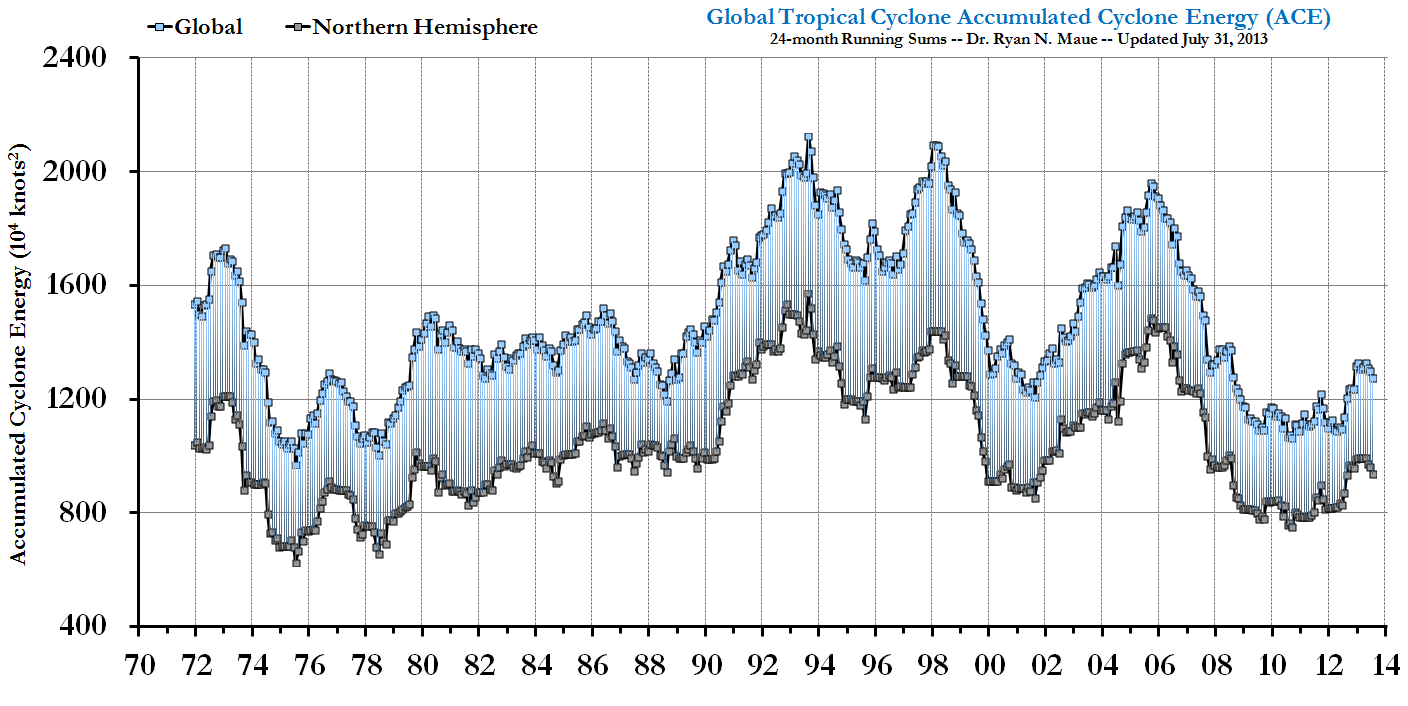
Of course, as you know, intensity as measured by ACE increased from 1976 to 1993, and has decreased since 1993:
"This resulted in greater wind speeds, and cyclonic clouds occurring at the storm fornts. This affects winds speed, but not necessarily rainfall."
I think I know what you are trying to say, but it is not quite so simple. By "cyclonic" clouds do you mean mesocyclones in the thunderstorm updrafts? Don't forget the role of low-level moisture coming off the Gulf of Mexico, where temperatures were much above average at the time of the outbreak.
And one does not necessarily need a front to trigger tornadic thunderstorms, severe or non severe. In fact, quasi-linear convective systems which often tend to develop along cold fronts produce far fewer tornadoes than do discrete supercells, or supercells embedded in a line. So the rather antiquated paradigm that tornadoes are caused by "cold air from Canada colliding with warm air from the south", while certainly true, does not tell the whole story.
But I must reiterate what I have said elsewhere-- any trends in tornadoes are really difficult to determine, and I would not say that they are a good example to use when making claims about an increase in extreme weather. That may turn out to be the case, but the data right now are just not good enough.
So, precipitation depends on most critically, convergence and increased humidity. These factors occur only in limited areas of the stereotypical mid latitude storm.
Were storms to occur in only one path, being of the same size, shape, and orientation each time, the preferred areas would be perpetually flooding while other areas would be drought stricken. And that's kind of what's happened this year in La Nina and aftermath - the west has record snowpack, the midwest is flooding while the south west is in drought.
To get 'normal' precipitation, storms need to be irregular such that wet and dry spells are spread out ( though not evenly ).
The case for AGW has merit.
But why do you believe that AGW has anything to do with the variability of mid latitude cyclones?
Part 1
Part 2
A quote from the landmark paper in Nature by Knutson et al.(2010), and that has a "skeptic" as a co-author:
"...future projections based on theory and high-resolution dynamical models consistently indicate that greenhouse warming will cause the globally averaged intensity of tropical cyclones to shift towards stronger storms, with intensity increases of 2–11% by 2100. Existing modelling studies also consistently project decreases in the globally averaged frequency of tropical cyclones, by 6–34%. Balanced against this, higher resolution modelling studies typically project substantial increases in the frequency of the most intense cyclones, and increases of the order of 20% in the precipitation rate within 100 km of the storm centre."
And a reminder, this is not so much about where we are now, but where we are going. For some phenomena (such as heavy rain, drought and heat waves, increasing trend are already emerging), for others it might well take longer before we can deal with attribution. But instead of using this as a reason for complacency, we should heed the warnings that are now occurring before our very eyes and take action.
Some interesting findings by Dr. Kerry Emanuel concerning the role of the cooling stratosphere (a fingerprint of AGW) on tropical storm strength can be found here.
"We can say that Florida receives a quarter of its precipitation from tropical cyclones."
Better, but 25% is still to high. They say in the paper, and I quote:
"The Yucatan and Florida Peninsulas and Caribbean Islands
also have significant TC rainfall (7%–20%), with the rest
of southeast U.S. coastal regions and central Mexico
having smaller percentages."
At #12 you say:
"So, precipitation depends on most critically, convergence and increased humidity. These factors occur only in limited areas of the stereotypical mid latitude storm."
The second makes no sense...these slips are tell-tell-signs that you are not proficient in this field, but trying to sound like you are.
NOAA Historical Hurricane Tracks
Wheat Rallying 20% as Parched Fields Wilt From China to Kansas
The take-away is that, while there are winners and losers, there is currently more than the regular amount of risk associated with growing food. For instance, rain that would normally fall in Texas and Kansas is missing and hurting yields; meanwhile, too much rain in more northern states is delaying planting, again hurting yields. Similarly, parts of China are flooding while others are in drought. It doesn't have to be huge dramatic events like hurricanes, a little shift of the rain bands here and there can have significant impacts.
FYI, ENSO has recently transitioned to neutral conditions.
[Source]
GISTEMP and NCDC shows that so far 2011 has been warmer than 2008 (another post la Nina year), and that global surface air temperature anomalies are firmly in positive territory. From the NCDC (same source as the above figure):
"The combined global land and ocean average surface temperature for January–May 2011 was the 12th warmest on record. The year-to-date period was 0.48°C (0.86°F) warmer than the 20th century average."
And a reminder that 2010 tied 2005 for the warmest year on record globally, despite the prolonged solar minimum and despite the development of one of the strongest La Nina's in recent decades.
And one last reminder, this is about long-term trends, but you know that do you not? ;) So please do not focus on individual years or short time frames (< ~20 years).
Check back in 2012 when the temperatures spike even higher. But again, this is about long-term trends and where we are potentially headed.
Synopsis: ENSO-neutral conditions have developed and are expected to continue at least through the Northern Hemisphere summer 2011.
A transition from La Niña to ENSO-neutral conditions occurred during May 2011 as indicated by generally small sea surface temperature (SST) anomalies across the equatorial Pacific Ocean east of the Date Line.
Strange indeed...if you don't want to know what is actually going on in the world.
1. There is an 8-12 month lag time for the effects of La Nina and what precip and temp will do.
2. The drought in Kansas/Oklahoma/Texas is a normal response to La Nina. The increased precip and cold temps are a normal response in the North Central US.
I can only recommend that some people who post about La Nina effects study before posting so that they don't look quit so foolish.
The long term climate outlook from NOAA has been epressing exactly what has/is happening for over a year.
Also, the current La Nina was not a strong one, as some have indicated.
Most folks want to ignore what the Univ of Florida's data shows. Not only has the number gone down, but the ACE has had a steady decline as shown.
That is expected to change, as there is a cycle exibited in hurricane creation and intensity. We have had the luxury of living in a long period of low intensity, as a rule, and low numbers as well.
If we get more relatively abnormal weather, with cold arctic air pushing south and warm temperate air pushing north (as has happened a few times in recent years), we could be looking at some very cool summer weather in some spots, and record warm weather in some northerly locations. On the other hand, we might see some more 'average' weather (notwithstanding that the NOAA climate 'normals' have increased by 0.5-2ºC over most of the USA, thanks to dropping off the 70s and adding in the 2000s).
Likely causes of changes in New Zealand precipitation.
You like the peer-review format. Here is a peer-reviewed article that shows the precipitation of Southwest Western Australia since the 1970's to present. If you look at the graph of precipitation over this time period, please explain how you see a trend and the trend is more extreme? I do not see it but maybe I need glasses.
Article on causes of precipitation variations in Australia.
"Nature's fury reached new extremes in the U.S. during the spring of 2011, as a punishing series of billion-dollar disasters brought the greatest flood in recorded history to the Lower Mississippi River, an astonishingly deadly tornado season, the worst drought in Texas history, and the worst fire season in recorded history. There's never been a spring this extreme for combined wet and dry extremes in the U.S. since record keeping began over a century ago, It was the most extreme spring on record" (117 years).
It was probably just the La Nina, worst in 117 years.
I don't know how it rated in your part of the world. This La Nina was extreme in Australia. Many parts of Australia had the wettest summer on record.
From the media release from the Bureau of Meteorology:
"This most recent La Niña [2010-2011] will go down in the record books as one of the strongest in living memory. It's been nearly 40 years [1975-76] since Australians have witnessed a La Niña event of this intensity," said Dr Watkins.
AFAIK global warming is deemed a contributing factor in the amount and intensity of rain here this past few months, amplifying the effects of La Nina.
Your point is my point. I do not know if waraming is driving the changes in SAM. I brought the article up because it does not make the claim global warming is the cause nor did it claim it was not the cause. It looked for the root known cause. Further research would be needed to see if global warming played a part.
I read articles on the web page daily but rarely post. This point is one that I find most unscientific and it prompts me to post.
In the above article the quote "How global warming affects weather parameters" should read How global warming may affect weather parameters.
Until you have the complete evidence to state the case it is unscientific to make the claims of certainty and mostly seems propoganda to get uninterested people interested in this issue. May be a necessary action if you believe the world is near doom if action is not taken very soon, but it is not a scientific approach. It is a shock the emotional core approach and it is the very thing that is generating such a wave of denial among the average citizen.
People have a natural resistence to what seems like emotional manipulation and react negative to it. When all extreme weather events (including very cold and heavy snow events especially without rigorous proof) are linked to global warming the Public becomes skeptical of the claims and turns of the channel. It does not serve your cause well and creates the very wall you are working to bring down.
Maybe you could provide the criteria that would convince you that Global Warming is affecting the weather ? What would it take to convince you ?
And, as a side-line, what is the "complete evidence" that has convinced you as to the validity of Evolution - that is, if you do accept it ?
Mechanisms would help. The claim is that there is 4% more moisture in the air (and this has a very high uncertainty factor and needs above and beyond proof as that moisture is entering and living the air at highly variable rates at any given period). The mountain ranges in US received well above 100% of their normal snowfall. If it would have been 104% then the claim that excessive snow is the result of a small increase in overal moisture levels in the air. When the snowfall is doubled it seems a far stretch that these events can be caused by that slight moisture increase.
On Evolution, the evidence is not just in the fossil record. That would be meaningless without the other factor. There is a mechanism for evolution that makes it a valid theory (but still not fact). That mechanism is that DNA is flexible, it can be changed by external forces. If it was a very stable molecule that was higly resistant to change than a mechanism would not exist and another explanation would be required to explain the fossil evidence.
In science one makes claims then they propose mechanisms that can explain these claims.
The graph you describe in your post is the one I am talking about. Extreme events would be excessive or much lower than normal rainfall. In the early part of the graph there were such extremes, then it seems to settle down for awhile and then extremes show up. Is there a trend in the frequency of the extreme events? Looks like there is not enough data available to make such a claim. A longer time frame is required for such.
That is not what the article claims. Global warming does not cause extreme weather events, but it increases the odds that such events will take place because of changes in the water cycle (and atmospheric circulation) brought on by rising sea and air temperatures.
The consequence of that has been that while floods in SWWA have almost entirely disappeared, drought has become effectively a permanent condition.
Moving from a situation in which you have either a drouht or a flood every three to five years into a situation in which you have drought in four out of five years represents a decrease in variability in the rainfall (which will show up in a detrended graph), but the drying will not; and itself results in a significant increase in extreme conditions relative to the twentieth century average.
While global warming theory predicts an increase in rainfall due to increased moisture, that does not correlate with snowfall. Snowfall is largely contralled by temperature; when the temperature rises above freezinf, the precipitation falls as rain. Historical data supports this. The snowiest winters are, on average, the coldest. The past two NH winters were both colder and snowier than the preceding winters.
Please cite references. It is well known that AGW theory predicts more precipitation in all seasons. During the winter this falls as snow. The last two winters were historically warm see here. There were a few spots in Europe and the US that were below average in temperature, but the entire Earth was hot. Your claim is apparently that your house was cold so therefore the entire Earth was cold. That is not correct.
Please provide data to support your wild claims that it was cold and that AGW does not predict more snow in a warming world.
From Weather Underground :
That it is snowy does not suggest that it is colder. If it gets warmer, it does not mean that we no longer see freezing temperatures in places like Michigan. If it gets warmer there is more water in the atmosphere, and when there is precipitation there will be more precipitation, and if it is below freezing, then that precipitation will be ice and snow. From a climate point of view it is more important to look at snow cover in the late winter and early spring. Is the snow melting earlier?
And from this very site :
Does record snowfall disprove global warming?
And, from the Union of Concerned Scientists :
It’s Cold and My Car is Buried in Snow. Is Global Warming Really Happening?
I have found that one of the easiest ways to understand just one mechanism by which precipitation will change, and how that mechanism will be affected by climate change (and this change is already being observed), is to study the Hadley Cells.
It's a fascinating subject, and easy to grasp. A quick Google will find you something at an introductory level, and you can go from there.
The basic idea, however, is that the intense warming at the equator (or rather, at the point of direct 90˚ solar incidence, which is at the equator in spring/fall but moves up/down a bit with winter/summer) causes that air to rise, laden with moisture. This cycles up, then north/south, then reaches a point where it falls back down.
The first point is that the area where it comes back down sees a lot of rain. The area in between is parched, and most of the world's deserts lie in these bands (but are, of course, subjected to other, local factors). Have a look at the globe and notice how most of the worlds deserts are just north and south of the equator, yet not at the equator, or just north of that arid band.
Because the point of 90˚ incidence moves with the seasons, so do the Hadley Cells, bringing seasonally consistent/predictable rainfall or dry periods to certain regions.
An increased global temperature will increase the size of the Hadley Cells (again, this has already been observed, so while it's not carved in stone, it looks to be true and hard to argue).
This means that those deserts will expand... the intervening arid areas will be larger.
It also means that some places that used to get seasonal rains will not any longer, while places that didn't get them (i.e. were just outside the Hadley Cell at the right time of year) suddenly do see that precipitation.
Spend some time reading up on it. It's a fun subject, and helps to move one beyond the too simplistic "an increase in rainfall due to increased moisture" point of view. It's obviously not that simple, and scientists are aware of it, even if we ourselves are not (always).
Very interestingly, two regions of the earth that will be subjected to climate change through this rather easy to understand mechanism (Hadley Cell expansion) are Australia and Texas, who are both in a way "big players" in climate denial.
Here is some information you may find useful.
History of Australia's droughts and causes.
You may want to look at page 3 and below to see if global warming is causing an increase in severity of Australian droughts.
Here is a quote from that page: "Many scientists believe that human activities associated with the generation of ‘greenhouse gases’ are causing climate change. (See STUDIES 2/2000.)
This, however, does not cause drought as it has been
experienced in Australia over thousands of years.
Natural climate change in Australia is caused by two
major elements – the changes in the pressure of air in
the atmosphere circulating between Tahiti and Darwin
(measured by the Southern Oscillation Index –
SOI); and the temperature of currents moving across
the equator from South America to the area to the
north of Australia (known as the El Niño effect)."
Here is an interesting article on Hadley cells.
Info on Hadley Cells.
http://onlinelibrary.wiley.com/doi/10.1002/joc.1014/pdf
http://www.springerlink.com/content/k631170346751481/
It's also important to note that that is a study of past climate, in a relatively steady, stable regime (1960-1993), in a very localized area (E. Europe). There is little that can be better than simplistically inferred from it about the impacts of serious climate change on global snowfall (or snowfall in other regions of the globe).
The same applies to your second paper, which studies the period from 1901-1994, and only in Switzerland. While temperatures did rise in that period (at most, 0.5˚C), I believe the extension of what is viewed there to the globe, under a dramatically changing climate regime and greater temperature increases (and accordingly greater precipitation pattern changes) is unwarranted.
In general, I believe your logic that overall snowfall will be diminished by the factor of the later onset of winter (cooler temperatures) and the early onset of spring (warmer temperatures) is valid, but the assumption that this factor will completely override any accompanying increases in precipitation during the winter months (due to other factors, such as specific humidity, and circulation patterns such as the Hadley Cell changes) is unwarranted.
In fact the persistent reduction in rainfall in SWWA is most probably a result of a southerly shift in the prevailing westerlies due to the Hadley cell getting larger - almost certainly a consequence of, and historically associated with rising global temperatures.
Rather than relying on appearances, can you provide any backing for any hypotheses you may have, especially if you believe that the global climate isn't warming ?