



 Arguments








How does Ljungqvist's reconstruction compare to others?
What the science says...
Ljungqvist's millennial temperature reconstruction was very similar to Moberg et al. (2005) and Mann et al. (2008). It also concludes that current northern hemisphere surface air temperatures are significantly higher than during the peak of the Medieval Warm Period (MWP). Further, arguing for a hot MWP is also arguing that climate sensitivity is not low - which undermines a critical argument for "skeptics".
Climate Myth...
Ljungqvist broke the hockey stick
Fredrik Ljungqvist created a 2000-year temperature history of the extra-tropical portion of the Northern Hemisphere (30-90°N) based on 30 proxy records. Certain "skeptics" have argued that his reconstruction shows greater natural variability than previous reconstructions, and that it shows the peak of the Medieval Warm Period (MWP) hotter than today's surface air temperatures.
Ljungqvist Compared to other Reconstructions
However, Ljungqvist's reconstruction is not substantially different from the many other millennial northern hemisphere temperature reconstructions, as the author himself states in his paper:
“Our temperature reconstruction agrees well with the reconstructions by Moberg et al. (2005) and Mann et al. (2008) with regard to the amplitude of the variability as well as the timing of warm and cold periods, except for the period c. AD 300–800, despite significant differences in both data coverage and methodology.”
Indeed by plotting Ljungqvist's data along with Moberg et al. (2005), Mann et al. (2008), and the surface temperature record, we can confirm that the three reconstructions are very similar (Figure 1).
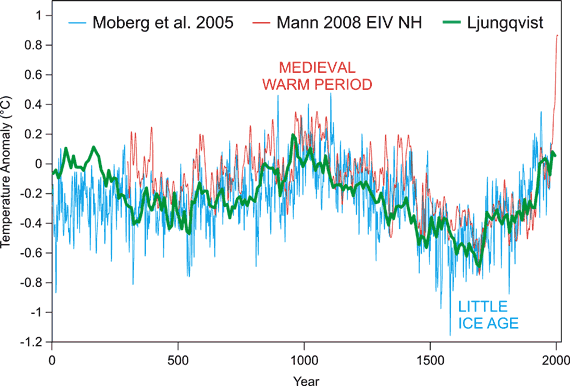
Figure 1: Moberg et al. 2005 NH (blue), Mann et al. 2008 EIV NH (red), and Ljungqvist 2010 NH (green). Courtesy of Robert Way and John Cook.
MWP Peak vs. Current Temperature
Contrary to "skeptic" claims that his reconstruction shows the peak of the MWP as hotter than today's temperatures, Ljungqvist says the following when combining his proxy reconstruction with recent instrumental temperature data:
“Since AD 1990, though, average temperatures in the extra-tropical Northern Hemisphere exceed those of any other warm decades the last two millennia, even the peak of the Medieval Warm Period”

Figure 2: Ljungqvist (2010) 30-90°N decadal averages (black) vs. HadCRUT land-ocean 30-90°N decadal averages (red). Courtesy of Robert Way.
What Reconstructions Tell Us
The NIPCC also claims that if the MWP was as hot as today (which it wasn't), that means that current global warming and climate change could be natural. It's true, hypothetically, the current warming could be natural, if there were a natural mechanism causing it. However, there is no such known mechanism. There is a measured energy imbalance caused by the increase in atmospheric greenhouse gases. We know that this energy must cause the planet to warm, and how much it warms depends on the climate sensitivity to the energy imbalance.
In fact, the hotter the MWP, the more sensitive the climate is to these energy imbalances. So arguing for a hot MWP is actually arguing that greenhouse gases must be causing significant global warming - the NIPCC has it exactly backwards.
Summary
Despite the different methodologies and data coverage used in Ljungqvist (2010), his reconstruction is consistent with previous peer-reviewed northern hemisphere temperature reconstructions, and like all previous peer-reviewed reconstructions, concludes that current temperatures are higher than the peak of the MWP. Claiming that the MWP was hotter than today is also counter-productive for "skeptics", because a hotter MWP means climate sensitivity is high.
Intermediate rebuttal written by dana1981
Update July 2015:
Here is a related lecture-video from Denial101x - Making Sense of Climate Science Denial
Last updated on 9 July 2015 by pattimer. View Archives







[dana1981] The figure in the post is correct. Ljungqvist terminates the data in his paper at 2000, so that's probably where the overlays you found on Google terminate as well. However, NH land temps did not stop warming in 2000. Our figure is up-to-date and uses the correct data, as other commenters have noted.
[dana1981] The error is that your "10 years" is more like 30 years. Each yellow dot represents a new decadal average. Some of the red data is included in Ljungqvist's study, but he omitted the final data point.
[DB] Please note that posting comments here at SkS is a privilege, not a right. This privilege can be rescinded if the posting individual treats adherence to the Comments Policy as optional, rather than the mandatory condition of participating in this online forum.
Please take the time to review the policy and ensure future comments are in full compliance with it. Thanks for your understanding and compliance in this matter.
I like how we are comparing Ljundqvist to Mann 2008, and Moberg. Just for fun I'm linking the GISP2 data. It seems to agree fairly well with the others.
http://www.hyzercreek.com/hockey3j.jpg
Because the GISP2 data only go up to 1900, I attempted to splice the last century of thermometr data (GISS) onto it to bring it up to 2013
http://www.hyzercreek.com/hockeysplice.jpg
I hope people enjoy my splice
[RH] Fixed image widths.
Morgan,
Have you spliced the GISS world wide temeprature record onto Ljundqvist's Northern Hemsiphere only data? Please provide citations for how you have concocted this graph. Why don't you compare the price of oranges to the price of gold? The OP shows that it is currently much warmer in the Northern Hemisphere than it ever was during the medieval warm period. Your post should be deleted as off topic. If you want to impress people you need to cite peer reviewed data, not graphs you make up after your frisbee golf tournaments.
Morgan... You do realize, don't you, that you are splicing a global record (GISS) onto a regional record (GISP2) of temperature... right?
And not only that, you're splicing a global record onto a very high latitude temperature record.
At risk of dogpiling - but Morgan, have you considered putting modern greenland temperature at the GISP2 site instead of a global average? (and I think the last record in GISP2 is 1855) . Don Easterbrook is the specialist in this nonsense. See here for more (including putting the modern temperature on).
As some may not want to trouble themselves following links, here is the GISP2 data with the difference in temperature between the end of the data and 2010 at the site appended, for comparison with Morgan Wright's effort @9:
That, however, is not the last word. Since the GISP2 data was analyzed by Alley et al, Kobashi et al (2011) analyzed the same ice core at higher resolution, and to a more recent date. The higher resolution shows some greater temperature excursions in the past. Kobashi et al also directly compare the proxy data with the reconstruction of modern temperatures at the site by Box et al (2010), and to the actual recent instrumental record at the site:
You will notice that the recent temperature was just, and briefly exceded during the MWP, and significantly (approx 3 C) exceeded around 750 C.E. (ie, prior to the commencement of the MWP). That, of course, is of little relevance except as regards temperatures in Greenland. A single site is not the globe. It is not the Northern Hemisphere. It is not even the extra tropical Northern Hemisphere. Pretending that it is, ie, that a single local proxy can substitute for a multi-proxy reconstruction is (at best) incredibly foolish.
An argument that such a local proxy is acceptably representative because "it seems to agree fairly well with the others" is jaw-dropping in its audacity. Such an appearance of similarity is, in fact irrelevant and gives no basis to trust the local proxy in prefference to the reconstruction - especially where they disagree. When the argument is backed by simple errors of fact (the original GISS2 reconstruction extends only to 1855, not 1900), and is followed by appending global temperatures to a local proxy to represent changes in extra-tropical NH temperatures, it is evidently an invitation to inaccurate analysis. The only thing correct in Morgan Wright's analysis is that he did in fact show the GISP2 data from Alley et al.
I just put the GISP2 chart here to show how it compares to the other 3 data sets. Looks like a nice fit. It also looks like some people are having a bad Monday.
Scaddenp that is a great idea, splicing modern Greenland Summit Station temps onto it. I probably should have done that. My bad.
Not a dogpile, more like puppies untying shoes.