





The Media & Global Climate Science Communication
Posted on 21 December 2011 by Brian Purdue
Communication – it’s Critical
Accurate and unbiased communication of information is essential when coming to an informed decision on any subject; and there is arguably no more compelling a subject than anthropogenic global climate change. Skeptical Science prides itself on being a website fully committed to communicating the science.
Pure climate science is complex, so it doesn’t take much misinformation to corrupt the communication process. When this is coupled with the remaining uncertainties inherent in the science, it is all-too-easy for the vocal “skeptic” view to confuse the public and the policy-making politicians.
Skeptical Science is playing an increasing role in disseminating the science and countering the misinformation, but the role of informing the less-engaged broader public still, and probably always will, remain with the mass media at the local, national and international level. This heavy responsibility is shouldered by small media outlets through to multinational media corporations.
Myths vs. Logical Facts
The problem is once misinformation, in the form of myths, is accepted as fact it becomes very hard to dislodge them from people’s general beliefs about the world, even when it can be clearly shown these specific beliefs are wrong. John Cook explains and demonstrates this in a recent presentation to the American Geophysical Union. A more detailed explanation of this phenomenon is given here. The media has played a major role in embedding these myths.
Matching the Media and Science Message
So what message should the mass media be communicating about climate change science?
The unambiguous message coming from the science is that to avoid dangerous levels of atmospheric carbon dioxide, all countries must put in place effective mechanisms, such as putting a price on carbon, to achieve a reduction in greenhouse gas emissions.
Paradoxically, the most recent studies show there is an acceleration, not decrease, in emissions; so the current message is falling mainly on deaf ears.
Emissions Reduction Progress?
Australia is the latest country to legislate such a mechanism, but this will have to be progressively strengthened to achieve the reduction goal. This tells the torturous and long path to enact the Australian legislation. During this period Australia’s mainstream media was hyperactive in the climate change debate.
Australian Media Study
A snapshot of Australia’s print media’s role is contained in a just-released study, which compiled data on the published material on climate change policy response from ten newspapers located in Australia’s capital cities.
A vigorous methodology was used, which included; Topic (Climate policy); Genre (Feature, News, Short Feature, Letters); Types and identity of sources quoted; A breakdown of business sources into different industries, and many other codings (refer to study).
The study’s key findings on published articles (carbon pricing policy) were:
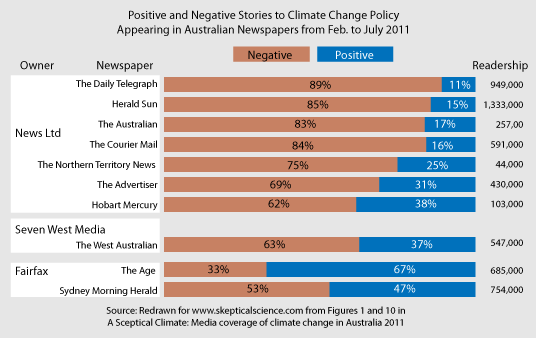
The article’s headlines were more unbalanced than the actual content of articles.
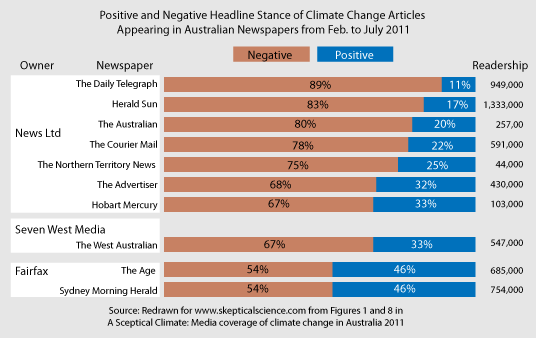
(Note: News Ltd. controls around 70% of Australia’s print media.)
There has been no equivalent studies done covering the radio and television media but from observing their output on climate change policy a similar result could be extrapolated.
Editorial Policy
The study’s results may come as a surprise to some because the Australian (News Ltd. flagship) has repeated stated in climate change editorials that, in respect to greenhouse warming, we must give the planet “the benefit of the doubt”. This editorial policy is not reflected in the study.
A Bright Future for the Media!
It is almost unanimously agreed that global temperatures over the past hundred years have risen (the diehards still say otherwise). The science shows this has been almost entirely caused by greenhouse gas emissions, and to a lesser degree by related land-use practices that result in deforestation and desertification.
Human activity has become a global force in nature.
One of the consequences of a warming planet is heat related extreme weather events, both in frequency and intensity. This is pretty basic physics so you don’t have to be a climate scientist of understand the principle involved.
The media report these weather events and their flow-on effects, so in the future there will be a corresponding increase in vision footage, printed words and verbal broadcast material.
One of the beneficiaries of global warming will be the media - but it will be a sorrowful tale to tell.

Arguments


“You can follow the logic to its conclusion: Conservatives are more likely to embrace climate science if it comes to them via a business or religious leader, who can set the issue in the context of different values than those from which environmentalists or scientists often argue. Doing so is, effectively, to signal a détente in what Kahan has called a ‘culture war of fact.’ In other words, paradoxically, you don't lead with the facts in order to convince. You lead with the values—so as to give the facts a fighting chance.”
Source: “The Science of Why We Don't Believe Science: How our brains fool us on climate, creationism, and the vaccine-autism link,” by Chris Mooney, Mother Jones May/June 2011 Issue
To access Mooney’s insightful article, click here
His most recent DeSmog Blog post “The Climate-Media Paradox: More Coverage, Stalled Progress” is particularly provocative when juxtaposed with Brian Purdue’s excellent article.
To access Mooney’s “The Climate-Media Paradox: More Coverage, Stalled Progress”, click here.
Julia Gillard is an unusually courageous politician to take on this type of print media opposition. It is surprising that climate change science retains a hold on the Australian public.
Is this repeated in other media? Or have bloggers and science communicators been unusually effective by other means?
If you look at the liberal policy here you find not a single word denying the climate science. The disagreement is only about the policy: liberals favour their "direct action" and try disproving the carbon tax method being implemented by govs. If Tony Abbott digress sometimes that "science is not settled yet", that's because Tony's mind is influenced more by some external events like 'lord' Monckton speaches rather than his own reasoning. Look at other liberal leaders, like Malcolm Turnball for more reasonable representatives.
So, this report, as confirmed by Brian, is about the climate policy. The one about climate sicence will be different. IMO.
I expect the results will make the Australian print media look rather dismal.
In fact the Liberal Party is deeply divided on the science of climate change. While some Liberal Party MPs (of which Turnbull is the most noted example) accept the science, others (Bill Heffernan comes to mind) are clearly deniers. Opinion is divided as to whether Tony Abbot, the leader of the Liberal Party denies climate change out of conviction or convenience, it remains the fact that he has said that "Climate Change is crap."
As Turnbull has observed, the only significant virtue of the Liberal Party's policy is that it is an easy policy to stop. It exists as a screen against attacks on the party that they are climate change deniers, which are perceived as politically damaging. However, as the very expensive policy is associated with no funding proposal, and the Liberal Party is committed to reducing taxes and hence revenue overall, the correct interpretation is that this is a policy designed to not be implemented. It is a smoke screen only.
I hope someone has submitted this study to the Australian federal government's current Independent Media Inquiry. News Ltd. needs to be held to account. The Daily Telegraph, for example, is blatantly in breach of its own "code of ethics".
I guess the Dentists have spoken!!!
Not off topic at all, when it is presented as a clear example of the problems that we are facing with respect to accurate and effective communication by the media.
The guy with the loudspeaker trumps all voices. Especially, with all the social media noise.
I like the saying "Death by data", where you generate so much irrelevant data for a project that in the end you don't have time to analyze or even find the relevant data. The same is true with information : "Death by information". That is the problem that social media have generated for people that do not have the time, the will, or event the tools (mental or otherwise) to collect, analyze, draw conclusions etc.
I despair looking at the fact that politicians, forming the policy for the response or not to global warming, are IMO at a low point with respect to the quality and accuracy of information that are fed to them by their underlings.
@14 - You have hit the nail on the head with one of your quotes about the person with the loudspeaker. I find this to be quite common even in basic dialogue with fellow workers. One denialist shouts or yells out loud that AGW is a hoax, so everyone likes to believe him and think he is an expert. Frankly it reminds me of one of my childrens temper tandrums. However as he shouts it out loud I think the average Joe see's this as confidence and therefore believe he must know what he is talking about.
The statement was made in article “So what message should the mass media be communicating about climate change science?” The mass media is NOT getting the climate science message out – you have to go to specialised media sources for that.
The decline of journalistic standards (not the fault of most journalists) is self-evident in the absence of “accurate and unbiased” communication of climate change science.
Your example of the introduction of pseudoscience by the media is not an isolated case but typical of the way the industry operates.
The article was about highlighting the mass media climate science communication problem - not fixing it!
The quick and dirty answer to your question is that efforts were made in the 1990s to limit the amount of media ownership by another media moghul. While all attention was limiting the extent of the Packer empire, particularly in television, the newspaper market was slowly shrinking. Fifteen years ago most Australian cities had two competing newspapers for consumers to choose from. Now, all but Sydney and Melbourne have only one paper each.
Murdoch papers now dominate because the smaller operators have died off. Attention was paid by government to limiting how much of the market a company could buy up but had no answer for how to stop a near monopoly growing by virtue of it's competition witherring on the vine.
The threads of misinformation are woven closely.
“There has been no equivalent studies done covering the radio and television media but from observing their output on climate change policy a similar result could be extrapolated”.
Please note the first post question for this column (not from me), in these comments. I hope you will respond to that poster's question. It would be very helpful for me, if you could actually define "negative" and "positive" for these charts. Does negative mean the article or headline says there isn't GCC, or that there might be, but humans are not to blame/can't fix it/it is "normal" cycles, or they were against policy changes or money budgetted toward the problem? And must "positive" articles/headlines be 100% in agreement with science and policy? Where do articles with mixed results land?
I would very much love to share these charts, but first, I need to know something of the parameters that put an article or headline into one category or the other.
Again, thank you, thank you, for your website.
Best,
Shoe
According to the study that Brian Purdue's article is based upon:
"positive" means that an article was positive towards the proposed carbon policy; and,
"negative" means that an article was negative towards the proposed carbon policy.
The methodology employed by the study is set forth on pages 21 thru 23 of the report, "A Sceptical Climate: Media coverage of climate change in Australia 2011: Part 1- Climate Change Policy."
To access a PDF of this report, click here.
Under each chart in article you will see reference to the figure numbers of charts in the study from which they were directly copied. They combine information from two separate charts in study to make them more comprehensive in detail.
If you are now confident about the data collection methodology feel free to share.
Indeed, I agree I painted the image of AUS Liberals (LIB) in my previous comment as too rosy. I was trying to say that the situation with respect to AGW in AUS politics is not as bad as it is in US. LIB's official docs do not deny the bottom line facts about CO2. Further to that Monckton, while visiting AUS earlier this year, was not allowed to pronounce his ridiculous testimony in Canberra's Parliament as he did in US Congress. It's hard to believe today, that back in 2008-2009, under the leadership of Michael Turnbull (a strong-minded conservative), LIB supported the ETS similar to that just introduced today by the ruling party (ALP).
But, sadly, the denialist voices within LIB prevailed when 2y ago, the caucus knocked down MT and elected Tony Abbott, who is just a silly puppet, IMO. I agree with you and MT, that their current "direct action plan" is worthless. So TA, who later sort of appologised for his "climate science is crap" comment as pronounced in "hyperbolic state of mind", should rather have said that about his own direct action policy. He would be very inappropriate about it, but at least sort of right.
Someone above praised Julia Gillard (current PM) for her currage in this divided political world. No doubt a strong and harismatic leader, JG however with respect to ETS, implemented northing more than her predecessor (Kevin Rudd) conceived yet in 2007. If talking about courage here, we should not forget a couple of independents Rob Oakeshott and Tony Windsor, who gave their support to ALP. Without RO and TW, ALP would not be able to rule let along do anything in the hang parliament situation we have here. RO & TW joined ALP despite harsh criticism in media and loud voices suggesting their background predisposes them towards LIB. I think more reasonable stance of ALP towards AGW weighed heavilly on RO & TW decision to join ALP rather than LIB. That's a lots of courage, and let's remember that without it ALP would not have been ruling here and ATS would not be alive.





