





Is Willis Wrong at WUWT? or Sensitivity and Sensibility I
Posted on 7 July 2010 by MarkR
Guest post by Mark Richardson
Willis Eschenbach at Wattsupwiththat has invented a way to calculate climate sensitivity – how much temperatures go up when you heat Earth. He takes changes in temperature and sunlight between summer and winter for each latitude then divides one by the other and concludes that if you doubled CO2 on Earth, temperatures would rise ~0.05 oC. The IPCC reckons 2-4.5 oC and Willis thinks they’re wrong because thunderstorms cancel out the heating. Wow!
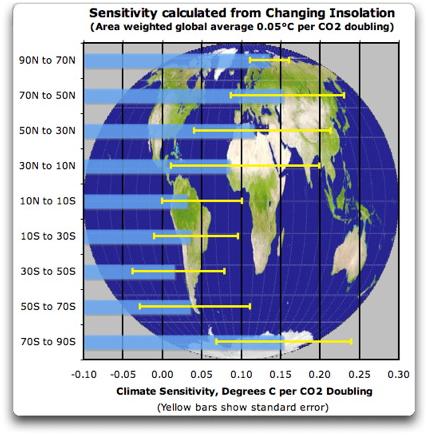
Figure 1 – Climate sensitivities in oC per CO2 doubling based on assuming that regional winter-summer changes in sunshine and temperature have the same relationship as changing CO2 globally over centuries.
Willis’ 3 obvious mistakes are that he isn’t calculating any of the IPCC’s climate sensitivities (neither equilibrium, effective nor transient), that regional and global heating are different, and that 6 months is a short time.
Here’s all 3 in action: yesterday London changed 14 oC from day to night whilst sunlight changed about 750 W m-2 which gives ~0.07 oC warming for a CO2 doubling. Is this because of thunderstorms, or because you’re looking at one place for too short a time? Thought experiments should help explain the physics behind this sleight of hand.
The ball in a box
Imagine a ball in a vacuum with two lights shining on it from opposite sides. If you turn up both lights then the ball warms up until it gives out enough extra infrared to cancel out the heating. This is where the textbook value of ~1 oC warming for doubling CO2 without feedbacks comes from (Lorius 1990).
On the other hand, if you turn one light up and one down by equal amounts and the sphere is a perfect thermal conductor then as soon as one side heats up it conducts the heat to the other side and the sphere won’t change temperature at all. Willis reckons that you can measure the change in temperature and light on one side and then calculate the ‘sensitivity’ of the whole sphere to be zero: which is wrong.
The kettle and the clock
Sometimes climate sensitivity is estimated from quick changes like volcanic eruptions (e.g. Forster and Gregory or Yokohata et al), but they account for how Earth is still heating up in such short times.
Imagine you turn on a kettle & hold the button down for hours. The water boils off and you report that the water is sensitive to the kettle. Your friend turns on the kettle for 10 seconds then measures the temperature change and reports that your claim of kettles boiling water is ‘a cruel joke.’
Heat flows and sensitivity
The 2-4.5 oC warming for doubled CO2 (IPCC 2007) is the equilibrium value – once Earth has warmed up so that heat in equals heat out.
Looking at the short term means you haven’t seen all of the heating: just like the kettle you only turned on for 10 seconds. If you measure a lot of heat going into the atmosphere and oceans then you’re far from equilibrium and underestimating sensitivity.
If you only look at one region and lots of extra heat is being transferred to another region, like with the conducting ball, you’ll see less warming and you’ll underestimate sensitivity.
In part II we’ll look at how much heat is stored during summer or moves around throughout the year.

Arguments


Meanwhile Gish is galloping once again... As you say, Mark, a simple thought experiment suffices to show this one's ridiculous. Why can't regular readers of WUWTF (spelling intentional) see through this for themselves? I mean, really: if there is a serious case that the science is flawed (and I've been looking hard for a few years in the faint hope that things aren't as bad as I fear they are), why do they entertain this sort of drivel?
"The Gish Gallop is an informal name for a rhetorical technique in debates that involves drowning the opponent in half-truths, lies, straw men, and bullshit to such a degree that the opponent cannot possibly answer every falsehood that has been raised, usually resulting in many involuntary twitches in frustration as the opponent struggles to decide where to start. It is named after creationism activist and professional debater Duane Gish."
It's sad. but ignoring such bullshit as Willis E's last groundbreaking research results altogether can only make things worse. So I think we should rather take this more as entertainment. And we should be aware of the Gish Gallop phenomenon, and try to develop simple and efficient counter rhetorics against the denialists.
As for the sensitivity issue, I think it is wise to be very careful and rather use very conservative estimates. The full sensitivity can only be assessed after several hundred years, when the system has reached a new equilibrium, and in the meantime, the people who shout "hey, the observed sensitivity is less than you said" will be kind of right. In the transition, quasi-periodic phenomena may also crop up and confuse a lot.
Can we establish a list of things which both sides of the debate agree on?
Because I think the more sensible sceptics will agree with quite a lot, and if they do, then their less knowledgable(how do you spell it?) followers might stop coming up with stupid arguments.
We could start with very simple things, like what the earths temperature would be if there was no water or greenhouse gases in the atmosphere.
I've been internet chatting with people who wave this around like a banner. I know they'll never accept any physics or evidence that goes against what they believe, but other laypeople who'd otherwise fall for Willis' sleight of hand might do so. I hope this would help them.
It's also a cautionary tale for any estimates of climate sensitivity from regional methods: including Lindzen's estimates of climate sensitivity from top of atmosphere tropical radiation.
/"Sometimes this sort of back of the envelope analysis is more powerful than sophisticated modeling because it is based on the real physics even if we do not understand all the physics we know the results are real."/
Wow indeed. According to Willis's value for climate sensitivity, the ~7°C rise in global average temperature at the end of the last glaciation must have been caused by a whopping 560W/m² change in forcing.
It depends on how much "forcing" comes from CO2, which in turn depends on the sign and strength of water vapor + cloud feedback.
As the water cycle is pretty fast (average residence time of water in troposphere is ~9 days, in stratosphere less than a month), the parameters of the water feedback can be determined from short term studies. Neither 30+ year "climatologies" nor computational climate models are needed. Proper measurement of atmospheric water response to seasonal changes of insolation (& SST) should be sufficient.
NH continental glaciation is a different matter. In that case most of the positive feedback comes from mid-latitude surface albedo changes, which is a slow process, on the order of millennia.
QUESTION: Willis Eschenbach recently estimated the Earth’s climate sensitivity by examining winter vs. summer temperature and insolation at different latitudes:
“My insight was that I could compare the winter insolation with the summer insolation. From that I could calculate how much the solar forcing increased from winter to summer. Then I could compare that with the change in temperature from winter to summer, and that would give me the climate sensitivity for each latitude band.”
From this estimate of climate sensitivity, Eschenbach concludes that the climate sensitivity to a doubling of atmospheric carbon dioxide is approximately 0.05 degrees C. This is in contrast to the IPCC climate sensitivity range of 2 to 4.5 degrees C. Explain why this is NOT an informative way to estimate climate sensitivity.
ANSWER: The main flaw in Eschenbach’s analysis is that the time period over which sensitivity is calculated (6 months) is too short. Thus, there is not nearly enough time to reach equilibrium (this is especially important given that the IPCC presents sensitivity at equilibrium). The heat capacity of the Earth is far too great to allow much of a temperature response over such a brief period. In contrast, if the Earth stopped orbiting the sun and the seasons remained fixed, then there would eventually be enough time to assess the equilibrium temperature response to such a large solar forcing. The equilibrium response would likely be very large indeed, yielding a much greater sensitivity value. However, this would still underestimate the true sensitivity because of teleconnections in the climate system, i.e. the Northern and Southern hemispheres are not isolated from each other in terms of energy flows. Energy from the summer hemisphere flows to the winter hemisphere and would reduce the apparent climate sensitivity.
A comparison with the planet Mercury is useful. On Mercury, there is very little heat capacity (e.g. no oceans, no atmosphere) and virtually no teleconnections (e.g. no oceans, no atmosphere). Thus we would expect its temperature to respond far more rapidly to changes in solar insolation (as it does). Eschenbach’s analysis of climate sensitivity based on seasonality might work for Mercury, but it is fundamentally inappropriate for Earth.
Beyond examining the assumptions of Eschenbach’s analysis, it is also worth examining its implications. A sensitivity of 0.05 degrees C to a doubling of CO2 is equivalent to 0.014 degrees C / Wm-2. This value suggests that the ~7 degree C change between glaciations would require a forcing of 518 Wm-2. This is greater than the average solar insolation of the entire planet (342 Wm-2)! This simple examination reveals that Eschenbach’s sensitivity is far too low to make any sense – the result of the extremely short time period over which it was calculated and the unaccounted for heat exchanges between hemispheres.
In short: Eschenbach takes an extremely large forcing (summer versus winter insolation), assesses the response over an extremely short period of time (summer to winter), and comes up with an extremely low sensitivity. What you put in is what you get out. Tada!
It depends on how much "forcing" comes from CO2, which in turn depends on the sign and strength of water vapor + cloud feedback.
It seems that Eschenbach is assuming 'interchangeable' forcings in terms of Wm-2 values - he's assuming net effects with feedbacks included (although he seems to only believe in negative feedbacks anyhow...). Case in point: he uses a strictly solar forcing to estimate a strictly CO2 forcing. Using this net forcings approach, one can simply convert the CO2 sensitivity to its degrees C / Wm-2 value (0.014). Hence the whopping forcing required to come out of an ice age.
if there is a serious case that the science is flawed...why do they entertain this sort of drivel?
I think you just answered your own question.
This is all they've got.





