



 Arguments







Part One: How do ice sheets lose ice?
Posted on 14 July 2010 by robert way
Guest post by Robert Way
Some individuals have a distinct predisposition towards creating illogical arguments. Certainly most of you are now familiar that Watt’s Up With That (WUWT) is often the mechanism through which these faulty arguments are delivered. Recently it became all too clear that Steven Goddard and his camp were going to be hauling out a new argument from their cupboard and that they had every intention of using it as much as possible. The argument which is shown here and has been used again here is that absolute air temperatures throughout most of Antarctica are below 0°C (and will likely remain that way) therefore significant ice losses on the Continent cannot occur. This sort of argument might work well with those already positioned to believe whatever the disinformation factory (WUWT) churns out but for fear of the unsuspecting public becoming tainted, it needs to be addressed. I must begin by asking for your patience as we go back in time to a world where bloggers read papers and supported their ideas with critical appraisal and this weird group of things called facts…
To begin, this will be a three part series with this post consisting mainly of basic glaciology to help people understand why glaciers lose mass.
Glaciers are large viscous masses of ice which creep naturally through a process called internal deformation. This “creep” or movement is caused by gravity and the weight of accumulated snow and ice forcing the ice to deform like plastic.

(Figure 1: Midtsdalsbreen,
Glaciers gain mass through accumulation of snowfall and through re-freezing of meltwater but lose mass (termed ablation) through surface melt, basal melt, sublimation and iceberg calving (Figure 2, right). The accumulation of ice primarily occurs in the glacier’s accumulation zone and ice loss generally originates in the glacier’s ablation zone (Figure 2, left).
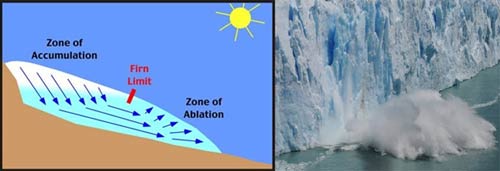
(Figure2, accumulation/ablation zones, www.physicalgeography.net, image of calving glacier on right)
For an ideal glacier, ice flow through a cross-section must exactly balance the accumulation and ablation taking place (Benn and Evans, 1998, 142). The difference between the total gains and losses measured over a specified time refers to the mass balance. Mass balance is usually measured over the course of a year which computes the sum of all the annual accumulation and ablation (Benn and Evans, 1998, 75). The velocity at which a glacier moves whereby its Mass Balance is 0 represents the point at which its inputs (through accumulation) equals its outputs (through ablation) and is termed the Balance Velocity (Figure 3).
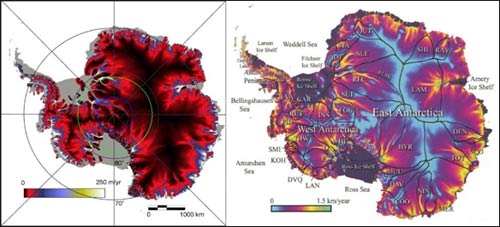
Figure 3: (Left) Balance Velocities for Antarctica as illustrated in Bamber et al (2009). (Right) Actual velocities across the ice sheet as measured by Rignot and Thomas (2002).
As every individual basin is rarely in balance, the actual velocities of glaciers/ice streams across
The question of balance velocities brings us to one of the most important points of this post. When a glacier is in balance or flowing at its balance velocity, net mass will remain balanced. However, when a glacier accelerates while near or at its balance velocity, the outputs resultantly increase but the inputs do not, thereby shifting the glacier regime to one of negative mass balance or net ice loss. This situation is particularly important because accelerated ice flow is the key method through which the Antarctic ice sheets incur a net ice loss. Accelerations such as these occur through two primary mechanisms. The first of which is caused by water reaching the bed of a glacier which results in less frictional forces opposing glacier movement. This mechanism has been observed in Greenland as being caused by increased surface melt water reaching the glacier's bed resulting in accelerated ice flow (Bell 2008).
The second mechanism refers to when the forces at the downstream terminus of a glacier or ice stream are disturbed or altered. This can occur through removing buttressing ice shelves or by shifting the glacier’s grounding line (point where glacier ice reaches floatation). The presence of an ice shelf provides a longitudinal compressive force which slows the flow of ice streams. If removal of this compressive force occurs, velocity of ice streams increase. This has been observed directly by Scambos et al (2004) and Rignot et al (2004) through both visual observations (Scambos) and radar interferometry (Rignot).
In terms of a grounding line retreat, progressive ungrounding of ice can be caused by thinning of the glacier. This inland shift of the grounding line can reduce the glacier's resistance to flow subsequently increasing the longitudinal strain rate of ice and thereby resulting in further acceleration and vertical thinning. The increased vertical thinning can then further enhance grounding line retreat completing the cycle. Grounding line retreats in Antarctica also tend to allow for warm sea water to penetrate deeper into ice streams and contribute to ablation through basal melting. This process can result in increased glacier velocities and subsequent inland thinning as more ice is being pulled from the accumulation zone (
We should all now at least remotely understand that mass balance changes in
I would like to thank Professor and Renowned Glaciologist Jon Ove Hagen for helping proofread all three parts of this post.
References
Benn, Douglas & Evans, David. (1998). Glaciers and Glaciation. Oxford University Press Inc. 1-734.
Rignot, E., Casassa, G.,Gogineni, P.,Krabill, W., Rivera, A. & Thomas, R. 2004. Accelerated ice discharge from the
Scambos, T., Bohlander, J.A., Shuman, C.A. & Skvarca, P. 2004. Glacier acceleration and thinning after ice shelf collapse in the Larsen B embayment,
Shepherd, A., Wingham, D. & Rignot, E. 2004. Warm ocean is eroding West Antarctic ice sheet. Geophysical Research Letters, 31, 1–4.
NOTE: This blog post has been adapted into a response to the skeptic argument "Antarctica is too cold to lose ice".


 0
0  0
0






Comments