



 Arguments







Why positive feedback doesn't necessarily lead to runaway warming
Posted on 13 September 2010 by nealjking
Some skeptics ask, "If global warming has a positive feedback effect, then why don't we have runaway warming? The Earth has had high CO2 levels before: Why didn't it turn into an oven at that time?"
Positive feedback happens when the response to some change amplifies that change. For example: The Earth heats up, and some of the sea ice near the poles melts. Now bare water is exposed to the sun's rays, and absorbs more light than did the previous ice cover; so the planet heats up a little more.
Another mechanism for positive feedback: Atmospheric CO2 increases (due to burning of fossil fuels), so the enhanced greenhouse effect heats up the planet. The heating "bakes out" CO2 from the oceans and arctic tundras, so more CO2 is released.
In both of these cases, the "effect" reinforces the "cause", which will increase the "effect", which will reinforce the "cause"... So won't this spin out of control? The answer is, No, it will not, because each subsequent stage of reinforcement & increase will be weaker and weaker. The feedback cycles will go on and on, but there will be a diminishing of returns, so that after just a few cycles, it won't matter anymore.
The plot below shows how the temperature increases, when started off by an initial dollop of CO2, followed by many cycles of feedback. We've plotted this with three values of the strength of the feedback, and you can see that in each case, the temperature levels off after several rounds.
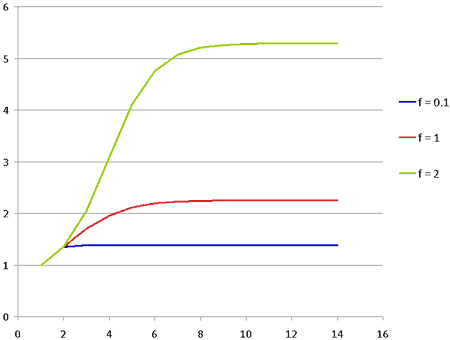
So the climatologists are not crazy to say that the positive feedback in the global-warming dynamic can lead to a factor of 3 in the final increase of temperature: That can be true, even though this feedback wasn't able to cook the Earth during previous periods of high CO2.
Note: this is a new rebuttal written by Neal J. King to the skeptic argument "Positive feedback means runaway warming", a sentiment sometimes expressed in comments on this website. In a first for Skeptical Science, Neal actually wrote all 3 levels of this rebuttal in one fell swoop. So as well as the Basic Rebuttal (which is used in this blog post), those seeking a little more meat can opt for the Intermediate Rebuttal which goes into more detail about gain factor. For the climate tragics (you know who you are), the Advanced Rebuttal lets you dive into the equations Neal used to derive his results.


 0
0  0
0 which in turn leads to subsidence,
which also leads to greater loss to space of IR)
The global area of subsidence greatly dominates the global area of rising
air ( convection takes place mostly at the ITCZ and
along frontal boundaries, subsidence, largely caused by IR cooling aloft covers a much larger area even though the mass of air exchanged should balance. ):
which in turn leads to subsidence,
which also leads to greater loss to space of IR)
The global area of subsidence greatly dominates the global area of rising
air ( convection takes place mostly at the ITCZ and
along frontal boundaries, subsidence, largely caused by IR cooling aloft covers a much larger area even though the mass of air exchanged should balance. ):
 Finally, lots of papers demonstrate a seasonal temperature humidity correlation.
But it's important to realize that a large
contribution to this is dynamic ( dynamic migration of the ITCZ, subsidence and cold(dry) air mass migration in the winter hemisphere, etc. ).
Observations do support some moistening of
the surface, but since drier air over more humid air
actually increases the IR cooling rate, it may well be that the water vapor feedback is actually negative.
Finally, lots of papers demonstrate a seasonal temperature humidity correlation.
But it's important to realize that a large
contribution to this is dynamic ( dynamic migration of the ITCZ, subsidence and cold(dry) air mass migration in the winter hemisphere, etc. ).
Observations do support some moistening of
the surface, but since drier air over more humid air
actually increases the IR cooling rate, it may well be that the water vapor feedback is actually negative.

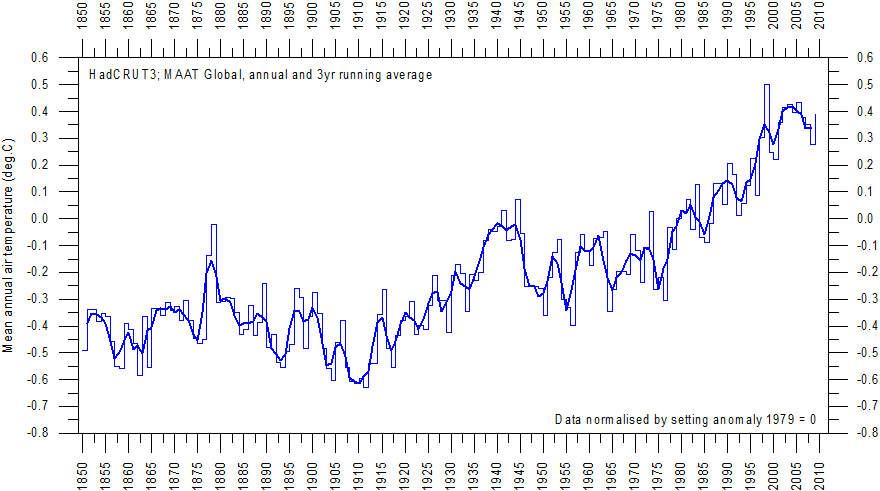 3. In fact, from 1910 through 1945, the CRU
land/ocean index rose at a rate (1.7K/century) that
is greater than the current rate (1.6K/century), even though GHGs were increasing at a rate of about one third of the recent rate.
If one assumes that recent warming is due to GHGs,
then something else must have contributed to
the 1910-1945 warming to keep the scaling consistent.
This period is certainly consistent with an increase in insolation:
3. In fact, from 1910 through 1945, the CRU
land/ocean index rose at a rate (1.7K/century) that
is greater than the current rate (1.6K/century), even though GHGs were increasing at a rate of about one third of the recent rate.
If one assumes that recent warming is due to GHGs,
then something else must have contributed to
the 1910-1945 warming to keep the scaling consistent.
This period is certainly consistent with an increase in insolation:
 So too, of course, is a period of centuries long
high temperatures commencing in the latter half of the twentieth century.
From the CRU data set, the recent warming is not
at a record rate, though it has taken us to higher
absolute temperature levels.
By the way, the IPCC says the
"Best estimate for a 'low scenario' is 1.8 °C"
They describe the 'low scenario' as the 'most optimistic'.
When was the last time you heard the warming is
taking place at a rate better than the 'most optimistic'?
So too, of course, is a period of centuries long
high temperatures commencing in the latter half of the twentieth century.
From the CRU data set, the recent warming is not
at a record rate, though it has taken us to higher
absolute temperature levels.
By the way, the IPCC says the
"Best estimate for a 'low scenario' is 1.8 °C"
They describe the 'low scenario' as the 'most optimistic'.
When was the last time you heard the warming is
taking place at a rate better than the 'most optimistic'?
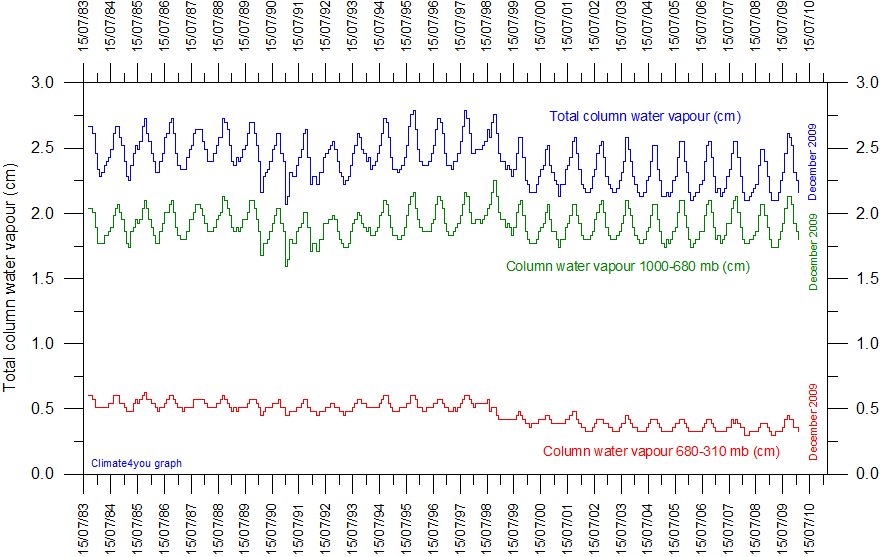
 and relative humidity:
 as outlined by Paltridge, Arking, and Pook:
http://www.springerlink.com/content/m2054qq6126802g8/fulltext.pdf
Particularly in the tropics, the region that Dessler and Sherwood assess to control water vapor feedback.
This appears to be consistent with the ICCSP data as well:
as outlined by Paltridge, Arking, and Pook:
http://www.springerlink.com/content/m2054qq6126802g8/fulltext.pdf
Particularly in the tropics, the region that Dessler and Sherwood assess to control water vapor feedback.
This appears to be consistent with the ICCSP data as well:








Comments