





The question that skeptics don't want to ask about 'Climategate'
Posted on 18 November 2010 by John Cook
A year ago, the climate debate was rocked by 'Climategate'. Email servers at the University of East Anglia were hacked, emails were stolen and distributed on the Internet. Out-of-context quotes were cited as evidence that the entire scientific case for global warming was all just a conspiracy. Even now, 12 months later, 'Climategate' is the most popular skeptic argument. But there is one question that skeptics seem to avoid:
Has 'Climategate' changed our scientific understanding of global warming?
Has the science changed? Is there any change to the many independent lines of evidence for human-caused global warming? This question is never asked because of the answer:
The evidence for human caused global warming is as solid as ever.
There are many lines of evidence that humans are causing global warming. Independent measurements of different aspects of the climate using a range of techniques by scientists all over the world all point to the same answer. When we consider the full body of evidence, we see a distinct, discernable human fingerprint on climate change.
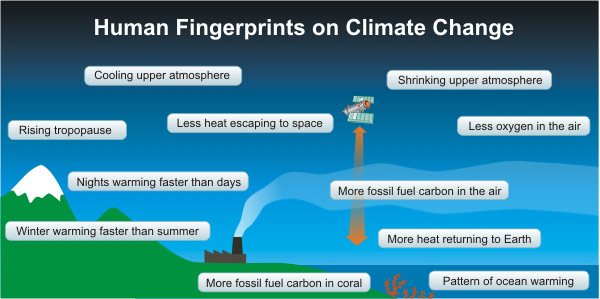
The 'Climategate' controversy is an attempt to divert attention away from the science. This is a common tactic in movements that seek to deny a scientific consensus - assume a conspiracy theory. But there is no evidence of any conspiracy. A number of independent enquiries have investigated the conduct of the scientists involved in the emails. All have cleared the scientists of any wrong doing:
- In February 2010, the Pennsylvania State University released an Inquiry Report that investigated any 'Climategate' emails involving Dr Michael Mann, a Professor of Penn State's Department of Meteorology. They found that "there exists no credible evidence that Dr. Mann had or has ever engaged in, or participated in, directly or indirectly, any actions with an intent to suppress or to falsify data". On "Mike's Nature trick", they concluded "The so-called “trick”1 was nothing more than a statistical method used to bring two or more different kinds of data sets together in a legitimate fashion by a technique that has been reviewed by a broad array of peers in the field."
- In March 2010, the UK government's House of Commons Science and Technology Committee published a report finding that the criticisms of the Climate Research Unit (CRU) were misplaced and that CRU’s "Professor Jones’s actions were in line with common practice in the climate science community".
- In April 2010, the University of East Anglia set up an international Scientific Assessment Panel, in consultation with the Royal Society and chaired by Professor Ron Oxburgh. The Report of the International Panel assessed the integrity of the research published by the CRU and found "no evidence of any deliberate scientific malpractice in any of the work of the Climatic Research Unit".
- In June 2010, the Pennsylvania State University published their Final Investigation Report, determining "there is no substance to the allegation against Dr. Michael E. Mann".
- In July 2010, the University of East Anglia published the Independent Climate Change Email Review report. They examined the emails to assess whether manipulation or suppression of data occurred and concluded that "The scientists’ rigor and honesty are not in doubt".
- In July 2010, the US Environmental Protection Agency investigated the emails and "found this was simply a candid discussion of scientists working through issues that arise in compiling and presenting large complex data sets."
- In September 2010, the UK Government responded to the House of Commons Science and Technology Committee report, chaired by Sir Muir Russell. On the issue of releasing data, they found "In the instance of the CRU, the scientists were not legally allowed to give out the data". On the issue of attempting to corrupt the peer-review process, they found "The evidence that we have seen does not suggest that Professor Jones was trying to subvert the peer review process. Academics should not be criticised for making informal comments on academic papers".
Just as there are many independent lines of evidence that humans are causing global warming, similarly a number of independent investigations have found no evidence of falsification or conspiracy by climate scientists. However, there is an important lesson to be learnt from 'Climategate'
The real scandal of 'Climategate'
A year since 'Climategate', we can look back retrospectively and understand what happened. Anonymous hackers illegally stole emails from climate scientists in a deliberate campaign to sow doubt about climate science and discredit climate scientists. Quotes were taken out of context in an effort to mislead the public about what's happening to our climate. In the last 12 months, the scientific evidence of the negative impacts of global warming has only got stronger. The real scandal of 'Climategate' is the illegal smear campaign designed to distract people from the scientific reality of global warming.

Arguments


Smear campaigns are rarely illegal, particularly here in the US. I think the "illegal" bit is restricted to the theft of the e-mails ...
Of course, denialists wouldn't be denialists if they didn't argue that the theft itself was illegal ...
Violent Backlash Against Climate Scientists
And waiting.
"Hotmail"
The Yooper
Climate scientist Michael Mann thinks that the US is in for a period "where climate science is likely to be subjected to the sort of politically motivated inquisition that we frankly haven't seen in this country since the 1950s"
http://environmentalresearchweb.org/cws/article/news/44339
Given the changes in the power structure in America recently, Dr. Mann induces wisely.
The Yooper
acidmail (for the oceans),
droughtmail
floodmail
faminemail
and probably chainmail to survive the wars for food, energy and water.
Kate also has an excellent summary here.
Stephen Leahy,
Do you plan to write something about the latest shenanigans of Mr. Harper?
How much warmth of the current warm period is attibuted to humanity?
Quantifying the human contribution to global warming
Ironically, the only way for AGW proponents to ultimately "prove" their theory is for global warming to actually happen. It must be very frustrating therefore to only be detecting +0.16 degrees C/decade, or +0.016 degrees per year, a value that competes hardily with measurement noise.
If there is a "scam" (or bad faith) to be concerned with, it has to do with attempting to make this out first and foremost as a climate issue, and only on a secondary level an environmental issue. As long as we can still be arguing about how CO2 is or is not warming the planet, the very directly measurable and indisputable lowering of oxygen and increase in CO2, and its environmental impacts is being ignored.
Perhaps if a year has been wasted, it has been in this sense and no other. Meanwhile, I will lower my thermostat 0.016 degrees.... oh, darn, it only steps one degree at a time...
Climategate has certainly changed the understanding of how these hard core climate scientists do their utmost to hide the uncertainty and to prevent that other views are published. And that fits perfectly to some of the recommendations of the IAC report about the IPCC:
"3. Characterizing and communicating uncertainties, particularly with regard to the level-of-understanding and likelihood scales used in the IPCC reports;
5. Increasing transparency, including explicit documentation that a range of scientific viewpoints has been considered;
So: has Climategate changed anything? Yes! It has revealed, that the IPCC hides uncertainties and that not all scientific viewpoints have been considered.
Let me fix that first sentence for you:
Has Climategate changed the understanding of AGW? No! Climategate has revealed what climate realists already knew for a long time: while the broad scientific consensus is solid, much of the detail is in a continual state of refinement.
Unfortunately this initial correction of your sentence renders the remainder of your post incorrect, so it must be deleted ;)
You are aware that the models predict around the 0.15 to 0.2 degrees centigrade of warming per decade aren't you?
"As long as we can still be arguing about how CO2 is or is not warming the planet..."
Who is arguing?
Who is we?
It's my experience that uncertainties are generally explained very clearly. The Briffa 2000 paper from Quart. Sci. Reviews where the 'divergence problem' (the 'hide the decline' thing) is fully explained is a good example that's relevant to climategate.
In terms of the most important part of climate research, calculating the climate sensitivity, there are entire papers devoted to the statistics of the uncertainty in it...
Is the purpose of the model to prove that CO2 is driving climate, or to predict and understand global warming?
The rate also agrees with projections from climate models that give overall sensitivity of a doubling of CO2 of 2-4.5 C, but not with those that have significantly lower sensitivity.
Of course, if we only warm 1.7 C this century, that's not going to be a huge problem.
But we should expect greenhouse heating to increase: CO2 is up by 40% in 150 years: by 2100 "business as usual" increases it by something like 130% in 90 years.
The Radiative Forcing over the last 150 years is approaching 1.8 W m^-2 from CO2. Over the next 90 years we expect to add another 4.5 W m^-2. Is it any wonder that we expect the rate of heating to increase?
Do you really think that the rest of my post is incorrect? Did the IAC make these recommendations unnecessarily?
Re MarkR # 15. I have read many scientific papers and yes, they are sometimes honest about the uncertainties. But mostly these uncertainties are communicated in a very vague way. In the IPCC-reports the uncertainties are played down as far as possible: deeply hidden in the enormous texts, but not prominent in the summaries.
By the way: it seems, that the wistle blower who leaked the Climategate documents is still unknown. This is a travesty! He or she should be nominated for the Nobel Peace Price!
The word nomination implies name. A tomb to the Unknown Whistle Blower is maybe more appropriate.
I think that quote pretty much sums up the reaction from the scientific establishment and their 'independent enquiries'.
One thing the so-called theft of emails has taught the scientists involved is, hopefully, that you should not put comments in your correspondance that contain things like: "Perhaps we should encourage our colleagues in the climate research community to no longer submit to, or cite papers in, this journal", and: "If they ever hear there is a Freedom of Information Act now in the UK, I think I’ll delete the file rather than send it to anyone".
"there is no consensus about whether the feed backs by clouds and water vapour are positive or negative."
Yes there is. The net effect is positive feedback.
See this youtube clip also
Didn't you previously make the point of your first paragraph? Did you have a problem with my response?
The answer is simple: Skeptics - scientists simply do not deal with the scandals and ... science.
For example, Marcus wrote:
... Sun has just recently come out of the deepest solar minimum for over 100 years-after a 30-year period of general decline in the sunspot trend.
Solar change and climate: an update in the light of the current, Lockwood, 2010:
“Solar outputs during the current solar minimum are setting record low values for the space age. Evidence is here reviewed that this is part of a decline in solar activity from a grand solar maximum and that the Sun has returned to a state that last prevailed in 1924.”
2010 - 1924 = 100 years !?
In addition:
Activity on multi-millennial time scale (Usoskin, Solanki, Kovaltsov, 2010):
“The Sun spends ~3/4 of the time at moderate activity, ~1/6 in a grand minimum and ~1/10 in a grand maximum state. The modern solar activity is a grand maximum.”
The sun is still so much more active now than at any period of at least 7 thousand. years ...
I don't know about "climate realists" (whoever they might be - at a guess, those who don't accept AGW ?) but anyone with even a passing interest in this subject knows that not everything is settled - after all, why does anyone bother bringing out related papers on the subject any more ? If everything was settled (apart from the physics, of course), so-called skeptics would have to look elsewhere for their political kicks.
But who are these "hard core of the IPCC supporters" who are "highly in doubt" ? Do you have any concrete examples that don't include interpretations of emails ?
fydijkstra wrote : "Climategate has certainly changed the understanding of how these hard core climate scientists do their utmost to hide the uncertainty and to prevent that other views are published"
Oh no, not back to the conspiracy theories again, are we ? Again, do you have any concrete examples that don't include interpretations of emails ?
fydijkstra wrote : "And that fits perfectly to some of the recommendations of the IAC report about the IPCC:
"3. Characterizing and communicating uncertainties, particularly with regard to the level-of-understanding and likelihood scales used in the IPCC reports;
5. Increasing transparency, including explicit documentation that a range of scientific viewpoints has been considered;"
Unfortunately not. That fits perfectly the interpretation that is given at a site called Moose and Squirrel.
Or was it wilbert1755 ?
Or did you copy it from somewhere else ?
Perhaps you should actually read the report and come to your own conclusions, in your own words ?
"I think that quote pretty much sums up the reaction from the scientific establishment and their 'independent enquiries'."
Shocking misuse of a quote, which anyone can see the truth of by simply going to point 6 in the main body above :
Academics should not be criticised for making informal comments on academic papers.
That's right : according to some, this comment from the UK Government's response to Muir Russell means that all the enquiries were biased and part of the conspiracy against so-called skeptics. Not.
Note that I myself have a journal on my blacklist: I will not review papers for it, nor allow any paper with my name on it be submitted to that journal. Petty? Perhaps, but I do not accept the unprofessional behavior of that journal with respect to my earlier submissions. I am most certainly not helping that journal improve its scientific stature by submitting my papers to it. I know plenty of other journals that do handle papers professionally.
The same story is obvious in the UEA e-mails: several scientists unhappy with the unprofessional behavior of a journal, publishing so obviously flawed papers (and being pretty bad at allowing comments to such papers, it should be added).
Your final quote is due to frustration. I think there are quite a few people who have once said "I'd rather be dead!", without coming even close to seriously implying they would kill themselves!
When papers containing errors that scientists would flunk their undergraduate students for are published and used as political weapons against them, said scientists are likely to get very cranky. That's pretty much all that the hacked email messages proved.
Ironically, the only way for AGW proponents to ultimately "prove" their theory is for global warming to actually happen. It must be very frustrating therefore to only be detecting +0.16 degrees C/decade, or +0.016 degrees per year, a value that competes hardily with measurement noise.
..."no consensus about whether the feed backs by clouds and water vapour are positive or negative"...
And absolutely no evidence whatsoever for the substantial negative feedbacks required to offset the effect of increasing CO2 levels. What was your point again?
"Yes, there is broad consensus about the fact that CO2 is a greenhouse gas. But there is no consensus about whether the feed backs by clouds and water vapour are positive or negative."
Water vapour is a greenhouse gas, it has a positive feedback.
Also, you want a real scandal-it was the failure of the press to report on the following Internal Memo (obtained *legally*, via an FOI request) of the Global Climate Coalition (a skeptic organization) which said-& I quote "The contrarian theories raise interesting questions about our total understanding of climate processes, but they do not offer convincing arguments against the conventional model of greenhouse gas emission-induced climate change. Jastrow's hypothesis about the role of solar variability and Michaels' questions about the temperature record are not convincing arguments against any conclusion that we are currently experiencing warming as the result of greenhouse gas emissions. However, neither solar variability nor anomalies in the temperature record offer a mechanism for off-setting the much larger rise in temperature which might occur if the atmospheric concentration of greenhouse gases were to double or quadruple."
This proves that, like the tobacco industry, the Denial Industry doesn't *believe* its own denial!
This was what I would consider stupid work (something I'm quite adept at) but here is what I find.
From the IPCC AR4...
In WG1 - chapter 1, I find 53 instances for the word "uncertain."
In WG1 - chapter 2, I find 207 instances for the word "uncertain."
In WG1 - chapter 3, I find 56 instances for the word "uncertain."
In WG1 - chapter 3, Supplementary materials, I find 9 instances for the word "uncertain."
In WG1 - chapter 4, I find 38 instances for the word "uncertain."
In WG1 - chapter 5, I find 36 instances for the word "uncertain."
In WG1 - chapter 6, I find 21 instances for the word "uncertain."
In WG1 - chapter 6, Supplementary materials, I find 0 instances for the word "uncertain."
In WG1 - chapter 7, I find 81 instances for the word "uncertain."
In WG1 - chapter 8, I find 60 instances for the word "uncertain."
In WG1 - chapter 8, Supplementary materials, crashed my browser.
In WG1 - chapter 9, I find 295 instances for the word "uncertain."
In WG1 - chapter 9, Supplementary materials, I find 14 instances for the word "uncertain."
In WG1 - chapter 10, I find 248 instances for the word "uncertain."
In WG1 - chapter 10, Supplementary materials, I find 0 instances for the word "uncertain."
In WG1 - chapter 11, I find 252 instances for the word "uncertain."
In WG1 - chapter 11, Supplementary materials, I find 2 instances for the word "uncertain."
Total for WG1, the words, "uncertain," "uncertainty" or "uncertainties" occur 1,372 times.
In a 940 page document that make the occurrence 1.45 times per page.
I would suggest if the IPCC were trying to hide something about the uncertainties in climate change they are doing an incredibly poor job of it.
Please don't make me do the other working groups.
Wow. Do you have a source for that memo from the GCC? Thanks.
http://www.sourcewatch.org/images/8/82/GCC_Primer_Draft.pdf
It was reported on, in 2009, by the New York Times-but really should have been reported more widely at the time. Not surprisingly, the GCC disbanded in 2002-not long after this document came to light ;)!
BTW, another useful quote from the same primer is this:
"Lindzen' s hypothesis that any warming would create more rain which would cool and dry the upper troposphere did offer a mechanism for balancing the effect of increased greenhouse gases. However, the data supporting this hypothesis is weak, and even Lindzen has stopped presenting it as an alternative to the conventional model of climate change.
Thanks a bunch!
You call for criminal prosecution of whoever leaked the CRU emails.
Where do you stand on the failed prosecution of the people who willfully defied requests for information under Freedom of Information laws?
Yes, we must vigorously pursue the serious offense of FOIA violations:
Such a breach of the act could carry an unlimited fine, but Smith said no action could be taken against the university because the specific request they had looked at happened in May 2008, well outside the six-month limit for such prosecutions under the act.
Why bother with such trifles as the criminal penalties for computer hacking?
penalties for the offence of attempting to gain unauthorised access to a computer being increased from a maximum sentence of six months to two years
Rejecting FOI requests is fully legal, an inherent part of the FOI act. If prosecution failed, it's not the fault of those that were prosecuted.
At the end of the day, the leak, hack, or whatever, may have been someone's desire to provide certainty on a different level.
Philippe Chantreau #40
Yes, the word whistleblower is overcharged in many respects, but it's hard to imagine someone "from the outside" would know what they were looking for. The other option is "disgruntled".
It wasn't a precise operation. How many emails were stolen to quotemine those few sliced & diced tidbits?
there are common tools for searching through large volumes of text for keywords. anyone with enough knowledge to hack a server will also be aware of them.
that's certainly the impression i got, considering the zip file contained more than a thousand emails, of which only a handful ever attracted the slightest interest. the vast majority of them were the sort of boring work emails everyone here must see a dozen times a day. if they *were* manually triaged, whoever did it wasn't very selective, to say the least.
perhaps more to the point, hacking a third party server to distribute "leaked" documents doesn't sound much like the actions of an honest but disgruntled scientist who just wants the truth to be known.
"....More certain is the conclusion that the hack of the server was a sophisticated attack. Although the police and the university say only that the investigation is continuing, Nature understands that evidence has emerged effectively ruling out a leak from inside the CRU, as some have claimed. And other climate-research organizations are believed to have told police that their systems survived hack attempts at the same time...."
So all the wild speculation about an 'inside-job' or 'whistle-blower' is just spin. It was most likely a co-ordinated attack, almost certainly funded by those wealthy organisations who have most to lose from a public acceptance of the reality of climate change. And it won't be too hard to work-out who the most likely suspects are likely to be.
H/T to Peter Sinclair.
To those who say that really this was not Climategate, I recommend especially the comments on cited by You article Nature News, 15 November 2010; Climate: The hottest year
... and Jones paper: An abrupt drop in Northern Hemisphere sea surface temperature around 1970, Nature, 2010.
One of the conclusions is as follows:
“Here we show that the hemispheric differences in temperature trends in the middle of the twentieth century stem largely from a rapid drop in Northern Hemisphere sea surface temperatures of about 0.3°C between about 1968 and 1972. The timescale of the drop is shorter than that associated with either tropospheric aerosol loadings or previous characterizations of oscillatory multidecadal variability.”
If the affair - scandals, was not, how this work and this conclusions?
a) Your comment is off-topic. You should post it in the correct place.
b) I'm not sure exactly what your question was. It's more than a little garbled.
c) Since I'm not and never have claimed to be a climate scientist (unlike some), directing questions at me will not necessarily elicit a correct answer. I willingly defer to someone who knows far more about this than I.
d) I detect a more than a hint of hostility in your post that indicates to me rather more than a purely objective search for the truth.
e) I have no axe to grind. I would dearly love AGW to be all a big mistake. I see no such evidence of this. I accept the science in totality, even though I have not read more than a fraction of it.
f) There is clearly a great deal of pseudo-science being passed-off as science.
g) Much of the climate drivel is funded by vested interests.
h) Now if you have a problem with all that, well that's your problem.





