





Dessler Demolishes Three Crucial 'Skeptic' Myths
Posted on 8 September 2011 by dana1981, Rob Painting

Andrew Dessler's new paper, which we first examined in a post yesterday, has some very far-reaching implications in terms of refuting climate "skeptic" myths. In fact, its results are relevant to three seperate myths in the Skeptical Science database.

As a result, we have incorporated the findings of Dessler (2011) into the three myth rebuttals as follows.
It's not internal variability
Roy Spencer is the driving force behind the "internal variability" hypothesis, which posits that some unknown and undefined mechanism is causing cloud cover to change, which, by changing the overall reflectivity of the Earth, is the driving force behind the current global warming.
In attempting to substantiate this internal variability hypothesis, Spencer & Braswell (2011) assumed that the change in top of the atmosphere (TOA) energy flux due to cloud cover changes from 2000 to 2010 was twice as large as the heating of the climate system through ocean circulation. Dessler (2011) used observational data (such as surface temperature measurements and ARGO ocean temperature) to estimate and corroborate these values, and found that the heating of the climate system through ocean heat transport was 20 times larger than TOA energy flux changes due to cloud cover over the period in question.
This empirical finding contradicts Spencer's hypothesis that cloud cover changes are driving global warming. However, it is consistent with our current understanding of the climate: ocean heat is exchanged with the atmosphere, which causes surface warming, which alters atmospheric circulation, which alters cloud cover, which impacts surface temperature. While Spencer hypothesizes that the changes in cloud cover are the main driver behind global warming, Dessler concludes that they're only responsible for a small percentage of the changes in surface temperature from 2000 to 2010. Spencer's internal variability hypothesis is contradicted by the observational data.
Spencer and Braswell (2011) is Contradicted by Observational Data
A highly-touted (and exaggerated in the media) claim in Spencer & Braswell (2011) was that their results suggested that climate sensitivity is low because climate scientists are misinterpreting climate feedbacks as climate forcings. In their paper, Spencer and Braswell analyzed 14 models, but they only plotted the 3 with highest and 3 with lowest equilibrium climate sensitivities. In the process, Spencer and Braswell excluded the three of the climate model runs which best matched the observational data, and also cherrypicked the data set furthest from the model runs (HadCRUT) (Figure 1).
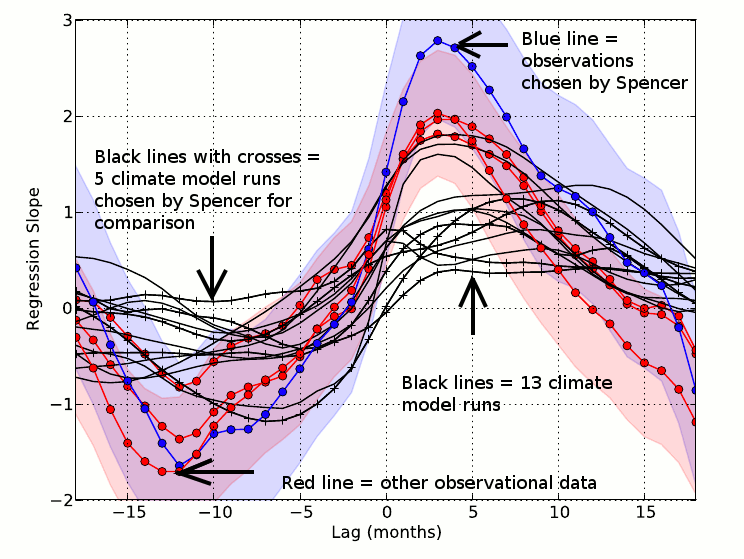
Figure 1: Dessler (2011) reconstruction of Spencer & Braswell's Figure 3, showing relationship between top-of-atmosphere (TOA) net flux and surface temperature, as a function of lag between them. The blue line is the observational data chosen by Spencer and Braswell (HadCRUT). The red lines show other available observational data. The black lines show climate model results. The black lines with crosses show the climate model runs chosen by Spencer and Braswell in their paper.
Dessler found that these three model runs excluded by Spencer which best matched the data are also among those which best simulate El Niño and La Niña, which is not surprising, given that much of the temperature change over 2000-2010 was due to the El Niño Southern Oscillation (ENSO). Thus Dessler concludes that
"since most of the climate variations over this period were due to ENSO, this suggests that the ability to reproduce ENSO is what's being tested here, not anything directly related to equilibrium climate sensitivity."
Spencer's claim of low sensitivity and negative feedbacks is based on this test, which is actually a test of models' ability to reproduce ENSO, and based on his internal variability hypothesis, which as noted above, Dessler's paper has also put to rest. Thus Spencer's claim of low sensitivity and negative feedbacks is not supported by the empirical observational data.
Lindzen and Choi (2011) is Fundamentally Flawed
Lindzen and Choi (2009), slightly revised as Lindzen & Choi (2011), used measurements of sea surface temperature in the tropics and satellite measurements of outgoing radiation from 2000 to 2010 in an attempt to determine climate sensitivity, ultimately concluding that sensitivity is less than 1°C for doubled atmospheric CO2.
Lindzen and Choi plot a time regression of change in TOA energy flux due to cloud cover changes vs. sea surface temperature changes. They find larger negative slopes in their regression when cloud changes happen before surface temperature changes, vs. positive slopes when temperature changes happen first, and thus conclude that clouds must be causing global warming.
However, Dessler also plots climate model results and finds that they also simulate negative time regression slopes when cloud changes lead temperature changes. Crucially, sea surface temperatures are specified by the models. This means that in these models, clouds respond to sea surface temperature changes, but not vice-versa. This suggests that the lagged result first found by Lindzen and Choi is actually a result of variations in atmospheric circulation driven by changes in sea surface temperature, and contrary to Lindzen's claims, is not evidence that clouds are causing climate change, because in the models which successfully replicate the cloud-temperature lag, temperatures cannot be driven by cloud changes.
Major Myth Mashing
It's difficult to exaggerate the impact of Dessler's findings, because these are three of the most crucial arguments for climate "skeptics." In order for the man-made global warming theory to be incorrect, climate sensitivity must be low (see Climate Sensitivity: The Skeptic Endgame). Since all previous studies using many different lines of evidence point to the same answer, that climate sensitivity is not low, climate "skeptics" had to rely on Spencer & Braswell and Lindzen & Choi as the only game in town arguing otherwise. In one fell swoop, Dessler has demonstrated that the only two modern papers arguing for low climate sensitivity are both fundamentally flawed, and their assumptions are contradicted by observational data. In short, there's absolutely no reason to believe the IPCC's equilibrium climate sensitivity range of 2 to 4.5°C for doubled CO2 is incorrect.
Additionally, climate "skeptics" have yet to put forth a plausible, coherent, internally consistent alternative to challenge the robust man-made global warming theory. Despite its fundamental problems, Spencer's internal variability hypothesis was probably the best alternative presented to this point, and Dessler drove another nail into its coffin by demonstrating what a small effect clouds have had on global temperature changes over the past decade.

Arguments


For me, it was the observational data on TOA flux being more than 20x smaller than ocean heat fluxes. So obvious, yet so totally devastating.
"Ouch."
It's almost like Spencer's "angered" [edited inflammatory language] the climate science community by saying essentially that either 1) he's smarter than everyone else or 2) since his "revelations" are so obvious, everyone else is in on the Grand Conspiracy.
Almost? :) :)
What Spencer seems unwilling to consider is that it's not that other scientists don't "get it," it's that he's making mistakes which invalidate his conclusions. Dessler's point that given Spencer's history of making these grandiose claims based on big mistakes (i.e. claiming the atmosphere wasn't warming until RSS corrected the UAH data analysis), his first thought should probably be "am I making mistakes again?".
Really anytime you're making grandiose claims about reversing a long standing body of scientific evidence, your first consideration should be "am I making a mistake somewhere?". But it's especially true when you have a history of such grandiose claims, based on a history of mistakes.
What you say is true, but is appear to not apply to those (like Spencer) afflicted with Dunning-Kruger. I know that you know that, but readers here may not be familiar with D-K.
Uh, you reversed the meaning, dude. Try "angered" the climate science community if you don't like the original.
I suspect that there is a personality type -- or perhaps mental aberration? -- that succumbs to Dunning-Kruger and it would be interesting for someone with psychiatric qualifications to define exactly what the characteristics are. I suspect it lies behind quite a few people in climate denial who clearly think they understand the science better than the acknowledged experts.
[DB] Embedded video at the end of the OP.
It would most closely be identified with narcissistic personality, where an individual has an exceedingly inflated self-opinion that cannot be substantiated by the evidence. The person instead seeks to create and perpetuate assorted rationalizations justifying their grandiosity, while minimizing the conclusions one would arrive at with more objective measures.
Not that I personally have any idea if this is how Roy Spencer actually operates - I don't pay enough attention to alleged "science" that you primarily only find on political media outlets. However, such an individual could easily be manipulated into supporting private political causes if the desired conclusions appeal to said narcissist's need for self-flattery.
I mean, what's more likely -- that I have uncovered fundamental flaws in this field that no one in it has ever thought about, or that I need to read a little more? Hint: it's the one that involves less work.
But it is always wise to show a little caution until the findings are robust. Dessler's paper DO show that SB and LC have serious problems. But it is also POSSIBLE at this stage that Desslers' paper also may contain some problems. If it does, then this post may be a little too reliant on the one paper.
Also, in my view, comments here are much more valuable if they tone down the mocking and the personal and concentrate on the science and a more "neutral" language. A science blog this is.
That said, keep up the good work. Lots of objective and valuable information on this site.
Congratulations to John Cook for winning the Eureka Prize for the Advancement of Climate Change Knowledge.
Fully deserved.
Any version of "the climate is warming itself for decades on end" runs into this.
as a general rule, I agree with you that we should not rely on any single paper untill it has been "digested" by the scientific community.
In this case, though, Dessler confirms what has been thought by many for a long while, he doesn't try to subvert the accepted knowledge like Spencer or Lindzen. In other words, while Dessler work is a very welcome bit of science, climatologists could live without it, there was no open question awaiting an answer.
Not exactly a presentation "good bad and ugly pics" you would find in a science site, however Spencer is saying that Dressler is wrong about the 20 fold error claimed found in Spencer's paper.
Spencer claims that Dressler is out by 10 fold in his calculation.
How do we know who is right here with these competing claims to consider?
Stig Mikalsen puts it aptly : "Also, in my view, comments here are much more valuable if they tone down the mocking and the personal and concentrate on the science and a more "neutral" language. A science blog this is".
Spencer is not the only one who shows that the 20 fold is .....a large large stretch to say the least.
Also, the use of the three models with the highest/lowest sensativity is not cherry picking.
And another point is, which model is correct? Of all the models, which are up to what....18 now?
The claims by skeptics and AGW folks about these sets of papers is getting almost to the point of comical.
I can only suggest to all to re-read the papers carefully again. There are claims all over the blogs from both skeptics and AGW that do not bear credence when examined.
Camburn - excluding more than half of the model runs, including those which best modeled the data, is by definition cherrypicking. Once again I ask that you try to actually make substantive comments rather than baseless disparagements like "comical." Saying "Dessler is a big poopy head" doesn't add anything to the discussion.
Please stop make unsubstantiated claims and talking through your hat. As per previous statements made by you on this thread you clearly do not understand the papers. And you have avoided answering the questions that i addressed to you here. I am glad though that you have acknowledged that "skeptics" are making comical and unsubstantiated claims.
I would advise you to read Chapter 8 of the latest IPCC report, it is a great overview, and explains the models developed by numerous research groups from around the world.
The point that you and people like Spencer continue to ignore is that several datasets also indicate a climate sensitivity near +3 C for doubling CO2. But Spencer, like Lindzen, is focussed on the models (that angle seems to be their last ditch end game), because, in his mind they are a cornerstone of the IPCC dogma. The man is paranoid and entertains conspiracy theories on a daily basis-- go to his blog if you don't believe me.
But back to Spencer's dear models. Funnily enough, the three models that compare best with with observations in his data and Dessler's (you know three models Spencer and Braswell ignored) have equilibrium climate sensitivities of +3.4 C (GFDL-CM2.1), +3.4 (ECHAM5/MPI-OM) and +3.2 C (MRI-CGCM2.3.2), respectively. But that is not really relevant to this discussion, but given that Spencer is so focussed on climate sensitivity it is odd that he failed to discuss this at all.
But it gets a little more interesting when one looks at the cloud feedbacks for the above models as shown in Dessler (2010), and that is relevant to this discussion:
GFDL-CM2.1: Short term cloud feedback +0.34 W m-2 (+/- 0.20), long-term feedback +0.81
ECHAM5/MPI-OM: Short term cloud feedback +0.74 W m-2 (+/- 0.20), long-term feedback +1.18
Results for the cloud feedback in MRI-CGCM2.3.2 were not reported in Dessler (2010), but the both the above models have both positive short-term and long-term cloud feedback.
With all that said, is Dessler (2011) the final word on this, probably not. But what is becoming increasingly clear is that a negative, nevermind strong negative feedback, from
clouds is highly unlikely, but Dessler is open minded enough to say that:
"A small negative feedback is possible, but one large enough to cancel the climate’s positive feedbacks is not supported by these observations."
Dessler also includes confidence intervals (something Spewncer and Braswell did not do). Now Dessler is in fact a good scientists who is really interested in the pursuit of truth, the very antithesis of Spencer.
"Also, the use of the three models with the highest/lowest sensativity is not cherry picking."
You know, having worked with real world data in my life, suspicious outliers are what get tossed out, not data that fits with other real world observations.
You're standing things upside down. Certainly if some models are going to be tossed, the outliers - particularly given that they don't do a good job of modeling ENSO-like events - would be those that would be tossed.
But of course, best would be to do what Dressler did - look at all the model outputs and take a stab at understanding why some match observational data during ENSO events than others (the answer that those that best model ENSO events in the first place do so is no surprise, of course).
The defense of Spencer has reached the point of being pathetic. Personally, I welcome it. First we saw the denialsphere defending Wegman's plagiarism on the grounds that "it's just plagiarism", now we see Spencer's cherry-picking being defended on the grounds that cherry-picking isn't cherry-picking because it's "logical cherry-picking".
Sheesh.
Keep at it, please.
"After reading the attack on Spencer"
What attack? Where? By whom?
People seems to confuse scientific debate and discussion with attack. Pointing out someone is wrong or noting problems with their methodology does not "constitute" an attack. The "attacking" going on here by "skeptics" and deniers of AGW on the integrity and advancement of science.
Who to believe? The multiple independent lines of evidence that point towards the theory (not hypothesis) of AGW. Consider too the sage words of Dr. Nielsen-Gammon (former editor of the prestiguos Journal of Climate):
"The only viable explanation for the glacial-interglacial cycles (not all that stable, really) involves a bunch of feedbacks (ice-albedo, water vapor, CO2, and methane), and there’s ample geological and ice core evidence for all of them. Why would anthropogenic CO2 now be the first forcing that doesn’t engage net positive feedbacks?".
and there is indeed good support for a positive feedbacks in the literature, including positive cloud feedbacks see here and Dessler (2010) that I linked to above @20, and also the findings from Screen and Simmonds (2010):
"Changes in cloud cover, in contrast, have not contributed strongly to recent warming. Increases in atmospheric water vapour content, partly in response to reduced sea ice cover, may have enhanced warming in the lower part of the atmosphere during summer and early autumn."
I would also advise being highly skeptical of work by a scientists who is so deeply entrenched in ideology and politics as Spencer is. Dessler is using science as a tool better understand how our climate system operates, Spencer is using science for altogether different reasons.
I also think Spencer is getting his come-upins for his publishing tactics. He's trying to get his work published essentially with as little peer review as possible. In that he's missing the opportunity to understand his own research better by having to answer hard questions from knowledgeable reviewers. The result is the tenuous results he's getting have to be played out (reviewed) through response papers.
"I would also advise being highly skeptical of work by a scientists who is so deeply entrenched in ideology and politics as Spencer is. Dessler is using science as a tool better understand how our climate system operates, Spencer is using science for altogether different reasons."
Will you enlighten me on this, please?
Thanks
Really? I think that you are being coy. Surely you have taken the time to read Spencer's blog and his musings elsewhere.
But I'll humour/help you since you can't be bothered to make the effort yourself. Look at the stark contrast of the following two statements in which the person describes what they are striving for:
Roy Spencer:
"Nicholas, I would wager that my job has helped save our economy from the economic ravages of out-of-control environmental extremism.
I view my job a little like a legislator, supported by the taxpayer, to protect the interests of the taxpayer and to minimize the role of government."
[Source]
Andrew Dessler:
"I went into science because I wanted to devote my life to the search for scientific knowledge and to make the world a better place. That's the same noble goal that motivates most scientists. The ultimate dream is to make a discovery so profound and revolutionary that it catapults one into the pantheon of the greatest scientific minds of history: Newton, Einstein, Maxwell, Planck, etc."
[Source]
EOS.
While many people have pointed out that this jaw-dropping statement about how Spencer views his job as a *scientist* is totally out of whack regarding the job description that goes along with a research position at a university ...
I've not seen anyone point out the arrogance and hubris implicit in his claim that his job is somewhat like that of a legislator *elected by the people*. The taxpayers didn't vote for you and you have no basis for arguing that you're acting in their interest.
Not to mention his recent publication of Fundanomics : The Free Market Simplified, as well as promoting it all over his blog.
Yup. He's everything I look for in a scientist. At least he can't be accused of having a hidden agenda.
Can you imagine the 'skeptic' uproar if James Hansen were to write a book on Keynesian economics or something similar?
More stat analysis
I normally like to do my own analysis of papers. I am harvesting now and very short on time. The above site provides some very important statistical information.
It seems that you are easily Impressed by some R-code and statistical parameters. That blog analysis is about Dessler (2010), not Dessler (2011) which is the primary subject of this post. Note too that people at the blog you linked us to, not being climate scientists, are having trouble understanding what to do with the CERES data and which values to use. Hardly reassuring.
It is impolite to ignore people when they ask you questions Camburn (see my post @20). How is your reading of IPCC Chapter 8 coming along?
Why the big fuss over poor papers that can not demonstrate without huge error bars, anything certain at this time?
[DB] If you are simply incapable of cogently reading a scientific paper and evaluating its merits, why bother advertising that fact to the world with comments containing no actual analysis of your own?
Please stick to the science rather than venturing forth unsupported assertions and opinions.
Look forward to your take down of Dessler (2011) ;) I'll keep any eye open.
While you are harvesting, maybe you should think and reflect about what Dr. Nielsen-Gammon said:
"Why would anthropogenic CO2 now be the first forcing that doesn’t engage net positive feedbacks?"
That all aside, good luck with your harvesting!
So Dessler analyzing all of the models rather than the cherry-picked six of Spencer isn't credible evidence in your mind.
Next, you'll be touting some future paper that proves models are wrong by cherry-picking *zero* results from a sample.
"Why the big fuss over poor papers that can not demonstrate without huge error bars, anything certain at this time?"
Spencer's paper had huge error bars? Where did he say that? Can you point to a figure in the paper, please?
If you're right, and Spencer's paper *did* calculate huge error bars, why did he state that "hey, this is my latest wooden stake in the heart of global warming"? (OK, he didn't say this this time, he's smart enough to use different phrasing each time he "disprove" physics).
You're a one-sided skeptic, which in my personal dictionary equates to ...
"denialist".
Or are you just shouting "Squirrel!" in the hope that it will somehow detract from Dessler's demolition of multiple bad climate skeptic papers?
Spencer has updated his 'The Good, The Bad, The Ugly' post with some information about what has come out of those discussions.
"the blog word of a mining geologist"
Just as a nitpick, McIntyre's training is mathematics and economics (both 4 year degrees). He's not a geologist.
Other than that, Dessler agreed to update his introduction to more accurately reflect Spencer's opinions regarding cloud changes not necessarily causing ENSO, but that won't effect the content of the paper.
Correct me if I am wrong, but isn't what he is referring to commonly called "bands of uncertianty"?
Is "error bars" now a commonly accepted term among reputable climate scientists?
If it isn't, I suggest that people responding to Camburn not use his perjorative term.
Two-sigma uncertainty range/error bars are often pretty large though, so I'm not really sure what Camburn is complaining about (I don't think he's sure either, frankly).
Thanks for the feedback re the term, "error bars."
In response, Spencer has claimed the ratio is closer to 2.2, and possibly as low as 1.7. Dessler and Spencer are currently in dispute about the appropriate source of data, the time scale to use, and the result obtained.
On Spencer's blog Socratic has no[w] shed some light:
Taking the best case scenario for Spencer, ie, 3 month data and shallowist mixed layer, the ratio becomes 10 to 1 at best, and 15 to 1 if, like Spencer, you assume a low climate sensitivity. If instead you use the more appropriate one month figures, the ration is Dessler's 20 to 1 or more. Either way you cut it, Spencer's fundamental assumption that cloud forcings are the major driver of short term variations in ocean temperature is falsified by this data.
On that blog, Spencers, and at Judith Curry, Bart is doing an excellent analysis with the stats showing a negative feedback.
Still ignoring my question posed to you earlier I see. And if you do decide to answer that, please tell us also what is so "excellent" about Bart's blog analysis. What do you think about is lag time, for example? Is it physically plausible?
And remember,
"Why would anthropogenic CO2 now be the first forcing that doesn’t engage net positive feedbacks?" Dr. John Nielsen-Gammon
Those in denial continue to bet against physics and history.
People are advised to realize that not only aren't the two anywhere near equal, but the comparison is laughable. You may be tempted to think to yourself that scientists do not have a monopoly on science and good methods. This is true.
Nor do doctors have a monopoly on medicine. You are welcome to allow yourself to be treated by someone who never went to medical school, and just reads and posts whatever he wishes, without critical review or consequence, on his blog "How I Can Cure You When Doctors Are Stupid Compared To Me, Especially Since, Unlike Them, I Will Tell You What You Want To Hear."
Like Monckton! He is an a self proclaimed expert in both climatology and medicine.
If Socractic's numbers are right, then it essentially confirms that Dessler was right and Spencer wrong. We'll have to see what Dessler and Spencer come back with. But in general, disparaging a peer-reviewed paper as "not good" for no apparent reason, while fawning over blog posts and their comments, is not a sign of true skepticism.
Unable to defend your original assessment of Dessler 2011 (and Spencer and Braswell 2011), you resort to distraction by drawing attention to Bart's blog comment analysis. Others have justly drawn attention to the discordance between your apparent extreme skepticism of peer reviewed papers and your credulity towards "blog comment science". I would rather address Bart's analysis directly, specifically, the claim that:
For clarity of discussion, here is the step response plot referred to:
So let's put this into perspective. "Bart", an unknown commentator on a blog performs a statistical analysis which purports to show, without any physical mechanism, and on just 10 years data, that the climate response to a doubling of CO2 will be to reduce temperatures by approximately 1.5 degrees C. Oddly, you do not find this highly suspect, but rather "an excellent analysis".
Without going into technical detail like Nick Stokes, I find this claim simply incredible, ie, not possible to be believed. A negative feedback of such strength would either force the Earth into a Snowball state within 50 years if it only cools; or if it is a negative feedback on warming as well, would force the climate into wild multiple degree oscillations in mean global temperature on decadal timescales.
What is more, I cannot help noticing that his data (10 years) is to short to determine if the response he is detecting is cyclical or not. Given that, the apparently coincident timing with regard to the average return interval of ENSO events, and more compellingly to me, a half solar cycle, is highly suspect. To the extent that he is detecting anything, it seems far more likely that he is detecting a residual response to cyclical (Solar Cycle) or quasi-cyclical (ENSO) events. He provides no analysis rebutting that possibility.





