





The Dunning-Kruger effect and the climate debate
Posted on 15 February 2010 by John Cook
One of the best titles for a scientific paper has to be the Ig Nobel prize winning "Unskilled and unaware of it: How difficulties in recognizing one's own incompetence lead to inflated self-assessments". The paper compares people's skill levels to their own assessment of their abilities. In hindsight, the result seems self-evident. Unskilled people lack the skill to rate their own level of competence. This leads to the unfortunate result that unskilled people rate themselves higher than more competent people. The phenomenon is known as the Dunning-Kruger effect, named after the paper's authors, and is often seen in the climate debate. There are many with a cursory understanding who believe they're discovered fundamental flaws in climate science that have somehow been overlooked or ignored by climate scientists. Some take this a step further and believe they're being deceived.
Before anyone takes offense, let me begin with some disclaimers. I'm not saying the Dunning-Kruger effect is limited to one side of the debate. It's a universal human condition not confined to a particular ideology. When I first got into climate science discussions, I made my fair share of over-confident yet naive statements. As my understanding grew, I came to realise the complexities of climate science and how much more I have to learn (as predicted by Dunning and Kruger). I'm also not saying all skeptic arguments are a result of the Dunning-Kruger effect. However, a few examples demonstrate how the Dunning-Kruger effect can lead one astray.
In the discussion on whether CO2 is a pollutant, a graph was included to show CO2 levels over the last 10,000 years. The graph includes ice core data for CO2 levels before 1950. For values after 1950, direct measurements from Mauna Loa, Hawaii were used.
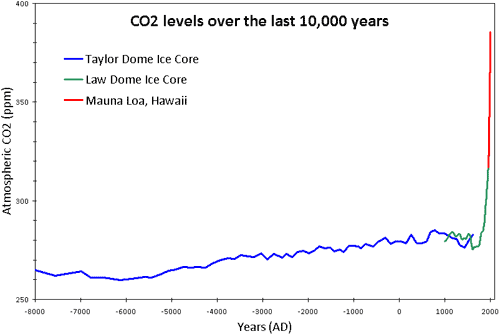
Figure 1: CO2 levels (parts per million) over the past 10,000 years. Blue line from Taylor Dome ice cores (NOAA). Green line from Law Dome ice core (CDIAC). Red line from direct measurements at Mauna Loa, Hawaii (NOAA).
A comment was posted querying the data in this graph. Here is the comment in full:
"Whoa, hold on a minute here. CO2 readings from ONE LOCATION prove we have an enormous GLOBAL spike in CO2 levels? You've got to be kidding me. This is science? That would be like me taking hydrological readings at the bottom of Lake Superior and then declaring that the entire surface of the earth must be covered with water based on my readings.
By the way, isn't Mauna Loa an active shield volcano? (http://en.wikipedia.org/wiki/Mauna_Loa) Hmmmm, you don't suppose that's where all that extra CO2 came from, do you? C'mon, people, wake up. I find it shameful that this obvious manipulation is allowed to pass as "proof". This is certainly NOT an unbiased scientific conclusion."
The commenter is asking whether it's appropriate to take CO2 readings from one location. Particularly when situated near a volcano which are known to emit CO2. Surely a better metric would be a global average of CO2 levels? These are legitimate questions. However, I deleted this comment as our Comments Policy allows no accusations of deception, whether the attack is directed towards skeptics, scientists or myself. This restriction is necessary to keep discussion constructive and restricted to science. Unfortunately, the comment began with a commendable question and ended with a not-so-commendable personal attack.
If the comment had stayed on methods and not strayed into motive, I would have posted the following response. Mauna Loa was used is because its the longest, continuous series of directly measured atmospheric CO2. The reason why it's acceptable to use Mauna Loa as a proxy for global CO2 levels is because CO2 mixes well throughout the atmosphere. Consequently, the trend in Mauna Loa CO2 (1.64 ppm per year) is statistically indistinguishable from the trend in global CO2 levels (1.66 ppm per year). If I used global CO2 in Figure 1 above, the result "hockey stick" shape would be identical.
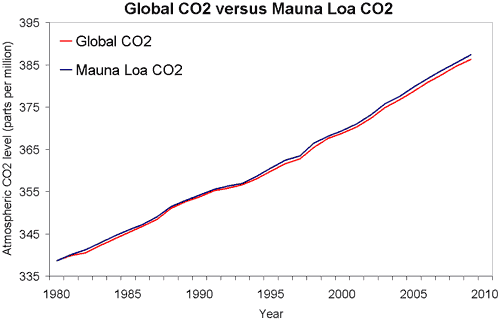
Figure 2: Global atmospheric CO2 (NOAA) versus Mauna Loa CO2 (NOAA).
Unfortunately, this type of presumptive misunderstanding is seen all too often. Someone doesn't understand a certain aspect of climate science which is understandable considering the complexities of our climate. Rather than investigate further, they assume a flaw in the climate science or worse, an act of deception. This response is often more a reflection of the gap in their own understanding than any flaw in the climate science. For further demonstration, here are the two most common examples of the Dunning-Kruger effect in the climate debate.
The most common example is the argument, "why don't climate scientists look up and see that big, fiery ball in the sky - don't they realise the sun drives climate?" In actuality, climate scientists have noticed the big, fiery ball in the sky that provides almost all our climate's energy. Consequently, there are a multitude of peer-reviewed studies examining the sun's role in global warming. These studies have independently come to the conclusion the sun has not shown enough trend to have contributed significantly to recent global warming. More recent papers using the latest data have found the sun is actually moving in the opposite direction to climate. Eg - the sun has been cooling while the climate is warming.
The second most common example of the Dunning-Kruger effect is "don't climate scientists realise climate has changed naturally in the past?" If one peruses the peer-reviewed science, they'll find that yes, climate scientists do realise that climate has changed in the past. There is a whole field of science devoted to examining and understanding past climate change: paleoclimatology. And what scientists find in the Earth's past is that the planet is highly sensitive to changes in energy imbalance. When our climate loses or gains heat, positive feedbacks amplify the temperature change. This is one (of many) lines of evidence that tell us our climate is sensitive to CO2 forcing.
How does one counter the Dunning-Kruger effect, in others or in themselves? Dunning and Kruger propose that improving a person's skills helps them recognise the limitations of their abilities. If there's a question about an aspect of climate science, the first step should be to investigate and improve understanding of the science. Odds are climate scientists have investigated the same question in the peer-reviewed scientific literature. Use Google Scholar to find out papers on the topic. Or search on Skeptical Science (in case you didn't know, there's now a freely available iPhone app :-) If there's no direct answer, find the closest topic and post a comment asking for answers. There are many well informed regulars who would be happy to point you towards any relevant peer-reviewed papers.
UPDATE 16 Feb 2010: Many thanks to Peter for sending me the following YouTube movie which is an excellent visual depiction of changing CO2 levels over the last few decades:

Arguments


I assume (given your background), that you don't really believe that animals "by the very act of living" produce CO2. It's an odd thing to say!
It's also difficult to understand how you consider that a gas diffusing in an atmosphere of gas such that it becomes well mixed is "counter intuitive"! I would have thought that the non-mixing of a gas would be counter-intuitive. Of course one should consider the relevant time scale. CO2 is rather well mixed when considered as a yearly global average, as is easy to see by comparing the CO2 measures at Mauna Loa with the average over the sea surface sites (for example).
http://www.esrl.noaa.gov/gmd/ccgg/trends/
"Euthanasia" ??? I wonder whether you might be drifting from the Dunning-Kruger effect towards something akin to Godwin's Law!
Very clever. But kindly try to make a difference between "being emotional" which in this context I meant as being insulting and irrational with "harboring opinions and inclinations" which in my post are rather obvious to the careful reader... and intended to be so.
No, I am not disingenuous but rather honestly confused by the nature of the discussion, barely supported by reliable quantitative evaluations in either direction and very concerned, if not ouright frightened by the potentially dire immediate effects of policies that could be triggered by a false evaluation of the facts.
Back to the very real D-K syndrome, let us not forget that it can (and does) work very well in very educated individuals, if not more so. Proof is in the tribulations of the human race ever since its beginings with an increasing propensity toward disastruous outcomes as the level of knowledge has increased.
And yes, my late-in-life financial readings do make me more apprehensive of the "idiocy of geniuses" than I was as a technical individual.
Haven't you done this before?
My previous comment labeled "41" was really addressed to "@46".
I am obviously not perfect either...
If humanity didn't ask questions we wouldn't have science.
This appears just another way of saying "support the concensus, stupid" dressed up with some psychobabble (Journal of Personality and Social Psychology, honestly!!!)
While the top article discusss "presumptive misunderstanding", I wonder whether you might be playing at "wilful misunderstanding"! Perhaps you simply didn't read the article properly, but it's not easy to see how you can have come away with the interpreation that it's about "support the consensus, stupid"! Surely it's about "before presuming that every one else is wrong and you're right, and that the blindingly obvious hasn't occurred to scientists, take an effort to find out what the evidence bring to bear befoe launching into contrary interpretations"...
Cook not Cole, Cook not Cole....
Where did I get "Cole", anyway?
Thanks!
Regarding your concern about CO2 & CH4 emitted/breathed out by humans and livestock - they would not be a problem, if the only source of that carbon was biological. If you source your carbon from plants, algae, & other biomass, then that carbon is coming *from* the atmosphere, and you are emitting it back into the atmosphere, so the balance doesn't change. CH4 may be a bit of an issue, as it's a more effective greenhouse gas than CO2, but that's not a huge concern compared to the use of fossil carbon, which has been geosequestered for literally hundreds of millions of years, in some cases.
Actually, when you look at it, even *that* carbon is sourced from nature, and much will ultimately be returned to nature via volcanic action. The problem, though, is that's a hundred-million-year cycle, and we're taking that material & dumping it back into the atmosphere in a few centuries, when the carbon-storing part of the cycle takes millions of years.
So the problem isn't that we're increasing the amount of CO2 in the world. The problem is that a large proportion of it is naturally 'locked up', which we are now liberating.
The solution (well, one of them, anyway) is to stop using geo-sequestered carbon to power our economies.
I find it amusing that one of the main efforts being supported by governments (particularly in Australia) is about trying to re-sequester the carbon after we've dug it up & burned it...
Again, more circular reasoning. If you can measure CO2 around the world, why are you relying on only one spot on the Earth as a data set? If you cannot
The heart and soul of science is the Scientific Method. This separates REAL scientists from alchemists, shamans, and witch doctors.
The Scientific Method depends upon REPEATABLE experiments, repeated by UNBIASED observers, in MULTIPLE LOCATIONS under VARYING CONDITIONS.
How many principles of the revered Scientific Method are violated by this global warming myth?
It is a fundamental principle of real science that any measurement or observation or experiment MUST be performed under varying conditions at different locations by different people, all of whom are unbiased.
Even if you imagine that there are no factors influencing the measurements, you cannot possibly know that for certain. Thus it is a fundamental requirement for genuine science that NO measurement can ever be valid if taken in only one location.
Jargon aside, let us confront the fundamental divide between genuine science and malarkey.
Aristotle was one of the wisest men who ever lived. For that reason, no one dared to question Aristotle's conclusions that a large body and a small body dropped from a tower would fall at different rates.
Gallileo was more courageous than smart, though smart he was. Yet not as smart as Aristotle.
But setting aside hero worship, Gallileo put it to the test by dropping 2 differently-sized cannonballs off the Leaning Tower of Pisa.
One of the smartest men to ever live: WRONG
A less-smart, relatively untrained Gallileo: RIGHT
The egotism and belief that one is part of an elite inner circle CONTRIBUTES TO ERROR.
It is a passionate commitment to the realization that one could be wrong which is the greatest safeguard against error.
It is not the belief in one's own superiority that makes science, but the humility of believing in one's own fallibility that creates genuine science.
Wrong, totally wrong.
One a proposition is advanced, it must be proven to be science. Horton wants to put an argument in my mouth, when it is the proponent of the original proposition who is responsible for establishing his proposition.
The proposition was: "The reason why it's acceptable to use Mauna Loa as a proxy for global CO2 levels is because CO2 mixes well throughout the atmosphere."
This is circular reasoning. This is stating the desired conclusion in support of coming to that conclusion.
COULD IT BE THAT "CO2 mixes well throughout the atmosphere." ?
Quite possibly, even probably.
But do we KNOW this (recognizing that the global atmosphere is staggeringly complex in relation to a tank in a laboratory)?
No.
If you have the measurements necessary to establish that to a scientific certainty, then WHY DON'T YOU SIMPLY USE THOSE MEASUREMENTS around the globe, instead of relying on only one location?
If you have the data world-wide, use it.
If you don't have the data from around the globe, then you cannot really conclude that CO2 is evenly diffused throughout the world's atmosphere.
The reason you are using a single measuring station, is that you DON'T have the necessary data world-wide to measure CO2 levels around the globe.
PROXY SCIENCE IS A HOUSE OF CARDS, with one guess stacked upon another guess, stacked upon another guess, with errors, assumptions, misinterpretations, and biases multiplied many times over.
(Never mind the fact that humans did not create the fossil fuels, they have been on and in the Earth for millions of years before humans, and fires existed long before humans existed.)
But this is not the question. The question is what happens in a massively complex global weather system.
Plants thrive on carbon dioxide. CO2 is nourishment for plants, including algae.
What is the NET effect of a source of carbon dioxide? After the stimulating effect to plant life and the gigantic quantities of algae in the oceans, what is the NET effect?
It is not enough to say that Activity A produces CO2, without considering Activities B through ZZZ in the Earth's complex global systems.
Because carbon dioxide is a life-giving, natural, healthy nourishment for plants -- a source of life -- it is quite a leap to assume that the ecosystem does not respond to the amount of CO2 in the atmosphere, by expanding plant life, and converting CO2 into Oxygen.
A PROBLEM for the global warming proponents:
Where did the fossil fuels come from?????
The CO2 released by CO2 does not magically appear out of nowhere.
CO2 from the Earth went IN to the fossil fuels, in order for it to come OUT again when burned.
That co2 has absorption/emission towards the peak output of surface radiation is is well quantified ( I can give specifics if you like), the effect isn't an arcane knowledge, its ability to provide energy to the atmosphere has been known since the late 19th century by various disparate observers. Similarly is absorption and emission is not just noted via the proxy of the atmosphere, but is observed by spectral analysis with in laboratory conditions. Again this not a myth, merely a property of it's molecular structure, which is known by a wide variety of practitioners in disparate fields, and can easily be verified by readily available equipment. Co2 is measured a numerous location other than Mauna Loa, and the consistency with which they align makes it's measurements suitable for use. This is also supported by measures from aerial observation devices.
There isn't an elite inner circle, this science is the culmination of chemical, physical, geomorphology and climatological understanding involving countless thousands of individuals . Comparing current scientific process to a single classical philosopher isn't even vaguely relevant.
@41 - I believe this to be applicable to your interests.
Jon, you should pause for a while and read this:
Dr. Spencer Weart's Discovery of Global Warming
Bern attempts to distinguish between biologic activity creating and consuming CO2, from what is wrongly portrayed as some kind of different or unnatural CO2.
Of course, in reality, it is ALL nature.
Nature put the fossil fuels in the Earth. Man did not.
The fossil fuels are every bit as much part of Nature as a snail darter or warm, fuzzy puppy.
The fossil fuels that Nature created have as much claim to be "NATURAL" as Bambi or Thumper.
MAN DID NOT CREATE THE FOSSIL FUELS.
Thus, in looking for a balance between CO2 creation and usage (consumption), Bern (like others) seeks to artificially distinguish between CO2 breathed out by lviing beings and CO2 released from 100% NATURAL fossil fuels, created by Nature, which Nature created, and Man had absolutely NOTHING to do with creating.
Where do we imagine this CO2 came from?
BUT, you say, CO2 has been stored -- by Nature -- and releasing it is "excessive."
"Excessive" by whose standards?
Since we know that at times the Earth has supported far more massive amounts of plant growth than exists today, we cannot merely assume that releasing stored CO2 won't result in compensating expansion of plant life.
The error is in looking at only a subset of the total system, rather than the entire system as a whole.
This however, is irrelevant. The question is not what CO2 does in the laboratory but what it does in the extremely complex global eco-system and atmosphere.
70m repeats the fundamental fallacy of the global warming proponents. What is true in an overly-simplistic case is not necessarily true in a complex, multi-variable mega-system.
First, as noted, CO2 is life-giving nourishment (of a fashion) to plant life. CO2 is not a pollutant, but the very building block of all life on Earth. Animal life requires plant life, which requires CO2.
Just as increasing sugar as food to a culture will stimulate growth, it is reckless to ignore the effect of the Earth's plant life reacting dynamically to an increased presence of CO2.
Life is extremely dynamic and adaptive, and to simply ignore its role is reckless.
Is the Earth's plant life capable of absorbing more CO2 than it currently does? Has the Earth's plant life reached a maximum cap, beyond which it cannot absorb any more CO2?
Well, we know that at times in Earth's history, the amount of plant life on Earth was vastly greater than today. So we know that we are not at the Earth's maximum capacity for plant growth.
Secondly, how do we know how CO2 behaves in terms of heat in the open atmosphere?
Answer: WE DON'T KNOW.
We have absolutely no idea.
The proposition is that CO2 abosrbs and traps heat.
HMMMMMMM.....
What happens to warm air in the open atmosphere?
Hot air rises.
The error is in assuming that CO2 at surface level will -- after absorbing heat -- WILL STAY at surface level.
Is that assumption warranted?
Can any theory be based on the assumption that CO2 - after being WARMED by capturing radiant heat -- will REMAIN at surface level?
And if CO2 RISES by virtue of becoming warmer, then isn't it simply transporting heat from the surface up into the upper atmosphere, where it is radiated into outer space?
Since CO2 is not anchored in place, but MOBILE, CO2's ability to absorb heat -- AND THEN RISE when heated -- may simply increase the efficiency of the TRANSPORT MECHANISM OF CONVECTION.
The ability of the Earth to cool itself through CONVECTION of air from the surface to the upper atmosphere may be ENHANCED by CO2's properties of absorbing heat.
If what you were saying were true, that CO2 was simply transporting heat out into space, then why are we seeing a warming trend over the last 60 years (a time of declining solar irradiance)? Why are satellites showing a reduction in the emissions of IR radiation-in the wavelength which we *know* CO2 absorbs-into space over the last 30 years? Why has the stratosphere been *cooling* for the last 30 years (it would warm if CO2 were transporting heat into the upper atmosphere)? Why was the planet so much warmer during the pre-Quaternary Era, when the sun was significantly cooler? If this additional CO2 is so good for plant life, then why are we not seeing a significant rise in plant biomass? In fact, like any trace element, CO2 can become *harmful* for certain types of plants above a certain concentration-& there is a threshold above which additional CO2 has negligible impact on plant growth. Indeed, the warming for which CO2 is believed to be responsible can hasten senescence, which will result in a *reduction* in total biomass, & rising CO2 levels has been found to make certain crops less nutritious &-in some cases-even downright toxic. Yes plant biomass adapted to much higher levels of CO2 in the past, but they had *millions* of years to adapt, compared to mere decades. Also, its highly unlikely we're ever going to see the vast primeval forests of the Carboniferous Era-with their enormous trees-any time in the near future, so it is people like *YOU* are being reckless in assuming that we can just "reset" our atmosphere to Carboniferous Era levels without it having a detrimental impact on Quaternary Era life. However, the fact that you reject the science put forward by 70rn, but embrace the melodramatic rantings of rmbraun123 prove to me that you're not interested in *facts*, just your own sense of self-importance, which makes you a classic sufferer of the D-K effect!
Co2s energy movments are rather complex and what your suggeting is broadly correct, the energy ultimately radiates back into space. Co2 absorption acts upon a specific range of wavelengths which it then re emits or transfers during molecular collision, end result being energy distribution. It isn't a process of trapping per sè, but one of delaying release into space. A greater of amount of co2 lowers the rate at which long wave radiation in the applpicable part of the spectrum escapes (this is observed) - which causes an imbalance as there is always more energy being inputted by the sun. The net effect is greater heat retention in the atmosphere.
The effect that extra heat will have upon convection is understood, and is considered a bit of a downer actually. Pressure cells all basically operate via this mechanism, and extra heat will increase their rate of function, leading to stronger storms - greater precipation etc... Conversly this intensification will also result in longer duration droughts in applicable regions, broken by larger flooding periods. Such a process cannot be considered positive for the infrastructural, agricultural or ecological systems effected.
Might need to go and play Donkey Kong on my Nintendo, I require some thoughtful entertainment.
Er, did you actually read my entire comment? All of it? And think about what I wrote?
I'll quote this bit:
"Actually, when you look at it, even *that* carbon is sourced from nature"
We're all aware, here, that the carbon in fossil fuels originally came from nature. The problem, as I tried to explain, is that we are fiddling with nature.
The 'equilibrium' state of the Earth has a certain amount of that carbon 'in circulation', as it were, that is released & absorbed continually in plant growth, decay, animal activity, etc. The rest is sequestered in coal & oil deposits, methane hydrates, and numerous other ways (I wont pretend to know all the details). There's probably an enormous amount buried deep in the crust, and even more down in the mantle.
Human industrialisation (specifically, the burning of fossil fuels) is upsetting that balance by taking large amounts of that sequestered carbon and dumping it into the atmosphere. We're talking about truly enormous amounts of carbon, here - enough to increase the amount of CO2 in the atmosphere by more than a third, *despite* the rate of absorption by plants & oceans increasing with the concentration. And we're doing it in a time-frame that, on a geological scale, is virtually instantaneous.
The consequences of that might be very unpleasant for human civilisation and many species of plants & animals, though I'm sure others will thrive.
Actually, the references by others to the Carboniferous Era prompted me to look it up. Wikipedia suggests that sea levels during that era were up to 80-120m higher than present levels. Hmm. I hope you don't live near the sea...
Also in your posts on CO2 levels.
With respect to your posts on measuring CO2. Before the CO2 measuring station was established in Hawaii, the scientist responsible for the work Keeling the elder traipsed around the USA for 2 years measuring CO2 levels at many locations. He found that in spite of previous assertions that CO2 concentration would vary...in fact they did not. He also found that there was a diurnal variation in CO2 levels. Lower in the day and higher at night...plants breathing in and out. Later studies also showed that there were seasonal variations in CO2...higher in summer, lower in winter.The continuous measurements of CO2 in Hawaii started by Keeling in 1956 show a year by year increase in CO2. Also note that Hawaii is not the only place where measurements are taken but it has the longest historical record of data. The other aspect of CO2 levels is that the level of carbon 14 in the atmosphere has declined as fossil fuels are burnt...they consist of carbon 12 only the carbon 14 has decayed away over the millions of years it has been locked away. You need to keep an open mind. The risks and costs of unpredictable climate change associated with AGW even in the mildest predictions of the IPCC are large and will be felt by those least able to afford the adaptations that may be required. So we have a moral duty to look at the science seriously...skepticism is fine but dismsiing obseravtions and facts collected and established over 50+ years is ethically unsound.
I did read the whole article, John started each small section with a skeptic question (quotes and italics). All very simplified but the question of uncertainty and poor understanding of some systems still needs to be raised.
Based on the examples John raises.
1) CO2 - Few believe that CO2 levels aren't rising in the atmosphere yet there does appear a case for what that means for future climate and maybe more importantly it's impact on society going forward. Many of the non-peer reviewed source issues with the IPCC seem to focus on this later aspect.
2) Solar - Just from John's list of papers solar seems to have contributed between -1.3% to 50% of 20th century warming. Scope for improvement there. IPCC seem to go with negligable affect. There are other solar scientists that take a different approach such as Friis-Christensen and Henrik Svensmark. That solar breaks down some the present period is as true as CO2 and temp break down 1940-1970. The climate is a complex thing.
3) Paleoclimatology - Methods and conclusions have been critised in both blogs and peer-reviewed papers. And it appears the IPCC presentation of this shows signs of political (with a little 'p') interference. You have to question throwing away 75%+ of your data to come to a 'desired' conclusion.
"Question everything"
You ask:
'Is the Earth's plant life capable of absorbing more CO2 than it currently does? Has the Earth's plant life reached a maximum cap, beyond which it cannot absorb any more CO2?'
Well, as we know that atmospheric CO2 is rising and has been rising since the Industrial Revolution, it would seem that the answer is yes!
And we know that the ocean has been absorbing around 50% of the carbon emitted. Rising temperatures aren't going to make things any easier either. There are a number of temperature-sensitive carbon sinks that are expected to to become carbon sources as temperatures increase.
You also state:
'Just as increasing sugar as food to a culture will stimulate growth, it is reckless to ignore the effect of the Earth's plant life reacting dynamically to an increased presence of CO2.'
Yes this is true, but as ideas go it is half-baked.
Can you point to CO2 starvation ever being a growth limiting factor in the open air? [Citations from reputable journals only, please.]
Now I can fully guarantee that this is only a partially-baked answer, but what do you expect in a blog post?
The over simplistic relationship between plants and CO2 is often raised as one of those: 'CO2 isn't universally bad, it will result in more plant growth' arguments [so beloved of the Denial Industry, who just seek to confuse the public], but this is an area which has revealed a number of genuine surprises. Free Air CO2 Enrichment studies reveal that the effects of enclosures that were used in many previous studies typically overwhelmed the CO2 enrichment effect. Now I realise that this isn't the same as what you were aiming at, but it reveals that studies that suggested CO2 led to increased plant growth need to be reassessed since their findings may be an artifact of the test method.
There are an increasing number of studies that show unforeseen effects of increase CO2 levels:
Growth and nutritive value of cassava (Manihot esculenta Cranz.) are reduced when grown in elevated CO2
RoslynM.Gleadow 1, John R. Evans2, Stephanie McCaffery2 & Timothy R. Cavagnaro2,3 Plant Biology ISSN 1435-8603http://www.biolsci.monash.edu.au/staff/gleadow/docs/gleadow-2009-cassava-online.pdf
Changes in Nutritional Value of Cyanogenic Trifolium repens Grown at Elevated Atmospheric CO2
RoslynM.Gleadow & Everard J.Edwards & John R. Evans J Chem Ecol (2009) 35:476–478 DOI 10.1007/s10886-009-9617-5http://www.biolsci.monash.edu.au/staff/gleadow/docs/2009-clover-cg-co2.pdf
Food for Thought: Lower-Than Expected Crop Yield Stimulation with Rising CO2 Concentrations
http://www.bnl.gov/face/pdfs/Long_2006.pdf
"Climate Change Surprise: High Carbon Dioxide Levels Can Retard Plant Growth, Study Reveals ScienceDaily (Dec. 6, 2002)
http://www.sciencedaily.com/releases/2002/12/021206075233.htm
Nine further studies here:
http://www.logicalscience.com/skeptic_arguments/CO2-fertilization.html
Therefore the answer to:
'Just as increasing sugar as food to a culture will stimulate growth, it is reckless to ignore the effect of the Earth's plant life reacting dynamically to an increased presence of CO2.'
is:
It is reasonable to expect wild plants to respond in a variety of different ways, and not necessarily in a manner beneficial to human society or the ecosystems where the plants belong.
Yes it is reckless to expect the biosphere to respond in a manner that will reduce our obligation to cease our destructive behaviour.
Yes increasing atmospheric CO2 will affect ecosystems, but their response cannot easily be predicted and surprises are likely.
Yes we should be cautious about large scale tampering with the energy budget of the earth, it may not be beneficial to us, the climate or other life on Earth.
Greenhouses are demonstrably not the "natural environment". Observed shifts in pH from CO2 increases thus far indicate that humans raising atmospheric CO2 to 1000 ppm would be catastrophic for the oceans of the world... even without the effects of global warming. Ergo, yes... by your own definition CO2 IS a pollutant.
As to there being no anomalies in AGW data... there have been plenty. Most (e.g. early UAH satellite temperature series or the first pass of ARGOS buoy ocean heat data) have been due to errors which were later corrected. However, there are some still outstanding... such as calculations of the factors contributing to sea level rise not adding up to the total observed increase. Likewise there is ongoing debate as to the causes of tree ring divergence over the past fifty years and fluctuations in the temperature record (such as the current period of decreased warming). That's not even getting into all the issues around proxies and climate sensitivity... particularly the complexities around clouds having multiple positive AND negative feedback impacts.
Helps to remember that over the long term climate variability one way or another imposed by solar fluctuation will dither widely while more or less exhibiting no net long term change (unless we go forward millions of years). On the other other, what we know of the behavior of C02 when it is illuminated by IR tells us it will impose a steady net increase in the amount of heat energy retained within our atmospheric envelope.
I think it's easy to overlook this important difference between one driver of variability (or net variation) and another.
what we know now tells us that given a few decades, added C02 in sufficient quantities will always win over solar forcing as a driver of climate change.
Also, having noticed a common error creeping into this thread, I'm going to be redundant yet again (r2) and point out that we devote fanatical amounts of engineering expertise to controlling anthropogenic emissions of substances also found as natural constituents of the atmosphere. C0 is a prime example. So it's a fallacy to say that C02 in excessive amounts is not a pollutant. A quick check of the dictionary will help with this.
There needs to be a clearinghouse for links to info of this sort as well. The extant resources I find lacking in various ways, it should be a dedicated endeavor, rather than expending enormous amounts of time debating people with irrational emotional attachments to political postures, which accounts for the bulk of the anti-AGW sentiment in the public, not any true spirit of scientific inquiry. You may enjoy attempting to knock sense into random heads but we are really wasting our time here arguing with these people.
There is a nice graphic presentation of the consensus on this issue. John has it in this article. Seems very clear to me.
There is agreement than that previous CO2 levels did not lead to a runaway global temperature rise, but a limited rise and that driving by the sun has a huge influence on global temperature. We may be seeing that at present. We'll know as the next solar cycle revs up as it is now. If there is a limit to how much CO2 can raise global temperatures we can breath a sigh of relief. There is such a limit in science as CO2 just closes the lower temperature window to re-emission of thermal radiation from earth's surface. So as global temperature rises CO2 has less of an effect on greenhouse warming because the wavelengths of the thermal IR are higher than the notch effect CO2 has. In other words as the temperature rises CO2 becomes transparent to the emitted radiation and therefore becomes less of a greenhouse gas.
The Dunning-Kruger effect brings to mind what writers thousands of years ago already recognized. "How precious are thy thoughts unto me, O God! how great is the sum of them! If I should count them, they are more in number than the sand..." Psalm 139:17-18 In other words the writer was admitting he was unskilled and God had skill.
C02 in ciculation as part of the natural carbon cycle versus C02 contributed to the atmosphere as part of fossil fuel combustion is easily distinguished by isotope ratios.
You might want to get up to speed on this entire topic by reading Dr. Spencer Weart's excellent summary, here:
The Discovery of Global Warming
A few hours and you'll have a basic grasp of the phenomenon, warts and all.
"You might want to get up to speed on this entire topic by reading Dr. Spencer Weart's excellent summary, here:
The Discovery of Global Warming"
I read through it. Thanks. But I still don't agree or better, I don't see what the point is. Doctor Weart frequently appeals to experts, in fact I see more appeal to experts than hard numbers and the equations and math models to go with them. I don't often go to popular TV series for wisdom, but a character on one of those crime scene investigation shows had a zinger when a colleague asked whether they should sort the pile of evidence first. She said, "No, because if you sort it you are predisposing yourself to an expected outcome. Just pick pieces at random without any thought to what the outcome should be and see what you get." I see Doctor Weart doing a lot of sorting based on an anachronistic disposition toward the outcome.
I already had a grasp of the basic principles that those folks were using and haven't seen a compelling argument for the kinds of actions being proposed to combat it.
Sorry, I still stick to my principles.
Spencer Weart's The Discovery of Global Warming is intended to be an overview--an introduction. If you want more detail, including the specific evidence backing up the experts' opinions, you are supposed to follow up elsewhere.
One excellent place is here at Skeptical Science. But that addresses your objection only if you actually read the references that John (and others) provide.
It sounds like you might benefit from, and appreciate, the overview by cce, The Global Warming Debate. But on that site, too, your objection to reliance on experts will be overcome only if you click on the links that cce provides to the sources of his info.
That's most unfortunate. Having a grasp of the basic principles and at the same time a reluctance to accept the outcomes predicted by those principles is of course something only you can address. You might want to think of it all in the same way you do fastening your seat belt, or brushing your teeth. Failing those, Good Luck to you, I can't offer better!
"I already had a grasp of the basic principles that those folks were using and haven't seen a compelling argument for the kinds of actions being proposed to combat it.
Sorry, I still stick to my principles. "
Then prove that you have understood it. For example by refuting the estimated 3 degC increase per CO2 doubling.
Otherwise, you just provide strong indications that you haven't - that may be another example of the effect discussed in the post.
The basic action, reduction of CO2 emissions, may be too simple for your taste. NOT doing that, will give some, by now, fairly well predictable effects. The biggest uncertainty is the exact time scale.
A Conversation at a Poker Game
However it's clear that measuring at isolated locations should give a consistent picture of any trend.
If you support the right of scientists to work without harassment and political attack, sign my petition at http://www.petitiononline.com/clim4tr/petition.html
The actual quote from the NOAA site is
"Data are reported as a dry air mole fraction defined as the number of molecules of carbon dioxide divided by the number of all molecules in air, including CO2 itself, after water vapor has been removed"
Note the "all molecules in air".
So your statement "Can you please enlighten a poor soul - who studied chemistry and physics quite some time ago - what exactly is "a molecule of air"?" looks rather silly.
Feel free to post an apology.
After my post at 95, I realised that 1077 may have been attempting to illustrate the Dunning-Kruger effect.
If that is the case there is no need for an apology.
The Dunning–Kruger effect is a cognitive bias in which "people reach erroneous conclusions and make unfortunate choices but their incompetence robs them of the metacognitive ability to realize it."[1] The unskilled therefore suffer from illusory superiority, rating their own ability as above average, much higher than it actually is, while the highly skilled underrate their abilities, suffering from illusory inferiority. This leads to the perverse situation in which less competent people rate their own ability higher than more competent people. It also explains why actual competence may weaken self-confidence: because competent individuals falsely assume that others have an equivalent understanding. "Thus, the miscalibration of the incompetent stems from an error about the self, whereas the miscalibration of the highly competent stems from an error about others."[1]
EndQuote.
Truly interesting, & so also is -
Quote:
The blogsphere adores Kruger and Dunning’s (1) ‘99 paper "Unskilled and Unaware of It" (2). Google blog search lists ten blog mentions just in the last month. For example: (3)
Perhaps the single academic study most germane to the present election … In short, smart people tend to believe that everyone else "gets it." Incompetent people display both an increasing tendency to overestimate their cognitive abilities and a belief that they are smarter than the majority of those demonstrably sharper.
This paper describes everyone’s favorite theory of those they disagree with, that they are hopelessly confused idiots unable to see they are idiots; no point in listening to or reasoning with such fools. However, many psychologists have noted Kruger and Dunning’s main data is better explained by positing simply that we all have noisy estimates of our ability and of task difficulty. For example, Burson, Larrick, and Klayman’s ‘06 paper "Skilled or Unskilled, but Still Unaware of It" (4):
We replicated, eliminated, or reversed the association between task performance and judgment accuracy reported by Kruger and Dunning (1999) depending on task difficulty. On easy tasks, where there is a positive bias, the best performers are also the most accurate in estimating their standing, but on difficult tasks, where there is a negative bias, the worst performers are the most accurate. This pattern is consistent with a combination of noisy estimates and overall bias, with no need to invoke differences in metacognitive abilities. In this regard, our findings support Krueger and Mueller’s (2002) reinterpretation of Kruger and Dunning’s (1999) findings. An association between task-related skills and metacognitive insight may indeed exist, and later we offer some additional tests using the current data. However, our analyses indicate that the primary drivers of miscalibration in judging percentile are general inaccuracy due to noise and overall biases that arise from task difficulty.
So why does Google blog search finds zero mentions (5) of this refutation? My guess: because under this theory you should listen to those you disagree with instead of writing them off as idiots.
Now Kruger and Dunning do have a 2008 followup paper (6), and in their first paper they were able to construct one situation where more able people had lower errors in estimating their ability. Also, Burson et al. saw some weak tendencies like this:
We regressed perceived percentile on actual percentile among bottom-half performers and among top half performers. A Chow test confirmed at a marginal level of significance that bottom-half performers were less sensitive to their actual percentile … than were top-half performers.
Oddly, none of the dozen papers on this I’ve read pursue the obvious way to settle this question: look at the variance of ability estimates as a function of ability. But however that turns out it seems clear that mostly what is going on is that we all misjudge our ability and task difficulty.
EndQuote
All Are Unaware (Link)
(1) http://en.wikipedia.org/wiki/Dunning-Kruger_effect
(2) http://www.apa.org/journals/features/psp7761121.pdf
(3) http://insocrateswake.blogspot.com/2008/10/judging-ones-own-competence-or-yikes.html
(4) http://sitemaker.umich.edu/kburson/files/bursonlarrickklayman.pdf
(5) http://blogsearch.google.com/blogsearch?q="Skilled+or+Unskilled,+but+Still+Unaware+of+It"
(6) http://www.psy.fsu.edu/~ehrlinger/Self_&_Social_Judgment/Ehrlinger_et_al_2008.pdf
And the CO2 levels remain an example even now, and to, at least some extent, perhaps, may even be effecting the author of this article.
The various posts above seem to abound with seemingly objective; but, in many cases, clearly slanted view points.
In nearly every post (including the article) some, often obvious, detail was omitted that might have impacted the conclusion.
Perhaps we could all take some extra time to refine our thoughts and triple check our facts before posting.
By the way, something I noticed long ago, and posted on on a number of forums; but, have get to get a well validated response to: O2 and CO2 have nearly the same IR absorption spectra / levels. Why is O2 not considered a green house gas when CO2 is? (If your planning on making the narrow band argument, please have something verifiable to back it up)





