





Hurricane Sandy and the Climate Connection
Posted on 1 November 2012 by dana1981
Hurricane Sandy was an unprecedented storm in modern times, arriving late in the hurricane season, making landfall abnormally far to the north on the US east coast, with an exceptionally low pressure, and a record-breaking storm surge. The hurricane also had among the most kinetic energy of all tropical cyclones on record at 222 trillion Joules (the equivalent of 3.5 Little Boy Hiroshima atomic bombs) - more energy than Category 5 hurricanes like Katrina despite Sandy just being Category 1, because Sandy was spread over a much larger area.
Given the unprecedented nature of this event, many people are asking whether it was caused by or its impacts amplified by global warming, and many others are of course trying to deny any hurricane-climate links. There is actually a fairly simple answer to this question: human-caused climate change amplified the hurricane's impacts.
Higher Sea Levels Cause Bigger Storm Surges
One reason we can draw this conclusion is that as Michael Mann noted, sea levels around the New York area are now close to 1 foot higher than they were a century ago. For example, Figure 1 shows the annual mean sea level rise since 1900 for Battery Park, New York from tide gauge data.
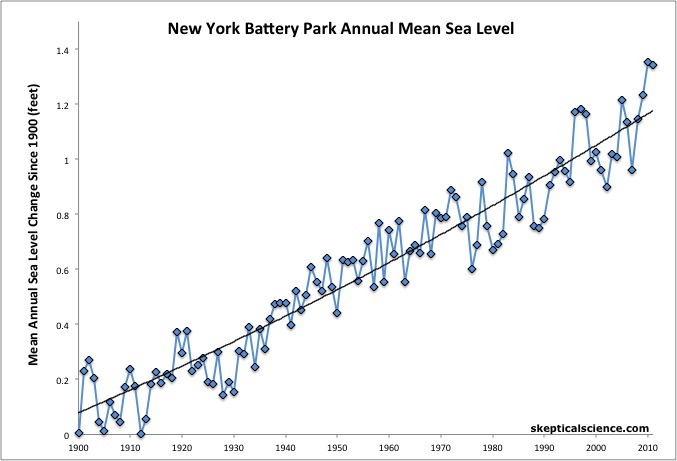
Figure 1: Annual mean sea level rise in Battery Park, New York from Permanent Service for Mean Sea Level (PSMSL) tide gauge data.
While Battery Park represents just one tide gauge, there are many other tide gauges in the region which tell a very similar story, as you can see at the PSMSL site. And of course we know that the global sea level rise (approximately 0.6 feet since 1900, on average) is predominantly caused by melting land ice and the thermal expansion of the oceans. As Church et al. (2011) found, approximately 40% of the average global sea level rise since 1972 is due to thermal expansion, and approximately 60% due to land ice melting (Figure 2), both of which in turn are predominantly driven by human-caused global warming.
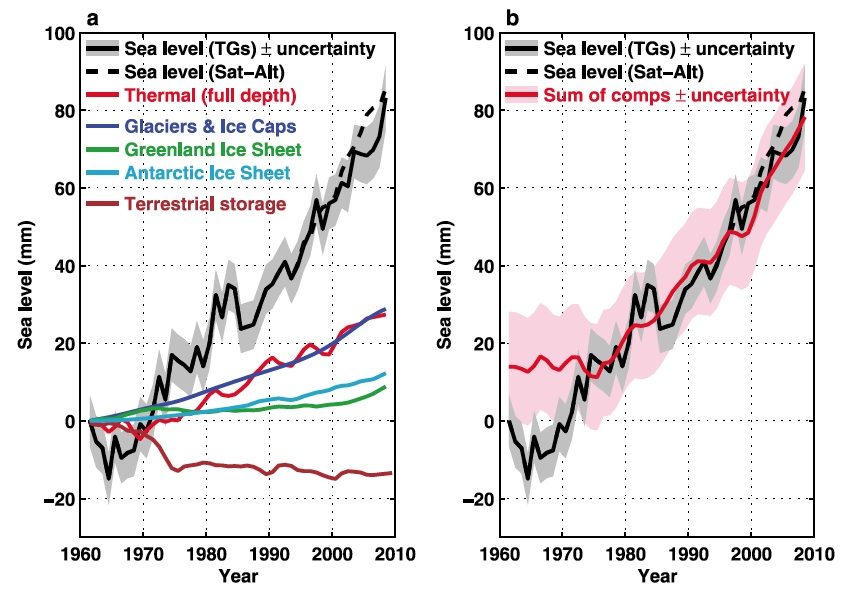
Figure 2: The global sea level budget from 1961 to 2008. (a) The observed sea level using coastal and island tide gauges (solid black line with grey shading indicating the estimated uncertainty) and using TOPEX/Poseidon/Jason‐1&2 satellite altimeter data (dashed black line). The two estimates have been matched at the start of the altimeter record in 1993. Also shown are the various contributing components. (b) The observed sea level and the sum of components. The estimated uncertainties are indicated by the shading. The two time series are plotted such that they have the same average over 1972 to 2008. From Church et al. (2011).
Looking into what we can expect for the impact of future sea level rise on hurricanes, Lin et al. (2012) found that:
"The combined effects of storm climatology change and a 1 m [sea level rise] may cause the present NYC 100-yr surge flooding to occur every 3–20 yr and the present 500-yr flooding to occur every 25–240 yr by the end of the century."
So this human contribution to the Sandy-related damage is quite straightforward. This is what we know:
- Humans increased the greenhouse effect.
- The greenhouse effect caused the planet to warm.
- The warming planet caused land ice to melt and the oceans to expand.
- Melting land ice and thermal expansion caused average sea level to rise.
- Higher sea level made the storm surge worse than it would have been in the past, thus causing more flooding.
Warmer Oceans Fuel Hurricanes
As Katharine Hayhoe noted, Atlantic sea surface temperatures (SSTs) are also significantly warmer than they were a century ago as a result of human-caused global warming. Figure 3 shows global surface temperature anomalies for the period 2000 to 2011 compared to 1900 to 1910. SSTs over most of the Atlantic ocean warmed 0.5 to 1.0°C over that timeframe.
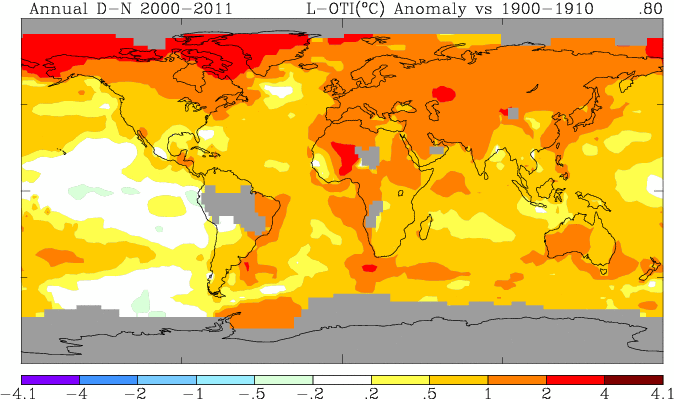
Figure 3: Surface temperature change (°C) from 1900-1910 to 2000-2011, from NASA GISS.
MIT hurricane expert Kerry Emanuel first proposed in Emanuel (1987) that warmer SSTs should lead to stronger hurricanes. Emanuel (2005) confirmed that hurricanes have grown stronger over the past several decades, in part due to human-caused global warming. As he put it in Emanuel (2012),
"In the North Atlantic region, where tropical cyclone records are longer and generally of better quality than elsewhere, power dissipation by tropical cyclones is highly correlated with sea surface temperature during hurricane season in the regions where storms typically develop"
As a result, hurricane strength and damage are projected to increase in a warming world (Figure 4).
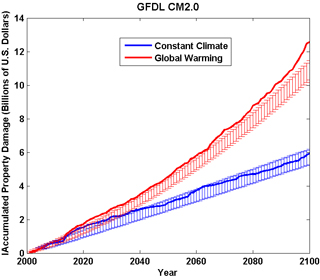
Figure 4: Accumulated damage from 2000 to the year on the x-axis using the the GFDL CM2.0 global climate model with climate held fixed at its 1981–2000 mean condition (blue) and under the global warming scenario associated with IPCC SRES Scenario A1B (red). The error bars shows one standard deviation up and down from the ensemble mean. From Emanuel (2012).
Elsner et al. (2012) confirmed that warmer SSTs feed stronger hurricanes, finding when mean seasonal SSTs are above 25°C
"a significant trend trend with increasing SST indicating a sensitivity of 7.9 ± 1.19 m s-1 K-1"
Elsner et al. and Knutson et al. (2010) also find that hurricanes will become stronger in a warming world.
"higher resolution modelling studies typically project substantial increases in the frequency of the most intense cyclones, and increases of the order of 20% in the precipitation rate within 100 km of the storm centre."
Again we have a very clear connection between human-caused global warming and impacts from Hurricane Sandy.
- Humans increased the greenhouse effect.
- The greenhouse effect caused the planet (including oceans) to warm.
- Warmer oceans feed stronger hurricanes.
However, note that during the hurricane event, SSTs along the coast were approximately 3°C above average, whereas global warming has increased SSTs by closer to 0.6°C. Thus as Kevin Trenberth notes, while global warming contributed to the hurricane intensity, so did natural variability.
More Atmospheric Moisture Causes More Rainfall
Kevin Trenberth notes that due to global warming there is now more moisture in the atmosphere than there was a century ago, which contributed to the flooding in the impacted areas, as Trenberth described:
"With every degree F rise in temperatures, the atmosphere can hold 4 percent more moisture. Thus, Sandy was able to pull in more moisture, fueling a stronger storm and magnifying the amount of rainfall by as much as 5 to 10 percent compared with conditions more than 40 years ago. Heavy rainfall and widespread flooding are a consequence."
This conclusion is consistent with the findings of Trenberth et al. (2005), which found that
"recent trends in precipitable water are generally positive and, for 1988 through 2003, average 0.40±0.09 mm per decade or 1.3±0.3% per decade for the ocean as a whole"
We have another fairly simple causal relationship here:
- Humans increased the greenhouse effect.
- The greenhouse effect caused the planet (including atmosphere) to warm.
- A warmer atmosphere can hold more water vapor.
- This allows hurricanes to pull more moisture from the atmosphere.
- More rainfall during the hurricane causes more widespread flooding.
Changing Weather Patterns Resulting from Arctic Warming
Francis and Vavrus (2012) found evidence that that the decline in Arctic sea ice and snow cover are linked to extreme weather, for example through more frequent blocking patterns. Liu et al. (2012) also found that "the decrease in autumn Arctic sea ice area is linked to changes in the winter Northern Hemisphere atmospheric circulation," which results in more frequent episodes of blocking patterns.
An atmospheric blocking pattern over Greenland, which may potentially be linked to this year's record low Arctic sea ice extent (though we can't say for certain), helped force the storm to make a left turn into the United States mainland. As Dr. Francis stated in an interview with Justin Gillis,
"While it’s impossible to say how this scenario might have unfolded if sea-ice had been as extensive as it was in the 1980s, the situation at hand is completely consistent with what I’d expect to see happen more often as a result of unabated warming and especially the amplification of that warming in the Arctic"
Extreme Weather on Steroids
The bottom line is that while global warming did not cause Hurricane Sandy, it did contribute to the "Frankenstorm" at least by causing higher sea levels (and thus bigger storm surges and flooding), warmer sea surface temperatures (and thus a stronger hurricane), and more moisture in the atmosphere (and thus more rainfall and flooding).
More importantly, as Francis noted and as many impacted residents are coming to realize, this type of extreme weather has and will continue to become more commonplace as the planet continues to warm. We know that many types of extreme weather events have already been linked to global warming, including hurricane intensity. A warmer world will "load the dice" and make extreme events, including strong hurricanes, more likely to occur. It's important not to lose sight of the long-term trends in arguing about whether or not climate change contributed to any single extreme weather event. As Dave Roberts notes,
"There is no division, in the physical world, between “climate change storms” and “non-climate change storms.” Climate change is not an exogenous force acting on the atmosphere. There is only the atmosphere, changing. Everything that happens in a changed atmosphere is “caused” by the atmosphere, even if it’s within the range of historical variability."
And as Stephan Lewandowsky put it,
"We are living with climate change.
It is happening now.
Debating the extent to which Frankenstorm Sandy was put on steroids by climate change is a distraction.
Nearly all weather events now have a contribution from climate change and it is up to us to manage and reduce that risk with mitigative action."
We often come back to the words of Lonnie Thompson, who said that climate change will result in some mix of mitigation, adaption, and suffering. So far we have failed to achieve significant mitigation of greenhouse gas emissions, and as a result, extreme weather events on steroids like Hurricane Sandy will cause more suffering than they would otherwise have, and we will have to adapt to a future in which these types of events occur more frequently. Unfortunately, as we saw in North Carolina, some science-denying policymakers are not even willing to implement the necessary adaptation measures. This type of denial will maximize future suffering.
Imagine a world where this type of extreme weather event happens once per decade instead of once per century. That's one small part of what we're talking about when we discuss the impacts of climate change.
Also see a similar good post on this subject by Joe Romm at Climate Progress.
Note: this post has been incorporated into the rebuttal to the myth Hurricane Sandy had nothing to do with global warming. It also has a convenient short URL sks.to/sandy

Arguments


You have entirely missed the point of the post. There is no contradiction.
This post does not say or imply that storms are at this point in time more frequent or stronger.
This post does not say or imply that the storm occurred because climate change is already making more storms occur (although that does seem to be happening, we need a longer period to ascertain it). This post does not say or imply that the storm was stronger because climate change is making all storms stronger.
This post does say that several unusual aspects specifically and strongly tied to climate change (blocking patterns, higher sea levels, warmer ocean waters) can be directly tied to the formation and path of this specific storm. So in this case, "weather" is "climate" because we can directly tie a very unusual confluence of factors to causing weather which is itself extreme, and those factors are directly tied to climate change. QED.
Can anyone exactly, unarguably prove the causation? No, of course not. That's why deniers will have a field day saying "but, but, but..."
That shouldn't, however, stop an intelligent person from looking at the facts, drawing conclusions, and taking action.
You appear to be right that Sandy was actually second in low pressure, although the total kinetic energy metric is, to me, far more important. It's also of little consolation to the people living in NY and NJ.
Your comment smacks of typical denial... i.e., try to find anything you possibly can to help comfort yourself with the idea that maybe this isn't climate change at all, maybe it's just a natural even that would have happened no matter what, so you can go back to ignoring the consequences of your actions for at least a few more years.
It's true that, as you say in your comment, we can't prove a causation link between a particular storm and climate change. That's why we have to look at statistics, and statistics tell us that nothing abnormal is happening.
You say that I am in denial.. but in this case it appears that the one in denial is you, as the one refusing to acknowledge what the official science says about hurricanes and tropical storms.
Sandy should not be used as evidence of anthropogenic global warming. AGW needs no more evidence than the basic, well-tested, observation-confirmed physics. Global warming was responsible for Sandy in that all weather everywhere is fundamentally different as a result of Earth's continued increase in stored energy. With no AGW, it's almost certain that Sandy does not form at that time in that place. Maybe earlier, maybe later, maybe not at all. Maybe two Sandys go back to back, killing tens of thousands. The bottom line, though, is that if it sprinkles on you as you walk from the car to the store, global warming is responsible. Global warming is not responsible for sprinkling or hurricanes in general, but it would be pure coincidence for the sprinkling event or hurricane to have taken place at the same time and place in a world with and without AGW.
If anyone wants to claim that AGW is not responsible for Sandy or any other specific weather event of the past fifty years, falsify the greenhouse gas theory. Then I'll believe you. Climate is what weather does over a long period of time (30+ years). Weather is not affected by climate change. Weather is climate change. There is no additional or intermediary component. The additional energy immediately and continually enters the general circulation system, with all its specific manifestations of what we call weather.
Is anything unusual? Yes. Increased SSTs, the unusually strong blocking high, and the weakened jet. Three conditions necessary for Sandy. Do those three conditions interact with every tropical system? No. One or two might at the same time (SSTs and the jet, specifically), if a storm happened to benefit from the right conditions in the first few weeks of its formation. If, if, if.
What the IPCC is saying is that link between GW and specific hurricane development (not formation) is not well understood, because the conditions for development are dynamic, and the circulation of additional energy is dynamic, affecting every part of the conditions for development. Give it a few years, and the science--if not shut down by a Monckton-informed Congress--will have a better grip. It already has a much better grip than it did a decade ago.
It's somehow right what you say: every single weather event is related to global warming, in the sense that, had the global warming not been there, the weather would have been different. However, exactly the same can be said also of the proverbial butterfly in Japan, that flapping its wings can cause a hurricane over the US: had that butterfly not been there, the weather would have been different. But does this imply that by killing all the butterflies we'd get less storms, i.e. a statistically significant decreasing trend in storms? Not at all, we would just get them in different places and times. Would it make sense to blame a particular storm on the butterfly that caused it? Obviously not, because then you should praise the same butterfly for the absence of storms everywhere else in the same moment.
In many cases, in general, yes, we need statistics with a long enough time frame and enough storms to measure the trend.
In this particular case, however, we are able to use logic and physics to evaluate possible causality. Your knee-jerk assumption that we must use statistics and so we must wait for decades to perform any analysis is just another excuse to wait and deny.
As far as your (tired, trite, predictable) assault on the IPCC and AR4... I will readily admit that the IPCC and AR4 tended (needed?) to err on the side of "caution" (as in underestimating), and they have made some mistakes in that regard (underestimating, for example, sea level rise). No one ever said the science 5 years ago was perfect, and there certainly had been and still is political pressure to make sure they aren't "overselling" the dangers.
Sadly, "underselling" the dangers is even more dangerous, especially with certain people who will use any excuse they can to ignore and fail to address the problem.
I just hope that ten and twenty years down the road, those people realize that they have blood on their hands.
Second, my assault on IPCC and AR4? You must be joking. I said that *you* are in disagreement with IPCC and its SREX report, which hasn't been published 5 years ago, but this year, 2012.
You may have a point here. I know you asked Dana, but I'm curious about this so will delve a little deeper.
One could rank the estimated energy for all Atlantic storms by category (1-5) and by energy, regardless of the Saffir-Simpson classification.
It is not statistics, it's logic. This has been explained to you several times now, and you can't seem to get it. This is not statistics, this is physics and logic.
[Don't worry, a lot of deniers have trouble with that distinction. They can't seem to let go of the things that are appealing to them and help them to arrive at the conclusions they prefer.]
It can and should be considered that Sandy was likely enhanced, in timing, strength and direction/location, by climate change. There is no positive proof, but to me it is beyond a reasonable doubt.
If you can't follow the logic, that's your problem. Other people can.
I invite the other readers to check our comments and decide by themselves.
I never contested what AR4 said. I contested how it does or does not apply to this situation.
You are right in that you did not attack the IPCC. That's my mistake. You tried instead to use it to incorrectly support a position of denial and inaction. On that I stand corrected. You didn't attack the IPCC. You simply misunderstood and misrepresented the facts.
But there are many tools in the human brain's toolbox, besides statistics, with which to evaluate positions, think ahead, and plan intelligently.
Oh, and you'll forgive my personal attacks on you (or not), but I live on the east coast, and have many friends and family in VA, MD, NJ and MA who are directly suffering as a result of Hurricane Sandy, so you'll forgive me if I'm just a little more sensitive than usual to denier B.S.
[I myself was very, very lucky, because while much of my town lost power, I did not, but MA in general pretty much dodged this storm, because it hit a little further south than it could have.]
That is the most bizare statement I have seen for a while.
It is logically flawed.
It's a bit like saying that when you increase a signal amplitude such as a sine wave clipped at zero. That the energy in the signal is responsible for when the voltage is zero as well as when it is at the peak!
You don't measure the absense or attribute an absense to a cause.
If there is more energy being held in the system and it gets unevenly distributed you would expect the frequency and intensity of storms to increase.
So, since there is no clear statistical increase of storms, it follows that if we can prove that some storms are indeed caused by global warming, then some others must be disappearing to keep the observed balance even. Otherwise we would see an increasing trend, which we don't.
[DB] "since there is no clear statistical increase of storms"
Please provide a link citation to a reputable source that documents this. Assertions lacking citations to proof sources are subject to moderation, as they constitute sloganeering.
Dr. Mann is very busy. I recommend you ask your questions here where people try to answer newbie climate questions. Find a thread where your comment is on topic and you will receive replies.
An absense of something doesn't impact the intensity of the individual events. The cause of an event that has a greater amplitude has no impact on the absense of the signal at other points.
The problem I have with your statements is that you are implying a cause and effect regarding the absense of something. That is frankly absurd. It also probably breaks the laws of thermodynamics and most other phyical laws.
You are confusing actual physical events and actions with mathematical human assessment of those events and actions.
Despite this difficulty in detecting the signal beneath the noise, as Emanuel shows (in the many links to his work in the post), higher SSTs fuel stronger hurricanes. SSTs are higher than they were in the past due to AGW, and that's the world in which Sandy existed.
For Moderator, I'd appreciate if you'd remove from my previous comment the request to provide a source, since it suggests that I hadn't - while I alrady had in my very first comment to this post:
>>-----
AndersMi at 22:06 PM on 3 November, 2012
It seems to me that this post contradicts the latest IPCC report on extreme events, SREX, published in March 2012, where it says:
"There is low confidence in any observed long-term (i.e., 40 years or more) increases in tropical cyclone activity (i.e., intensity, frequency, duration), after accounting for past changes in observing capabilities."
>>-----
For dana1981: The Knutson et al. (2010) paper has been surely taken in account in IPCC's SREX (2012). As for what Emanuel shows, it's fine, but it's model-based. Reality doesn't seem (yet) to show the signature of GW in this respect.
Webster et al (2005) (PDF) says of the North Atlantic:
So, the trend in North Atlantic cyclones (Hurricanes) is statistically significant, contrary to Andermi's clear suggestions. The validity of that trend, at the time of the SREX had "low confidence" not because the data do not show a trend, but because it is unclear whether the data accurately reflects the frequency of hurricanes in the early part of the record.
That lack of confidence is no longer warranted. Grinsted et al have used long records of consistent quality to establish that Hurricanes are twice as likely in warm years as in cool years. The connection between increased temperature and increased frequency of Hurricanes in the North Atlantic must therefore be considered well established. (Note: although Grinsted et al show a positive trend in US land falling tropical storms, and in Accumulated Cyclone Energy, those trends are not statistically significant in large part because the record starts in the relatively warm 1930s.)
Turning to AndersMi's frankly silly argument, he says:
Leaving aside the fact that his premise is false of the North Atlantic, the implied argument is nonsense. He equates "no statistically significant increase" with no increase. That is, he assumes uncertainty about the magnitude of the increase implies certainty that there has been no increase.
Assume the increase in tropical cyclones since the 1950s was 5 +/-10 per annum. Then there would have been no statistically significant increase. We would not know from that fact, plus the fact that one particular cyclone was caused by global warming that the increase was in fact zero, and that therefore a potential cyclone was caused to dissipate by global warming.
The new Grinsted et al paper is certainly interesting and I didn't know about it. Let's see whether its findings will be confirmed by other studies.
As for my "silly argument". No statistically significant increase doesn't mean, as you say, "an uncertainty in the magnitude of the increase". It means no increase detected. If you can't detect changes in events on a statistical scale, how can you blame a single instance on a specific cause? Not only you would need an absolute certainty on the causation mechanism, and on the fact that in different conditions the event wouldn't have realized - which you don't and can't have in this case; but you also need to justify why this causation mechanism doesn't show its signature with a detectable statistical trend, that is, why doesn't it happen *repeatedly*. You're like somebody claiming that a tumour was caused in a patient by a particular chemical substance, although there is no statically significant increase in tumours in populations subject to that same substance.
I'm sorry, but this is simply wrong. One can detect an increase that doesn't reach statistical significance, which is commonly meant to mean that the computed trend reaches the 95% confidence level.
A[n] [in]famous example was the "no statistically signifcant trend since 1995" comment twisted into "no increase detected" by denialists. Actually, at the time the statement was made, the significance level was > 90% but < 95%.
If you think this means "no increase detected", let me hand first hand you a revolver with 100 chambers, 95 filled with cartridges, and then one with (say) 92 cartridges. If you have faith in your interpretation you'll gladly play russian roulette with the second, because it is "empty" while the first is "full".
Meanwhile, the original point of the post (that the fingerprints of climate change can be found all over this particular extreme weather event) is lost under silly arguments about what a trend is, what the trends say, how they apply, etc.
If the argument actually had any merit, that would be one thing.
But it doesn't. It's just another hardcore-denier pretending that there is no evidence, when the evidence is slamming his head over and over into a brick wall saying "can you hear me now?"
AndersMi, you need to examine in turn the factors that initiate, drive/inhibit, steer and multiply the effects of hurricanes in the North Atlantic and consider how these parameters may be affected by a system containing more energy. Such factors including variations in sea surface temperatures, convective instability in the tropics, deep-layer shear throughout the entire area, likewise atmospheric circulation patterns, changes in sea level and so on. These vary from basic physics based on observations over many years to new emergent properties (e.g. atmospheric responses to very rapid - compared to predictions - meltdown of Arctic sea ice).
Some of these factors (e.g. shear profiles) may well change in ways that might inhibit developing storms (then again they may go the opposite way), but it is worth noting that Sandy ploughed straight through a zone of fairly high shear quite merrily on its way to landfall. Just one of the meteorologically-interesting features of the storm. Another was its explosion in energy during barotropic to part- and then fully-baroclinic transition. Baroclinic storms thrive in high-shear environments and these two features may well be related.
"Dunnavan. G. M. and Diercks, J. W. 1980. An analysis of super typhoon Tip"
However the real reason that AndersMi's argument is silly is because it is a straw man. Nobody AFAICS is arguing that climate change is the cause of this storm, but that climate change influences the intensity of storms. Note that in this case the observations are not the only line of evidence, there is also physics (as Trenberth amongst others points out). This suggests that the lack of statistical significance may be due to the test having low power, rather than the null hypothesis actually being true (i.e. you would expect not to see a statistically significant trend even if the null hypothesis is false).
I too appreciate your analogy. I hope you don't mind if I shamelessly plagiarise it in future posts!
"..... Note that in this case the observations are not the only line of evidence, there is also physics (as Trenberth amongst others points out)...."
Indeed in agreement with Trenberth:
http://www.livescience.com/24377-weather-climate-hurricane-sandy.html :
Hurricanes are giant heat engines but the hypothesis is they'll be prevented from feeding on additional available heat to do more work.
All hurricanes will obey the new paradigm? The hypothesized mechanism to stop hurricanes from exploiting a more energetic environment will always work? Color me "ignorant" but that doesn't sound very likely.
Also, what does an obedient hurricane look like? If a hurricane has followed the plan and is shrugging off the opportunity to be more kinetic but is only coincidentally the largest ever in its region what's the diagnostic of the obedience, the fingerprint of "normal?"
"..... ever in its region what's the diagnostic of the obedience, the fingerprint of "normal?" ..."
Worth thinking about: Here is an Australian report showing we should expect a 'super-cyclone' every 200 to 300 years, not every 1000 as previously suspected.
Now, Europeans have only been recording such things in Australia for 200 years or so... so we are not sure when the nest one is due.
But when it comes along I am sure we will blame it on AGW.
http://www.nature.com/nature/journal/v413/n6855/full/413508a0.html
Nature 413, 508-512 (4 October 2001) | doi:10.1038/35097055; Received 20 February 2001; Accepted 21 August 2001
High frequency of 'super-cyclones' along the Great Barrier Reef over the past 5,000 years. Jonathan Nott & Matthew Hayne
http://www.nature.com/nature/journal/v413/n6855/full/413508a0.html
"I too appreciate your analogy. I hope you don't mind if I shamelessly plagiarise it in future posts!"
Certainly! It amazes me how many people interpret "X not shown to be statistically significant" is the same as saying "X refuted".
Must be careful of educating people about probability/statistics, though, would hate to be blamed for putting casinos out of business! :)
If I understand what you're saying, you claim that the trend can be strong, but yet not statistically so relevant to be taken for sure. However, a stronger trend should also be easier to detect from a noisy background, so the fact that any detected trend doesn't even show a statistical significance suggests per se that the trend must be small, not large.
Indeed, here's what Tomas Knutson from NOAA says (http://www.gfdl.noaa.gov/global-warming-and-hurricanes ):
"We find that, after adjusting for such an estimated number of missing storms [storms that weren't detected by ships], there is a small nominally positive upward trend in tropical storm occurrence from 1878-2006. But statistical tests reveal that this trend is so small, relative to the variability in the series, that it is not significantly distinguishable from zero (Figure 3)."
So Knutson seems to confirm what I was saying. He goes on writing:
"In addition, a new study by Landsea et al. (2010) notes that the rising trend in Atlantic tropical storm counts is almost entirely due to increases in short-duration (<2 day) storms alone. Such short-lived storms were particularly likely to have been overlooked in the earlier parts of the record, as they would have had less opportunity for chance encounters with ship traffic. In short, the historical tropical storm count record does not provide compelling evidence for a substantial greenhouse warming induced long-term increase."
But specifically for the Atlantic and the US?
"If we instead consider Atlantic basin hurricanes, rather than all Atlantic tropical storms, the result is similar: the reported numbers of hurricanes were sufficiently high during the 1860s-1880s that again there is no significant positive trend in numbers beginning from that era (Figure 4, black curve, from CCSP 3.3 (2008) ). This is without any adjustment for "missing hurricanes".
The evidence for an upward trend is even weaker if we look at U.S. landfalling hurricanes, which even show a slight negative trend beginning from 1900 or from the late 1800s (Figure 4, blue curve). Hurricane landfalling frequency is much less common than basin-wide occurrence, meaning that the U.S. landfalling hurricane record, while more reliable than the basin-wide record, suffers from degraded signal-to-noise characteristics for assessing trends."
So there is a (not significant) trend in US hurricane landfalls. And it's negative. Should we thank global warming for that?
Well, a few more years' worth of data should go a long way towards answering that: if indeed, AGW results in a lower rate of landfalls for Atlantic storms, good.
However, I can hear it now, from the denialistas: "AGW causes LESS hurricane destruction! Alarmists never predicted that, did they?"
Ah, sir......
}:-P





