





Republican Presidential Candidates vs. Climate Science
Posted on 24 August 2011 by dana1981

We've previously documented the general anti-climate science stance of Republican politicians in the USA. With the race for the 2012 Republican presidential nomination already beginning to heat up, we thought it would be a good time to examine how the various candidates' comments stack up against the body of climate science evidence. The candidates below are listed in order based on a very rough estimate of their chances of winning the Republican presidential nomination (highest probability candidates are listed first).
Rick Perry
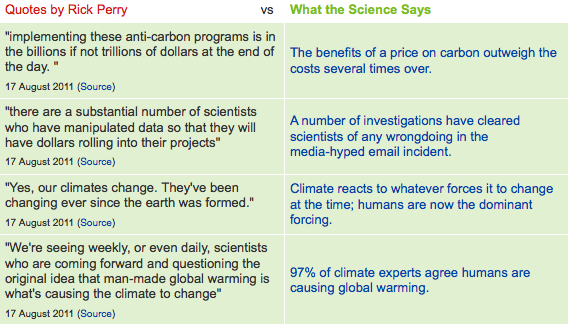
Rick Perry is the governor of Texas, former Lieutenant Governor under George W. Bush, and even more anti-climate science than his former boss. Recently, Perry has been questioning the climate science consensus, and claiming that climate scientists are falsifying data in order to receive research funding. This sort of conspiratorial mindset is perhaps as anti-climate science as possible.
Mitt Romney
Mitt Romney is the former governor of Massachusetts, and one of the few Republican presidential candiates who doesn't deny basic climate science.
In June 2011, Romney said:
"I believe the world is getting warmer, and I believe that humans have contributed to that...It's important for us to reduce our emissions of pollutants and greenhouse gases that may be significant contributors."
These aren't the most Earth-shattering comments, but a simple refusal to deny basic climate science has become a rarity in Republican politics.
Michelle Bachmann
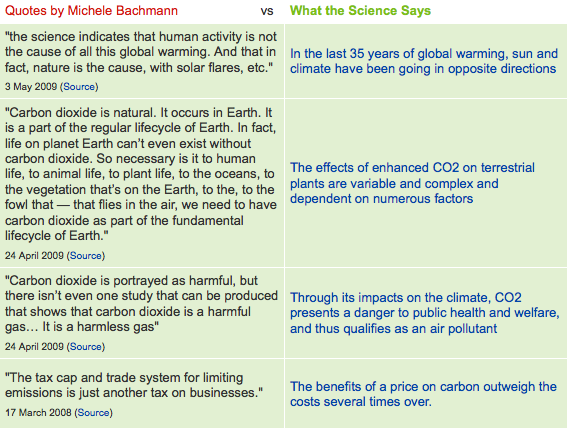
Michelle Bachmann is a congresswoman from Minnesota, and founder and chair of the Tea Party Caucus in the US House of Representatives. Bachmann's climate arguments generally tend to center around the claims that carbon and climate change are natural, and therefore nothing to worry about. In short, a straight-up denial that humans could possibly be causing significant climate change.

Ron Paul
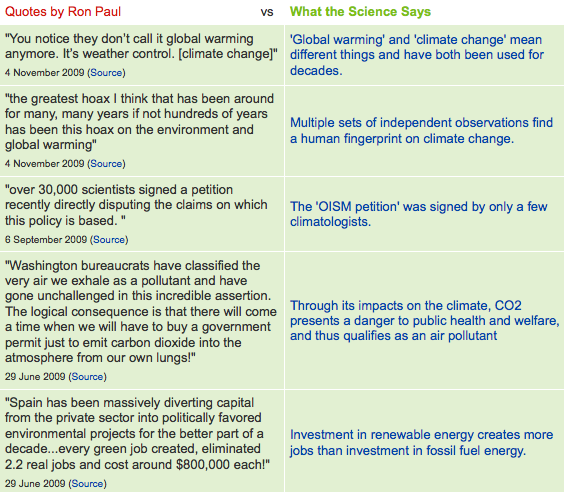
Ron Paul is a congressman from Texas. Although he's a registered Republican, his political philosophy is more Libertarian, and thus many pundits don't consider him a "top tier candidate" with a serious chance to win the Republican presidential nomination. Paul has become increasingly anti-climate science in recent years, going as far as to call it "the greatest hoax...for many, many years if not hundreds of years." Paul believes the government can do nothing right, and thus opposes most proposed climate solutions (such as carbon pricing), which may cloud his perception of climate science.

Sarah Palin
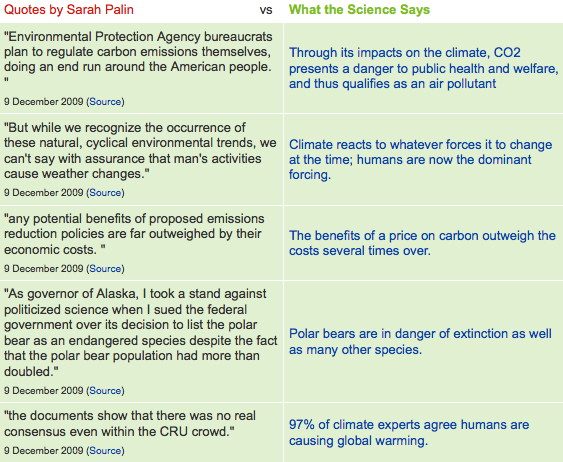
Sarah Palin is the former governor of Alaska. She has not yet entered the 2012 presidential race, but may very well eventually throw her hat in the ring. Palin has long denied many aspects of climate science, from the man-made global warming consensus, to the existence of man-made global warming itself, to the endangerment of polar bears as a result of climate change.

Newt Gingrich
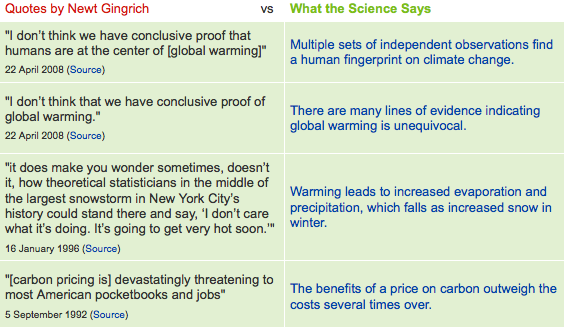
Newt Gingrich is the former Speaker of the House of Representatives and congressman from Georgia. Gingrich is guilty of the biggest flip-flop on climate science amongst these candidates. In 2008, he appeared in an ad with then-Democratic Speaker of the House Nanci Pelosi in which he said:
"our country must take action to address climate change"
Those were the days. Since then, Gingrich's positions on climate science and solutions have changed dramatically. Recently, Gingrich has not only denied that humans are causing global warming, but has gone as far as expressing "skepticism" that the planet is even warming to begin with.
Jon Huntsman
Jon Huntsman is the former Governor of Utah and US embassador to China. He is one of the few Republican presidential candidates to express confidence in climate science research.

In response to an interview in which Rick Perry expressed his climate "skepticism", Huntsman tweeted:
"To be clear. I believe in evolution and trust scientists on global warming. Call me crazy."
Huntsman later expanded on this point:
"I think there's a serious problem. The minute that the Republican Party becomes the party - the anti-science party, we have a huge problem. We lose a whole lot of people who would otherwise allow us to win the election in 2012. When we take a position that isn't willing to embrace evolution, when we take a position that basically runs counter to what 98 of 100 climate scientists have said, what the National Academy of Science - Sciences has said about what is causing climate change and man's contribution to it, I think we find ourselves on the wrong side of science, and, therefore, in a losing position"
However, Huntsman's chances of winning the presidential nomination are considered slim.
Herman Cain
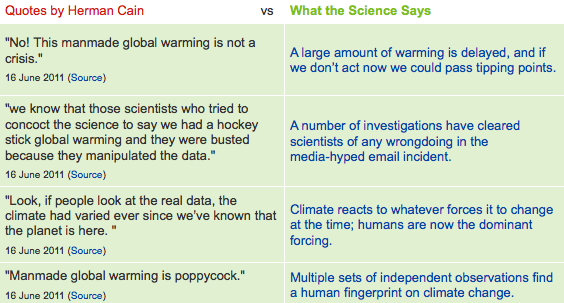
Herman Cain is a businessman from Georgia. He had a brief surge in popularity in the Republican presidential race, but it didn't last very long. Similar to Perry, Cain claims that humans aren't causing global warming, and accuses climate scientists of falsifying data.

Rick Santorum
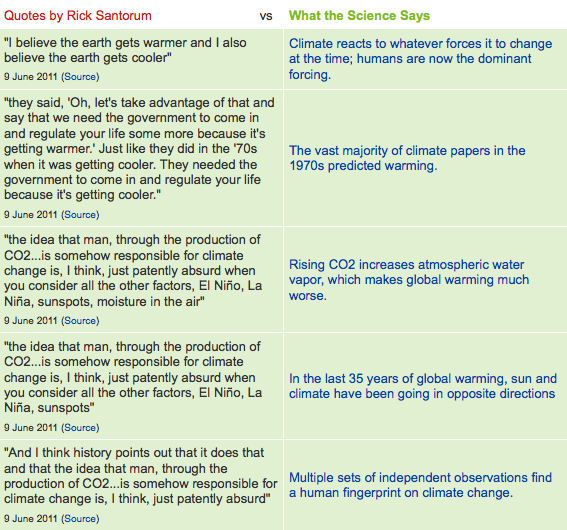
Rick Santorum is a former Senator from Pennsylvania who has been very consistent in his denial of basic climate science.

An Anti-Science Group
With the exception of Mitt Romney, John Huntsman's warning to his fellow candidates not to become the anti-science party seems to be falling on deaf ears. Most Republican presidential candidates deny the basic science about the warming of the planet and/or accuse climate scientists of falsifying data. Unfortunately, denial of basic climate science appears to have become a "litmus test" for any candidate trying to win a Republican political nomination.
UCS Climate Science References
In response to the general Republican climate science denial, the Union of Concerned Scientists (UCS) has assembled a number of references to recent climate assessments and statements from scientific societies. They also referenced Skeptical Science as a useful resource to debunk climate myths.
Note: the quotes above have been added to the Politician Climate Myths resource, and some have been added to the Climate Misinformers page at sks.to/skeptics

Arguments


"Republican Presidential Candidates on Climate Change" by Timothy Hurst posted Aug 22 on Ecopolitology.
While his profiles are not as detailed as Dana’s, Hurst does provide some valuable insights.
In addition, the caricatures of the candidates done for the Hurst article are a hoot!
"No politics. Rants about politics, ideology or one world governments will be deleted."
While the article is about politicians, it is not about their politics. It is about their stance on AGW science and science in general.
Also, it is not a political rant ($PARTY is evil and wants to destroy $COUNTRY!) but a list of statements made by politicians. While I would prefer that SkS stay away from politics discussing the statements of politicians is fair since they are so important to how policy will be shaped (or not) by the science.
OSHA's maximum safe level is 3%; lethal concentration (death in 30 minutes) is 10% Would Palin go to sleep in a room with 5% CO2? Of course, "safe levels" have nothing to do with global warming.
I do not see how anyone can believe the science is a hoax. The science is supported by thousands of scientists, of different disciplines, hundreds of institutions, and speaking dozens of languages. Every major scientific organization from China to the USA has endorsed the findings.
Read more: http://wiki.answers.com/Q/How_much_carbon_dioxide_intake_is_lethal#ixzz1VtHmDBuF
The rest of them have picked up on the fact that this kind of message resonates with the base, or they actually sincerely believe it because they are scientifically incompetent and close to innumerate. The way Joe Barton had to be reminded (if he ever knew it in the first place) in a congressional hearing that landmasses have changed position over geological ages is unfortunately representative of how Republicans are nowadays.
Rather sad. But, hey they indeed are representatives; they wouldn't be there if the people who elected them knew better. There lies the real problem.
The above is the concluding paragraph of an excellent article, "Huntsman, Romney believe in global warming, but not action" by Rachel Weiner posted on the Washington Post's The Fix on Aug 23, 2011.
Weiner's article nicely supplements Dana's.
I have interacted with apiratelooksat50 for quite few years and I can vouch for his sincerity in posing his question.
The challenge is to turn that potential problem into a very real problem. It is a glaring political weakness, even in the US.
KenH
I think anytime we start discussing politics on this site it is going to be a slippery slope before the conversation devolves away from the science.
I know the politicians say what they think their constituents want to hear. A vote is a vote. The latest polls show that more and more Americans are not in support of the AGW theory. Of course, the politicians are going to play on that.
I'm not in favor of that. I wish politicians would speak truthfully. But, they never have and never will.
Case in point: look at Obama's words and promises pertaining to AGW and environmental policies before he got elected. He has not done much at all in that area, and that was with 2 years of a heavily Democratic weighted House and Senate.
I know in the UK we have Labour and Liberal Democrats that are skeptic.
I guess if there are no Democrats, then that is the problem in the US, far to polarised and the issue of climate change is politicised.
What polls are you citing? Here is a summary of polls that disagree with your contention.
Action by EPA to regulate CO2? favor 71% stop 28%
New legislation this year to regulate energy output from private companies in an attempt to reduce global warming? favor 56% oppose 40%
Energy policy to keep prices low or protect the environment? environment: 56% energy prices 37%
Global warming: major problem 54% minor problem 23% not a problem 19%
Perhaps you have some data to the contrary. But as always, a source speaks louder than an unsubstantiated assertion.
( -Snip- )
[DB] Off-topic snipped. This post is about Republican Presidential Candidates vs. Climate Science, not public opinion polls on various and sundry topics.
[snip]
Anyway, with the exception of the far right and left, the polls show similar support (or lack thereof) for action on global warming. Statements that Democrats support AGW and Republicans do not are contradicted by the polls themselves. Politicians tend to listen to the polls.
A very recent poll can be found here.
I wasn't criticizing any individual by that statement. I was criticizing politicians in general who will say anything that needs to be said to get elected. They watch these same polls and conduct their own to feed back to the potential voters what they want to hear.
Politicians, for the most part, are not scientists. Whether Democratic or Republican they merely echo their constituency on polarizing issues such as abortion, climate, Creationism/Evolution, etc... Some may try to move to the middle to appear likeable to the other side.
The following table shows that there is broad agreement that something must be done. The remainder the data on the source page show the broad ideological divisions on AGW opinions.
There's a stunning contradiction between decreasing numbers who believe AGW is a real problem and the large percentages shown in this table who say we must do something. This indicates a high level of confusion in the general public and a potential area for an education effort. Not surprising that they're confused, given all the misinformation they are fed by the Limbugs, Becks and What's up/Faux News Bastardis.
It also shows how far out of touch the Republican do-nothing/spend-nothing crowd really is - and illustrates a very strong weakness in their appeal in a national election.
Knowing that, I think it must pain him greatly to see how the Republican party simply refuses to look reality in the face, instead insisting on a reckless path to devastation of the whole biosphere, all for the sake of profit.
I forgot to say what browser I am using: it is FF 3.6.17 under Fedora 13 with NoScript installed. And now I see that you are right: the visible text actually does form coherent sentences with no missing words. But there should be a margin (or padding) between the text and the graphic; there is none, creating the appearance that words are covered up.
I see no contradiction between the two surveys. The error is in assuming that energy efficiency and global warming abatement are linked. The surveys indicate that most people want to do something about energy independence and efficiency, but not necessarily global warming.
These numbers are similar to those in the survey to which I linked earlier. Also, you will notice that there is no difference across the politcal spectrum from moderate Republicans to Democrats. The only difference occur at the extremes.
Missing the point yet again? The table I posted above shows that clear majorities of Repubs are in favor of:
- requiring increased energy efficiency
- federal investment in renewable energy sources
- mass transit
- nuclear power
You can pretend that this combination is just about efficiency if you want. But (except for nukes) these are neither Tea Party nor deep denial-type positions (see Heartland Institute or American Enterprise for those; AEI is even against energy efficiency!) Nor are they Libertarian Party positions.
The (now) leading candidate (Guvna P) is diametrically opposed to the federal govt requiring or investing in anything (unless Texas needs the money). Well, he likes nukes -- and here's why:
“We don’t have tsunamis in Texas.”
The man's a genius!
A separate table in the linked article shows that a majority of Repubs
- don't see solid evidence of warming (it's not happening - 62%),
- don't see warming as a problem (it's not bad - 57%)
- don't believe science agrees on the anthropogenic cause (there's no consensus - 58%).
My take on that internally inconsistent (and incorrect) profile is that they simply believe what they are told to believe by the disinformation industry.
Unfortunately, their chosen trusted information sources are right-leaning media, who tend to trumpet false 'facts' about global warming, and spread disinformation like it's going out of style.
So it's not a matter of them doing what they're told, rather they are being misled by those they trust. The problem for the rest of us is to figure out how to convince these people that they are being lied to. Given the attack on the credibility of science in general, and climate science in particular, that's no small task...
Ignoring 20? I gave you what you asked for...
However, I did give you a shout-out in #22.
I've recently quoted Dr. Curry, of all people, for some psychological insight:
“All else being equal, individuals tend to be significantly better at detecting fallacies when the fallacy occurs in an argument for a conclusion which they disbelieve, than when the same fallacy occurs in an argument for a conclusion which they believe. ...
“As more and more peers weigh in on a given issue, the proportion of the total evidence which consists of higher order psychological evidence [of what other people believe] increases, and the proportion of the total evidence which consists of first order evidence decreases . . . “Over time, this invisible hand process tends to bestow a certain competitive advantage to our prior beliefs with respect to confirmation and disconfirmation” --emphasis added
And if you can't trust a skeptic blogger to know a bit about fallacy in argument, who can you trust? She's an expert in that department, after all.
Your poll regarding Republicans is only ten percentage points higher than the general populace (62% vs. 52%). One could assume that Democrats are ~42%, which is a difference of 20 percentage points, and similar to other polls.
As I mentioned earlier, both the conservative Republicans and liberal Democrats are separate from the general populace, which is fairly consistent. You are constantly trying to tie energy efficiency to global warming and the political parties. This is why you see it as inconsistent. The polls are saying that they are separate issues among the voters.
Contrary to Bern's assertion, I don't not think they are being misled by those they trust, but rather thinking for themselves.
The question here is not R vs. D; the question here is identifying what the general population of Rs say they believe vs. what their candidates are pushing at them. You say politicians listen to the polls; it's not happening. If anything, the R candidates are driving each other into increasingly radical positions; surely you are not saying that the general population of Rs is driving that? And of course, you miss the fact that President Obama keeps moving towards the center.
"polls are saying that they are separate issues among the voters."
Polls are saying that Rs are confused. They say they don't believe in AGW, but they support government investment in alternative energies. Their leaders would take solar panels off the White House (oh, they already did that one).
"I don't not think they are being misled by those they trust"
So do you trust Limbaug, Beck, Bachmann and Palin? Enough to go all-in with the climate hanging in the balance? But 'thinking'? Based on the repetition of the talking points by Rs whenever possible, there's no evidence of any thinking. Thinking is hard work.
Does he not know what state he represents?
"Thinking for themselves" implies critical thinking. I am at a loss to come up with a widely accepted denier position that includes critical thinking; indeed it would appear most denier positions require a lack of critical thinking (take a look around this site for examples).
There are certainly a few issues where more research is required (ocean heat content, my old favorite, for one). But were is that nuanced, critical thought and position amongst the right in the US? To my eyes it has been in steep decline for the last 10 years or so.
The election of Bush (and rejection of Al Gore) seemed to mark an inflection point where the right began to support some pretty major departures from fact based science to form their worldview.
I still disagree that the polls are indicating confusing among the general population. Belief in global warming is but one reason to support government investment in alternate energy. Energy independence from OPEC and the big oil companies or cheap alternatives to rising oil prices are some others.
I do not trust the politicians or bureaucrats on either side of the debate when it comes to scientific understanding, and I do not believe that most other people do either (although I have heard people claim it is so because they heard it from whomever).
Yes, Obama is moving towards the center. The polls show similar thinking from the moderate camp of each party through the independents in the center. Those outside this area will find difficult running come election time. Both Conservative Republicans and Liberal Democrats are outside this area and unless their constituents feel likewise, have election night struggles. Gerrymandering has create many districts which push towards both extremes allowing many of the politicians to get elected.
The Texas heatwave is generally blamed on the strong La Nina. Passing it off as AGW influenced is the type of misinformation that is causing people to distrust climate scientists, as shwon in the previously posted polls.
If OPEC/big oil was the concern, then where is the support for 'cheap, reliable American coal'? What happened to all those 'clean coal' TV ads? Banished to the SciFi channel?
"Gerrymandering has create many districts which push towards both extremes"
You have the process exactly backwards; redistricting is done by the party in control of the state legislatures. Extremists win local elections, take control of state houses (look at Wisconsin, for example) then redraw the electoral maps to suit their candidates - and that can win a presidential election (see: Tom Delay).
"generally blamed on the strong La Nina."
Off-topic; but not so much any longer. You're forgetting the hallmark of this heatwave: nighttime cooling isn't getting the job done; that's not an elNi/laNa effect - but it is a greenhouse symptom.
Statistically if they (politicians) all studied the science and came to their own conclusions, you would get some Democrats being skeptic and some Republicans pro AGW.
So the only conclusion, is that both sides are largely ignoring the science.
The current situation defies science in many ways.
That would only be true if there were some science which supported a position skeptical of AGW. There isn't.
Indeed, by the same reasoning we should see Democratic politicians who deny evolution... rather than that too being a purely Republican position.
In 'news' and politics there often seems to be a search for false 'balance' even on issues which are entirely one sided.
"The Texas heatwave is generally blamed on the strong La Nina. Passing it off as AGW influenced is the type of misinformation that is causing people to distrust climate scientists, as shwon in the previously posted polls."
Darn good point.
I think EtR is drawing a false dichotomy and invoking a double standard. We should (and do) acknowldge the influence of ENSO and other factors in the SW weather patterns. But wouldn't we be remiss if we didn't also acknowledge the likely role of warming - given that we know it is occuring? Why is mere mention of AGW with respect to record breaking temps to be avoided? That seems more like a political position than a scientific stance.
Think of it this way. The La Nina just past was substantial, but not the most severe on record. The la Nina can explain a persistent pattern of drought in the SW...but it cannot explain the degree to which this summer has spawned an enourmous number of temp records, nor can it explain the disproportionate number of nighttime temp records.
La Nina (and other factors) that influence weather patterns at regional scales are important. However, the the diel signature of warming and its extreme nature are perfectly consistent with a role of global warming, distinct from La Nina.
The old proverb 'may you live in interesting times' should be updated to 'may you live in exceptional times.'
With regards to the drought in Texas, La Nina is the persistent cause. I was making no reference to temperatures, either daytime or nighttime, but to the rainfall, or rather lack thereof. This past La Nina was the most severe, and neither is the current drought. Texas has experienced worst droughts at lower temperatures than have occurred this year.
We have a strong historical connection between La Ninas and drought in Texas, but not so with global warming. No dichotomy, no double standard.
That said, suggesting La Niña without acknowledging the importance of warmer baseline temperatures from AGW and the tendency for extreme weather to become more extreme as a result of the warming, strikes me as disingenuous.
I think this thread is the most topical for 2011 droughts in Texas.
Bringing my own contribution back on topic, I find it unfortunate (some understatement involved) that (a) the majority of Republicans who are running to represent their party in the 2012 Presidential election are so deep in denial about climate change and (b) the one who isn't is probably not, at least the way things appear at present, likely to secure his party's nomination.
Since global warming theory tends to favor El Nino conditions, the occurrance of the strong La Nina runs counter-intuitive. The warmer baseline temperatures are certainy a possible cause for the higher temperatures, however, linking that to the current drought is a stretch. This is not to say that AGW could not be a contributor, but the La Nina has a strong, historical cause for the current drought.
I agree with you first statement, but that only makes the point I was trying to make stronger. Even if warming and intensity/frequency of ENSO cycles were not linked in some way, it would make no sense to dismiss warming out of hand as a factor given the ENSO state. Since they are potentially linked, it makes dismissing an effect of warming even less sensible.
EtR...
you specifically referenced the heatwave in your post above as quoted by apirate. It's OK to backtrack, it would be better if you did so explicitly, though.
Also, I would argue that heat does exacerbate drought conditions. It certainly makes it harder for plants to maintain water balance at a given level of soil moisture.
Saying something is a 'historical cause' is meaningless here.





