





Guest post: scrutinising the 31,000 scientists in the OISM Petition Project
Posted on 11 March 2010 by angliss
In early 2008, the Oregon Institute of Science and Medicine (OISM) published their Petition Project, a list of names from people who all claimed to be scientists and who rejected the science behind the theory of anthropogenic (human-caused) global warming (AGW). This was an attempt to by the OISM to claim that there were far more scientists opposing AGW theory than there are supporting it. This so-called petition took on special importance coming after the release of the Intergovernmental Panel on Climate Change’s Fourth Assessment Report, and specifically the Working Group 1 (WG1) report on the science and attribution of climate change to human civilization.
The WG1 report was authored and reviewed by approximately 2000 scientists with varying expertise in climate and related fields, and so having a list of over 30,000 scientists that rejected the WG1’s conclusions was a powerful meme that AGW skeptics and deniers could use to cast doubt on the IPCC’s conclusions and, indirectly, on the entire theory of climate disruption. And in fact, this meme has become widespread in both legacy and new media today.
It is also false.
According to the Petition Project “qualifications” page, “Signatories are approved for inclusion in the Petition Project list if they have obtained formal educational degrees at the level of Bachelor of Science or higher in appropriate scientific fields.” The fields that are considered “appropriate” by the OISM are as follows:
- Atmosphere, Earth, and Environment fields: atmospheric science, climatology, meteorology, astronomy, astrophysics, earth science, geochemistry, geology, geophysics, geoscience, hydrology, environmental engineering, environmental science, forestry, oceanography
- Computers and Math: computer science, mathematics, statistics
- Physics and Aerospace: physics, nuclear engineering, mechanical engineering, aerospace engineering
- Chemistry: chemistry, chemical engineering
- Biochemistry, Biology, and Agriculture: biochemistry, biophysics, biology, ecology, entomology, zoology, animal science, agricultural science, agricultural engineering, plant science, food science
- Medicine: medical science, medicine
- General Engineering and General Science: engineering, electrical engineering, metallurgy, general science
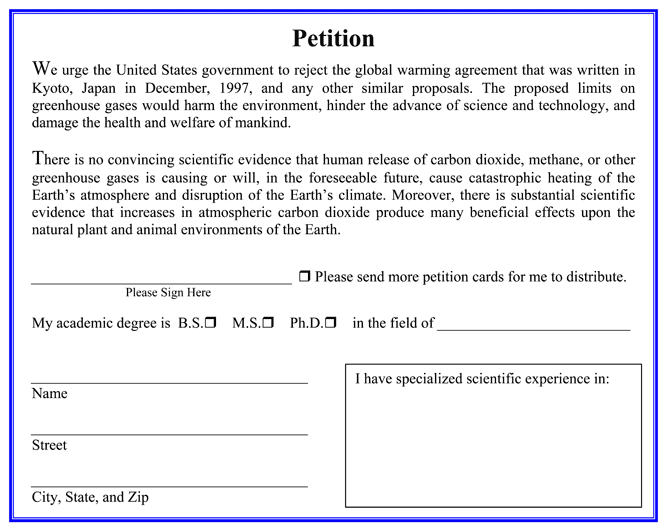
The OISM’s qualifications for being a “scientist” are expansive, and as such there are a number of questions that have to be answered before we can take this list seriously. What expertise does a nuclear engineer or a medical doctor or a food scientist or mechanical engineer have that makes them qualified to have an informed opinion on the cause(s) of recent climate disruption? How many of these names are working climate scientists instead of science or math teachers or stay-at-home-mom’s with engineering degrees? How many of these people has actually published a peer-reviewed paper on climate? How many people took a look at the card that served as a “signature” (click on the image to see a larger version) and realized that they could lie about having a science degree and their deception would never be discovered?
At this point it’s literally impossible to know because the names and degrees on the list cannot be verified by anyone outside the OISM. We can only take the OISM’s word that they’re all real names, that all the degrees are correct, and so on. This does not stand up to the most basic tests of scientific credibility.
Unfortunately, the OISM’s list has had its credibility fabricated for it by individuals and groups as diverse as Steve Milloy of Fox News (see this link for a S&R investigation into the background and tactics of Steve Milloy), L. Brent Bozell of conservative “news” site Newsbusters and founder of the conservative Media Research Center, Benita M. Dodd of the Georgia Public Policy Foundation, the libertarian/conservative site American Thinker (a site that has regularly failed to fact-check their AGW posts), conservative commentator Deroy Murdock (who works on Project 21 with the wife of one of Steve Milloy’s long-time associates), RightSideNews, Dakota Voice, Dennis T. Avery of the Hudson Institute, Lawrence Solomon of the Financial Post, Michelle Malkin, and the Competitive Enterprise Institute, to name just a few of the better known. As a result, the OISM’s petition has been elevated to a level of credibility that is arguably undeserved.
While it’s not possible to test the validity of OISM list directly, it is possible to test the conclusions that have been drawn from the OISM list. Specifically, we can test what percentage the 30,000 “scientists” listed on the OISM petition represent when compared to the total number of scientists in the U.S. And we can then compare that to the percentage represented by the 2000 IPCC AR4 WG1-associated scientists as compared to the estimate number of U.S. climate-related scientists.
According to the OISM website, anyone with a Bachelor’s, Master’s, or Doctorate of Philosophy in a field related to physical sciences is qualified as a scientist. In addition, the OISM sent the petition cards pictured above only to individuals within the U.S. Based on this information, we can us the OISM’s own guidelines to determine how many scientists there are in the U.S. and what percentage of those scientists are represented by the OISM petition.
The U.S. Department of Education tracks the number of graduates from institutions of higher education every year, and has done so since either the 1950-51 or 1970-71 school years, depending on what specifically the Dept. of Ed. was interested in. This data was last updated in the Digest of Education Statistics: 2008. We’re specifically interested in the number of degrees that have been awarded in the various scientific disciplines as defined by the OISM in the list above. This information is available in the following tables within the 2008 Digest: 296, 298, 302, 304, 310, 311, and 312. Table 1 below show how many graduates there were in the various categories defined by the Dept. of Ed. since the 1970-71 school year (click on the image for a larger version). The numbers have been corrected to account for the fact that PhD’s will usually have MS degrees as well, and that both are preceded by BS degrees.
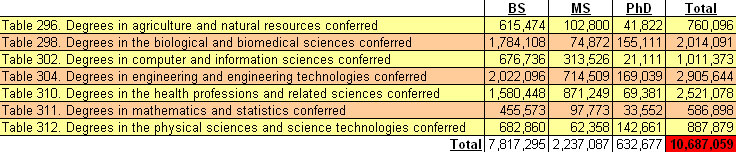
As you can see, Table 1 shows that there were over 10.6 million science graduates as defined by the OISM since the 1970-71 school year. This is a conservative estimate as illustrated by the 242,000 graduates in biological and biomedical sciences from 1950-51 through 1969-70 alone, never mind the 166,000 engineering graduates, and so on. Many of these individuals are still alive today and would be considered scientists according to the OISM definition thereof.
The OISM website lists how many signatures they have for scientists in each of their categories. Given the number of graduates and the number of signatures claimed by the OISM, we can calculate the percentage of OISM-defined scientists who signed as referenced to the total. These results are shown in Table 2 below.
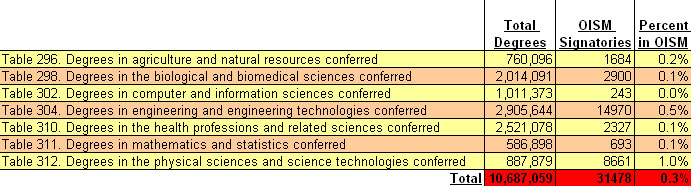
In other words, the OISM signatories represent a small fraction (~0.3%) of all science graduates, even when we use the OISM’s own definition of a scientist.
However, as mentioned above, it’s entirely reasonable to ask whether a veterinarian or forestry manager or electrical engineer should qualify as a scientist. If we remove all the engineers, medical professionals, computer scientists, and mathematicians, then the 31,478 “scientists” turn into 13,245 actual scientists, as opposed to scientists according to the OISM’s expansive definition. Of course, not all of them are working in science, but since some medical professionals and statisticians do work in science, it’s still a reasonable quick estimate.
However, it’s not reasonable to expect that all of those actual scientists are working in climate sciences. Certainly the 39 climatologists, but after that, it gets much murkier. Most geologists don’t work as climate scientists, although some certainly do. Most meteorologists do weather forecasting, but understanding the weather is radically different than understanding climate. So we can’t be sure beyond the 39 climatologists, although we can reasonably assume that the number is far less than the 13,245 actual scientists claimed by the OISM.
13,245 scientists is only 0.1% of the scientists graduated in the U.S. since the 1970-71 school year.
We can, however, compare the number of atmospheric scientists, climagologists, ocean scientists, and meteorologists who signed this petition to the number of members of the various professional organizations. For example, the American Geophysical Union (AGU) has over 55,000 members, of which over 7,200 claim that atmospheric sciences is their primary field. The OISM claims 152 atmospheric scientists. Compared to the atmospheric scientist membership in the AGU, the OISM signatories are only 2.1%, and this estimate is high given the fact that the AGU does not claim all atmospheric scientists as members.
The AGU hydrology group has over 6,000 members who call hydrology their primary field. The OISM list has 22 names that claim to be hydrologists, or 0.4%.
The AGU ocean sciences group claims approximately 6,800 members. The OISM has 83 names, or 1.2%. And again, given that AGU membership is not required to be a practicing ocean scientists, this number is inflated.
The American Meteorological Society claims over 14,000 members and the OISM claims 341 meteorologists as petition signatories. That’s only 2.4%.
It’s clear that the OISM names don’t represent a significant number of scientists when compared to either the total number of science graduates in the U.S. or to the number of practicing scientists who work in likely relevant fields. But that’s not all.
Over recent years, various organizations have set out to estimate just how widespread the supposed “scientific consensus” on AGW actually is. Two recent efforts were conducted by the Statistical Assessment Service (STATS) at George Mason University and by the Pew Research Center for the People and the Press. The STATS survey found that 84% of climate scientists surveyed “personally believe human-induced warming is occurring” and that “[o]nly 5% believe that that human activity does not contribute to greenhouse warming.” The STATS survey involved a random sampling of “489 self-identified members of either the American Meteorological Society or the American Geophysical Union” and it has a theoretical sampling error of +/- 4%.
The Pew survey was taken in early 2009 and asked over 2000 members of the American Association for the Advancement of Science (AAAS) their opinion on various scientific issues, including climate disruption. 84% of AAAS respondents felt that “warming is due to human activity” compared to only 10% who felt that “warming is due to natural causes.” The AAAS has over 10 million members, and the results of the survey are statistically valid for the entire population with a theoretical sampling error of +/- 2.5%.
84% of 10 million scientist members of the AAAS is 8.4 million scientists who agree that climate disruption is human-caused. 84% of the climate scientists (conservatively just the members of the atmospheric science group of the AGU) is, conservatively, 6,000 scientists who have direct and expert knowledge of climate disruption. The 13,245 scientists and 152 possible climate scientists who signed the OISM petition represent a small minority of the totals.
The IPCC AR4 WG1 report was written and reviewed by approximately 2000 scientists. If we assume that the 20,000 AGU members who claim to be atmospheric scientists, ocean scientists, or hydrologists represent the pool of potential experts in climate science in the U.S., then approximately 10% of all climate scientists were directly involved in creating the over 1000 page report.
That compares to less than 1% of all OISM “scientists” who mailed a pre-printed postcard.
A more recent survey of earth scientists asked the question "Do you think human activity is a significant contributing factor in changing mean global temperatures?". 97.5% of climatologists who were actively publishing papers on climate change responded yes.(Doran 2009). What is most interesting about this study was that as the level of active research and specialization in climate science increases, so does agreement that humans are significantly changing global temperatures.
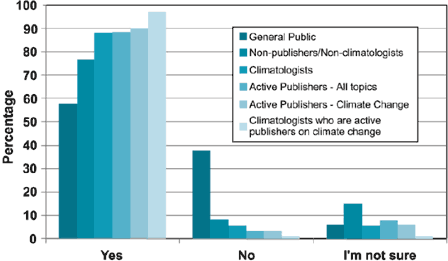
Figure 1: Response to the survey question "Do you think human activity is a significant contributing factor in changing mean global temperatures?" (Doran 2009) General public data come from a 2008 Gallup poll.
Ultimately, The OISM petition will continue to rear it’s ugly head until its fabricated credibility has been thoroughly demolished. Social conservatives and libertarians, each of which has their own ideological reasons to push the OISM petition, have been effective at keeping the “30,000 scientists reject warming chicken-littleism of IPCC” meme circulating throughout conservative media outlets, even as climate disruption-focused media have worked at limiting the damage from the OISM petition. But given the fact that the science supporting a dominantly anthropogenic cause for climate disruption is overwhelming, it’s only a matter of time before the OISM petition wilts in the heat.
Acknowledgements to Brian Angliss at Scholars and Rogues who guest wrote this post.

Arguments


The folks who wrote this post need to lighten up; this is something to laugh about.
So why do denialists continue to count them?
I think as long this keeps happening, it is entirely fair play to continue to shoot this nonsense down in flames.
Every scientist, no matter what background they come from, understand due scientific process and from that understanding alone, they are qualified to reject any statement that they believe was reached at through a faulty process.
As for climate scientists themselves - what constitutes being one? Perhaps we can look at the World Meteorological Organization as starters - the UN organization established to facilitate the gathering of meteorological observations and promote the standardization and uniform publication of observation and statistics. It was through the WMO that weather forecasters switched from saying "a good possibility of rain" etc to assigning a probability (ie 60% chance of showers). I bring this point up because the purpose stated when the switch was made was simply that people did not understand phrases like slight chance, strong probability etc but felt a percentage assigned to a forecast was more meaningful. In other words when they say "60% chance of showers, there is no relation whatsoever to true probability from a statistical perspective, but rather they assign a percentage to allow people to better believe their forecast. In the end it has not resulted in better or more accurate forecasting.
Instead of questioning the credentials of people on a list, even if 50% were found out to be incorrect, that still leaves a significant number of scientists who disagree with the findings of the IPCC. As a geologist with over 35 years of experience, I can assure you that over 80% of my colleagues have a serious doubt about the findings of the IPCC.
In the end I guess we should look to the UN who recently agreed to appoint an independent commission to look into the activities of those scientists who were involved in the published findings of the IPCC reports, even though I have my doubts as I believe it was the way in which the UN established the IPCC in the first place that contributed to the poor scientific process used to generate the IPCC reports.
Ultimately, folks such as myself become part of conversations which may influence the way someone votes (not that I would ever do that in my practice of medicine).
My participation in this forum is one such conversation. I imagine a number of other participants on this forum are in a similar position, non climate -scientists, yet interested enough in a hot topic (pun intended) to engage with the issues.
Consequently, a survey of what tertiary educated individuals with some background in the sciences might think is of some relevance so long as it is represented as no more than just that.
A short addressing of the role of consensus in science is a few slides in Naomi Oreskes's "Consensus in Science: How Do We Know We're Not Wrong?" More depth on the topic can be gotten from any number of books on sociology, history, and philosophy of science.
To avoid duplicating my own comments (which would violate the Comments Policy), I'll just link to some relevant ones: 195, 196, and 197 on the thread There is no consensus.
Probably that is the more appropriate thread if you want to discuss the role of consensus in science rather than the OISM petition specifically.
>>What is most interesting about this study was that as the level of active research and specialization in climate science increases, so does agreement that humans are significantly changing global temperatures.<<
This plays right into the hands of the "no funding without a cause" crowd of denialists.
- Larry Weisenthal/Huntington Beach, CA
With Climate Science, the language is in temperature, ice, snow, water vapor, IR absorption, sea level, etc. so People have a real world understanding of that and hence anyone with a website and an idea can attempt to debunk it - though many are lacking the science to do that correctly. Climate Science is quite complex and as someone who is learned in the underlying physics of Astronomy/Cosmology with a dose of quantum mechanics and electrical engineering I can appreciate the complexities of this study. And i feel competant enough to read the peer reviewed papers, analyze measured data, compare AGW theories to observations, pose my own questions and draw conclusions. And anyone who understands the underlying physics can and should become educated in the field and seek their own answers through the peer reviewed literature and the observations. I think the Climate Science community should welcome the newfound interest in Climate Science and seek to understand this complex system through the scientific method.
The fact that there are large numbers on both sides of this argument should tell us something. And not all can be explained away by politics and association with Coal/Energy sectors. Let's understand this complex system to the point where it can be explained in simple terms and understood by all - because the climate affects everyone.
I can assure you that over 80% of my colleagues have a serious doubt about the findings of the IPCC.
That seems pretty significant, do you have any ideas of which parts or working group of the IPCC that is disagreed on?
I too encounter people, although it is almost always the older 'grey'crowd at the office who are the more skeptical of climate science. My PhD student peers when we are not "busy" with our projects debate quite a lot about climate science but we accept the basic science (and some of us are in the Skeptics Society so we know what skeptic means)
I would be very interested to see the average age of the scientists who are "climate skeptics". The most famous ones I can think of Plimer, Monkton, and Seitz are pretty old (by my standards at least :P)
My old (now very much retired) physics lecturer used to tell us that when he was an undergraduate there was still quite a few of the older respected physicists out there who outrightly rejected Einstien's General Theory of Relativity.
I am curious as whether it is the younger scientists (who incidentally have more to lose) entering their careers as the oldies retire that will be the determinate of what improves the consensus in the statistics.
Much more research into measuring temperatures across both the atmosphere at low, medium and high levels, calculations showing energy gain/loss of solids versus liquis, versus gases must be made to determine where the true energy gains and losses are made. I am a lowly MS in AeroAstro from Stanford and I have strong misgivings about the true science that has been presented on the subject, yet I have little doubt about other scientific phenomena that have been discovered and modeled using engineering principles and equations.
When will someone show more valid scientific data instead of roundabout opinions?
Basic energy transfer ideals makes me think that most energy gain and loss by the earth is via heat conduction via the land and oceans, and virtually little by means of the atmosphere (i.e. gases). Once steady state occurs (energy coming in from the sun balances energy going out from the atmosphere), balance occurs. Heat retention in air is minimal compared to that of heat retention in liquids and solids. Can someone scientifically comapre those rates and relate them to the conditions of the earth with the energy it is constantly exposed to by the Sun?
Mankind seems to always be so confident that they know the truth, until the lack of their knowledge shows them the folly of their ways.
Please think about my post before denying keeping it.
Peer review is a double edged sword. It may ensure quality or it may function as covert censorship in the setting of competing paradigms - a major problem when people have a huge emotional investment in an idea or a notion. Sometimes, peer review seems no more than a rubber stamp. Ultimately, there is no substitute for critical appraisal of the basic science (and climate science, while very complex, thankfully stays within the realms of Newtonian physics making it accessible to to the non-specialist).
Yet unfortunately it is represented as more than that most of the time. The Petition Project is regularly trotted out as evidence that large proportions of real, qualified and practising scientists active in the field of climate studies have grave and serious doubts about what is published in the relevant literature.
This is quite clearly not the case.
Additionally, is a survey of people in other scientific disciplines any more or less valid than asking an intelligent layperson what their opinion is?
I wonder how, say, neurosurgeons would react to a survey of particle physicists on their opinions of brain tumour treatment? Or what veterinarians think of the latest on loop quantum gravity?
That's one of the main problems with the OISM petition - it produces a false equivalence between expertise in climate and expertise in other, totally unrelated fields, purely on the existence of a Bachelor of Science degree.
The other point of my post is that, by the OISM's own criteria, their 31,000 signatories do not represent a "significant number of scientists who disagree...." Using the OISM's criteria, 31,000 people represents only 0.3% of all scientists.
This is the difference between an absolute measurement and a normalized measurement - yes, 31,000 sounds like a lot of people, but in reality it's a tiny number when compared to the entire defined population.
...and as far as the question:
"Do you think human activity is a significant contributing factor in changing mean global temperatures?".
...the wording is pretty loose and would be hard for anyone to deny. To say "significant contributing factor" isnt say much of anything. 4% could be considered "significant", for instance, we are talking about a pay cut, or increase in taxes. And anyone who lives in or near a city, (and that is about nearly anyone), knows very well that urban sprawl adds heat, which would necessarily "contribute" to an increase in mean "temperature".
As I have said in earlier posts, a big problem with the marketing of AGW is that it doesnt restrict its claims nor provides precision in its definition of global warming.
Why wasnt the question simply construed as:
"Do you think human activity causes global warming?"
...since the letters AGW, afterall, say nothing more than this.
I would be curious, RSVP, as to what you would answer to this question if given yes or no option in a survey.
I also have a science degree, but I would definitely not consider myself a scientist, and I do know people who completed the same degree as me who would still rather believe quack theories on some subjects over proven scientific research. So while a science degree may teach scientific process, it can’t make all graduates apply it in all situations. Based on this I think it is valid knowing that the “scientists” in the OISM petition are no more qualified than myself. I have an opinion, but I would never pass myself off as an expert just because I have a degree, flattering though it would be to be considered a scientist!
It is a meaningless trick question (for the reasons stated), but I would have to say "yes".
How well does near-vacuum conduct?
You really ought to read Spencer Weart's history of climate research, here:
The Discovery of Global Warming
It's a fun read and once you've digested it you'll be much better prepared to deal with the finer points of the topic. Honestly, I don't want to sound supercilious but conduction is really not the issue here.
'I wonder how, say, neurosurgeons would react to a survey of particle physicists on their opinions of brain tumour treatment? Or what veterinarians think of the latest on loop quantum gravity?'
As a psychiatrist, it happens to me all the time.
I've learnt to live with it.
Actually the added burden of accountability to the public at large while at times discomfiting has been a good thing for my profession.
With years to self select, we're on <1% of what they call 'scientists' (hey look, I'm now a 'scientist', thanks OISM!) they've collected 0.3% signatures.
Polls seem to find over 80% support amongst Earth & atmospheric scientists, so it's no surprise they got 0.3% of them to sign a petition saying otherwise.
The Independent Review, Spring 2009
"Generally speaking, we can observe that the scientists in any particular institutional and political setting move as a flock [!!!], reserving their controversies and particular originalities for matters that do not call into question the fundamental system of biases they share."
—Gunnar Myrdal, Objectivity in Social Research
"Perhaps we avoid studying our institutional lives because such work is not valued by our colleagues. The academy is, after all, a club, and members are expected to be discreet. Like any exclusive club, the academic world fears public scrutiny. Research is in the public domain. Outsiders [!] might use what the research reveals against the academy."
—Richard Wisniewski, "The Averted Gaze"
"The thousand profound scholars may have failed, first, because they were scholars, secondly, because they were profound, and thirdly, because they were a thousand. [...]"
—Edgar Allan Poe, "The Rationale of Verse"
"There is no convincing scientific evidence that human release of carbon dioxide, methane, or other greenhouse gasses is causing or will, in the foreseeable future, cause catastrophic heating of the Earth's atmosphere and disruption of the Earth's climate."
For me the important word in that sentance is catastrophic.
It is difficult to actually lump all individuals who are critical of the state of climate science, the castostrophic predictions or the anti-human agenda it promotes as having one brain that denies all the science.
For example assuming the Richard Lindzen on the petition is the same Richard Lindzen of Wikipedia's list of climate deniers then here is his position according to Wikipedia.
"We are quite confident (1) that global mean temperature is about 0.5 °C higher than it was a century ago; (2) that atmospheric levels of CO2 have risen over the past two centuries; and (3) that CO2 is a greenhouse gas whose increase is likely to warm the earth (one of many, the most important being water vapor and clouds). But – and I cannot stress this enough – we are not in a position to confidently attribute past climate change to CO2 or to forecast what the climate will be in the future."
I'm not even sure this form of analysis is valid. What percentage of any population would sign a contentious petition not matter what the subject. Especially one that would potentially expose them to co-workers, employers and funding bodies.
In fact even those with little to hide aren't on there. I had a quick scan for some of the more infamous 'denier' names I know and couldn't find them. It's a dull and pointless exercise but feel free to give it a go.
My experience of radical politics is that very few people are willing to put their head above the parapet when the nature of the politics goes against the prevailing current in society. Relatively small numbers of people in the 1950s, 1960s and even into the 1970s openly supported gay, black or womens rights, this did not make them unworthy fights.
Apologies for anyone who has seen this comment before that I have posted elsewhere.
"Re: the Oregon petition.
I have been trying to spread my view on an aspect of the wording of the petition which seems barely to have been noticed. It is a misleading nature of the statement that even Jim Hansen could have legitimately agreed with.
The wording in the petition is:
There is no convincing scientific evidence that human release of carbon dioxide, methane, or other greenhouse gasses is causing or will, in the foreseeable future, cause catastrophic heating of the Earth’s atmosphere and disruption of the Earth’s climate.
The weasel words are a)”is causing or will”, b)”catastrophic” and c)”disruption”. The first is an absolute statement. Even if the scientific evidence said there was a 99.99 % chance, then that is still not absolutely definite is it? A pernicketty type could not deny the very small possibility that the climate may not react as we think, so they would have been able to sign with a clear conscience.
The second and third effectively put forward the straw man that climate science is saying that the worst scenarios will come to pass, warming will be at the very top of the scale and we will definitely be screwed. As the science and evidence does not state that categorically, again people can sign legitimately.
The wording also seems to only restrict consideration to that warming likely to be caused by human emissions – it cleverly leaves out feedback emissions. The relatively small increases of temperature that human emissions alone are causing, and will cause, directly will, in turn cause feedback emissions (water vapour, melting permafrost, clathrates etc) that probably will cause the rises in temperature that are likely to be dangerous and lead to climate disruption. The petition implies that it only is concerned with direct human emissions.
Just my interpretation, because I have really not seen any dissection of the actual wording – or if it’s been done it’s not widespread as a counter argument to the validity of the views of those who signed it.
Nick Palmer
"Sustainability and stuff according to Nick Palmer"
I have a degree and a PhD in electronic engineering, teach comupter science, and perform research in statistics, including work on climate change. I am not the only one, for example Gavin Schmidt has a degree and a PhD in (applied) mathematics, I'm sure you wouldn't want to ignore his views. ;o)
Engineers, computer scientists and mathematicians are just the sort of people who should be working more in climate research, especially when so much of it involves engineering, computing, maths and stats!
P.S. Some computer scientists and mathematicians I know might take exception at being described as not being "actual scientists"!!!
There are lots of people in the US who believe that vaccines are more dangerous than the diseases that are protected against. However, when you look at the scientific, peer-reviewed studies of the dangers of vaccines vs. the dangers of the diseases, the data clearly shows that the incidence of serious vaccine side effects is much lower than the incidence of serious injury or death from the disease. Yet people still refuse to allow their children to be vaccinated.
Would you, as a medical professional, accept that a software programmer or a geologist has equivalent expertise to a medical doctor in determining the safety and efficacy of a vaccine? After all, the geologist at least has experience with peer review, the scientific method, and so on, just like an MD.
I wouldn't were I in your shoes.
It's one thing to accept that some people are going to second-guess your professional expert opinions. It's something else to accept that those people are going to be held up as having equivalent expertise to you by Newsbusters, Fox News, and Dennis Avery.
As Mike (#12) pointed out above, this is exactly how the OISM petition has been presented.
Dennis Avery, from EnterStageRight:
Mark Sheppard, via American Thinker:
Steve Milloy, via Fox News:
I've learnt to live with it. " Does that mean that the input you receive from from all individuals with various levels of knowledge and training in your field are equally valid? Or have you learned to accept comments that off the mark due to a persons over confidence on how well they understand the field.
As an MSEE myself, I'm not inherently qualified by way of my education to have an informed opinion on climate disruption. The same is true of anyone in a similar position, including you. What qualifications you or I have are derived not from our having a Bachelor of Science degree, but rather from the work we've done educating ourselves on the subject of climate science.
While an engineer or computer scientist or statistician may be qualified to have an informed opinion on the science underlying climate disruption, there is nothing inherent in the earning of the degree that makes them qualified. However, the OISM's own selection criteria assumes that the engineer, computer scientist, and statistician are equally qualified as people like Schmidt or Santer or Lindzen or Spencer who conduct climate science every day.
1) There is the science of climate change. The hard detailed work of understanding what is really going on. Messy, complicated science.
2) There is a massive political campaign targeting the science of global climate change. Ugly, vitriolic politics.
The Oregon Petition is one of the many political ploys used to obfuscate the science. It doesn't really have anything to do with the opinions of the people who sign the petition. It's a tactic.
"As an MSEE myself, I'm not inherently qualified by way of my education to have an informed opinion on climate disruption. The same is true of anyone in a similar position, including you." Actually no, I have worked (and published) with climatologists in the past and had to learn enough of the science to be worth collaborating with. I suspect there are many who are qualified by having read the litterature, e.g. Tim Lambert, without needing a formal qualification.
The point is that even if the OISM approach has no indication of a quality check, discarding the views of engineers, computer scientists and mathematicians without checking their background is no kind of quality check either and worse introduces a bias into the analysis that favours the view expressed. Engineering, computing and mathematical skills are essential to climate work and arbitrarily deleting them is a bogus step that devalues the point being made. It is bias either way, not quality control, you only get quality control by checking on a case by case basis.
The best science is conducted the way a chess player plays chess, you don't play the best move you can see, you play the best move that your opponent can't refute (i.e. you minimise his maximum advantage). The analysis above goes against that maxim by deleting half of his opponents evidence, without giving a sound reason, even though the results would still show that climate skepticism is a minority view. A stronger more would just be to show it is a minority view, even if you assume the sample is representative.
Having said which, it isn't (or at least shouldn't be) a popularity contest. A scientific argument stands or falls on its own merits. However, that isn't to say it isn't worthwhile demonstrating that a rhetorical argument is false (and point out that it is a rhetorical/political rather than a scientific point).
Dr Mörner, who (according to himself) was an expert reviewer of the chapter on Sea Level Changes in the IPCC report in 1999, claims that none of the 22 authors to that chapter was classified as a sea level specialist.
That doesn't sound so good. In a posted comment in another thread, somebody claimed that one of the authors actually was a sea level expert. Even if so, that is still not very impressive.
Science does work on certain levels of consensus. Science must always remain skeptical but that can't mean conclusions can't be reached (even temporary ones).
Even the peer review process is a process of consensus. Reviewers have to come to some level of consensus that a paper is worthy to be published. When you have 97% of the scientists working in a particular field agreeing on the science, that is a powerful message.
That 0.3% of the broadly defined scientific community (as with the Oregon Petition) rejects those findings is virtually meaningless.
If we now jump forward to the most recent version we find reference to another "peer reviewed research paper" published in that "highly respected" and "rigorous" "research journal" Journal of American Physicians and Surgeons.
Not a lot of scientific credibility associated with that fraudulent petition.
Here are links to the 3 papers referred to above:
http://web.archive.org/web/20070321030056/www.oism.org/pproject/review.pdf
http://www.int-res.com/articles/cr/13/c013p149.pdf
http://www.oism.org/pproject/GWReview_OISM150.pdf
Thank you for supporting my point that engineers etc. don't have the inherent expertise that the OISM assumes. After all, if you had to learn the climate science yourself before climatologists would consider collaborating with you, then other engineers etc. would also have to learn enough climate science. The OISM offers no way to know and no guarantees that their signatories are qualified.
As an EE myself, I'm not going to denigrate engineers or claim that they have nothing to offer climate science. I'm saying that there is nothing inherent in their degree that ensures that they are qualified.
Ultimately, however, I think you've latched onto a secondary point here. The primary point is, by the OISM's own criteria, they cannot justify the claim that their petition disproves the IPCC consensus claim. Including or rejecting engineers et al does not affect that conclusion.
Luckily, however, technology does not stand still. Google Kurweil solar power exponential if you want some further detail.
Cheers, :)
So if the discussion is now openly political, which it always was anyway, wouldn’t it be relevant to start a poll as to what the political affiliation is of those who support AGW vs. those who oppose it and those who are on the fence?
Assuming that a clever pollster can get predominantly honest answers, the results might be worth beholding. How about “Skeptical Science” trying its hand at it?
"There is an important angle to the manner in which the petition was originally circulated that is worth repeating ... Whether intentional or not, it was clearly misleading to some people."
Exactly. There's some additional points that need to be recognized:
1) Many signatures came from 1997. This was well before most scientists outside of the field had any reasonable understanding of the on-going research and the evidence was far less solid even to practicing climate scientists.
2) When Scientific American randomly contacted 26 of the signatures with related PhD's, only 11 (1 active researcher, 2 with relevant experience, and 8 based on an informal evaluation) said they still agreed with the petition. 6 would not sign it now, 3 don't remember ever signing it, 1 died, and 5 did not respond.
gallopingcamel (1) wrote:
"The folks who wrote this post need to lighten up; this is something to laugh about."
It would be funny if it weren't repeatedly brought up and deceiving so many people. Having been raised on a farm I know that if someone keeps throwing cow manure against the barn wall, some is bound to stick. Unless you regularly scrape off the manure, your barn will start to look pretty bad (no matter how solid the structure). The same is true for communicating the reality of AGW to the general public. Sadly, it's necessary to repeatedly clean up the manure repeatedly thrown at it.
Though he's very intelligent, I would no more give credence to my surgeon neighbor's view on AGW than I would ask a brilliant PhD EE friend for advice on cancer treatment.
Nice attempt at framing here. The discussion wasn't always political, and it's not ONLY political, now.
And you conveniently neglect to note who has been driving the 'politics' of this. Historically, long before Al Gore;'s movie, the ones with POLITICAL objections to climate science have been the right wing/conservative/free marketeers. And that's where most of the blogospheric and mainstream media 'critiques' of climate science come from today.
You are missing my point, if someone can have an informed opinion that is independent of their formal qualifications then deleting names from the list based solely on formal qualification is an obviois source of bias and weakens the argument. If you are going to do that, then why leave in the phycisists, chemists and biologists - none of those qualifications is a guarantee of informed opinion on climatology either, and the skeptic list would be even shorter.
Of couse if you are going to exclude on the basis of formal qualifications, then the skeptics should be able to leave out the opinions of all IPCC authors who are engineers, computer sceintists, mathematicians etc. Sauce for the goose is sauce for the gander.
The point is if you are going to argue against a rhetorical/political assertion, it is best not to use a counter that has any visible, let alone obvious bias, as it invites the obvious complaint of "bias! bias!". Much better to show that the skeptics are wrong, even with a generous interpretation of the evidence, which in this case, they are.
I believe that IPCC authors are nominated and selected based on their formal qualifications.
Statistically, if "science" was indeed the ultimate object of the exercise, one may reasonably use the hypothesis that science is apolitical and therefore the political affiliation of those on one or the other of the AGW is randomly distributed. Thus the poll should yield an equal percentage of liberal and conservative sympathizers on both sides of the controversy.
Anecdotal evidence indicates that this may not be the case. Hence a "scientific" poll may be in order... and also relevant, regardless of "who started it?" issue which is better left to the playground of those who are striving to mature.
Let's see ... Inhofe wants to jail climate scientists, the right wing in this country is on a witch hunt against climate scientists, and you think that unless 50% of climate scientists are Republicans it will prove that *climate scientists* are politically driven?
Why would you expect climate scientists to join a party whose leaders talk about, among other things, criminalizing their work?
I know many individuals who could be on that list who know very little about climate science.





