



 Arguments







Why did sea level fall in 2010?
What the science says...
| Select a level... |
 Basic
Basic
|
 Intermediate
| |||
|
Sea level fluctuations during El Niño (rising) and La Niña (falling) are the result of large exchanges of water between land and ocean in the form of rain and snow. This averages out to zero over time. It does not affect long-term sea level rise, which comes from melting icesheets, glaciers, and thermal expansion. |
|||||
Climate Myth...
Sea level fell in 2010
Large sea level fall in 2010 means IPCC sea level projections are wrong.
A number of climate not-so-skeptics have been exploiting global sea level data in their latest attempt to hide the incline. Skeptical Science readers will be very familiar with the tactics the "skeptics" use to make this argument:
- Cherrypick a very small amount of data during which the short-term noise has dampened the long-term incline.
- Ignore the long-term trend.
- Refuse to examine the reasons behind the short-term change.
Climate "skeptics" have used this exact same strategy to hide the incline in global surface temperatures (here and here and here), lower troposphere temperatures (here), and ocean heat content (here and here). We've found that an effective way to reveal the deception of these arguments is with an animated GIF, comparing the long-term data with the short-term "skeptic" cherrypick. Figure 1 makes this comparison for the global mean sea level data during the satellite radar altimiter record (since 1993) from the University of Colorado. The first frame shows the entire record, the second shows four periods of flat or declining mean sea level, and the third shows the most recent short-term decline.

Figure 1: University of Colorado global mean sea level data with a 12-month running average, and short-term declines.
Cause of Short-Term Decline
Figure 1 confirms that yes, global mean sea level has declined slightly over the past year or so, and even slightly more than previous recent short-term declines. But a true skeptic should ask what has caused this short-term decline, especially since it appears counter-intuitive. After all, land-based ice continues to melt rapidly, and the oceans continue to warm rapidly (thermal expansion of ocean water contributes to sea level rise). So what has dampened the long-term sea leve rise illustrated in Figure 1?
As Skeptical Science has previously reported, climate scientists attribute the short-term decline to extreme flooding in 2010. This period also saw a strong La Niña cycle, which typically results in an increase of rain and snow falling over land, which corresponds with a fall in global sea level. 2009 to 2011 saw some epic deluges throughout the world; countries such as Pakistan, Sri Lanka, Australia, the Philippines, Brazil, Colombia and the United States have been hammered with extreme flooding. Figure 2 illustrates where the water has gone.
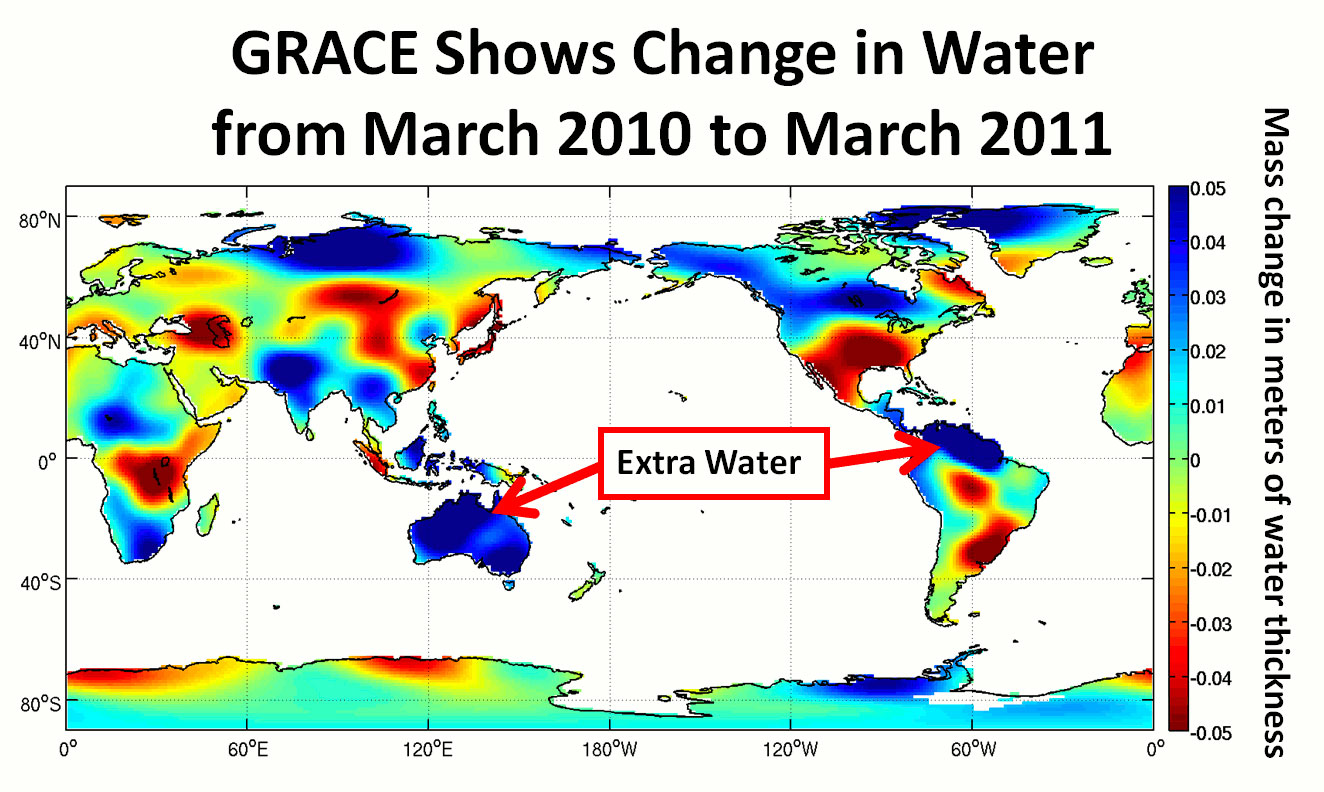
Figure 2: change in land-based global water storage in the period March 2010 to March 2011, as observed by GRACE gravity satellites. Image from NASA JPL.
Cherry-Flavored Water
In short, arguments that sea level rise has stopped are based on the same tired old "skeptic" tricks of cherrypicking short-term data and ignoring the long-term trend. We know that ocean warming and melting ice will cause sea level to rise over the long-term, and the only reason the sea level rise has temporarily slowed is that there was so much flooding in 2010 - hardly a result worth celebrating. As long as humans continue to warm the planet by increasing the amount of greenhouse gases in the atmosphere, we can expect the long-term sea level rise to continue.
Basic rebuttal written by dana1981
Update July 2015:
Here is the relevant lecture-video from Denial101x - Making Sense of Climate Science Denial
Last updated on 24 August 2017 by skeptickev. View Archives







[DB] "I'd be glad to read your views on the percentage increase in airborne water vapour that the missing water now represents"
Lewis, remember that atmospheric water vapor excesses have a residence time of about 9 days. Thus that water piled up onto land masses has a slow trek through cachments, impoundments and reservoirs on its way back to the sea. And some will make its way into water tables as well.
I think that this short-term decline from lanina isn't affected much because it will back to the same situation. But its effect much on the climate of that area. How is it increasing amount of greenhouse gases?
Why did sea level fall in 2010?
This exchange in the Fall of 2011 presents a fascinating discussion of the relationship between global mean sea level and water transfer to land masses. Specifically, the apparent temporary downtrend in sea level around 2010 was purported to be explained at least partially by torrential rainfall in Australia and elsewhere. BUT the accumulation of rain on land was not nearly enough to account for the sea level drop. The discussion trails off in December 2011 without a resolution of the discrepancy. And the anthropogenic increase in sea level resumed its upward trend in 2012.
Was this discrepancy ever resolved? Does the discrepancy have implications regarding the accuracy annd relliability of satellite measurements? Is this related to the later downturn in sea level in the 2016 timeframe?
VR, richieb1234
[DB] NASA has continued to track water motions across the planet, from alpine and ice sheet mass losses to the ocean and land impoundment changes over time, including torrential rains in the Amazon and Australia lowering global sea levels for a time. The overall trend is upward with the net effect that global sea level rise is accelerating in lockstep with accelerating ice sheet mass losses. NASA has a video on GRACE's 15-year mission tracking that, here.
Richieb @21 , I am not clear about the nature of your inquiry. Australia (the part that gets rained upon!) is about 3% of the world's land area . . . so presumably it was the other 140-ish million square kilometers receiving the bulk of the "missing" ocean water. Spread kinda thin, even allowing for local concentrations (see chart in OP).
Water runs off quickly and returns to the ocean, or soaks into the soil for a year or two ~ and eventually trickles back to the ocean, or evaporates and rains into the ocean. All part of the normal variation of things.
There doesn't seem to be any discrepancy requiring special explanation. There are always small ups and downs imposed on top of the continuing rise in sea level.
RitchieB,
I do not think that there was ever a "discrepancy" to be corrected in the comments above. The first commentor says they are a "layman" who eyeballs a graph and does some rudimentary calculations. The responding posters cite Llovel et al 2010 which states in the abstract:
"We show that whatever the period considered, interannual variability of the mean sea level is essentially explained by interannual fluctuations in land water storage, with the largest contributions arising from tropical river basins"
Obviously the laymans eyeball is not as accurate as professional scientists calculations. If you want more information Google Scholar says Llovel has been cited 84 times. If you read the titles of the papers you can find one that answers your questions. Here is one I looked at. In the abstract it says all the fall in sea level in 2010-2011 is caused by land storage.
If you look at the intermediate level of the explaination of this myth here at SkS, there is a graph that shows the yearly seasonal variation of sea level in the Northern Hemisphere varies by about 60 mm and the Southern Hemisphere varies by about 30 mm. It seems reasonable to me that a change in rainfall could cause 10 mm yearly change for a short time when seasonal variation is so much larger.