





Does Urban Heat Island effect exaggerate global warming trends?
The skeptic argument...
It's Urban Heat Island effect
A paper by Ross McKitrick, an economics professor at the University of Guelph, and Patrick Michaels, an environmental studies professor at the University of Virginia, concludes that half of the global warming trend from 1980 to 2002 is caused by Urban Heat Island. (McKitrick & Michaels)
What the science says...
| Select a level... |
Basic
|
Intermediate
| |||
|
Urban and rural regions show the same warming trend. |
|||||
The Urban Heat Island Effect (UHI) is a phenomenon whereby the concentration of structures and waste heat from human activity (most notably air conditioners and internal combustion engines) results in a slightly warmer envelope of air over urbanised areas when compared to surrounding rural areas. It has been suggested that UHI has significantly influenced temperature records over the 20th century with rapid growth of urban environments.
Scientists have been very careful to ensure that UHI is not influencing the temperature trends. To address this concern, they have compared the data from remote stations (sites that are nowhere near human activity) to more urban sites. Likewise, investigators have also looked at sites across rural and urban China, which has experienced rapid growth in urbanisation over the past 30 years and is therefore very likely to show UHI. The difference between ideal rural sites compared to urban sites in temperature trends has been very small:
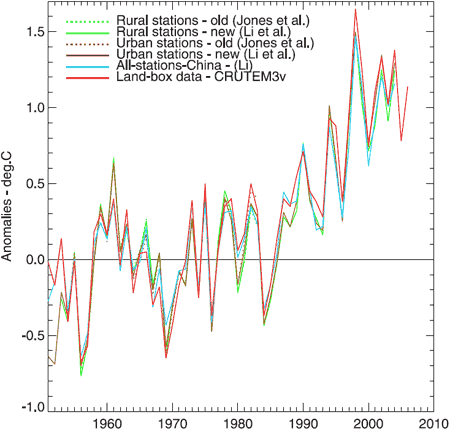
Figure 1. Annual average temperature anomalies. Jones et al (dotted green and brown) is a dataset of 42 rural and 42 urban sites. Li et al (solid green and brown) is an adjusted dataset of 42 rural and 40 urban sites. Li (blue) is a non-adjusted set of 728 stations, urban and rural. CRUTEM3v (red) is a land-only data set (Brohan et al., 2006). This plot uses the 1954–83 base period.
Another way to explore the UHI would be to look at where the majority of warming has occurred across the globe. The UHI should match where most people live. However, if you look at the 2006 global temperature anomaly (figure 2.), you find that the greatest difference in temperatures for the long term averages where across Russia, Alaska, far north Canada and Greenland and not where major urbanisation has occurred.
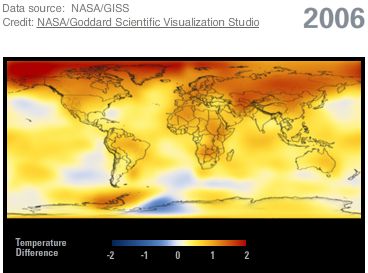
Figure 2. Using source data from NASA/GISS, this illustration shows the amount of change in global surface temperatures in 2006 from 1885.
The Urban Heat Effect has no significant influence on the record of global temperature trends.
Last updated on 5 September 2011 by mothincarnate.

Arguments


Basic
Intermediate


I know this may sound strange but the Urban Heat Island Rffect is so far the only proof we have that there is AGW. The urban enviroment produces additional heat, moreso in some cities like New York because the public buildings are heated by steam piped in from a central location. To maintain boiler pressure it is bled off to the atmosphere daily. In addition the pipes are old, poorly insulated and leak. You dont get ice on the road in NYC. Add to that the fact that the heated surfaces take longer to cool and to have a positive man made input. Industy, especially steel and power plants produce extra year round heat. Every home and vehicle produce heat and in the case of vehicles its direct from the radiator and more since the clean air act because to decrease emissions the engine must run at least 10 degrees F hotter than a normal winter thermostat. We used to use 160 F for warm climates and 180 F for cool climates, now we use 190 F for both. So we do in fact have good evidence for AGW that does not involve GHGs at all. I do not believe the IPCC models account for this and I know they correct for stations in urban environments. What they should be doing is using two uncorrected data sets, One from rural stations only to see what the temperature actually is and another for urban environments to see how much is being added. Well I said it may sound strange.
Canada, Greenland, Siberia all hotter than the Sahara desert?
There are several sites dealing with Use of Colour to Alter Phsycological Perception and Mind States.
Red is associated with danger/alarm/anger/hostility and generates an internal need TO DO SOMETHING.
Now, if they had used blue, green, indigo............
The night-time shot is presumably a single pass compilation whereas the other is a year's data processed and averaged. I would therefore expect the UHI signal to get buried.
Can't seem to find a temp anomaly picture at low enough time resolution to make a valid comparison.
re #3: In any analysis/description of temperature variations in any field of science and technology, colours are associated with spectral features associated with temperatures. Therefor the red end of the spectrum is hot and the blue end of the spectrum is cold.
One would observe the same in thermal colour imaging of body heat sources from infrared imaging:
e.g:
http://www.digitalinfrared.com.au/images/sample_back.bmp
...and so on.
So why on Earth would they use "blue, green, indigo...", unless they were trying to deliberately confuse the observer!
Re #4: with respect to your odd statement "isn't the comparison a bit off"?
No the comparison isn't "a bit off". Perhaps you need to think about what is being represented in the two images before making an inappropriate interpretation!
Our bodies detect IR quite well but not UV, yet more people get sunburnt than fireburnt.
My point about the two images above is that the temp anomaly is a compilation of a years data and thus the UHI's would be obscured. We regularly fly thermal imaging 'sorties' over our airfields to assess which buildings are inadequately insulated ( as well as to give the pilots some practise), but we do it at night to improve the image contrast.
UHI effect will also vary according to season.
So if these images are supposed to show that UHI effect is so minimal that they do not affect global temp, then, in my opinion, they fail.
That's good.
But you're going to carry on maintaining that there's some sort of a disconnect between the satellite photo of the Earth at night (which is a pretty good identifier of urbanization and its density) and the surface temperature anomaly.
It should be obvious that if one were to take the satellite picture of the Earth each night and average this for a year, that it would look pretty much the same as the snapshot.
Or do you consider that averaged over a whole year there would magically appear lights from massive connurbations in the Arctic and Alaska, the vast Northern territories of Canada and Serbia, the empty regions of Australia, North and Central Africa and so on...?
...I think not.
The global anomoly picture is an average of a years data.
If I stood in Times Square and you took a photo of me, I would clearly stand out.
If you left the camera running and took 365 photos on ONE frame I would disappear...other things would get between me and the camera and obscure my image.
This is what the GA picture does to UHI effects.
..and nor will the lights of the great cities and connurbations spreading Westwards from the East coast....nor the cities of Western coastal USA...nor the great built up areas down the East coast of South America (Rio; Buenos Aires...)...nor the great cities and connurbations of Western Europe...nor the equivalent cities and connurbations of Japan and the East and S. east coast of China...nor the cities and connurbations scattered around the inhabited coastal regions of Australia...and so on...
...and lights are not magically going to appear in Arctic and Alaska, the vast Northern territories of Canada and Serbia, the empty regions of Australia, North and Central Africa and so on...
The Urban Heat Effect is by definition an URBAN heat effect. Urban areas are identifiable by night time satellite photos since they are lit up. The greatest density of light relates to the greatest density of urban infrastructure.
The rather obvious conclusion from John Cook's juxtaposition of global surface temperature anomaly and nightime satellite image is that most of the vast areas of the world that have undergone rather large warming in the years to 2005 are those that are very far away indeed from urban centres.
In fact one doesn't really need John Cook's night time satellite photo to make that conclusion. One only needs to inspect the global surface temperature anomaly image with a reasonably informed understanding of human population geography to see that the urban heat effects can't have made significant contribution to global surface warming...
...but the satellite photo is an excellent aide to those that might not be too clued up on the geographical distribution of industrialised human populations.
...and it's a beautiful photo, so kudos to John Cook for a very informative juxtaposition...
http://www.seedgen.com/thermallondon/space.htm#space
"LONDON FROM SPACE
Adapted from material kindly submitted by the The British National Space Centre on behalf of the
Science and Technology Facilities Council
London and many other English cities can be seen as bright thermal `footprints' in this night-time image of England, France and the English Channel. In the false-colour representation used here, temperature increases through blue and yellow to orange over a temperature range of 278-288K (= 5 to 15 degrees Celcius).
London Airport reservoirs appear as orange hot spots as they remain hotter than the surrounding land that has cooled quicker since the sun has gone down; the water bodies have a higher thermal inertia than the land due to the higher specific heat capacity.
The image was from captured by the European Space Agency's (ESA) ERS-1 satellite at an altitude of around 777 km. (This is a 12 micron night-time image acquired on 7th September 1991; the area covered is 512 x 512 square km.)"
Note the temperature range...10C
Also , on the same web site you can see THERMAL images of the UK which clearly show the higher temps around cities.
http://www.geo.uni.lodz.pl/~icuc5/text/O_27A_2.pdf
One only needs to inspect the global surface temperature anomaly image with a reasonably informed understanding of human population geography to see that the urban heat effects can't have made significant contribution to global surface warming...
Well err Chris, oceans cover about 73% of the planet, not many weather stations there, I believe the desserts cover another 10%, not many there either. The majority of the weather stations were and still are situated in the northern hemisphere and this is exactly where most of the cities are located. Google UHI and population growth and see what you get. The other point Chris is that rural sites show little or no warming. Ask yourself why on earth Hanson/giss would want to compare pristine rural data with dodgy urban sites then use iffy and secret algorithms to try to extract the UHI effect out of the urban data when they have the rural pristine data in the first place, odd that. Also ask yourself why T min is increasing at double the rate of T max, I don`t believe the sun shines at night. Have an honest debate, visit climate audit and wattsupwiththat you lean something to your advantage.
Data @ NASA GISS Surface Temperature Analysis Maps.htm
(October 2008). Quite a difference to the 2005 composite,a lot more 'colder' areas, especially Antartica, Alaska, North Am,erica and Northern Europe/Greenland.
Not really Rob. The oceans are covered rather extensively with a series of ocean surface temperature measures.
Desserts don't cover 10% of the Earth's surface. At any one time a tiny proportion of the Earth's surface is covered by desserts. Even if every 280 million US citizens was holding a chocolate fudge sundae or a baked Alaska, this would cover a tiny, tiny proportion of the surface of the USA. The proportion of Africa covered by desserts is tiny, since Africans rarely eat dessert...etc...etc...
The fact that Tmin is increasing faster than Tmax is what one expects from greenhouse-induced warming. Remember that the atmospheric warming due to enhanced greenhouse gases results from trapping of longwave infrared radiation emitted from the Earth's surface. While the absorption of solar radiation occurs during the day, the emission of longwave IR occurs during the day and the night. It doesn't stop when the sun stops shining.
So it's not unexpected that Tmin should increase faster than Tmax...
Googling 'African deserts' gives 25% of Africa is listed as desert....hardly tiny.
Although from an econometric/modeling point of view I am not convinced that their analysis is top notch, I am equally unimpressed with the rather superficial analysis of the article at the top of this page.
I think it is unlikely that there is NO Urban Heat Island effect with a detectable influence on temperature records. Luckily, I am currently supervising a pertinent doctoral dissertation at the University of Piraeus in Greece.
With my very best regards to all,
John Paravantis
Assistant Professor
University of Piraeus
Greece
So, from your econometric training, are you saying that UHI is NOT affected by wind?
I cannot say anything of value about WIND although it seems REASONABLE to expect that wind would affect the intensity of UHI.
I certainly will have much more to say in about 2 years from now, when the PhD I supervise will be near completion.
Did you have something in mind that I failed to read?
two graphs on that site, one is 177 urban stations using adjusted data from the GHCN data set with stations w/o data before 1930 and after 200 excluded
the other is 778 rural stations with same exclusions
sorry guys but the data disagrees with the explanation made here on this site and it matters not whether adjusted or unadjusted data is used all that matters is whether or not you pick urban or rural stations
if you wish to make your own graphs then go here:
http://www.appinsys.com/GlobalWarming/climate.aspx
some of you should plot some for yourselves and see what you get instead of taking my word for it or anybody else's for that matter
what is that 9 °C drop in temperature in one of your graphs? Looks weird.
when you do a running average like that software does you will see a messed up end and beginning of the graph if the data set is missing a value
if you go to the noaa website and download the data you will see lots of stations that have data dropouts which when that software at the other website above gets one of those at the end or beginning of the graph it will blow up or in this case down, what is important is the long term trend
ftp://ftp.ncdc.noaa.gov/pub/data/ghcn/
you can plot all sorts of stuff from that data, temps gridded or not, adjusted or not, a couple data sets to choose from as well as precipitation amounts as well
I think everyone should do a few, pick your home town and have a look, pick some rural stations and urban ones and graph them and see how they look. You might be surprised at what you see.
I would also recommend just for your own sanity do a few single station plots and look up what the actual stats are for that station as far as where it is and what kind of quality it has. They are labeled as to what kind of local situation they are in like wooded or grassy plains etc etc.
it's not only the running average that has that weird drop, the blu curve drops as well. There must be something wrong in how the data are processed.
However, the simple average of stations doesn't tell you much. More so if you compare unadjusted data (the 778 stations) with adjusted data (the 173 stations).
its supposed to filter those out but for some reason it doesn't at the end of beginning of a plot sometimes
strange that the missing data come mostly from the last few years. It may generate large errors also in the previous years. The very first step should be to check the code, no one is going to trust those numbers so blatantly wrong.
i'm not an expert but there are a few things i know.
Comparing the raw data has no meaning. Comparing adjusted data from two nearby stations, one rural and one urban, tells us that the UHI effects exists, which we all know and it's corrected for. Full analysis, with homogenization, averaging and gridding separately the data from urban and rural station would be requied, which i'm not able to do by my self and that you have not done either. I'm left with the published papers by professionals, in part referenced in this blog post.
If ever someone will come up with a serious demonstration of the fault in the current analysis, which incidentally appears to be in agreement with satellite data (no UHI effect there), i'm ready to listen. For sure i'm not going to trust anyone who in its spare time play around with a computer and a bunch of meaningless (to him) numbers, the whole story is far more serious than just this.
this blog cherry picked an instance and claimed it was valid for everything and that's hardly the case at all which has already been demonstrated
furthermore guys like Jim Hansen have already claimed single stations can and do reflect what is going on with complete continents or even globally which of course is false in its own right
satellite data doesn't go back far enough to be of much use
i didn't go yet throgh the details of Spencer's analysis. What's surprising is that other peer-reviewed studies (e.g. Peterson et al. 2005) already checked for population and other effect. I do not fully understand why Spencer decided to use a different dataset which didn't pass through the same quality control as GHCN. This may at least in part explain the different results.
1. do you think that the sun is the major energy resoure of the surface of the earth (no matter in which form it store,like coal, oil, living creatures, organic matters,carbohydrate...and so on)beside the nuclear reaction the core of the earther is under going and before we discovered and stareted to use nuclear energy?
2.If you do belive that the sun is the major energy supplier to the earther surface, then where those engergy the surface of the earth from the sun got go? It dissapeared by it's self or they just stored in other form rather the heat?
3.Yes i do believe the urben area is much hotter than the rural area, but does that mean UHL is the major contributor to global warming? becuae we all know that about 71% of the earth surface is cover by water, and the propotion of rurual area must be more than times to urban area(according to an estimation rurual area only account for 3% of the earth surface, even if the average tempreture of the urban area is 10 times than the other part of the world , the average tempreture rise it can cause if is only 0.27 centidegree.
4.Look at the the energy we realised from the engery store in other form the near 100 yeas, i think it's not a big quesiton to understand glob warming
Got to go, to be continue next time if i were bump into this forum agian next time.
An obvious question is not addressed as far as I can see: are the arguments presented by McKitrick & Michaels wrong, and, if so, why?
"Bureau of Meteorology researchers have found that daytime temperatures in our cities are warming more rapidly than those of the surrounding countryside and that this is due to the cities themselves."
And, as muoncounter pointed out, about 1% of greenhouse gas warming, a forcing of ~0.028 W/m^2 waste heat compared to 2.9 W/m^2 greenhouse effect forcing.
Thanks
http://www.agu.org/pubs/crossref/2011/2010JD015452.shtml
The results are consistent with other measurements of urbanization effects.
(-Snip-)
[DB] Posting just a graphic (please restrict widths to 450 pixels or less) without demonstrating the significance of it helps no one. And therefore proves nothing.





