Subscribe in a reader


Username
Password
Keep me logged in
New? Register here


It's the sun
Climate's changed before
There is no consensus
Surface temp is unreliable
Models are unreliable
It's cooling
Ice age predicted in the 70's
Al Gore got it wrong
We're heading into an ice age
CO2 lags temperature
View All Arguments...


Latest Posts


Urban Heat Island effect exaggerates warming

The skeptic argument...

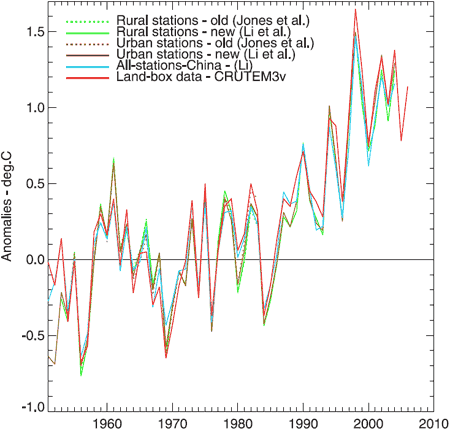
There has been a great deal of controversy about the accuracy of the temperature data, mainly the bias of temperature data due to urban heat island effect. This controversy has lead many to focus on rural temperature stations. Rural stations are intended to represent the cool breezy countryside, small towns, farms, trees and grass.

In recent weeks, researchers have been visiting these temperature stations. What they noticed was that there are serious problems with the quality of these temperature stations. They noticed that many of these temperature stations were located next to concrete buildings, near hot exhausts of air conditioning units, attached to metal towers and poles, surrounded by driveways and above gravel.

What the science says...

When compiling temperature records, NASA GISS go to great pains to remove any possible influence from Urban Heat Island Effect. They compare urban long term trends to nearby rural trends. They then adjust the urban trend so it matches the rural trend. The process is described in detail on the NASA website (Hansen 2001).

They found in most cases, urban warming was small and fell within uncertainty ranges. Surprisingly, 42% of city trends are cooler relative to their country surroundings as weather stations are often sited in cool islands (eg - a park within the city). The point is they're aware of UHI and rigorously adjust for it when analysing temperature records.

This confirms a peer review study by the NCDC (Peterson 2003) that did statistical analysis of urban and rural temperature anomalies and concluded "Contrary to generally accepted wisdom, no statistically significant impact of urbanization could be found in annual temperatures... Industrial sections of towns may well be significantly warmer than rural sites, but urban meteorological observations are more likely to be made within park cool islands than industrial regions."

Another more recent study (Parker 2006) plotted 50 year records of temperatures observed on calm nights, the other on windy nights. He concluded "temperatures over land have risen as much on windy nights as on calm nights, indicating that the observed overall warming is not a consequence of urban development".

Does temperature rise correlate with urban areas?

Surfacestations.org are compiling photographs of US weather stations photographs to demonstrate the unreliability of surface temperature measurements. Photos are an anecdotal way to do science - the only way to quantify the impact of urban heat island is to analyse the data from these stations. This is what GISS have done, with their methodologies and data freely available online.

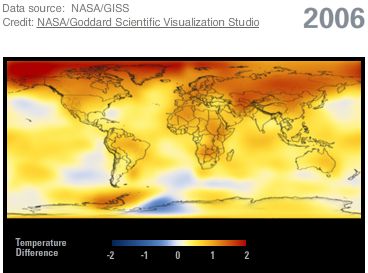
Nevertheless, a picture is worth a thousand words (although not a thousand data points) so I'll indulge in some pretty pics also. Compare a map of surface temperature rise for 2005 (the redder areas show greatest temperature rise) to a satellite photo of earth at night.

The satellite photo reveals the heavily populated (and therefore lit) regions - North America, Europe, the east coast of South America. If Urban Head Island effect was exacerbating global warming records, there would be a correlation between urbanisation and warming. Instead, the regions of the globe with greatest temperature rise seem to be anywhere but the urbanised regions.

Other lines of evidence for rising temperatures

Statistics aside, current temperature trends has been measured and confirmed from multiple, independent sources, most of them without a carpark or air conditioner in sight.

All these paint a similar picture of temperature change and global warming.

Related Arguments

Further reading

  • The Modern Temperature Trend (by Spencer Weart). An in-depth history of surface temperature measurements since the late 1800's. If you find this lengthy article fascinating, you're a complete nerd (raises hand sheepishly).
  • The Power of Large Numbers (July 2007 by Tamino). Explores how we can discern with precision temperature trends with the statistical power of large numbers.
  1. Johm
    I know this may sound strange but the Urban Heat Island Rffect is so far the only proof we have that there is AGW. The urban enviroment produces additional heat, moreso in some cities like New York because the public buildings are heated by steam piped in from a central location. To maintain boiler pressure it is bled off to the atmosphere daily. In addition the pipes are old, poorly insulated and leak. You dont get ice on the road in NYC. Add to that the fact that the heated surfaces take longer to cool and to have a positive man made input. Industy, especially steel and power plants produce extra year round heat. Every home and vehicle produce heat and in the case of vehicles its direct from the radiator and more since the clean air act because to decrease emissions the engine must run at least 10 degrees F hotter than a normal winter thermostat. We used to use 160 F for warm climates and 180 F for cool climates, now we use 190 F for both. So we do in fact have good evidence for AGW that does not involve GHGs at all. I do not believe the IPCC models account for this and I know they correct for stations in urban environments. What they should be doing is using two uncorrected data sets, One from rural stations only to see what the temperature actually is and another for urban environments to see how much is being added. Well I said it may sound strange.

Post a Comment

Foul language, trolling, personal attacks or non-relevant links will be deleted.

You need to be logged in to post a comment. Login via the left margin or if you're new, register here.

© John Cook 2008