



 Arguments









The difference between weather and climate
What the science says...
| Select a level... |
 Basic
Basic
|
 Intermediate
| |||
|
Weather and climate are different; climate predictions do not need weather detail. |
|||||
Climate Myth...
Scientists can't even predict weather
...Since modern computer models cannot with any certainty predict the weather two weeks from now, how can we rely upon computer models to predict what the Earth's climate might be like a hundred years from now? They can't! Yet people like Al "Carbon-Credit" Gore want you to believe that these models can predict the future. I bet I can do at least as well with a crystal ball (source: Kowabunga)
At a glance
How do you go about weather forecasting by yourself? Study the computer models. With experience, you will become familiar with the art - for it takes human interpretation of model output to make the calls. That's what weathermen do.
Forecast model output is freely available online and covers many parameters - pressure, temperature, rainfall and a myriad of others. Different models extend to different end-times - the Global Forecasting System (GFS) extends to T+ 384 hours or 16 days, for example. Pressure, or synoptic charts as they are known, portray the positions and subsequent developments of high and low pressure systems over large swathes of the planet.
Models are run several times a day. If you examine synoptic charts for the same run of several different models, you will see they all look very similar to start with. But if you then follow them through successive time-points - T+24, 48, 72 hours and so on, there will come a point where you start to notice slight and then larger differences between them. This divergence is where confidence in forecasting falls right away.
Forecasting - interpreting the GFS and other model output - is about working with uncertainty in the highly dynamic and to an extent chaotic medium that is our atmosphere. But with experience, you can do your own short term forecasting too, at least for the coming 3-5 days.
Longer-term weather forecasting a week or more in advance is about stating probabilities, not saying what will happen. Very different things. Serious amateur forecasters stick to the shorter, next few days bracket, if they want to avoid egg on their faces. There are a few out there who often make wild claims that usually fail to be borne out by reality. Unfortunately, sections of the more populist media happily quote them. It generates click-baity headlines.
Now, what about climate? Climate differs from weather because it includes certain highly deterministic drivers. Deterministic means they evolve independently of weather but can change the physical conditions on Earth from state A to state B. Cyclic variations in Earth's orbit of the Sun, operating over tens of thousands of years, are a good example. They may only drive average planetary temperature changes of a few degrees Celsius, upwards or downwards. But with the help of climate feedbacks, that is enough to have caused past ice-ages - and to have gotten us out of them again.
Changes in the strength of Earth's greenhouse effect are likewise deterministic, but to a far greater extent. They have forced past transitions from the Hothouse to the Icehouse climate state. Hothouse, by the way, is an ice-free Earth. Because we know how the greenhouse effect works, we can say with confidence that intensifying its strength will cause global temperatures to rise over centuries. What we cannot say is what weather will occur on a certain day at a certain place, decades from now. But there's a handy saying to cover that: "climate trains the boxer, but the weather throws the punches". (Deke Arndt, Climate Monitoring Branch Chief, NCDC, 2010)
Please use this form to provide feedback about this new "At a glance" section. Read a more technical version below or dig deeper via the tabs above!
Further details
This claim, based more on an appeal to emotion than fact, wrongly conflates weather and climate. That creates the grounds for making the incorrect inference that climate predictions, decades into the future, cannot possibly be right when the weather forecast for the next few days has uncertainty. To drill down into this topic, we need to consider weather and climate predictability and the substantial differences between the two.
Short term weather forecasts are in fact highly accurate and have improved dramatically over the last three decades. However, slight errors in initial conditions make a forecast beyond two weeks nearly impossible. This is because the weather is partly chaotic in nature when going forward. Forecast model-watchers - keen amateur meteorologists - know this all too well. The GFS model for example runs out to T+384 hours. But all and sundry refer to the last week or so of a GFS run as 'fantasy island'.
Understanding uncertainties and where they appear on forecast model runs is the name of the game here. Uncertainty kicks in as soon as the forecast charts produced by the different models start to produce outcomes that diverge from one another. This may be 120 hours into runs or it may be much sooner. Some synoptic situations are easier to model correctly than others. It's important to understand that at all times.
There can also be problems with how the public interpret forecasts that are often delivered in a woefully short time-slot. A very good example is on days when an unstable airmass is over a country. It can be fiendishly difficult to say where the thunderstorms will break out on a town-by-town basis, twelve hours in advance. But with regions of a country it's a bit easier - such places are what storm-chasers call their 'target area'. A Tornado or Severe Thunderstorm Watch may be issued well in advance for such a region, because it is likely that severe weather will occur somewhere within it. But a Tornado Warning is only issued when a storm is being monitored, both on Doppler Radar and by people on the ground. Eyes and radar alike can detect the tell-tale rotation within a cloud-base that can quickly spawn a twister. These things can only be predicted with a much shorter lead-time. People who are not paying attention to such details often opine that, "the forecasters got it wrong", when they did nothing of the sort. That's just how it is, unfortunately.
Climate forecasting is a different kettle of fish. Atmospheric science students are taught "weather is what you get and climate is the weather you expect". This is why this common denialist argument doesn't hold water. Climate models are not predicting day to day weather systems. Instead, they are predicting the evolution of long-term climate averages.
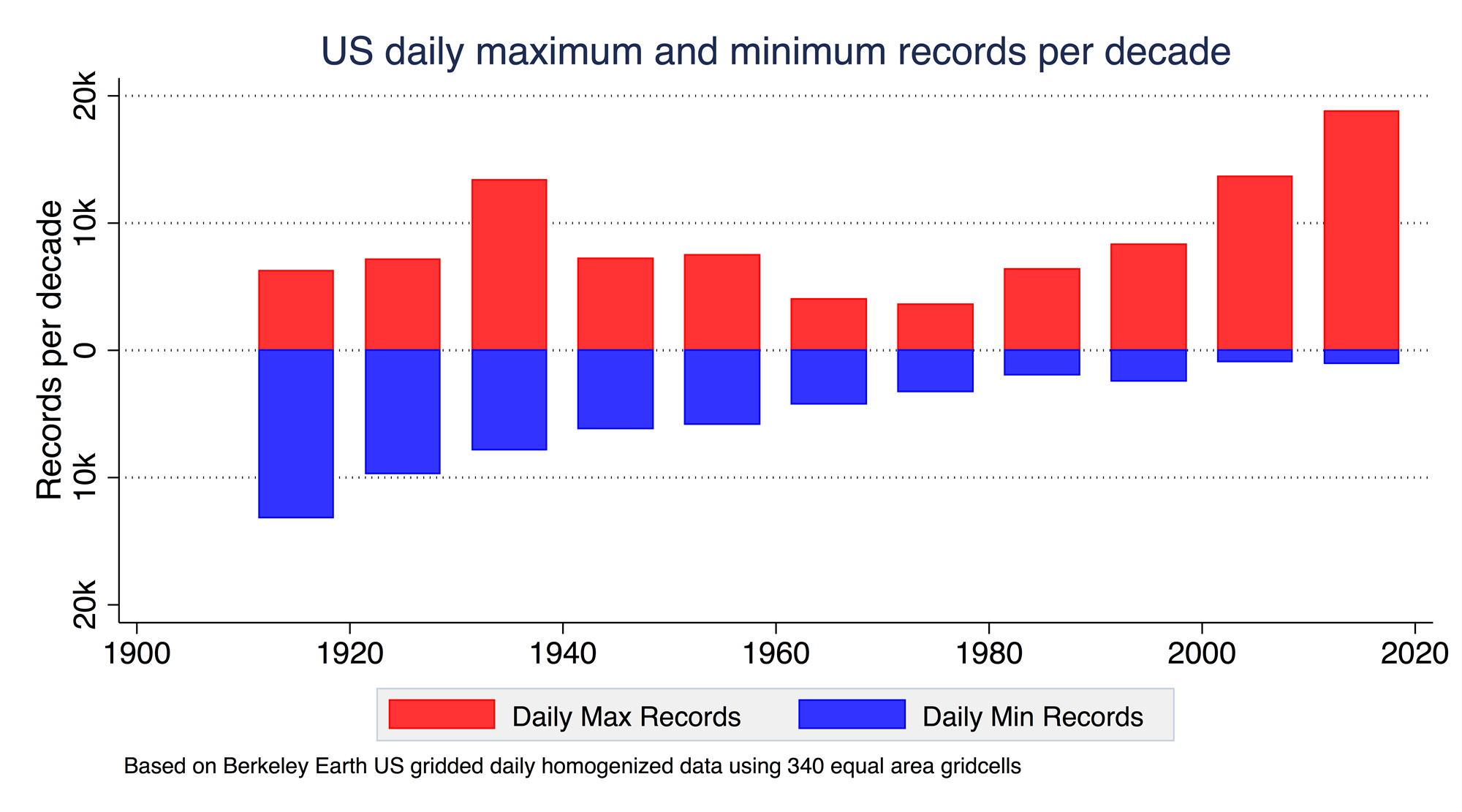
Figure 1: Changes in the occurrence of record-setting daily maximum (TMax) and minimum (TMin) temperatures per decade in the US based on Berkeley Earth US gridded daily homogenized data using 340 equal area gridcells. (Hausfather et al. 2021, AGU Fall meeting)
A change in temperature of just 5º Celsius from one day to the next is barely worth noting when you are discussing weather. But an increase of five degrees in global average temperature is altogether different in terms of climate. The average global temperature rose by that amount in the course of the transition from the last glacial to the current interglacial (IPCC AR6 - PDF). That transition was accompanied by more than 120 metres of sea level rise as the great ice-caps melted away.
One good analogy of the difference between weather and climate is to consider a swimming pool. Imagine that the pool is being slowly filled. If someone dives in there will be waves. The waves are weather, and the average water level is the climate. If the water-hose is left running overnight, then a diver jumping into the pool the next day will also create waves, but this time the water level (aka the climate) will be higher so the waves will have different consequences. The water level is a deterministic factor that is rising due to the running water-hose - independently of the waves.
With regard to the above analogy, in the case of Earth's atmosphere the water-hose is increasing greenhouse gases. They are increasing primarily due to our emissions from fossil fuel burning - another deterministic factor that goes on independently of weather. By increasing the strength of the greenhouse effect, the climate will warm up but on top of that we will still have changing weather (those waves), whose characteristics will depend to varying degrees upon the change of energy in the system. But when climate scientists use models, they are predicting the average water level in that swimming pool, not the behaviour of the waves on any given day decades into the future.
If you want to follow these points up, a good basic explanation of climate models is available in Climate Change - A Multidisciplinary Approach by William Burroughs.
Last updated on 14 April 2024 by John Mason. View Archives
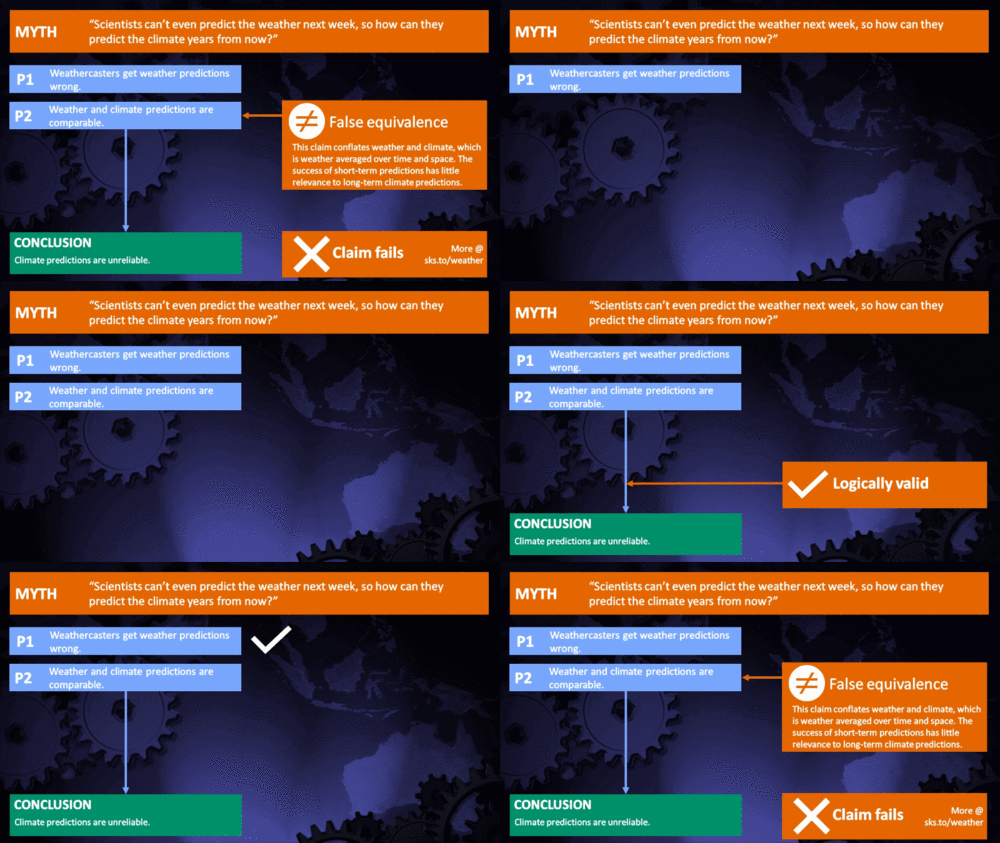







Editing problem in the Intermediate version.
I can't parse this sentence. Can you?
"Or expressing that in weather terms, you can't predict the exact route a storm will take but the average temperature and precipitation will result the same for the region over a period of time."
BillWalker, it makes sense if you substitute "be" for "result".
Steve Easterbrook has a great balloon analogy of weather versus climate.
IMO a much more compelling arguments for laymen uses the example of tossing a coin.
Predicting the outcome of a single coin toss with better than fifty perc ent accuracy is impossible. However, predicting the outcome of a thousand coin tosses is trivially easy: very close to half of them will be heads.
The weather forecast involves a lot of random elements and is therefore more like predicting a single coin toss. Predicting climate change is much more like predicting a thousand or a milion coin tosses and is therefore more accurate.
Most likely this has been posted somewhere on here already, but I love the analogy: climate is your personality, weather is your mood.
Do the information is trustworthy? How can we predict the exactly true weather for the hundred years from now? Just only tomorrow we never know that the weather will likely happen as we are predicted or not, the weather always changes and we cannot control it. So, if we think about the prediction of the weather for the hundred years from now, I think it will be impossible and hard to explain.