





Food Security: the first big hit from Climate Change will be to our pockets
Posted on 26 December 2012 by John Mason
"While the global community has committed itself to holding warming below 2°C to prevent “dangerous” climate change, the sum total of current policies—in place and pledged—will very likely lead to warming far in excess of this level. Indeed, present emission trends put the world plausibly on a path toward 4°C warming within this century."
Turn down the Heat - why a 4oC warmer world must be avoided
World Bank, 2012
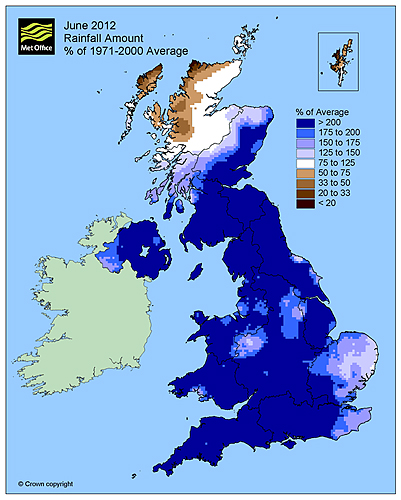
I've been growing a lot of my own food this past few years and amongst the varied challenges I've had to work around, the dismal summer of 2012 here in Wales has been the greatest of all. A cold and often overcast spring was followed by an exceptionally wet summer - the Met Office graphic for June (R) spells that out in no uncertain terms - and the few brief flickers of warmth that were felt early in the autumn came too late: the wind and rain soon set in again.
How did that affect the crops? Well, firstly, despite all sorts of control measures, including dead-of-night visits armed with a torch and bucket, the slugs had a field-day, chomping their way through anything they fancied. Slugs are always a nuisance to veg-growers, but the conditions this summer were just about perfectly in their favour. But there was more to it than that: the cold spring meant that the soil was slow to warm; bees and hoverflies, both vitally important to any grower, were both late to appear and in short supply and the severely reduced sunshine further compounded things. In short, it was a bit of a disaster!
Across the pond, conditions were the exact opposite with heat and prolonged drought affecting the American Midwest and severely reducing crop yields across vast swathes of normally productive land. It was as if the weather was stuck: wherever you were, if you had one type of weather, you were likely to be left with it for a long time. For growers, from my little one-man operation up to the big landowners, it's a bit like the Goldilocks story: you ideally need conditions to be 'just right', yet in both the cases I cite they weren't just off a bit - they were way off to one extreme or the other.
Skeptical Science has covered the recent research into the slowing and stalling of the Rossby Waves - the large upper ridges and troughs that trundle around the Northern Hemisphere from west to east and dictate the type of weather that goes on below. Evidence is accumulating that manmade global warming, at its greatest up in the Arctic (as demonstrated in no uncertain terms by the dramatic record sea-ice melt up there this year), has, by reducing the thermal gradient between the Arctic and the Tropics, affected the way in which these waves behave, and thereby caused weather-patterns to stall. Extreme weather does not have to just be about mile-wide EF-5 tornadoes: it can include weeks and weeks with no rain, or pretty much constant cloud and rain. And there is one early casualty of such conditions: agriculture.
On exactly that topic, Oxfam released a report on September 5th 2012, entitled Extreme Weather, Extreme Prices, available here; now we have Turn Down the Heat - why a 4oC warmer world must be avoided, a report prepared by the Potsdam Institute for Climate Impact Research (PIK) and Climate Analytics for the World Bank. Chapter 6 of the report looks at how future warming scenarios might further affect food security and it makes worrying reading. The report looks at the effects upon agriculture from three key perspectives: what they refer to as 1) the temperature-induced effect, 2) the precipitation-induced effect, and 3) the CO2-fertilization effect. There are other factors too: loss of biodiversity for instance can include loss of pollinating insects, which play an essential role in the reproduction of flowering plants. Given that very many types of fruit and veg fall into the 'flowering plants' category of plantlife, it is obvious that biodiversity is vitally important and we damage it at our peril. But let's look at the findings regarding the three factors above.
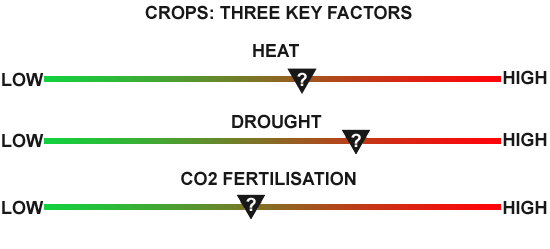
above: three key variables likely to affect crop yields in a warming world - but how?
Temperature
Since the release of the IPCC's AR4 in 2007, there have been significant developments in understanding the effects of temperature rises with respect to crop production. It's a mixed picture. Rising temperature may increase yields at higher latitudes where low temperatures are a limiting factor on growth. Conversely, at lower latitudes, increases in temperature alone are expected to reduce yields from grain crops because these mature earlier at higher temperatures, reducing the critical growth period and leading to lower yields, an effect that is well understood. Field experiments have, however, shown that crop sensitivity to temperatures has certain thresholds above which it takes off in a non-linear fashion (in other words these are tipping points beyond which crop-failure can be severe). Because, the report states, most current crop models do not account for this effect, with the very real risk of a 4oC world ahead of us, we need to overhaul the models to take these recent findings into account.
Precipitation
Recent projections and evaluations against historical records point to a substantially increased risk of severe drought affecting large parts of the world: currently affecting 15.4 % of global cropland, with 4oC of warming (relative to 1961-1990 temperatures) this could rise to a colossal 44 % by 2100. The regions expected to see increasing drought severity and extent over the coming decades are in southern Africa, the United States, southern Europe, Brazil, and Southeast Asia. Wetter conditions are projected in particular for the northern high latitudes: countries likely to be affected are those in northern North America, northern Europe (parts of which, i.e. the UK, have been in the news of late due to the severe floods they have had to endure) and Siberia, plus some monsoon regions.
CO2 Fertilisation
The effects of increasing atmospheric CO2 concentrations on crop yields are, the report states, one of the most critical assumptions with respect to biophysical crop modeling. It is critical because if the effects of CO2 fertilization can occur to the extent assumed in laboratory studies, then global crop production could - possibly - be increased; if not, then a decrease is possible. Thus, it's not a straightforward picture (although those who oppose mainstream science like to repeat 'CO2 is plant-food' as though they were chanting at a football match). A key constraint of the carbon fertilization effect on the ground (and not in the controlled conditions of a greenhouse or laboratory) is that it would be operating in situations where other variables, essential to plant growth, may not play ball. It's a long list when one includes all the various minerals and trace-elements but key factors are major nutrients such as phosphorus, potassium, nitrogen and so on. CO2 is plant-food but so are these elements and they are essential, as any serious vegetable-grower will tell you.
The table below (redrawn to fit our format) shows the results of a study on maize in China, and it illustrates an example of the way in which these three factors interplay - it's not a simple picture. Note that projected temperature figures in brackets are above the pre-industrial average and those not in brackets are above the 1961-1990 average.
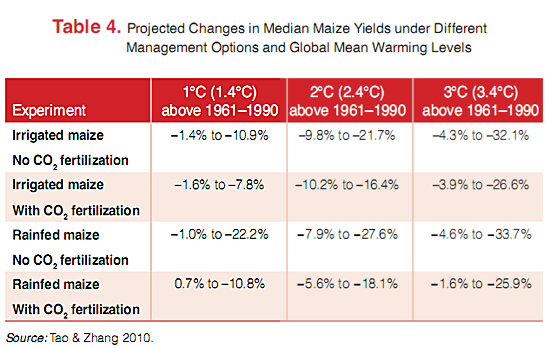
Even with carbon dioxide fertilisation, yields tend to be reduced, with the possibility of severe reduction. Other factors that may have some success in mitigation of the worst effects are the production of new cultivars that have better resistance to heat or water stress, or resilience to plant pathogens that favour certain conditions: I may well be trying the new blight-resistant potato cultivars that are emerging if I can get hold of any, as our damp Welsh summers in recent years have seen major outbreaks of this devastating fungus.
Alternatives?
And what of the warming northern latitudes? Some argue that if we lose the USA Midwest then we simply shift production northwards. It ain't that simple, folks. Yes, in time one would be able to grow crops in areas that are currently thawing permafrost. But there's one thing you need to grow fruit and veg productively: healthy soils. And that's the problem: healthy soils take a considerable time to develop. The problem is not the end result in a few centuries' time (assuming things reach an equilibrium state by then): the problem is the period of transition from now to then, in which events may move at a pace beyond our ability to keep up, to adapt.
Consequences
The first noticeable effect of reduced crop yields is already manifesting itself in rising food prices:
According to the Food and Agriculture Organisation in Rome, global wheat production is expected to fall 5.2% in 2012 and yields from many other crops grown to feed animals could be 10% down on last year.
"Populations are growing but production is not keeping up with consumption. Prices for wheat have already risen 25% in 2012, maize 13% and dairy prices rose 7% just last month. Food reserves, held to provide a buffer against rising prices, are at a critical low level. It means that food supplies are tight across the board and there is very little room for unexpected events," said Abdolreza Abbassian, a senior economist with the FAO. (source: Guardian, October 2012)
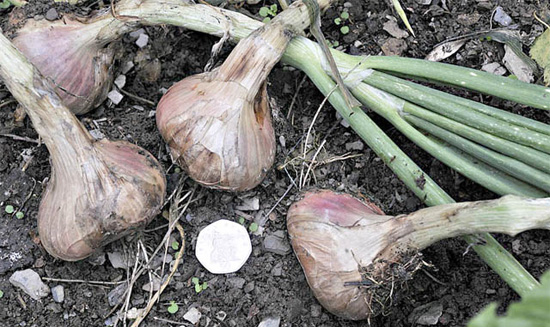
above: a few of the author's shallots nearing harvest-time, July 2010. With a lousy spring and summer due to weather-patterns getting 'stuck', 2012's crop was a sorry sight in comparison!
Food is one thing that cannot be regarded as a luxury (unlike a lot of consumerist 'stuff'). Any major hike in food prices places immense numbers of the world's poorest people under severe hardship or even starvation. At the same time, across the developed world, it hits all but a small percentage (the wealthy) as an unavoidable, universal tax, a big dent in the pocket. But rises to date have been relatively minor, when compared to what would be in the pipeline for a +4oC world.
Those who loudly oppose mainstream science like to pretend how we are being fleeced by all sorts of 'green taxes'. But you never hear a squeak from them about this one, the greatest, most far-reaching tax of all time, that if they get their way we will all have to pay. The alternative is to starve: it's not much of a choice really, is it?
So the World Bank joins the academic institutions of every country worldwide, the world's military, the International Energy Agency and the United Nations. Everyone, apart from a few noisy think-tanks and their shills and their disciples, realises that we are heading in the wrong direction; that what we are doing is far from being in the best interests of humanity. Four degrees of warming can - and must - be avoided.
Our leaders need to stop thinking about the next election, four or five years ahead, and take a longer-term outlook. This is happening on their watch and the worse things get - and let's not forget that hikes in staple food costs were a factor in the emergence of the Arab Spring unrest - the less likely it is that they will be forgiven for failure to take action.
Postscript (30/12/2012):
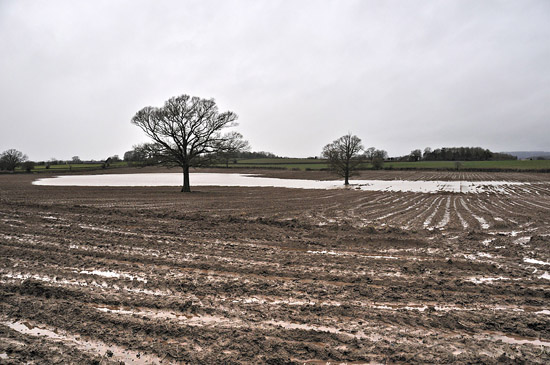
Driving from the Midlands back to Mid Wales last week, it occurred to me that I ought to record the spectacular flooding along the River Severn for posterity; having done so it then occurred to me that the state of the ground was worth recording too. The photograph below was taken near Leominster in Herefordshire, but frankly it could have been anywhere between Birmingham and the Welsh mountains as most fields looked similar. How one goes about planting in such conditions is anybody's guess!

Arguments


The farmers round here in the SW UK (some in their 70s and 80s) tell me they've never known a summer like it in all their years. To cap it all they're now running out of silage for the cattle over the winter because they just weren't able to take enough cuts off the fields this year.
And the bad news is that there's nothing to suggest it will be any different in 2013. This is the reality of climate change in the UK. Problem is, most townies -- insulated from the environment -- haven't realised it yet. This is a disaster.
I dont like this new normal, i planted grapes, olives (dead now) etc expecting mediterranian weather, lulled by a few good years where only prob was drought! Last two winters wading through feet of snow, at moment mud. But it could be worse; russia and ukraine stuck under the high pressure have record cold, hundreds dead already. Having to pump out flooded septic tank small prob in comparison.. Happy new age, all!
Surprisingly few people seem to be aware of what is lurking just around the corner, and at this stage there's a rapidly diminishing range of responses available...
Keep the comments coming in, growers! Bernard, you are of course right: history is littered with examples, the Year Without a Summer - 1816 .
We have a Mediterranean climate here and the weather is relatively stable. I might even be able to get two crops in the extended warm season. Water is piped in though.
Even worse than climate zones shifting northward would be flickering. That is the climate shifting back and forth between the present regime and the new one. Farmers would have no idea what to plant each year.
More catastrophic than the present, gradual 4km per year creep of the climate zones northward is if they lurch northward. This may occur if the Arctic ocean collects enough energy to reverse the polar Hadley cell. The polar jet stream which indicates where the Polar Hadley cell and the Ferrel cell meet looks suspiciously like a top that is slowing down just before it tips over and stops.
ps. Here in New Zealand lots of rain interspersed with sunshine. Just harvesting a bumper crop of garlic. Raspberries going nanna brained and all the fruit trees on line for a great crop.
http://mtkass.blogspot.co.nz/2012/11/greenland-melting.html
Our civilization simply cannot be reformed. It will collapse and turn into something resembling a feudalistic state. Or perhaps a network of communities like Arcosanti.
Arcosanti is an experimental community under construction 70 miles north of Phoenix, Arizona. It is designed to be self reliant in food and economically. When finished, it will house approximately 5,000 residents. Of utmost importance, its food will be grown in greenhouses sheltered from the worse of weather.
Basic infrastructure will all be within a ten minute walk from all residencies. This will minimize the need for long distance commuting.
A global network of Arcosanties replacing our current urban/suburban/rural civilization would be sustainable into the indefinite future.
When food supplies become scarce and expensive, due to a combination of crop failures and rising energy prices, wealthy countries and individuals will have the survival advantage of being able to pay the higher price.
The disadvantaged are not likely to accept starvation without putting up a fight, just as those living in low-lying coastal areas are not likely to quietly drown without resistance as sea levels rise. The resulting civil and international wars could destabilise even the strongest economies.
In addition, pests and diseases of ourselves and our food sources are likely to migrate to areas where they do not currently exist, causing sickness and death in populations having no natural resistance to them.
The global human population supportable by the coming climate will likely be far lower than it stands at present. War, pestilence and starvation will take care of that equation for us. The survivors may choose to follow an entirely new political paradigm for what passes for civilisation, but I would put my money on the emergence of fragmented populations held together by the equivalent of warlords. It will be of academic interest to see what role religion plays in the new world order.
I think that the attitude the conservative elite in the US, political and religious, have regarding disaster victims will spark civil unrest at some time in the near future.
These people are so arrogant as to blame the victims of Sandy and Katrina for their plight. They actually state that the homeless were negligent because they chose not to have flood insurance!
As for the role that religion will play in the future we have no further than the past to look for answers. The clerical elite will serve as an opiate for the masses to deaden the pain.
Yes we're living in interesting times.
I think food security is something most people are still blithely unaware of and it's something we should be coming back to time and again. Events like Sandy grab people's attention but it's important that we use those opportunities to point to these issues which will impact on everyone.
For people like me it just means a depressing patch of weedy mud and a few more pounds and pence on the weekly shop. For many people around the world a poor harvest means devestation.
I picture a Mad Max style assault on Arcosanti, where the attacking horde wants not gasoline but a sustainable lifestyle, even though their very numbers will preclude it. Still, when people are hungry, logic goes out the window (actually, it seems that when people are wealthy and happy, logic goes out the window, as well).
Arcosanti may seem sustainable, but it is not a solution that can be used for 7 billion people. And I imagine that it is taking a huge amount of energy and global resources to construct, unless it is being build with horse-and-man-power alone, and only locally attained resources like precious metals.
No... in the long run, Humongous would sit before his punked-out horde in his souped-up cobbled-together roadster, announcing over the loudspeaker that if the Arcosanti will abandon their stronghold, he will let them live. And when they refuse, Arcosanti will be overrun, and what is there will be destroyed.
It's a nice thought, but probably not a viable, globally applicable solution.
global ecovillage network http://gen.ecovillage.org/ worldwide network of permaculture and similar groups and communities
In uk and spreading fast transition towns http://www.transitionnetwork.org/
Spaerica i have that nightmare its replaced the nuclear one ill be an old lady with my bees and chickens easy meat for the roving gangs of brutalised starving townies. We have to make a better vision, enough nuclei of rational self sufficiency to spread to all. The great turning is the vision, it might sound impossible right now but has to be tried. Mutate and survive!
John - forgot to say leeks did brilliantly and i did get early potatos and sarpo mains, they definately worth growing. I have been doing nearly everything in plugs and twice what i should need, and lots different stuff and varieties so at least i get something, i sell or swap gluts which gets me to meet the neighbors - more building community. Some things have gone feral and come up every year: chard, lambs lettuce, watercress, parsnips (really! They still dont come up from bought seed but 'my' ones pop up everywhere). But i have 1/2 acre to play with, and most of it is nettles :/
The current shortages of weapons and ammunition at US gun stores is not due to government restrictions, but on a surge in demand. When the US population really is hungry, the resulting anarchy will be well-armed, and NRA nuts will feast on liberal tree hugger flesh, at least if you take various rightwing blogs seriously.
Community gardens will be plundered,
wildlife populations will be poached to decimation,
and all will struggle.
It makes me very morose, until I start thinking about the Toba catastrophe, and a personal hypothesis, formed after some interesting neuro research a year or two ago into people who tend to respond with fear, vs those who can keep conflicting info in their head at once. http://www.sciencedaily.com/releases/2011/11/111101173636.htm
Think of humans as an "heirloom variety" with different populations having different traits, to better weather changing circumstances.
Sure, aggression may benefit the gun nuts initially. But as things get worse, perhaps the genes for cooperation will pass thru a bottleneck of human evolution, like some say occurred after the Toba eruption reduced human pop to a few thousand souls.
Add in religion... essentially a culturally accepted mythology.... and there is a chance we can rewrite the script. From a Christian perspective, more of a "stewardship" version of God's post-flood commands to Noah, than the resource exploitation version favored by contemporary industrialists (and consumers).
In sum, I am hoping we really do miss those three meals. But only once in awhile, enough to perk people up so that they value good government intervention, instead of simply embracing mob rule.
Anyway, in the US, when hunger comes, even the liberal treehugger peace and loveniks will realize just how many guns live on their street. Buckle up, Bones.
. My guessing goes like this:
I think
"My guessing goes like this (I think)"
We're trying to adapt to unpredictable and chaotic weather and seasons by using poly tunnels and hugel culture, which is working to some extend, but are adding their own complications.
All in all, growing food is becoming more difficult, more time consuming and the general public still think that anybody can do it after watching "Ground Force" a few times. This cannot end well...
Anne - Hey polytunnels! If we put up enough, could we cancel out the albedo change from the arctic ice loss? You can already see the ones in spain from space :)
http://www.youtube.com/watch?v=ixx1c3RSw_8
It is more a response to Peak Oil than to climatic factors, but dealing with either require strong resilience-design being built into food production. Rarely have I seen so much common sense crammed into one short film!
http://www.permaculturenews.org/
You guys are years ahead of me! Great stuff in comments too
"I keep hearing food prices will double in real terms by 2030..."
Food prices are likely to double before 2030. That estimate sounds like it based on linear models taking only temperature rise into account. Commodities, however, tend to jump in price in a non-linear fashion e.g. oil prices in 2008.
2020 is when the arctic is bound to get ice free in the summer and the great alterations in weather will affect crops. It's safe to assume that the Arctic meltdown is not included in whatever model was used to calculate those prices. Nor are drenching thunderstorms.
I couldn't reach my garden today - half a mile of raging floodwater stood between me and it.
A slug-free New Year to you all, those of you I know and do not know.
Best wishes - John
Wherever you go, be sure to arrange strong defences against those gun-toting desperadoes who would try to take your safe place away from you by force. Remember, if the climate changes as projected by models, the bad guys are going to be migrating to more comfortable climes, along with everybody else. This time around, the meek are unlikely to inherit the Earth.
Connected to the mainland portion of the UP via the lift bridge at Houghton/Hancock, the Keweenaw (also called Copper Country) is separated from the "mainland" UP by a natural "moat" and (counting Lake Superior) is completely surrounded by fresh water.
The climate is harsh still in winter, but continued warming will greatly lengthen the growth season, fresh water is virtually inexhaustible, it's defensible (just drop the bridge and it's an island), it has abundant forest and farmlands and there's still copper and other ores (albeit deep) in the ground.
Basically, one of the few areas in North America that figures to have its climate improve over the next couple of centuries: winters will grow milder, with snow becoming less of an issue [the record is 390" in 1979] and even less common [about 24" thus far this winter]; summer heat will still be ameliorated by the enormous thermal inertia of the big lake. And by urban standards, land is quite cheap right now. And there's over 600 square miles of it.
"Wherever you go, be sure to arrange strong defenses against those gun-toting desperadoes who would try to take your safe place away from you by force. Remember, if the climate changes as projected by models, the bad guys are going to be migrating to more comfortable climes, along with everybody else. This time around, the meek are unlikely to inherit the Earth."
Well put, but individuals and family groups will be insufficient to arrange a strong defense against roving gangs.
If we are to survive we need to organize in eco-villages/Arco-Santi like communities. 500 or more people, in a cohesive community, will allow for maximum efficiency of horti-permaculture as well as self defense.
I suggest networking with such survivalist like minded people for a possible future relocation. A sense of community is of utmost importance.
"And by urban standards, land is quite cheap right now. And there's over 600 square miles of it."
Daniel, how much per acre?
Cheaper parcels seem to run between $4,000 and $6,000 per acre. Frontage...varies. But the views are spectacular...
On a gently-sloping hillside below the level of a pond I'll raise the soil level of a rectangle of land, incorporating the 20 tonnes of horse manure that I've just taken delivery of from a friend who keeps horses. On this rectangle I intend to erect polytunnels, and round the outside of it I'll dig a metre-wide ditch leading off to a nearby drainage channel to take away any excess water. That should allow me to control the water level in the soil within the poly tunnel; and the pond will provide a gravity-fed source of water in case of drought.
Deer are a major problem round here (SW UK) so surrounding all this will be 6-foot deer fence with rabbit netting round the bottom three fee, pegged out to stop burrowing-under. Around the West, East and North will be planted a belt of alders to act as a wind break.
I'll report back at some point how I get on.
Best place: Desert wastes, to poor for farming, but can sustain goats.
Rationale: The "best place" is anywhere the human population remains within local carrying capacity. Since everyone is just as smart as we are, when the migrations come in earnest the entire population is going to seek their own idyllic Keweenaw (or Michigan's Beaver Island for that matter). No matter how stable these places might be for gardening and homesteading, they will be loved to death by EVERYONE. In the end, carrying capacity in these oases will be overshot by a long margin more than the nomadic goat-herding carrying capacity of desert wastes they walk away from. And their will be a lot fewer guns per hectacre in the scrub as well. So I'd say, figure out where everyone else is running, then figure out how to live wherever they left. See
http://www.amazon.com/Goatwalking-A-Guide-Wildland-Living/dp/0670828467
Nomadic goat-herding? Are we back to Old Testament days? ;-)
I personally believe that we'll have pockets of civilization here and there. You can have a civilization with as little as 50,000 persons.
In the future I fear we are headed for, survivor pockets of humanity may be separated by long and inhospitable distances, making trade less possible. A remnant population of 50,000 is not going to be manufacturing flat screen TVs, or transmitting podcasts, or making mobile phones, or delivering any of the other gadgets and services we now consider benchmarks of our civilisation. Remember, all the easily accessible resources have already been extracted from our environment. Without the machines we rely upon today, nobody is going to be able to smelt aluminium, steel, zinc, or titanium, even if the group had sufficient surplus food to enable them to dedicate some of their people to extracting the ores.
On the contrary, I expect 'incompatible with organised human society' to mean smaller, mobile extended-family groups will develop into hunter-gatherer or simple agrarian communities, whose concentration will be on acquiring adequate food, shelter and clothing to sustain life, whilst defending their territory against hostile invaders. That's why I made the comment about an Old Testament future being wishful thinking.
On the other hand, a cure for our dirty habits with carbon may magically appear and make predictions like mine ludicrous. Nothing would make me happier than to find I am making a fool of myself over a mere 4, 5, or 6°C.
While hoping for the best, I am preparing for the worst. I have moved my family from a coastal city to a country town 433m (1421ft) above sea level; I am growing veges, fruit and nuts; we have a chook run; we do not fly anywhere and drive only when public transport or Shanks' pony can't get us to where we need to be; we have the ability to live off-grid. Not that any of our preparations will help our personal security when the brown stuff hits the revolving cooling device.
Alarmist? I am certainly alarmed at where the smart people are saying we are headed. I would be extremely happy if trustworthy people could show me why my gloomy, worst-case prognostications are wildly inaccurate. (Note: denialist attempts to cheer me up by overturning the laws of physics are bound to fail, so please don't try.)
The major problem that I foresee would be a trans-generational illiteracy. Once you disrupt the education system we will get an entire generation of people with no reading skills.
However, if even a small percentage of people (20%?) are literate then you could have a network of mini-civilizations spread throughout the most habitable regions (wherever that may be).
50,000 people would be sufficient for light industry and road repair (a minimum of roads for purposes of trade). A network of these 100 of these communities could scavenge whatever is left of this civilization. It would be a civilization with a mixture of 19th, 20th and even some 21st century technology.
They may not be able to go to the moon but think of all the vehicles they could build.
PS: Minimizing the weight of a vehicle by ten fold would reduce the required energy for it's construction by roughly an equal amount.
PPS: :-)
Food security, along with access to safe drinking water, will define the scope and limitations of the remnant populations. Foodstuffs will be valued much more highly than at present. Surpluses will be stored and preserved against future need, as there will be no supermarkets offering fruit and vegetables from the other side of the world in our off-seasons. Farmers and herders will be people of status, unlike the taken-for-granted primary producers of today.
There is unlikely to be sufficient surplus food to sustain a population of non-food-producing service providers, such as politicians, computer programmers and telephone sanitisers (h/t Douglas Adams). People who can read and write will become scarce and teachers will be revered. Much that we know today will be forgotten. Intellectual pursuits like cosmology and quantum physics will be abandoned, as they do not contribute to our ability to grow, catch and kill our food. Abstract ideas, like religion and democracy, may be discarded because they have not helped humanity avoid its excesses: they have been part of the problem, not part of the solution.
It will be of academic interest to see what group dynamics, spiritual distractions and political systems arise from the ashes of our greed. I hope the next wave of humanity is smart enough to learn from our mistakes.
As an aside, remnant populations will not be able to support the medical and prosthetic industries we take for granted today. There will be no lens grinders making corrective spectacles for our vision, no chemotherapy for cancer, no psychiatric drugs to help the depressives and sufferers of conditions like bipolar disorder. Natural selection will operate to breed a healthier humanity. Medical interventions will be the domain of witch-doctors and herbalists. The weak, the frail, will have to find a way of contributing, or they will die earlier than similar people do at present. Charity is a luxury many may be unable to afford in a warmer world.
http://www.project-syndicate.org/commentary/global-warming-and-agricultural-production-by-bj-rn-lomborg
yours
Frank Johnston





