



 Arguments








16 ^ more years of global warming
Posted on 10 January 2013 by Kevin C
Update 21/02/2013: Troy Masters is doing some interesting analysis on the methods employed here and by Foster and Rahmstorf. On the basis of his results and my latest analysis I now think that the uncertainties presented here are significantly underestimated, and that the attribution of short term temperature trends is far from settled. There remains a lot of interesting work to be done on this subject.
Human greenhouse gas emissions have continued to warm the planet over the past 16 years. However, a persistent myth has emerged in the mainstream media challenging this. Denial of this fact may have been the favorite climate contrarian myth of 2012, first invented by David Rose at The Mail on Sunday with an assist from Georgia Tech's Judith Curry, both of whom later doubled-down on the myth after we debunked it. Despite these repeated debunkings, the myth spread throughout the media in various opinion editorials and stunts throughout 2012. The latest incarnations include this article at the Daily Mail, and a misleadingly headlined piece at the Telegraph.
As a simple illustration of where the myth goes wrong, the following video clarifies how the interplay of natural and human factors have affected the short-term temperature trends, and demonstrates that underneath the short-term noise, the long-term human-caused global warming trend remains as strong as ever.
In particular, once the short-term warming and cooling influences of volcanic eruptions, solar activity, and El Niño and La Niña events are statistically removed from the temperature record, there is no evidence of a change in the rate of greenhouse warming. This replicates the result of a study by Foster and Rahmstorf (2011) under slightly different assumptions.
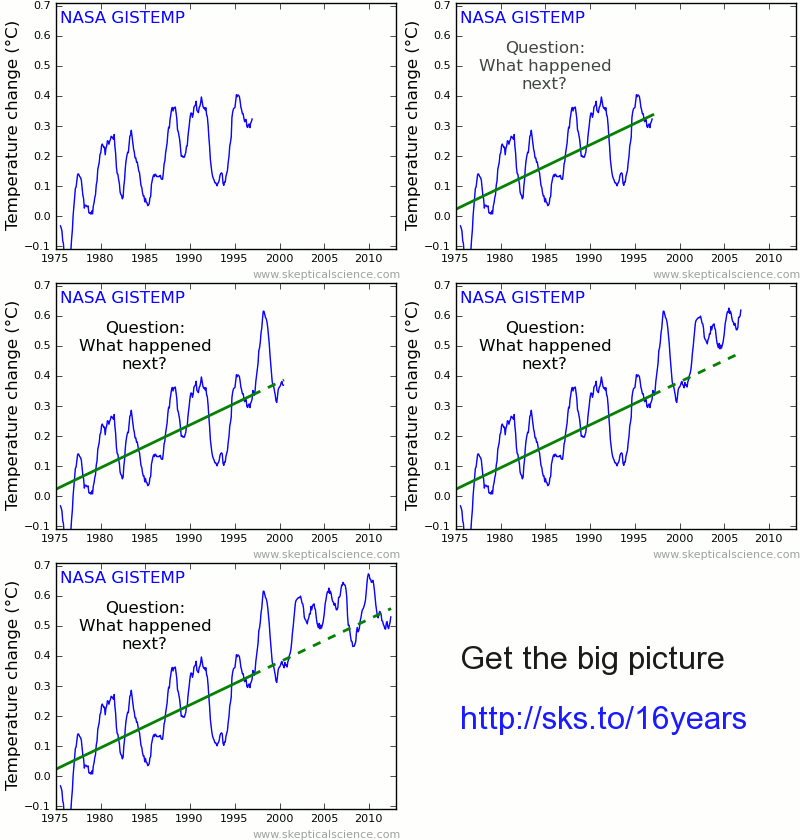
The human contribution to global warming over the last 16 years is essentially the same as during the prior 16 years¹. Human-caused greenhouse warming, while partially hidden by natural variations, has continued in line with model projections². Unless greenhouse gas emissions are brought under control, we will see faster warming in the future³.
Implications:
- The 16-year temperature trend provides no evidence to suggest that human-caused greenhouse warming has slowed.
- The 16-year temperature trend provides no evidence to suggest that the consensus understanding of human-caused climate change is incorrect.
- The temperature record over the past 35 years is consistent with climate change being driven by human greenhouse gas emissions.
- Given that human greenhouse gas emissions are increasing, and that the natural influences do not show a trend on longer timescales, we must expect increasing global warming in the future.
Further Reading:
For details of the method, see the Advanced rebuttal to the myth 'no warming in 16 years'.
The results of this analysis are consistent with a statement by WMO Secretary-General Michel Jarraud:
"Naturally occurring climate variability due to phenomena such as El Niño and La Niña impact on temperatures and precipitation on a seasonal to annual scale. But they do not alter the underlying long-term trend of rising temperatures due to climate change as a result of human activities"
Credits: Video: Kevin C. Voiceover: Daniel Bailey. Advice: The SkS team.
Teaser graphics: What happened next? Does this look like global warming?
Footnotes:
We have attempted to keep the language in this video at the same non-technical level as the media stories it refutes. As a result, it has been necessary to simplify much of the terminology. The following notes are for technically literate readers.
¹ i.e. If a change in gradient is allowed at 1997 then the change in gradient is not statistically significant (even at the 1σ level).
² i.e. Within the envelope of AR4 trend projections.
³ On the basis of both AR4 projections and that global GHG emissions are increasing.
Update 21/02/2013: Troy Masters is doing some interesting analysis on the methods employed here and by Foster and Rahmstorf. On the basis of his results and my latest analysis I now think that the uncertainties presented here are significantly underestimated, and that the attribution of short term temperature trends is far from settled. There remains a lot of interesting work to be done on this subject.


 0
0  0
0 Figure 1: Coverage maps for various temperature series. Colors represent mean change in temperature between the periods 1996-2000 and 2006-2010, from +2C (dark red) to -2C (dark blue). Note that the cylindrical projection exaggerates the polar regions of the map.
The other indices don't have good coverage at the poles where, according to GISTEMP, UAH and the NCEP/NCAR reanalysis dataset warming has been fastest over the 15 year period shown.
If my analysis of HadCRUT4 here is correct, then this is particularly serious over the period post 1998, with coverage bias in HadCRUT4 shifting from a warm bias around 1998 to a cool bias now. Of course UAH is the only set of measurements we have for these regions, and probably suffers ground contamination over the antarctic, however the possibility that there is a huge cooling trend over one of the poles which hasn't been picked up by any observations or models is farfetched.
On this basis I think that GISTEMP is the best choice for measuring global trends. I'm working on kriging HadCRUT4 to provide a global version for comparison.
Figure 1: Coverage maps for various temperature series. Colors represent mean change in temperature between the periods 1996-2000 and 2006-2010, from +2C (dark red) to -2C (dark blue). Note that the cylindrical projection exaggerates the polar regions of the map.
The other indices don't have good coverage at the poles where, according to GISTEMP, UAH and the NCEP/NCAR reanalysis dataset warming has been fastest over the 15 year period shown.
If my analysis of HadCRUT4 here is correct, then this is particularly serious over the period post 1998, with coverage bias in HadCRUT4 shifting from a warm bias around 1998 to a cool bias now. Of course UAH is the only set of measurements we have for these regions, and probably suffers ground contamination over the antarctic, however the possibility that there is a huge cooling trend over one of the poles which hasn't been picked up by any observations or models is farfetched.
On this basis I think that GISTEMP is the best choice for measuring global trends. I'm working on kriging HadCRUT4 to provide a global version for comparison.









Comments