





Sea levels will continue to rise for 500 years
Posted on 19 October 2011 by John Hartz
This is a reprint of a news release posted by the University of Copenhagen
on Oct 17, 2011.
Sea levels will continue to rise for 500 years
Rising sea levels in the coming centuries is perhaps one of the most catastrophic consequences of rising temperatures. Massive economic costs, social consequences and forced migrations could result from global warming. But how frightening of times are we facing? Researchers from the Niels Bohr Institute are part of a team that has calculated the long-term outlook for rising sea levels in relation to the emission of greenhouse gases and pollution of the atmosphere using climate models. The results have been published in the scientific journal Global and Planetary Change.
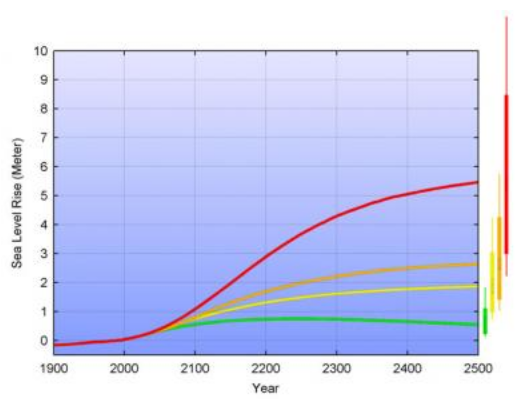
Estimates of Sea Levels to the Year 2500. The graph shows how sea levels will change for four different pathways for human development and greenhouse gas pollution. The green, yellow and orange lines correspond to scenarios where it takes 10, 30, or 70 years before emissions are stabilized. The red line can be considered to represent business as usual where greenhouse gas emissions are increasing over time.
"Based on the current situation we have projected changes in sea level 500 years into the future. We are not looking at what is happening with the climate, but are focusing exclusively on sea levels", explains Aslak Grinsted, a researcher at the Centre for Ice and Climate, the Niels Bohr Institute at the University of Copenhagen.
Model based on actual measurements
He has developed a model in collaboration with researchers from England and China that is based on what happens with the emission of greenhouse gases and aerosols and the pollution of the atmosphere. Their model has been adjusted backwards to the actual measurements and was then used to predict the outlook for rising sea levels.
The research group has made calculations for four scenarios:
A pessimistic one, where the emissions continue to increase. This will mean that sea levels will rise 1.1 meters by the year 2100 and will have risen 5.5 meters by the year 2500.
Even in the most optimistic scenario, which requires extremely dramatic climate change goals, major technological advances and strong international cooperation to stop emitting greenhouse gases and polluting the atmosphere, the sea would continue to rise. By the year 2100 it will have risen by 60 cm and by the year 2500 the rise in sea level will be 1.8 meters.
For the two more realistic scenarios, calculated based on the emissions and pollution stabilizing, the results show that there will be a sea level rise of about 75 cm and that by the year 2500 the sea will have risen by 2 meters.
Rising sea levels for centuries
"In the 20th century sea has risen by an average of 2mm per year, but it is accelerating and over the last decades the rise in sea level has gone approximately 70% faster. Even if we stabilize the concentrations in the atmosphere and stop emitting greenhouse gases into the atmosphere, we can see that the rise in sea level will continue to accelerate for several centuries because of the sea and ice caps long reaction time. So it would be 2-400 years before we returned to the 20th century level of a 2 mm rise per year", says Aslak Grinsted.
He points out that even though long-term calculations are subject to uncertainties, the sea will continue to rise in the coming centuries and it will most likely rise by 75 cm by the year 2100 and by the year 2500 the sea will have risen by 2 meters.
“Sea level projections to AD2500 with a new generation of climate change scenarios,” S. Jevrejeva, J.C. Moore, and A. Grinsted, Journal of Global and Planetary Change, Sep. 21, 2011. Click here to access the Abstract and a summary of the paper.

Arguments


Hansen and Sato see a non linear rise- with as much as a 4-5 meter rise by 2090. During the Eemian interglacial when global temperatures where at best a few tenths of a degree Celsius warmer then today, sea levels where about 4 meters higher then present.
With C02 levels reaching double the PI era by mid century, and a 2 degree rise in temperatures over the PI era; with arctic ice 4 decades ahead of IPCC estimates (which will hasten ice melt in Greenland) A 1 meter rise by 2100 seems too cautious.
However, the curves only represent the central estimate, without the uncertainty shown except for at 2500.
I think the important point to take away is that this sort of modelling helps to demonstrate why it is that we've really only got a decade or two to sort out GHG emissions. Wait another 20 years for more "certainty", and we end up with sea levels that are still rising five centuries from now...
Hansen & Sato discussed the dual subjects of (i) Whether 2oC global temperature rise would bring seriously bad sea level rise and (ii) The possible speed of that rise. While (i) was presented quite convincingly, (ii) was actually little more than speculation. They developed the idea of a 'doubling time' for accelerating sea level rise, suggesting that the limited GRACE data available (6 year's worth) indicates a 'doubling time' of 10 years. This would imply massive rates of sea level rise by 2100.
Present rates of sea level rise are 3mm pa. The IPCC 'most pessimistic' forecast is for an annual rise of 13mm pa by 2100 (which is roughly the average rise during the climb out of the last ice age). With large increases in the rise due to melting land ice, there is a limit to the rise because of the latent energy required to melt the ice, a limit Hansen & Sato 2011 greatly exceed. But if enough land ice turns into icebergs, very large sudden rises can result. As Hansen & Sato 2011 say, past ice ages have ended with multi-metre sea level rise due to much smaller climate forcing than the present-day man-made forcing.
In my opinion, the take-way from this study is the following statement by Aslak Grinsted:
"Even if we stabilize the concentrations in the atmosphere and stop emitting greenhouse gases into the atmosphere, we can see that the rise in sea level will continue to accelerate for several centuries because of the sea and ice caps long reaction time."
The accuracy of the model forecasts is of secondary importance to this basic finding.
Hopefully the rate of sea level rise will be at the lower end of the predictions. This will allow more time to implement adaptation strategy and give existing infrastructure a longer lifetime before it needs upgrading. Planning restrictions in high risk areas will be important to minimise risk.
This World Bank article (pdf) states:
Gotta love that legal jargon.
An interesting question, but most likely not. See how those curves flatten rapidly and are virtually flat from 2400 onwards (assuming the forcing for the warming is reduced)? The LIA peaked in the late 1600s (so over 300 years ago) and the graph below suggests that the event was not associated with any notable decline in sea levels because of increased glaciation, although the rate of increase did appear to slow somewhat during that time. Either way, any lag in the system from events back then would currently certainly not be described as "significant".
[Source]
The fact is that our inaction now is going to affect the planet and its inhabitants for hundreds of years to come, perhaps even for millenia. We cannot change the past and/or natural variability, but we can control emitting GHGs. This paper underscores the importance of taking prompt action.
The rate of any rise caused by a warming will slow with time after the warming stops. Globally, the rate of sea level rise was 1mm pa in 1900, 3mm pa in 2000. Whatever comprised the 'little ice age' & any resulting sea level rise have been superceded by more recent warming.
You assert:
"The basis of this whole story is the assumption that there is a straight relationship between the emission of greenhouse gasses and global temperature."
Where in the underlying published paper is this assumption stated?
Anyways the CO2 maths are pretty simple - the carbon cycle is the key - and the key to understanding it is ocean chemistry. All the other influences people get caught up with come out in the wash on these time scales.
So yes 15m to 25m sea level rise is the ultimate consequence of the next 20 years CO2 emissions. More details on www.carbonvirgin.com
There is nothing that you can name outside of anthropogenic CO2 that is going to melt as much ice and expand as much water as we are now.
But that's not true for collapse of ice is it? There are places where a substantial incursion of rising waters beneath an area of ice could convert land ice into a floating (or near enough for these purposes) ice shelf. At which point the ice merely has to displace water rather than become water to affect sea level. No latent energy required.
And if you read on...
"With large increases in the rise due to melting land ice, there is a limit to the rise because of the latent energy required to melt the ice, a limit Hansen & Sato 2011 greatly exceed. But if enough land ice turns into icebergs..."
Sorry - this sentence seems a bit clumsy to me (I was raised by schoolteachers!) May I suggest 'But how frightening are the times that we face?' or 'But how frightening are the times we are facing?'?
What decades are being referenced and what figures were used to derive the 70% faster?
The optimistic scenario would require an average sea level rise of 6.74 mm/yr over the next 89 years.
Where is the acceleration in SLR required to make either one of these scenarios realistic?
I disagree. Look at a map of the world for even a 20 metre sea level rise and its not obvious at first glance what is different. Although on second glance you notice stuff like half of Florida gone.
And look around you. How much of the roads and buildings etc has been built within the last 100 years? Most of it. How bad can it be if you have to rebuild a small percentage of our cities over the next 100 years? It may add up to scary figures if you try and put it in billions or trillions of dollar terms for the globe, but if you average it out as actual cost per person per year I doubt the cost would be all that dramatic.
What I am scared of is eco system disruption. Warm the planet by 5 degrees and I'd expect that nearly every ecosystem on the planet will be unrecognisable compared to today. Now perhaps man will carry on mostly unconcerned except for the sense of morale outrage over mass extinctions and ecological disruption. Or perhaps there will be very real and nasty consquences. Something like the Pine Bark beetle that affects wheat. Or a human disease that does what the pine bark beatle does.
Or agriculture disruption. If we get more bad luck with droughts and less good luck with adaptive breeding, Co2 fertilisation, increased warmth and precipitation we may find ourselves with significantly reduced agricultural capability. What percentage of the worlds population could that kill? 10%? 20%?
Or consider that at a dew point of 35 degrees human exposure to the outside world for significant periods of time becomes unavoidably fatal. Look at a global map of which areas may experience conditions that require humans to air condition or die under a pessimistic warming scenario and the result is far more striking than a map of which areas are under water.
Unfortunately for lay readers such as myself, it's behind a paywall.
Might I suggest linking to the article in the OP (as well, perhaps, as a link back to the original press release)?
Apart from icesheets themselves, there are thousands of areas that are (or were) glaciers as well as all those regions which get regular heavy snow. With glaciers melting and snowmelt beginning earlier in spring (no, not every single year, but on average) does that not mean that the hydrological cycle will not only cause more frequent, severe flooding on land. But it could mean that waters are returned to the ocean much more quickly. Presuming that most of the vapour which precipitates as rain or snow came from the ocean originally.
Put simply, ice and snow in a warming world will lose their historical function as a 'bank' of waters. When snow and ice don't accumulate year by year and gradually slip, slide and move towards the ocean but just form and melt seasonally, that must mean that there's just more water in the ocean on average. That water will adjust to the warmer temperatures and will expand along with the rest.
If anyone knows where I got this idea please give me a reference.
Let me intervene before this becomes at all contentious.
If your opinion is that AGW may not be happening and you will only trust blatant and indisputable observations of direct sea level rise to confirm these predictions, then these predictions will look silly to you. This is especially true since, like global mean temperatures, there is a lot of noise so that short term trends are meaningless.
If you instead believe the science that predicts an acceleration in ice melt along with continued thermal expansion, then the conclusions are obvious (with huge error bars) and confirmation through observation will come in time.
Most scientists put themselves in the latter position.
"Wary skeptics" might put themselves in the former position.
You can set yourself where ever you like, but the science projects an accelerated sea level rise, and has good reason not to use a too short and noisy record at this phase of climate change to make predictions fifty to one hundred years into the future. Logic and an understanding of the mechanisms involved serve much better.
Scenario 1. The Optimistic Scenario. Humanity makes it through this century without a catastophic collapse of civilisation. All the problems we face including AGW are managed, at leat well enough to allow a decent size, modern technology civilisation to continue. Growth of knowledge continues - Nuclear Fusion finally works for example. Our descendents are left with a damaged eco-system in which to survive but they still have the social tools to make that possible.
Scenario 2. The Pessimistic Scenario. Humanity doesn't do well this century at all. The Hydrological Crisis, AGW, Depeleted resources, social upheavel and a major population crash down to 1 billion or so by centuries end. In such a world the possibility of a collapse to the equivalent of a Medieval level or lower in a SERIOUSLY eco-damaged world. And one of the biggest losses in all this would be the very knowledge base we have built up over the last couple of centuries. And the Technical/Industrial Capacity that goes with it. In a Medieval world things like Carbon Sequestration or Geo-Engineering activities aren't possible. So our descendents have to eke out an existance in a world much harsher than anything we saw during the last 10,000 years. And all they could do is hang on untill the cooling comes - millenia from now. What new Religions & cults will have sprung up over that time. Will Science become the great blasphemy, the cause of ancient woe?
Yes humanity are intelligent, resourceful etc. Now! But what will H Sapiens evolve into after millenia of poor nutrition, poor hygene, low life expectancy, regular famines and disease, cannibalism, low education levels, superstitions etc. Evolution can work both ways. Our adaptation may well be to go back to an earlier form. Better adapted to a harsh environment.
Since we can't be sure what the coming decades may hold in terms of the dgeree to which it is scenario 1 or 2, we probably need to assume the worst till we can be sure that we are coping well enough. And that may take several generations until we are sure.
Source: Climate scientists grapple with uncertainty (though not the kind you think), Era Klein’s Wonkblog, Washington Post, Oct 18, 2011
To access this article, click here
This post is about what long term sea level will be. One way of looking at this is to ask what has happened in the past. During the previous Inter-Glacial, the Eemian around 150,000 years ago surface temps peaked at about 0.5 DegC warmer than now. But they didn't stay that high for long, perhaps only 1-2 thousand years. In contrast since the peak of this current inter-glacial, although not as warm as the Eemian, they have stayed high for 10,000 years or so before we started elevating them recently.
During the Eemian around 1/2 the Greenland Ice Sheet went and sea levels rose enough to flood Denmark and turn Scandinavia into an island - The Baltic joined up with the White Sea to form what has been named the Eemian Sea
Many people seem to fixate on the models and computer predictions of Climate change as if they are the only evidence. I sometimes get a sense that they treat the idea of AGW with incredulousness, as if it is an outlandish proposition that has appeared out of left-field that only really originates in some 'models' Yet the best evidence for Climate Change is that it has happened before.
[DB] This is what it may have looked like:
(yet another fine graphic from jg)
Yep, that is what is expected to happen - hence more flooding, more uneven supply of water for agriculture. And a greater need for even more dams. Dams serve 2 purposes. They store water so if you are loosing a storage system supplied by Nature you need more man-made storage. In addition, dams perform a vital role in flood prevention. If Mother Nature isn't providing that service for us we need extra dams for that role as well.
And that extra water increasing sea level - yep again. To date Glacial melt has added more to sea level rise than Greenland/Antarctica. In decades/centuries to come the 'big boys' will take on a larger role. But not so much yet.
[DB] At one meter of SLR, Miami is effectively an island, impossible to defend from storm surges and vulnerable on the whole "back side"; much infrastructure will be inundated.
At 2 meters, even more so. Anything more and all of South Florida will be under the waves, not just Miami (click for larger image):
More details for other areas can be found here.
I think your dismissal of sea level rises as a major issue is somewhat disturbing. The biggest issue is the fact that most of the Earth's population is based in coastal cities. Indeed, the most prosperous cities are located on coastal regions. It has taken a huge amount of effort and carbon emissions to build them. Meanwhile the surrounding rural areas are crucial for agriculture.
Cut away even a small distance inland and the result is a massive migration of the most economically active people on the planet onto land that is already under strain trying to produce enough food.
Firstly the abandoned cities would need to be sanitised before sea waters were allowed to engulf the cities, this would have to be done in parallel with moving people and building a new city inland. On top of that, you would have resistance from rural dwellers who would be against their land being urbanised.
Meanwhile you would get sea water causing problems inland as it pushes up along rivers and 'polluting' farmland.
Land erosion would increase making it dangerous for any stability in building communities near some coastal areas.
Admittedly, many cities and agricultural areas have already "reclaimed" low-lying marshes, wetlands and mangroves. Here in Adelaide there was once an area called 'Reedbeds', no need to wonder why it was called that. Nowadays, residents of suburbs beside the waterway called a river (it's really a seasonal creek) complain bitterly about occasional flooding.
But more generally, mangroves and marshes as well as beaches serve as a buffer for high tides and storms. These very low lying areas will be the first to go under the merest advance of rising waters. And the adjacent landward areas will then be exposed to the full force of storms and tides. All buffering will be gone. I know it's true of this city and many others, I just don't know how many others, but on flat land near the sea we have the airport and the sewage processing plant, the major power generator is on an island - as well as the port and its associated train lines and road transport infrastructure.
Urbanising agricultural land is one thing. Commandeering land for airports and other major infrastructure will put those problems in the shade.
As for CO2 fertilization - that's turned out to be a fizzer so far. The latest global forest inventory finds little evidence for it, and a recent peer-reviewed paper finds none.
"Rising sea levels in the coming centuries is perhaps one of the most catastrophic consequences of rising temperatures.",
"What I am scared of is eco system disruption. ", "Or agriculture disruption. "
What I am truly terrified by is 'The Sum of All Off It' It is easy to get into trying to compare the relative awfulness of each aspect. But it is the sum of all of them that matters, and particularly the way the differing threats intersect to produce compound threats.
The external challenges are bad enough. But when we try to factor in how these external pressures impact on the internals - social cohesion, ongoing education levels, psychological pressures, civil disorder, war etc we start to move into really frightening territory. How they can degrade our capacity to respond to the externals, leaving us far less powerful to act than we think we are.
This from their Environment Assessment Agency.
""For the Netherlands, being a country with one of the most densely populated deltas, one of the threats of climate change is sea level rise. This report reveals that the Netherlands will be able to cope with sea level rise, for many centuries to come, even in a worst-case scenario of 1.5 metres sea level rise per century.""
Quite amazing realy.
Do you have a link to the pertinent document?
As I explained in comment 27 you are not going to "see" the real acceleration at this point in time (except for the abrupt seemingly linear acceleration at the advent of warming around 1979).
We are in that early part of the curve where it looks flat. It is going to accelerate. We know it is because we are thinking human beings and we can put together 2 + 2.
Here is the part of the curve we can see now, representing just the first 3 decades of global warming:
If we zoom out a bit, here is the part we have to wait to see, the next couple hundred years:
Taminos graph shows the trend rate as function of starting year, so you are actually comparing trend rates over periods of different lengths. That may be fine if you want to investigate how many years of data ou need to establish a significant trend (as Tamino does in the post "How long").
If one wants to demonstrate that the trend rate is increasing I think it would be better to calculate trends over e.g. a period for 30 years all for all 30 years period in the data and then plot these to se how they change over time.
I'm not sure why #40 & #41 cannot give a more useful looking graph. A link to such a graph (of my own authorship) is here (hoping it works).
Graph of sea level rise & IPCC prediction ranges 1880-2100
I was asking FundME to provide a link to his quote from the Dutch Environment Assessment Agency, not inquiring about any graph(s).
My apologies if my comment was capable of being misinterpreted in that light.
Because I was lazy. Here's your graph inline: (Oh, and thanks!)
You state that most of the world's population is based in coastal cities.
But just because a city is coastal does not mean that the entire city will be submerged, unless we are talking entire loss of Antarctica and 50 metre type sea level rises.
For instance I live in Brisbane, and I've looked at google maps of sea level rise to see what will be lost. At say 2 metres it is only a minority of the city that is lost. Once you get past something like 10 metres much of the densely populated northern corridor is lost, and the CBD is under serious threat, but much of the densely populated western and southern corridors is still fine. It would take well over 2 metres, and something of the order of 10 metres before 'most' of Brisbane is lost.
A look at Sydney shows that the city will cope significantly better, and a look at Melbourne looks similar to Brisbane, except the CBD and inner city will be threatened at only about 2-4 metres.
On this small sample of cities, it seems quite unlikely that most (i.e. > 50%) of the population in these cities will be impacted within 100 years. And Australia is a very coastal nation, with a dry and arid interior, and a love affair with the beach.
It will only ever be a minority of the population that will be required to pack up and move within any reasonable timeframe of say a century or two. And for nearly all of these cases there will be suburbs in the same city that are 50 or so metres above sea level. There will be a small minority of cities in the world that may require a more complete abandonment/relocation.
And within such a timeframe the majority of the population will pack up and move somewhere else, often to a totally different city, and do so multiple times, simply because they are bored with where they currently live, or they have changing family or employment circumstances etc. And a quite a large number of the buildings they live in will be bulldozed because they are old and tacky and we'd rather build something shiny and new than maintain the old.
Can anyone give a reasonable argument that the amount of dislocation and reconstruction that we will be forced to perform due to sea level rise will ever be comparable to the dislcoation and reconstruction that we perform simply due to convenience?
"For instance I live in Brisbane, and I've looked at google maps of sea level rise to see what will be lost. At say 2 metres it is only a minority of the city that is lost."
Tell that to those who live in the "minority" of Brisbane who get to experience that 2 meter SLR up close and personal:
"A look at Sydney shows that the city will cope significantly better"
Looking at the same effects of 2 meters SLR one surmises the denizens of Sydney to be descendents of Prince Namor, the Sub-Mariner:
But then, Australia is but a small place compared with the world as a whole. Expanding our viewpoint beyond the parochial pale (and ignoring the easy, low-hanging fruit of the Maldives or Bangladesh [and since Miami is so "been-there, done-that"]), a quick trip to the other side of the orb brings us to the Old Country, Europe:
Meseems like savvy investors should avoid Edam cheese futures...
[Maps courtesy of the visualization tools from the Department of Geosciences, University of Arizona]
Actually, the Dutch are probably better off than most.
Due to climate change and relative sea-level rise, the dikes will eventually have to be made higher and wider. ... Currently, reinforcement of the dike revetments ... is underway. The revetments have proven to be insufficient and need to be replaced. This work started in 1996 and should be finished in 2015. In that period the Ministry of Public Works and Water Management in cooperation with the waterboards will have reinforced over 400 km of dikes.
Imagine that ... a government that can do something -- with popular support. Guess it really does take a crisis to solve a problem.
I'm sure those displaced by such SLR will be consoled by the fact that they are only a minority.
Before we even think of our own home towns I'm more concerned for the people in Tuvalu and Kirrabati. They are feeling the effects of SLR now.
The really disastrous Oz lifestyle consequence is that all that lovely sandy beach will disappear under the waters.
It won't re-form on any historical time-scale. And, let's be honest, the geological time-scales needed to reestablish such landscape features are not terribly relevant to us or our several generations of descendants.





