





Trigger for past rapid sea level rise discovered
Posted on 23 July 2012 by John Hartz
This is a reprint of a news release posted by the University of Bristol (UK) on July 11, 2012.

![]()
The cause of rapid sea level rise in the past has been found by scientists at the University of Bristol using climate and ice sheet models. The process, named ‘saddle-collapse’, was found to be the cause of two rapid sea level rise events: the Meltwater pulse 1a (MWP1a) around 14,600 years ago and the ‘8,200 year’ event. The research was published in the July 12 issue of Nature.
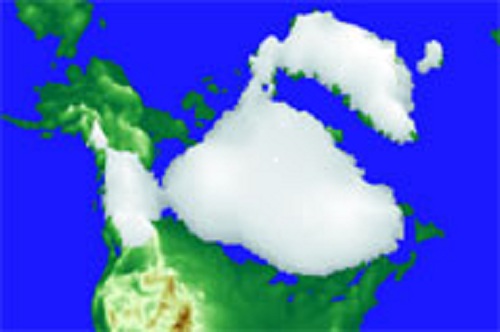
North American ice sheet during the saddle collapse, 14,600 years ago, simulated in this study. Image by Dr Lauren Gregoire.
Using a climate model, Dr Lauren Gregoire of Bristol’s School of Geographical Sciences and colleagues unearthed the series of events that led to saddle-collapse in which domes of ice over North America became separated, leading to rapid melting and the opening of an ice free corridor. Evidence of these events has been recorded in ocean cores and fossil coral reefs; however, to date the reason behind the events was unclear and widely debated.
Ice domes up to 3 km thick (three times the height of Snowdon), formed in regions of high snowfall and higher topography, such as the Rocky Mountains. Together with the saddles – lower valleys of ice between the domes – these made up the ice sheet.
Towards the end of the last ice age, at the time of mammoths and primitive humans, the climate naturally warmed. This started to melt ice at increasingly high elevations, eventually reaching and melting the saddle area between the ice domes. This triggered a vicious circle in which the melting saddle would lower, reach warmer altitudes and melt even more rapidly until the saddle had completely melted. In just 500 years, the saddles disappeared and only the ice domes remained.
The melted ice flowed into the oceans leading to rapid sea level rises of 9 m in 500 years during the Meltwater pulse 1a event 14,600 years ago and 2.5 m in the second event, 8,200 years ago.
Dr Gregoire, lead author of the study, said: “We didn’t expect our model to produce such a rapid sea level rise. We got really excited when we realised that the events we simulated corresponded to real events!”
In the model, Dr Gregoire found that saddle-collapse could explain a significant amount of the sea level rise observed: “The meltwater pulse produced by the saddle-collapse can explain more than half of the sea level jump observed around 14,600 years ago. The rest probably came from the progressive melting of ice sheets in Europe and Antarctica.”
This research not only identifies the process which caused the melting of the North American ice sheet and the trigger for rapid sea level rises in the past, but also increases our understanding of the nature of ice sheets and climate change, allowing further questions to be posed and, with more research, answered.
Research like this allows climate and ice sheet models to be tested against evidence from the real world. If climate models are able to reflect patterns observed in natural records our confidence in them increases. This is particularly relevant where the models are also used to investigate the effect of climate change on ice sheets in the future.
The study was funded by the NICE Marie Curie Research Training Network and the Natural Environment Research Council (NERC), and the numerical model simulations were carried out using the facilities of the Advanced Computing Research Centre (ACRC) at the University of Bristol.
Subject paper
Deglacial rapid sea level rises caused by ice-sheet saddle collapses, Lauren J. Gregoire, Antony J. Payne & Paul J. Valdes, Nature, Volume: 487, Pages: 219–222, Date published: (12 July 2012) DOI:10.1038/nature11257
Received 23 February 2012, Accepted 21 May 2012, Published online 11 July 2012

Arguments


Based on the current rate humans put Co2 into the atmosphere, which is 10,000 times faster than the natural processes.
For that matter and potential singular positive feedbacks the rate of Sea Level Rise (SLR) can be assumed to rise with a similar rate. And for that matter there is no equivalent in the earth recorded history. The main SLR rise is likely not to come from melted water, rather then thermal expansion, which is attributed to be 70-75% of current observed SLR.
I'm happy to entertain many possibilities, no matter how wild, but in the end it comes down to physics and evidence. As the esteemed Martin Vermeer suggests on your blog, perhaps you should check your maths.
As it stands, your comment is not very on-topic for the OP of this thread.
The maximum SL in the top warmth of Eocene (~40Ma) was 70m above present. I find your claim that it could rise 30m further above that is less likely than runaway greenhouse effect, during which the water would boil at the surface while the bottom part would remain cold. So the total volume of ocean would not have a chance of thermal expansion to reach your figure before it starts to evaporate.
This article does not explain Heinrich events (5 of them between 45ka - 15ka) each attributed to the melt pulse of 5m/100a. Other than that, the results are good news: Greenland dome does not have "saddle shape", so future warming can spare us the MWP1A and 8.2K-like events.
The paleoclimate record also shows that 560 ppm would be enough to melt all the ice in the Arctic, and later the Antarctic. Rohling said that once the Antarctic melts, sea levels would rise by 60 to 70 meters. “If governments keep going the way they are going,” Hansen added, “the planet will reach an ice-free state.”
Now it would be interesting to know exactly what the maximum possible thermal expansion could be on top of the melted water.
The point with the image of sea level rise is to show us the future. Because with current emissions, we will get there.
Show me some comp in the paleo record whereby 70 meters SLR was achieved in a world already at an interglacial peak and then you will have my attention.
As an FYI, I touched on SLR impacts around the world in this SkS post:
http://www.skepticalscience.com/mapping_sea_level_rise.html
And if you were to ask Eelco Rohling if your timetable of SLR had any merit he'd also be incredulous.
And (how I hate this repetitiousness) I have indeed re-read your post. All previous criticisms still stand. Despite that fact that I am still the SkS author most likely to be in your circle, you are not convincing.
And with modest "natural" climate changes as discussed in this article here, we have already a realm of SLR within a few centuries. It makes a lot of sense to assume that anthropogenic driven SLR will advance much faster, as we know it does, from our observations. Maybe it is not 100 meters but even 20 meters will be catastrophic. I really have no intention to argue about a few meters and that is why i wrote below that image that it is not accurate.
The point is that things will be faster than in the past of earth history and any modelling is helpful in our learning and understanding of this threat. So if we know that within 350 years a SLR of 18 meters can happen, than we can assume that the magnitude with faster Co2 addition to the system, will have an effect on the timescale. We are today 10.000 faster than the natural process. And we have data from coral reef proxies which show rapid SLR within a few decades.
1. Maintain there will be less ocean upwelling? Do you think the upper surface layer exists in a vacuum, disjointed from the layers below? We know that the deeper layers are warming, thus we know both upwelling and downwelling still exists between the ocean layers. Please furnish a credible mechanism under which this might occur.
2. Assert that current SLR attribution to thermal expansion will not change? Indeed, current understanding is that it is indeed changing, with the component due to melt already increasing. With many meters of ice-melt/mass loss already in the pipeline (century+ timescale).
3. The 100-meter assertion was yours, thus it is yours to defend. If you screwed up your maths, then admit it.
What we (you and I, not the rest of SkS) have in common:
1. The GIS and the WAIS are screwed. Indeed, in a future sense their melt has already happened (when one views time a certain way), based on today's CO2 levels and the forcings/feedbacks derived from it.
2. Yes, 20 meters SLR is catastrophic, and may/will happen (given time). The point you miss is that 2 meters SLR is catastrophic, and will likely happen to the world's seaport cities ere the centuries end. All SLR which happens after that, and which will continue for centuries, is moot.
3. Yes, we are changing things many times faster than any comp in the paleo record. And also faster than mankind as a species can wake up to and internalize. And thus, mitigation is likely already out as a viable option. Which leaves suffering and adaptation. The former on a global scale; the latter, on a much smaller scale (for those that still live).
The link seems to be busted - maybe a wrong backslash in there?
Here 'tis if anyone else is having my problem.
http://www.bristol.ac.uk/news/2012/8626.html
You can calculate termal expansion from this data and the average ocean depth of 4000m.
The PETM studies calculated the temp rise of deep ocean as 8K from O18 ratio. The corresponding thermal SLR was 5m, which is about 1.1% vol.
Your number of 30m indicates thermal volume expansion of close to 1%, which is equiv to 45K temp rise in the link I provided above. Not strictly the boiling point yet so physically possible but pointless to even consider as whole life (except some bacteria) would be dead long beforehand. So before claiming "I see no reason why this [thermal expansion component of SLR] should change considerable", check you basic maths.
http://pubs.usgs.gov/fs/fs2-00/
And as i said above, i have no interest in discussing if there will be 80, 90 or 100 meters SLR equivalent.
he impact from massive SLR will be felt globally differently, depending on the planets gravitational field and mass movements. Therefore will an ice free state have SLR of above 100 meters.
Surely you mean 0.11%?
http://atoc.colorado.edu/~dcn/ATOC1060/Members/Lectures/26_SeaLevelRise.pdf
The author claims it is unlikely but if all ice melts it could be up to 180 meter?
The article stated: "The melted ice flowed into the oceans leading to rapid sea level rises of 9 m in 500 years during the Meltwater pulse 1a event 14,600 years ago..."
AND: "The meltwater pulse produced by the saddle-collapse can explain more than half of the sea level jump observed around 14,600 years ago."
9 * 2 = 18
No 'substantial difference'.
Thanks for correcting my typo.
Chris@21,
You should know by now that the claim of "potential SLR of 180m" in that presentation is unsubstantiated rubbish. I have also noticed another problem: in their simulation of GIS melt on slide 17. They assumed CO2 reaches 550, 750 and 1000ppm (3 scenarios) and stays constant after that for almost 3000y until 5000AD. That's very pessimistic/unlikely because, according to Archer 2009, figure 1 therein, pulse 1000GtC in the atmosphere cannot stay constant for so long, because its tail is reduced to 350-450Gt in just 1ky timescale after ocean invasion and neutralization by CaCO3. So their scenarios assume humans to keep burning coal (or some other CO2 release, e.g. from permafrost) into 5000AD to keep up with ocean CO2 uptake. That assumption cannot be substantiated.
CBDunkerson@22,
Thanks for puting it together. Now the numbers make sense to me.
You stake your reputation on essentially hearsay.
The real problem of sea level rise does not involve big numbers. A rise of more than a few metres will place indecribable pressure on future generations, already labouring under the stresses of a heated planet with a seriously degraded biosphere and dwindling energy, soil, water and other resources.
These few metres of sea level rise are already set in train with the current rate of human-caused global warming and its concurrent SLR change, and given a little more time than the arbitrary time limit of 2100. It's these simple, little numbers that will have huge consequences.
And most human action these days continues as if these future consequences are still only hypothetical.
What happens when ice melts in the middle; does it run to the bottom and collect there? Does it get part way down and re-freeze? It's hard to imagine the ice above melting fast enough (takes a LOT of heat) to create a saddle in the ice, but there is a saddle underneath.
A more revealing image depicting the bowl-shaped morphology, including the deep ice-advecting drainage channels of Zachariae and Petermann, is shown thusly:
[Source]
There seem to be some updates to ice sheet melt contribution to SLR ie. the wiki cites Greenland ice to rise 7.2 SLR, where the USGS numbers only use 6.4 - and maybe thermal expansion is higher then 10 m too.
However if somebody can point me to a better graphic for showing the ice free planet, i would be happy to use that.
Yep. And this is a paper by Richard Alley and colleagues... not good.
Chris Machens #21, those are lecture notes. You may want to take it up with the lecturer (seriously):
David C. Noone
The statement "In unlikely case that all of Antarctica melts, 100-180 meters of sea level rise!" on the last slide is just plain wrong, as you know by now.
It's actually over 1.6 km thick; other sources give 2 km. (But OTOH the rock surface on which it lies is up to 2.5 km below sea level in West Antarctica.) And then, of course, ice contracts when melting. That gives us 0.9*2000*14/360 = 70 meters, which is the value most often found in the literature.
"Map showing where the albedo reduction is greatest; the southern ‘saddle’ region, the peripheral low elevation areas, and the northwest." http://www.meltfactor.org/blog/?p=580 updated map of ice sheet albedo decline from Dr Jason Box - Box, J. E., Fettweis, X., Stroeve, J. C., Tedesco, M., Hall, D. K., and Steffen, K.: Greenland ice sheet albedo feedback: thermodynamics and atmospheric drivers, The Cryosphere Discuss., 6, 593-634, doi:10.5194/tcd-6-593-2012, 2012. If he says there's a saddle, I trust him.
"An elevated occurrence of above melting temperatures are observed 11-14 July near the ice sheet topographic summit in an area typically considered to be melt-free, a.k.a. the “dry snow zone”. http://www.meltfactor.org/blog/?p=556
"The process, named ‘saddle-collapse’, was found to be the cause of
twothree rapid sea level rise events: the Meltwater pulse 1a (MWP1a) around 14,600 years ago,andthe ‘8,200 year’ event, and the unanticipatedly nonlinear Anthropocene Greenland event ca. 2000-2100." &;>)





