




A visual depiction of how much ice Greenland is losing
Posted on 27 April 2010 by John Cook
I'm talking at the University of Queensland next week so I thought I might use Skeptical Science to test-drive a new visual metaphor. Sometimes in the climate debate, we get a bit lost in the data and statistical analysis, forgetting the sheer scale of the impact we're having on our climate. A vivid example is the amount of ice that Greenland is currently losing. When scientists talk about ice loss from the Greenland ice sheet, they refer to gigatonnes of ice. One gigatonne is one billion tonnes. To get a picture of how large this is, imagine a block of ice one kilometre high by one kilometer wide by one kilometre deep (okay, the edges are actually 1055 metres long as ice is slightly less dense than water but you get the idea). Borrowing from alien invasion movies, the scale is well illustrated by comparing a gigatonne block of ice to a famous, historical landmark like the Empire State Building:

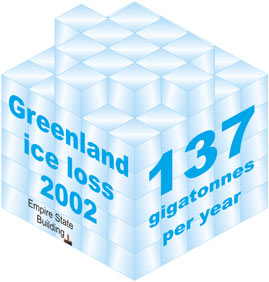
How much ice is Greenland losing? This is monitored by satellites which have measured changes in gravity around the ice sheet over the last decade (Velicogna 2009). In 2002 to 2003, the Greenland ice sheet was losing mass at a rate of 137 gigatonnes per year.
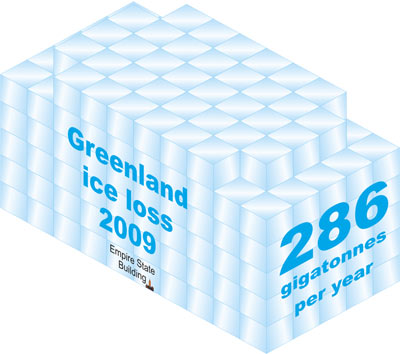
However, the rate of ice loss has more than doubled in less than a decade. The rate of ice loss over the 2008 to 2009 period was 286 gigatonnes per year.
This is a vivid reminder that global warming isn't a statistical abstraction cooked up in a climate lab. Greenland is just one example of the physical realities of climate change. On the other side of the planet, Antarctica is also losing ice at an accelerating rate. All over the globe, glaciers are retreating at an accelerating rate.
It's also a reminder of the massive amount of inertia at play in our climate. It takes time for the massive Greenland ice sheet to respond to warming. But this inertia is not our friend. Now that Greenland is losing ice at an accelerating rate, it's not like we can throw a rope around the ice sheet and hold it back. The steadily accelerating ice loss from Greenland is an ominous reminder that our actions now will have effects long into the future.

Arguments


Call me a skeptic, but I don't completely "trust" that this ice loss necessarily correlates with the big TV that I watched the James Balog show on. We know man has pumped tons of CO2 into the atmosphere and the amount has risen exponentially since the mid 1850's. But why were many of the worlds glaciers retreating at a good pace in 1900 when we emitted only 1/8th of the CO2 that we are now?
Why were the glaciers in Greenland retreating throughout much of this century when the Greenland temperatures were stable?
The same thing was evidenced by the paper written by the glacierologist from India.
If man has been only responsible for temperature rise from 1975 onward, why were glaciers melting since 1850? Why are glaciers retreating if the world precipitation is supposed to be increasing because of the super computer climate models, just like the heavy snowfall this winter in the NH was all expected and "modeled" apparently, (but i'm not so sure about that, because there were many IPCC references of less snowfall, but I guess the theories seemed to just change this year in light of the new data.
I did the same things as this did here in Montana at Glacier NP and came up with the same results using the raw data from NOAA. Temperatures didn't seem to rise but glaciers did melt. Call me a skeptic, but I am not so sure we have anything to worry about. Surely world sea levels are rising, but isn't this about the same rate as it was when man was just getting started to discover the wonders and wealth of burning fossil fuels over 150 years ago?
Last point(sorry for being bandwith hog on this post), but this is my favorite glacier picture, scroll to page 3. Is all of the above "unprecedented" just like the CO3 above 300 and just like the dramatic rise in temperatures pointed out this century? On page 3 the guy is standing on tree stumps created from a glacier that formed 3,000 yrs ago, this may seem like a long time, but is just a blink of the eye in geologic time.
I heard the other night that Antarctica ended its 2010 'Summer' at minus 100 degrees Fahrenheit. So perhaps the Antarctic can now gain back some ice.
Because of the decline in Global Temperature from 2004 to 2009, the arctic ice has grown in area. The rumors I have heard is that there are three active volcanoes in the arctic ocean that are adding tremendous heat to the arctic ocean and that prevents a gain in the thickness of the thin ice covering the arctic ocean.
Even if that statement was true, Arctic sea ice has increased marginally in surface area since its all-time low in 2007, but it remains far belows its average extent in decades previous. Moreover, while the surface area has recovered somewhat, there is strong evidence that much of the new ice is so-called rotten ice that will melt again easily, rather than the multi-year ice that is resistant to melting. Also, the Arctic sea ice minimum is driven by factors much more complex than the global average temperature.
Finally, why are you repeating crazy "rumors" you "heard" about active volcanoes melting Arctic sea ice? Let's stick to actual science, shall we?
antarctica gaining ice
Arctic sea ice grew from 2004 to 2009? Would take some special cherry-picking to support that, like the cherry-picked range for temperature. Try the long term data - eg Graphs in Has-Arctic-sea-ice-returned-to-normal
And the old "volcanoes under the ice" trick. This is disinformation. Dont fall for it. Some discussion at dotearth
First of all, its a glaciologist not a "glacierologist" as an individual who studies "glacierology" (as you would put it instead of Glaciology) I can assure you that your credibility was lost with that one sentence.
Secondly, Greenland has not been melting for 150 years. See Wake et al. 2009 for confirmation of this. There have been many periods of growth over the last 150 years.
Thirdly, Glaciers still retreat with increased precipitation because they are dependent mostly upon Summer Air Temperature even more than Winter Precipitation. Ablation occurs faster than accumulation.
Fourthly, The rate of sea level rise is currently at 3.4 mm per year (Cazenave et al. 2008) whereas the TAR (IPCC Third Assessment Report) predicted rates of 1.9 mm per year. That's an 80% acceleration over the expected results... So I don't see how you indicate that the rate of sea level rise is not accelerating?
The graphs of sea ice area anomaly at Cryosphere Today do not support the assertion that Arctic Sea ice has increased. The Tale of the Tape shows that it has not experienced a meaningful positive anomaly since 2003, even with the new baseline including all years until 2008.
The global sea ice shows negative anomaly at or greater than 2 million sq.km for the past 4 years. The last positive anomaly of similar magnitude was in 1988
Many of the same group have recently produced a paleoclimate reconstruction of Greenland temperature going back 1400 years showing a MWP as warm as present day.
Greenlands temperature has shown a fair amount of natural variation no doubt allowing periods of retreat and advance over the past 1400 years. The real skill is putting the changes of the past decade into a context that fully aknowledges this natural variation. Terms such as "steadily accelerating ice loss" are meaningless without putting a timeframe on them.
Also, Humanity Rules comment should give you forewarning to be prepared for questions about the MWP and early Norse settlements. If there is more or almost equal ice volume in that area of Greenland today when compared to the Norse settlement period you're going to lose some of your audience regardless of the science.
It would be interesting to see a similar ice cube representation for a much earlier year, and as HumanityRules commented, how this matches up with the entire Greenland icesheet.
There's no reason why regional ice loss rate should match the vector on global CO2 emissions. The dynamics in play are completely different. What they have in common is increased warming. I would caveat the top post by mentioning that 7 years of data is a little short to make confident analyses of trends.
We know CO2 is a greenhouse gas and how much we are emitting. The greenhouse effect has been known for over 150 years. We know that on our current path, CO2 concentrations could triple from pre industrial levels in this century.
If you knew nothing else about climate change or maybe had never heard of it, or the politics of it, and you learned the above, what would your initial reaction be?
I would think common sense would give you concern. So why are so many intent on denying it?
Imagine a fat man, weight 150 kg (330 lbs) losing 15 g (half an ounce) a year. This is the type of slimming cure Greenland is going through recently.
Of course, when I look at that picture, it reminds me of the numerous papers that have looked at the last interglacial when temperatures were 1 to 2 degrees warmer than now (eg - the warming expected from some of the more optimistic emission scenarios). They found that sea levels were at least 6 metres higher than current levels. Looking at all the ice still stored in Greenland, it's not hard to see why. Going on past history, Greenland (and Antarctica) are very sensitive to sustained warmer temperatures.
"Oceanic control of the warming processes in the Arctic - a different point of view for the reasons of changes in the Arctic climate" - professor A. Marsz, 2009.
Summary
"The paper describes the strong correlation between the sea surface temperature (SST) in the region of the Gulf Stream delta and anomalies in surface air temperature (SAT) in the Arctic over the period 1880-2007. This correlation results from the transfer of a variable amount of heat from the Atlantic tropics into the Arctic through oceanic circulation (AMO - Atlantic Multidecadal Oscillation). Reaction of sea ice is the main mechanism controlling the heat content in water carried to the Arctic and influencing the SAT. Sea ice may either increase or limit the heat flow from the ocean to the atmosphere. The genesis of the 'Great warming of the Arctic' in the 1930s and '40s is the same as that of the present day. Both may be considered to be attributable to natural processes and are not demonstrably associated in any way with a supposed 'Global greenhouse effect'. CHANGES IN THE CONCENTRATION OF CO2 IN THE ATMOSPHERE COULD ONLY EXPLAIN 9% [!] OF VARIATIONS IN THE SAT IN THE ARCTIC."
"Greenland Ice Sheet Surface Air Temperature Variability: 1840–2007*" Box et. al. 2009, AMS - "The annual whole ice sheet 1919–32 warming trend is 33% greater in magnitude than the 1994–2007 warming." (http://www.worldclimatereport.com/wp-images/greenland_xmas_fig1.JPG). By this work in the years circa 193X-5X in Greenland was warmer than today ...
There's an old saying in the field of computational neuroscience: "The implementation is independent of the architecture". That is, there are many different paths to the same end result. As far as Arctic ice loss goes, predictions from fairly old models (I have a text book about 20 years old that presents a model predicting ice loss specifically from AGW) state that ice loss is hypothesised to occur due to warming caused by CO2. The model has nothing to say about the mechanism by which this occurs - it could be by the ice being pushed around differently by changes in weather/win patterns, or it could be by it sitting there melting. The models don't care, they just predict the outcome, not the mechanism.
So the changes in wind patterns are not any sort of evidence for or against the anthropogenic cause of Arctic ice loss. You could of course try to develop a model looking at what different mechanisms of arctic ice loss may occur under different global warming scenarios, but you'd have to develop an understanding of what the relevant parameters were.
I'm not sure of the purpose of repeating what I said back. My point was that the weather that causes the melt is at least somewhat independent of the climate (e.g. manifested by temperature anomaly. Modeling the temperature and the climate are essintially independent tasks. I's very unlikely that a model of the weather will be able to falsify a model of the climate.
Prior to about 1999 Greenland's ice sheet was pretty much in mass balance. It had dipped slightly and then rebounded in the 70s, but otherwise nothing but minor fluctuations for decades. Since 1999 it has dropped at a precipitous and accelerating rate.
If we assume that this acceleration stops and Greenland will continue losing ice at 286 gigatonnes per year then it would take about 9,000 years for the entire ice sheet to melt (which matches Berenyi's 15 g out of 150 kg = 10,000 years pretty well).
If we instead assume that ice loss will continue to increase at a LINEAR rate equal to what it has been recently (a little under 25 gigatonnes per year) then it would take about 450 years.
Finally, if we assume that the rate continues to double every six years then it would take about 60 years.
We probably need AT LEAST a decade more data to get any kind of handle on what sort of long term trend we are likely to see, but if ice loss is being driven by CO2 caused warming then the answer will likely be somewhere between the last two figures... though since we are looking at such a small time frame, slightly increased CO2 levels over that period would have a negligible impact, and we are really talking about the melt rate at the CURRENT CO2 level. If CO2 continues to increase the melt time would decrease.
Some points:
1. Does it matter when the ice sheet has melted?
The eventual result is the same. Coastal cities will be flooded and problems for human populations will occur.
2. 3 out of the 4 scenarios you portray are very serious.
Lets take the Linear example first. It is generally accepted that the greenland ice sheet will add some 6m or so to sea levels. So in 450 years time a large number of coastal cities will be under water. Ok, 450 years is apparently a long time. But the real problems will still plague coastal cities and communities long before then.
Add just 2 or 3 metres in 200 years or so and many coastal city communities will have serious flooding problems.
In any case the ultimate fate of many cities will be mass abandonment and migration inland, it doesn't matter when that will happen, the fact that it will happen is the problem.
3. The non-linear scenario doesn't really need explaining once the consequences of the Linear scenario is clarified. Cities would probably start planning for mass evacuation now.
4. If the actual scenario is somewhere between linear and non-linear, then we still have some very serious problems. Evacuation probably needs to be planned for the next century or towards the end of this century.
So given that in all probability flooding will occur, risk analysis suggests we should do something about it.
In other words, they are not just rumors, they are complete nonsense.
"nofreewind" (#3) posed some interesting questions that you failed to address. Instead you attacked his credibility which makes no sense when he was merely asking questions.
Why don't you have another go at answering "nofreewind" and this time stick to the point and lay off the "ad hominem" stuff.
Thus, yes we should be planning for long term sea level rise. However, I think we have time to see how that is going to develop to better inform our efforts to handle it.
Of course, all of this is just Greenland. Antarctica is melting too... and oceans are also rising from thermal expansion. However, even with all those factors combined we have time to see how trends are going to develop before taking action.
"By this work in the years circa 193X-5X in Greenland was warmer than today "
I understood the work to say that the slope of the 'line' (line segment?) was steeper then than more recently. That doesn't say anything about the height of the line, and temperature is X.
Regarding
#3 NoFreeWind,
#8 rway024,
#22 CBDunkerson
#23 The Ville,
#25 gallopingcamel,
@#25,
It's hard to know how to answer questions that imply what you believe to be a false premise. (Have you stopped beating your wife?) If you are going to answer at all, the first step has to be pointing out that the premise is false. Once the premise has been shown to be false, there's really no need to answer the original question. (#3, #8, #25)
@#23,
"Prior to about 1999 Greenland's ice sheet was pretty much in mass balance." (#22)
is at least in part a response to
"Greenland has been warming and loosing ice for well over 150 years" (#3)
@#8,
'glaciologist not a "glacierologist" ' is a bit of a nit-pick. You're correct of course, but Camel is right, there's no need to make a point of it.
Lastly, and to further address one point from #3, "Temperatures didn't seem to rise but glaciers did melt." It might be useful to remember that, in proximity of a phase state change, temperature looses its tight coupling with energy. The temperature in a glass of ice water will not change significantly between when it is mostly ice to when it is mostly water, but there is a lot of energy change. But then also, melting isn't the only way for a glacier to retreat.
It´s only a tiny increase in CO2 concentration each year.
And hey, a few meters of sea level rise are pretty insignificant compared to the total ocean depth.
Rationalization is the ultimate solution to global warming.
Even if there was glacier retreat in 1900, it would be consistent with the steady increase in global temperatures at that time. CO2 does not cause glaciers to retreat, CO2 causes warming which causes glaciers to retreat. Unlike the warming that began around 1970, the warming from about 1850 to 1940 was primarily due to an increase in solar activity. This is discussed some here. It is also worth pointing out that the warming now is already more extreme than the 1850 warming period, and projected to get worse.
To the other question, even if temperatures were stabilized today glacier retreat would continue for a long while, there is nothing inconsistent about this. This was already pointed out in John's original post: "It takes time for the massive Greenland ice sheet to respond to warming." The glacier retreat you see today is the result of warming in years past. Unfortunately temperatures are continuing to rise, so not only will the melting continue, it will get worse.
BTW, at many places glaciers have been melting since the little ice age, I think you can find many examples in the NH. However, the rate of melting seems to be accelerating, which is a bit worrying. How large the impact of natural variability is compared to AGW we will probably see in the next few decades, because of the quiet sun and negative PDO (which have both been proposed by the skeptics for giving large global temperature variations).
Volume might be better represented by something more common like the Superdome or some other stadium. Some large common object or space that represents volume.
I also think that CBDunkerson's comments on the linear growth aspect of ice sheet loss is very important. It's probably valid to mention that the trend is likely accelerating without attaching a particular rate to it. And even Berényi Péter's comment of relating it to the total volume of the Greenland ice sheet is important.
I think this gets right down to the nitty-gritty of why a) so many people are reacting negatively to the idea of AGW, and b) why it's been so easy for the climate change denier crowd to make hay out of the issue. Regular non-scientific folk lack adequate ways to understand the scale and meaning of climate change.
What John's trying to do, along with all the great suggestions here, is totally on the right track to fix that.
"Unfortunately temperatures are continuing to rise, so not only will the melting continue, it will get worse."
It is strange that reasonable people can draw entirely different conclusions from the same data. Temperatures have risen by ~0.7 degrees Celsius since 1850 and I would describe that as "fortunate" given the miserable conditions during the "Little Ice Age".
During the LIA glaciers were swallowing up Swiss farms. With a little more warming large areas of Canada and Russia would become farm land. Overall, the melting of glaciers is a blessing, not a curse.
Your "rate" argument is nonsense. At the end of the last Ice Age, sea levels rose at an average rate of more than 1.2 meters/century.
About 7,000 years ago the rates started to fall. For the last 2,000 years sea levels have been rising by less than 0.3 meters/century. There is no big mystery about this. The main continental ice sheets melted long ago and all we have left is the Antarctic, Greenland and relatively few glaciers.
Your "soil creation" argument is not much better. For much of Earth's history there were no ice caps so plants were growing from pole to pole. Once the ice melts, plants will start growing again, except in those places that have been stripped down to the bed rock by glacial flow.
One of my students expressed ice volume volume loss in terms of Nimitz-class aircraft carriers, reasoning that these were probably the largest mobile things built by man. But that still resulted in a huge number -- who can visualize 10,000 Nimitz-class aircraft carriers? (that number was not for Greenland).
Which is a relatively long way of saying that your point about sea level rise having been faster then is totally irrelevant to the present day.
Ice leaves behind outwash and rock, not past soils. Plant colonisation is rapid but a productive soil, especially compared to delta, very slow.
I wouldn't call it a nitpick at all. This individual spent so much time on skeptic blogs looking up his argument that he forgot that you need the overall knowledge of the issue at hand also. It is not as though we were referring to some abstract type of specialist. Glaciologists are very well known today and not taking the time to learn who it is that studies these things, and then talking in a manner as if he/she were an expert is not something which I am willing to defend. You look up the core literature and gain the core knowledge before you make accusations about the existence of AGW or not. I don't want to be rude to the individual in any shape or form but it does get a little annoying when comments are made with such certainty and yet such ignorance all at once.
You mention plants growing from pole to pole, but never explain exactly how long you think this would take. I assure you new ecosystems do not sprout up overnight. In the meantime, our society could be going through some severe economic and environmental turmoil. It is of little comfort to say that 2000 years from now our problems may not seem so bad.
It's also interesting you noted potential agriculture improvements in Canada and Siberia, but neglected to mention any other possible effects. There are other places in the world after all. How would lower latitude countries be affected? Did you weigh the negative effects vs. the positive to come up with your conclusion that warming will be a "blessing", or did you just cherry pick the details that support your conclusions? That's an intellectually lazy approach, and you'll need to do better if you want to make a convincing argument.
If you are interested in knowing more about the predicted effects of global warming, both positive and negative, this post is a great start. The IPCC and EPA also go into more detail on the subject.
While I generally agree with what you say, it is worth noting that the remains of stone buildings have been found "beneath the waves" in many places, for example in the Mediterranean and Black seas. The submersion in some cases may have been caused by rising sea levels rather than seismic activity.
The folks on this blog generally seem to believe that mankind can influence the rate of rise of sea levels. At the risk of upsetting some of you I consider that idea to be nonsense with no credible scientific basis.
The sea levels are going to do whatever Mother Nature wants them to do and we need to stop whining about it.
There are a lot of reasons why land falls below or rises above sea levels over time. Most of which are red herrings when viewing the global perspective of what is going on.
Some parts of the UK are now land locked where as in the past they were on the coast, other parts are underwater where as in the past they were above sea level.
The reasons for changes are numerous, but it doesn't impact on the global picture of what is going on.
More often than not they are simple diversions.
"Your "rate" argument is nonsense. At the end of the last Ice Age, sea levels rose at an average rate of more than 1.2 meters/century.
About 7,000 years ago the rates started to fall. For the last 2,000 years sea levels have been rising by less than 0.3 meters/century. There is no big mystery about this. The main continental ice sheets melted long ago and all we have left is the Antarctic, Greenland and relatively few glaciers."
OK by your own figures and checking some others seas rose about 110 metres between the last ice age and 7000 years ago. Not surprising.
Humankind was mobile and used to a harsh life, plus the human population was tiny by comparison with today. No major static cities or other developments. eg. Sea levels rising 1.2 metres per century wasn't a big deal for the population at the time, especially if populations had to deal withj much more severe problems.
However Now is not the past. Most populations today live in static locations and invest a lot of time and effort building infrastructures that they expect to be preserved for many centuries.
Hence the consequences of the remaining ice melting is huge and you are underestimating the impacts.
I really like the river and lake comparisons. The cubic volume that John has in nice, but the numbers are too large to get a good feel for.
However, I think your math is a little off. I get
Mississippi
12,743 m^3/s = 0.000012743 km^3/s
*60 // minute
*60 // hour
*24 // day
*365.25 // year
= 402 km^3/year // 1 Gton ~= km^3 water, neglecting temperature and sediments
Flow rate from http://en.wikipedia.org/wiki/Mississippi_River, which is derived from USGS measurements.
So, to keep things simple, the net loss of water (ice flow + melt) off of Greenland is about 3/4 of the Mississippi river at present. If the two measurements above are directly comparable, that means that the flow increased from 1/3 of a Mississippi to 3/4 in a 6 year span. Wow.
"For the last 2,000 years sea levels have been rising by less than 0.3 meters/century. "
Yes, substantially less than 0.3 m/century. Over the last 2,000 years, up until recently, there has been negligible change. Over 20 centuries, anything close to that rate would have caused approximately 6 meters of rise. That hasn't happened.
Here is a summary
http://commons.wikimedia.org/wiki/File:Holocene_Sea_Level.png
"At the risk of upsetting some of you I consider that idea to be nonsense with no credible scientific basis."
This would seem to be an example of argument by assertion.
Presumably, if it's impossible that "mankind can influence the rate of rise of sea levels," there is some physical mechanism that makes it impossible. What might that mechanism be?