





An Even Cloudier Outlook for Low Climate Sensitivity
Posted on 12 December 2010 by dana1981
Research has given us good confidence that if CO2 doubles in the atmosphere then there will be 1.2°C of directly CO2-caused global warming, and a combination of melting snow/ice and increased evaporation of water will act as positive feedbacks to increase this warming by approximately 1 to 2°C.
This climate sensitivity of an additional 1 to 2°C warming would mean most recent global warming was human-caused and more is in the pipeline; but some scientists believe that changes in clouds will cool us down, though the most public paper to claim this (Lindzen and Choi 2009) has been heavily criticized for using a method that can be fiddled to give any desired result and ignores much of the planet.
The strength of the cloud feedback is commonly calculated by determining the change in cloud-caused heat flow for a change in temperature:
F = ΔRcloud /ΔTs
Where "F" is cloud feedback, ΔRcloud is the change in the top of the atmosphere (TOA) flux caused by cloud changes, and ΔTs is the global-average and monthly mean surface temperature anomaly.
Roy Spencer believes these calculations are invalid because we can’t tell whether the warming is changing the clouds or the clouds cause the warming through his hypothesized ‘internal radiative forcing’. If the change in temperature is caused by the clouds in the first place, then we could calculate a positive feedback even if it is actually negative!
A new paper by Dessler (2010) attempts to get around this and calculate the quick cloud feedback using measurements by the Clouds and the Earth’s Radiant Energy System (CERES) instruments from March 2000 to February 2010. The satellite measures how much heat is coming from the Earth at TOA, and Dessler accounts for greenhouse gases, humidity, El Niño Southern Osciallation (ENSO), etc. to determine how much of the heat flow is from clouds. He then looks at how far above or below the average it is for its month, and plots this against temperature.
If the temperature is related to clouds, then you expect a slope in the graph thanks to the above formula. Figure 1 displays the results, and Dessler finds that the short term feedback is 0.54 ± 0.74 (2σ) W m-2 K-1, i.e. far more likely to be positive than negative, although negative values can’t be ruled out based on this data. However, a small negative feedback is insufficient to support the theory that clouds will prevent significant future warming.
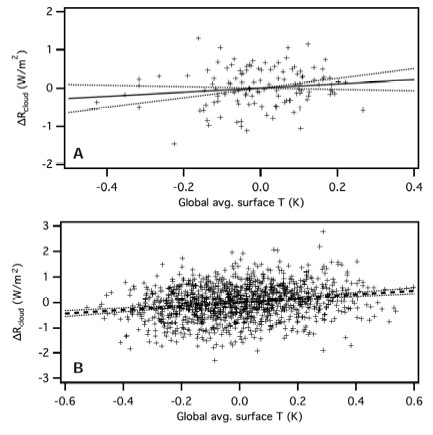
Figure 1: (A) Scatter plot of monthly average values of ΔRcloud vs. ΔTsusing CERES and ECMWF interim data. (B) Scatter plot of monthly averages of the same quantities from 100 years of a control run of the ECHAM/MPIOM model. In all plots, the solid line is a linear least-squares fit and the dotted lines are the 2σ confidence interval of the fit.
A key point in the paper is that most of these short-term temperature changes are caused by ENSO. If the temperature change is being caused by ENSO, then it’s likely not being caused by clouds, and Spencer’s hypothesis is potentially sidestepped. Spencer has countered this by arguing that ENSO changes are caused by clouds, and thus the response of clouds to surface temperature changes cannot be inferred. Dessler argues that Spencer's hypothesis that ENSO is caused by clouds is new and untested, and the burden of proof falls on Spencer to demonstrate that his hypothesis is correct.
Dessler (2010) adds confidence that the cloud feedback is not significantly negative, and various climate models are largely in agreement with the CERES observations., as illustrated in Table 1.
Table 1: Cloud feedback values. All uncertainties are 2σ. Feedbacks are calculated from a 100-year segment of a control run, except for CCSM3, which is based on 80 years.
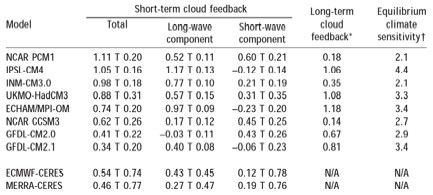
Dessler is careful to point out that there are differences between short-term and long-term cloud feedbacks in models, which suggests that these observations might not be a good guide for the future. However, although long-term climate sensitivity cannot be determined from 10 years worth of data, the global climate models did pass this test, and the evidence against a strong negative cloud-climate feedback continues to mount.
The paper also comes on the heels of Lauer et al. (2010), which examined and provided support for the high end of current estimates of global climate sensitivity due to a positive cloud-climate feedback.
This guest post was written by Mark Richardson (MarkR) and Dana Nuccitelli (dana1981)

Arguments


Nothing has seriously challenged that figure.
http://www.agu.org/journals/pip/gl/2009GL042314-pip.pdf
Discussed in detail here.
There are several major flaws in the L&C paper.
Beyond Trenberth et al. 2010, there is Murphy 2010: http://www.agu.org/pubs/crossref/2010/2010GL042911.shtml
And in effect Chung et al. 2010:
http://www.agu.org/pubs/crossref/2010/2010GL043051.shtml
Also, Lindzen and Choi came to the exact opposite conclusion of two previous studies ([1] and [2]) without discussing why their results differed so greatly. I can only assume this either means that Lindzen knew about these papers, but couldn't explain such conflicting results given the same data, or no longer feels like doing his homework when publishing potentially groundbreaking results.
[1] Forster & Gregory (2006) http://journals.ametsoc.org/doi/pdf/10.1175/JCLI3611.1
[2] Tsushima et al. (2005)
http://www.gps.caltech.edu/~vijay/GRC/Papers/tsushima-etal-05.pdf
You have it the wrong way round. The guys who are wrong (because they have errors in their papers) are bad. If Lindzen et al stopped making stupid errors they would become good guys.
We have provided links to both the prior work and the subsequent critiques of L&C, as requested by our skeptic friend HR. You are most welcome to criticize them - scientifically.
Please leave any insinuations of suspicious activities by "good guys" or "bad guys" where they belong: in the gutter.
You can't be sure their results are global anyway, and the ability to change their result by several-fold just by changing the selected periods by a few months means their approach looks seriously, seriously flawed. Unless they have a very strong justification for their time period choices, which they haven't presented.
However, models account for this, so it's a good paper that sidesteps Spencer's cause/effect so it can be used to test models: and the data from the past 10 years don't contradict the model calculations. So we can be a bit more confident in them.
Which is a much more complicated 'point' than just reading the abstract suggests...
Lindzen and Choi are welcome to point out the "major flaws" in the criticisms. The fact that they have chosen to not defend their position in the face of criticism suggests that they feel the criticism is correct.
Science is a dog fight. People get criticized all the time. If you think you are right you defend yourself. If you chose not to defend your position the science moves on. Look at the criticism of the hockey stick: Skeptics criticized the result and Mann has responded with more data to support his position.
Papers eventually falling by the wayside still serve a useful purpose in that a greater and deeper understanding of the science remaining is developed. But that does not make authors of failed peer-reviewed papers bad. Or those of confirmed papers good.
The Yooper
Try Trenberth 2002, it is approachable and even the abstract explains a lot.
http://www.agu.org/pubs/crossref/2002/2000JD000298.shtml
By being in a positive phase as a posed to negative La Nina phase. NOAA has some good info on the El Nino Southern Oscillation.
There are some suggestions that El Nino will get stronger as the oceans warm and La Nina will potentially get weaker. Currently however, there is very little evidence to back this theory up especially since ENSO (La Nina) is in it's strongest negative phase for a long time. ENSO has a huge impact on annual temperature and it is the reason why the this year will no longer be the warmest on record.
As explained in the link above, they match model results from the AGCM to the satellite observations using a gradient descent with the control variables listed on page 19. They adjust those control variables in the various equations that drive the AGCM. For example the water content control variable affects the scattering albedo in both the shortwave and longwave equations.
I think the primary problem with this approach is that some variables are controlled coarsely and not observed. A good example is wind which can only be indirectly validated by the match of other model parameters. But there are multiple solutions to the control variables to obtain the match from model to observations. "with four parameters I can fit an elephant and with five I can make him wiggle his trunk" http://mahalanobis.twoday.net/stories/264091/
There's at least one error in the article, as it says the change over land is 0.3°C when it's actually 0.6°C. So I suspect they got the 1.64°C sensitivity wrong too. Perhaps somebody could link the whole paper, but here's the abstract.
http://www.agu.org/journals/ABS/2010/2010GL045338.shtml
If you've demolished it as thoroughly as you have apparently done, I'm sure you'll have no problem convincing him ...
You start with a GCM that gives 1.94C sensitivity, i.e. pick a low outlier and subtract 0.3C from that.
However, recent evidence indicates a decline in the global land evapotranspiration trend due to limited moisture supply.
Add in Dai et al 2010 and you have a recipe to cast into doubt much of Bounoua et al's primary hypothesis.
This person's quick two cents (further reading required),
The Yooper
Thank you for posting this. You beat me too it. There are methodology problems with Dr. Dressle's paper.
"Indeed, our results suggest a global warming of 1.94°C in the RP‐case [baseline] versus 4.5°C by Betts et al. [1997] and 2.6°C by Levis et al. [2000]."
and then subtracting 0.3°C from it. Which of course would make no sense whatsoever, because the 0.3 is incorporated into the 1.94. 1.94°C sensitivity for 2xCO2 would be low, but not unreasonable (the study also suggests that a lower climate sensitivity model may be realistic, which is how they get to that 1.94 with just a 0.3°C cooling effect). But the Register article is not surprisingly just riddled with errors.
And like Daniel Bailey (#21) from what I've read, the results of this study are rather questionable.
Other prominent and respected climate scientists (including Trenberth and Soden) agree that Dr. Dessler's methodology is sound. Certainly much more sound that that used by Lindzen and Choi (2009).
From ClimateProgress:
"This is a very important check of the models,” says climate researcher Qiang Fu of the University of Washington, Seattle. “It shows no evidence of a large negative cloud feedback.” But climate researcher Roy Spencer of the University of Alabama, Huntsville, disagrees. He published one of the two papers finding evidence of a strongly negative cloud feedback. He finds in his own analyses signs that Dessler is seeing not only cloud changes caused by temperature changes but also temperature changes caused by natural cloud fluctuations. Such effects garble the true negative feedback beyond recognition, he says.
Spencer’s “interpretation is wrong," says Soden, but even if Spencer were right that there’s a cause-and-effect problem, Dessler’s method of comparing observations and models "eliminates some possibilities, such as the models being egregiously wrong. It’s about as good as we can do with current data sets."
Also,
"Dr. Kevin Trenberth, head of the Climate Analysis Section at the National Center for Atmospheric Research, is one of the leading experts on cloud modeling. He had been critical of some recent studies on the cloud feedback effect, so I asked for his thoughts on this study. He replied:
"The work is sound and is a very useful contribution. It is a foil to some of the misleading work that Richard Lindzen has published (and which we have shown is wrong). Kudos to Andy Dessler for trying to do this and doing it as well as it can be done."
Those are some pretty glowing reviews from some very critical and discerning climate scientists. Trenberth in particular, is a stickler for details, so his support of Dessler is important.
I'm not familiar with data used here, but ECMWF reanalyses are extensively validated and generally speaking the use of AGCMs isn't a problem since the sets feature regular data assimilation which prevents drift and includes the effect of coupled changes.
If you have the time to delve further then I'm sure there will be plenty of papers discussing validation and testing.
There are some problems with certain sets (e.g. ERA40 snow mass) but in that case at least the reasons are well known and publicised.
I'm not sure what you mean by no observations of wind: iirc synthetic aperture radar observations are regularly assimilated and they can give good estimates for wind speed over oceans...
#####################################################################
In our present climate, the reflection
of solar energy back to space dominates, and the
net effect of clouds is to reduce the net flux of
incoming energy at the top of the atmosphere
(TOA) by ~20W/m*2, as compared to an otherwise
identical planet without clouds.
######################################################################
There is something here for a lot of people to learn from. Admittedly I'm finding it difficult to find information to look into this. Would anyone here be able to explain how Andy came to 20W/M*2.
How does the net effect of clouds reduce the net flux of incoming energy at the top of the atmosphere by 20w/m*2, as compared to an otherwise identical planet without clouds?
GO ASK HIM AT REAL CLIMATE.
C'mon people, are you afraid that your debunkers might not really be debunking anything at all?
"In our present climate, the reflection
of solar energy back to space dominates, and the
net effect of clouds is to reduce the net flux of
incoming energy at the top of the atmosphere
(TOA) by ~20W/m*2, as compared to an otherwise
identical planet without clouds."
If this were known to be true, then the net feedback from clouds wouldn't be the big mystery it is acknowledged to be, would it?
You are catching on. It is STILL a big mysterday.
"fiddled" - Definition 'The act or an instance of cheating or swindling; a fraud.'
SkSci Comments Policy
"No accusations of deception. Any accusations of deception, fraud, dishonesty or corruption will be deleted. This applies to both sides. Stick to the science. You may criticise a person's methods but not their motives."
It seems like a poor choice of words that's breaking the sites own rules, it could do with being changed. "Lacks robustness" sound more in the spirit of scientific criticism.
Reading RC and Spencers own blog then this statement seems to be a misrepresentation. Spencer does not support a hypothesis that clouds cause ENSO, in fact he clearly refutes it. This has nothing to do with a Spencer hypothesis and seems to be a mis-reading by Dessler. I think it's an important point given the way Dessler uses this point to try to isolate Spencers work from the mainstream.
That's funny.
I think the point is that people are concerned about the censorship over at RC, and feel more free to ask questions here.
It doesn't say they necessarily fiddled with the data, it criticizes the method they used as one which can be fiddled to cherrypick convenient starting or ending points.
"You are catching on. It is STILL a big mysterday."
It's been a big mystery forever, and an openly acknowledged mystery. I've been aware of it for years, as has been anyone following climate science.
It's not the science side saying it's not a mystery, it's the anti-science side saying "it's not a mystery, net cloud feedbacks are negative and at a magnitude that will counteract CO2-forced warming and feedbacks such as water vapor". Spencer doesn't talk about a "mystery", Spencer talks about *certainty* that his magic negative cloud feedback will save us.
However, the preponderance of evidence shows that the net feedback will be slightly positive. Slightly negative's not off the table, but there is no sound evidence for the kind of magic feedback that folks like LIndzen and Spencer claim will kick in "real soon now" (i.e. as temps rise slightly) and forestall warming.
Statements like this:
"Thank you for posting this. You beat me too it. There are methodology problems with Dr. Dressle's paper."
Are easy to make. I'll make an easy statement, too: put up or shut up. Seriously. Go show Dressler where he's wrong.
Tough. He's there. Ask away. Now, if you ask something like "why don't you acknowledge that your paper is fraudulent and all of climate science is a fraud?", it's not going to show up. If you ask a rationale question about the paper, nicely, I'm sure it will.
No, he's said "it's an oversimplification of my argument". If you follow his argument, it's essentially what it boils down to, though Dressler's being a bit snarky.
He quite clearly states that he believes that the accepted science gets causuality backwards ...
In particular you can choose starting and ending points and get just about any result you want, and they gave no reason for the choice of their particular start/end points.
Also, HR, you've only given one definition of "fiddled", there are common definitions that don't assign a malignant motive to the act, such as this one:
"to touch or manipulate something, as to operate or adjust it; tinker (often fol. by with ): You may have to fiddle with the antenna to get a clear picture on the TV."
Clearly saying a mathematical process can be "fiddled" uses the word in the sense of "to tinker with".
Wait a sec, is that really what they're saying? Has anyone called 'em on it? As in, why didn't these miraculous clouds stop the 5 Holocene warmings of 6 degrees or more?
But the bottom line is that if cloud changes aren't causing temp changes via ENSO changes, then they're acting as a temperature feedback, and Dessler's approach is correct, because ENSO is dominating the short-term temp changes.
But there's already been an ~0.6C increase since the 70s, with nowhere near a doubling in CO2 (1970=325ppm, 2010=388ppm). How are they getting away with what is the equivalent of 'voodoo economics'?
#45: Eric, you're correct!
Deleting troll posts is hardly censorship. There's no law forcing private websites from cleaning out their comments sections. Some websites just have lower tolerance for trolling, that's all.
And, in case you wonder, I *do* consider that repeating the same old debunked "skeptical" argument is trolling at this point.
"it criticizes the method they used as one which can be fiddled to cherrypick convenient starting or ending points."
Cherrypicking suggests intent (in the fiddling). Can you accidentally cherrypick? I suppose as long as you both think Lindzen is an honourable guy (just his method is weak) then I guess everything's OK.
Absolutely. It's called cognitive bias.
The first thing I ever posted on RC was deleted. Same was true at Rohm's website. In fact I got into an email exchange with Rohm were he used exactly your reasoning.
But how do you expect people entering the debate to know "the same old debunked "skeptical" argument" from a legitimate concern or question? As you say RC can do what they want. And like you I have no problem with them alienating people.





