





CERN - Saying Nothing About Cosmic Ray Effects on Climate
Posted on 13 September 2011 by dana1981
CERN scientist Jasper Kirkby, about his recent cosmic ray experiment:
"At the moment, it actually says nothing about a possible cosmic-ray effect on clouds and climate, but it's a very important first step"
At CERN, Europe's high-energy physics laboratory near Geneva, Switzerland, scientists created an experiment to test how clouds are formed. The experiment ties in with a climate "skeptic" hypothesis that cosmic rays (charged particles from space) are causing global warming. As the hypothesis goes:
Solar magnetic field gets stronger => More cosmic rays are blocked from reaching Earth => Clouds, which are hypothetically seeded by cosmic rays, are less likely to form => Fewer clouds means more sunlight reaches Earth's surface => More sunlight means warmer temperatures => global warming!
Many climate "skeptic" bloggers and commenters have claimed that the CERN experiment has proven that cosmic rays are causing global warming, and that the experiment is "the final nail in the man-made global warming coffin" (i.e. here and here and here and here). It's always the final nail in the coffin, isn't it?

In reality, the CERN experiment only tests the bolded step in this list of requirements for cosmic rays to be causing global warming:
- Solar magnetic field must be getting stronger
- The number of cosmic rays reaching Earth must be dropping
- Cosmic rays must successfully seed clouds, which requires:
- Cosmic rays must trigger aerosol (liquid droplet) formation
- These newly-formed aerosols must grow sufficiently through condensation to form cloud-condensation nuclei (CCN)
- The CCN must lead to increased cloud formation
- Cloud cover on Earth must be declining
In short, the CERN experiment only tested one-third of one out of four requirements to blame global warming on cosmic rays. Whoops, not quite a nail in the coffin!

Additionally scientists have measured solar activity and the number of cosmic rays reaching Earth, and neither meets the first two requirements listed above. Both solar magentic field strength and the number of cosmic rays reaching Earth have been flat over the past 50+ years (Figure 1).
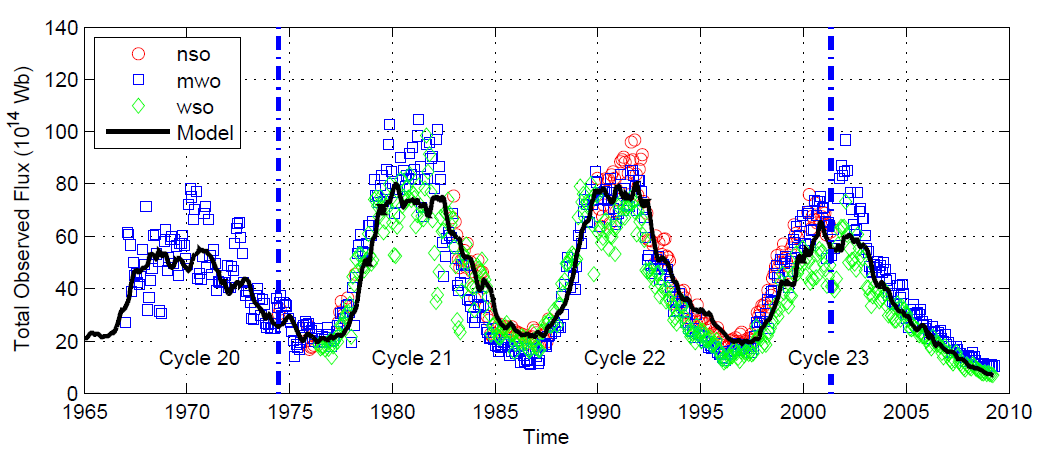
Figure 1: Solar Magnetic Field Strength from 1967 to 2009 (Vieira and Solanki 2010)
A number of other recent studies have also found that cosmic rays have minimal influence on cloud formation, and thus minimal influence on global warming.
As Dr. Kirkby said in the quote above, it is an important first step, just like buying eggs is an important first step in baking a soufflé. But just having some eggs doesn't mean I can bake a successful soufflé. There are a whole lot of other requirements necessary for me to bake a soufflé, and believe me, I don't meet them!
As is always the case, this climate "skeptic" declaration about "the final nail in the coffin" is no such thing. Not even remotely close. Every time they declare the man-made global warming theory dead, it comes back to life.

Note: Graphics provided by SkS user jg. This is the Basic rebuttal to CERN CLOUD experiment proved cosmic rays are causing global warming. Thingsbreak's CERN post has been adapted into the Intermediate version. The rebuttal can also be found at te short URL http://sks.to/cern.

Arguments


The big problem with this line of research on cosmic ray effects is that cosmic ray flux has not been increasing over the past 50 years or so whereas both temperature and CO2 concentrations have been increasing.
By the way it is "Kirkby".
A serious study of the link between GCR and effects on climate
Svensmark has stated this before, and this is a moderate confirmation of his link.
[DB] "and this is a moderate confirmation of his link"
Nope; this has been pointed out to you before & still you repeat the meme.
Also, you are still ducking Albatross' questions here. A real skeptic would embrace challenges, not hide from them.
Bill Chameides has posted a similar article today (Sep12) on his “TheGreenGok” blog.
To access Chameides’ “Climate’s Cosmic Connection?,” click here.
there has been a whole lot of studies on the cosmic ray influence on climate. Saying that scientists are now studying it is simply untrue.
But don't believe my words, go check the scientific litterature.
I also think the overlay of solar cycle and GCRs on the same graph is illuminating, a very quick way to show that it isn't the sun, and, because they are correlated, it's not cosmic rays either.
A good post, but I'm not entirely comfortable blurring the distinction between a theory that is alive and well because of its robustness, and the zombie arguments still walking around despite being well dead. It might be more humorous to show AGW standing nearby, alive and well, as the nail is being driven.
The theory is fine yes, just like that nail might have been fine had the person with the hammerer looked where they were swinging.
Ian, thanks for the correction on the spelling of Kirkby.
The paper you'v cited ignored ~10 other studies that yields contradicting relationships between cloud cover and decrease in GCR (Forbush decreases). (For example see references in Laken et al.
In addition, Laken et al demonstrated that there is a strong correlation between the decrease in solar irradiance prior to an FD event, and thus just relating FD event to a change in cloud cover does not necessarily say anything about GCR, as the effect of a change in TSI can't be isolated.
"Basically, what’s actually been demonstrated by Kirkby, et al. isn’t at odds with the IPCC. What is at odds with the IPCC hasn’t been demonstrated by Kirkby, et al. And the claims by Svensmark, Shaviv, and other ‘GCRs drive climate’ proponents have been debunked at pretty much every step of the way. GCRs may have some influence on cloud behavior, but they’re not responsible for significant climatic changes now or in the geologic past."
"After the initial furor of “skeptic” blog-spinning dies down, cosmic rays will probably find themselves falling out of favor once again. But there’s no such thing as too debunked when it comes to myths about climate change, and there’s little chance this will be the last time cosmic rays will be trotted out to claim that we don’t need to reduce greenhouse gas emissions.'
But I understand that 'skeptics' and those in denial about AGW have to continue to fabricate debate and uncertainty, it is what they do. Readers, don't fall for their misinformation and distortion and cherry-picking.
It would help readability if you were to enlarge Figure 1.
[DB] Now thumbnailed; click on it for larger 1050x454 native resolution.
Given theres no discernable trend in cosmic rays over the last 60 years, any link to climate must indicate that the climate is incredibly sensative, wouldnt you say?
Validity? I wonder. An FD occurs in response to a solar coronal mass ejection. The influx of charged particles enhances magnetic shielding of the earth, resulting in a lowered CR flux at the ground (hence the counter-intuitive decrease following a solar 'storm'). The typical FD has a sharp onset and an exponentially decaying tail lasting a few days.
Your linked paper (Dragic et al 2011) shows a measurable effect for only FDs with at least 7% decrease from prior background. That cuts the population down enormously, as weaker FDs are much more frequent. The authors have a dataset running 41 years (1954-95); there are a grand total of 35 7% FDs in that period. If this is what is causing clouds to form, there isn't even 1 cosmic ray induced cloudy episode per year!
It gets better. From the paper:
We have decided to avoid the direct use of cloudiness data in the analysis of CR-cloud connection and replace it with a different, well defined physical quantity: diurnal variation of surface air temperature (DTR), which should be inversely correlated with cloud cover. The rationale for this is the following: if cloudiness is high in the daytime, more sunlight is reflected back to space and the daily temperature maximum is lowered; in the nighttime, less infrared radiation from the earth surface is emitted into outer space and the daily temperature minimum is increased. Therefore - more clouds means lower DTR.
So we're not even talking 'cosmic rays cause clouds' anymore. Here's the new mechanism: 'A decrease in cosmic rays causes a temperature change that might or might not result from fewer clouds.' However, when the authors broaden their sample to include 5% FDs, the DTR increase disappears; hardly a robust result.
But it is not necessarily true that this 'mechanism' works the other way: Does higher DTR only mean fewer clouds? Figures in the paper show that 3-4 days after onset, DTR peaks on the order of 0.5C difference. Why does the peak in DTR occur as the FD is declining or quite possibly over? Does it take that long for the cosmic-ray cloud connection to stop making clouds? Is there going to be some sort of mystery lag between FD onset and DTR increase? Or are there other causes for these short-term DTR increases?
With studies like this posing as evidence, the cosmic ray-climate connection looks weaker than ever. That splitting sound you just heard? Another nail bent.
Surely that conundrum needs to be definitively settled before we argue the merits of claims about cosmic rays on cloud formation?
"Even if the GCR cause significant changes in cloud cover or GCR has other influences on climate - they are small or very small. It's true. "
This is, I think, is the central point, a small but not very significant influence of the sun has been detected in the last 60 years. Whatever may be found on the capability of GCR to nucleate aerosols, let alone cloud condensation nuclei, we may safely conclude empirically that the effect must be small.
The microphysics of clouds is a very interesting topic well worth studying. I'm sure it will contribute to our understanding of the climate in general and of clouds and precipitations in particular. What we can already say, though, is that it will not change significantly our current views on AGW.
it depends on the type of clouds. Very crudely, low level cumuliform (convective) clouds tend to result in cooling while thin stratiform clouds in warming.
You're right that GCR would result in cooling only if they increase low level clouds.
While both effects will result from increased cloud cover, the general thought is that more sunlight will be blocked, leading to cooling. Data indicates that cloud cover was less during the 1990s, correlating with the increasing temperatures.
The types of clouds also play a role; higher, cirrus clouds are very ineffective reflecters of sunlight, but will block escaping radiation from Earth. Conversely, low cloud cover blocks more sunlight from reaching the Earth's surface. Large, thunderclouds move heat via convection from the Earth's surface up through the troposphere.
The final word has not been reached regarding the full effects of cloud cover. Some scientists maintain that the effects are local, and insignificant globally. Others claim that the increased temperatures led to the observed decrease in cloud cover. Still others, like Svensmark, claim that the decreased cloud cover was responsible for the rising temperatures.
For these reasons, clouds remain the largest uncertainty in climate science.
Basically, requirements 1, 2, 4, and (newly stated) 5 for GCRs to be causing global warming are all contradicted by the available evidence. Items 3.2 and 3.3 are uncertain. However, given that ALL of these things would have to be true for the 'GCR induced warming' hypothesis to hold up... it already doesn't.
The details of cloud formation and climate impacts are extremely complicated issues which will likely take decades of further study to work out to a high degree of accuracy... which is likely why 'skeptics' keep coming back to this issue; 'You cannot prove every detail of how clouds interact with the climate... therefor they could be causing the observed warming'. The first part of that statement is true, but the second is false. We don't know how gravity works either... but we can measure its effects closely enough to put bounds on its behavior. Ditto for GCRs and clouds. We can determine the possible range of their impact on the climate from observations and thus rule them out as a significant factor even without knowing all the details.
Maybe so. But this is no longer uncertain: In 41 years of cosmic ray data, only 35 possible events of CR decrease -> less clouds -> short term warming were observed. Fewer than one event per year. If the GCR crowd expects anyone to buy in to this mechanism, is that all there is to show?
It would be interesting to compile a timetable of when even these few events occurred and see just how much global warming (or is it cooling?) is due to these ephemera.
Or is it chimera? A fitting question to pose to the keeper of the uncertainty monster.
To pinch the quote Albatross used (which Camburn still hasn't responded to):
"Why would anthropogenic CO2 now be the first forcing that doesn’t engage net positive feedbacks?" Dr. John Nielsen-Gammon
The following paper shows recent data correlating the different cloud clusters with temperature. While the paper may be a difficult read for some, it shows the warming effect of cirrus clouds, and the cooling effect of low-level clouds. The discussion and conclusion are easier for the non-expert to understand.
http://www.atmos-chem-phys.org/10/6435/2010/acp-10-6435-2010.pdf
One should note that this paper was an attempt to correlate clouds with temperature increase only. Other factors influencing clouds were not examined, and acknowledgement that they could exceed the temperature influence.
I hope this answers your question, and I fully understand that some people are trying to prove a large positive or negative cloud feedback.
You're correct; this apparent contradiction should dent Svensmark right out of the park. The solar minimum was indeed accompanied by a max in GCR flux in 2009. So there should have been beaucoup clouds and much cooling. But the people who buy this 'theory' also believe warming stopped in 1998.
I suppose this proves that if you believe in two simultaneous falsehoods (warming stopped and GCRs cause climate change), that makes them true.
I'm quite puzzled by this CERN experiment. When I first heard about it, I took a look at the sun's output and found the same thing - not much going on in TSI, field strength or rays. So my question is this: why is Kirkby looking for a mechanism that correlates cosmic rays with climate change, when the catalyst for the 'forcing' has been notably absent during the most dramatic increase in global temperatures?
The original its cosmic rays thread has the history. Blame the fascination with Svensmark's earlier work, suggesting a correlation between CR flux and cooling episodes; Nigel Calder hyped this to no end (still does). What I've noted is that they've lost any connection at all to the paleo record of CR-produced isotopes (such as Be10) and their correlation with cooling events.
By the time rebuttals of Svensmark were published, the CLOUD funding was approved. It is an interesting academic question with valid theoretical support - ionizing radiation does indeed make 'clouds' in saturated environments (ie, cloud chambers).
High energy particle physics projects take a long time to get going and tend to live for a while; look at the number of secondary authors on their papers. Once the detector is built, secondary beam time (they are not using the LHC's main beam) is relatively inexpensive. One could also suspect that the LHC administration was anxious to produce some results while waiting for the Higgs to show up.
Off the top of my head here is a list of potential or real influences that the solar cycle 'could' have on climate variability.
- Overall solar energy flux from the sun varies a fraction of a percent over the solar cycle. This is well known
- Higher energy parts of the solar spectrum, UV and up vary by more than this - 1 to 2% over the cycle. Since UV is absorbed preferentially in the stratosphere, this could have an impact. Also UV is actually involved in the creation of Ozone in the stratosphere. And research in recent years has suggested that the Ozone hole over the Antarctic is having an observable impact on Antarctic weather, resulting in the continent becoming more isolated from weather systems in the rest of the world.
- Methane conversion to H2O and CO2 happens mainly in the stratosphere an depends on the availabilty of OH radicals. UV changes could impact on this reaction pathway.
- One major source of aerosols that are known to impact on clouds, sulphates, is phytoplankton in the ocean. Changes in TSI and/or UV levels could impact on the rate of aerosol formation by the plankton.
- Changes in Solar wind and the magnetosphere don't just impact GCR's, they could impact weather in the Ionosphere for example.
- Similarly changes in the degree to which the Earth is shielded from solar influences, solar wind etc could also impact on rates of deposition of interplanetary dust etc onto the Earth. As this falls through the atmosphere it could impact on cloud formation.
- Fluctuations in GCR's are also thought to possibly impact on charge separation in clouds. The tops and bottoms of clouds have a significant charge separation and fluctuations in this could impact cloud optical properties and precipitation rates. This pathway of GCR's impacting on the charge searation of existing clouds seems to need fewer hard steps to have an impact than Svensmark's hypothesis.
- Then their is Svensmark's theory which is plausible as a possible minor contributory mechanism, but implausible as a substantial or dominant mechanism.
Are none, some, all of these mechanisms possible (as well as others we haven't thought of). Yep. Are they proven? No. Hence broad research is worth while.
But it is research into cyclical variability, not underlying trend because we know that the cycles involved are too short to explain the observed trends.
mean tropospheric temperatures and CR data when the data is properly adjusted for known forcings. Any comments/refutations of these published results?
Secondly the data in Figure 2 has nothing in particular to say about the relationship between global temperature variation and cosmix ray flux (CRF). Since the CRF marches pretty much in (antiphase) step with the solar irradiance (TSI), any apparent correlation between tropospheric temperature is likely simply to be due to the TSI variation which is known to affect tropospheric temperature.
Thirdly the correlation is pretty dismal anyway -0.47.
Fourthly the apparent correlation only works when the actual seculr warming trend has been removed! In other words the cumulative warming has nothing to do with changes in solar outputs which have been broadly trendless (trending in a cooling direction since the mid 1980's) as Lockwood and Frolich have described pretty categorically.
Fifthly, S-F's "response" to Lockwood/Frolich is based on a completely misguided interpretation of Lockwood/Frolich as is apparent from reading S-F's first paragraph.
It's poor science, and would never have passsed peer review if an attempt had been made to publish it.
Done and done; see the prior intermediate and advanced rebuttals It's cosmic rays.
As to 3, in what universe is a .47 correlation "dismal". One need only observe the fit to refute your disparagement. And de-trending data prior to correlation analysis is standard practice, especially when one is trying to separate stimulus from response in non-linear systems with memory. In such systems, the variance is often rectified and when integrated, the resulting ramp will always de-correlate the system's dynamic response. The authors address this issue:
(lower), it is customary to attribute to greenhouse gases
any increase in global temperatures not due to solar
changes. While that is reasonable, one cannot distinguish
between the effects of anthropogenic gases such as carbon dioxide and of natural greenhouse gases.
In other words, whatever the source of the trend, it is safe to assume it is a response to a forcing. If all of the forcing stimuli can be accounted for through regression, how is it possible to attribute the trend to some other stimulus?
Perhaps you could elaborate on your final point and respond to the criticism of the PMOD data used by Lockwood/Frolich. To the untrained observer, it is non-obvious where the charge of poor science should land.
This statement is nonsense. In integrative systems, it is the area under the stimulus curve that counts, not the trend. And in non-linear systems, even symmetrical inputs can give rise to trending outputs.
It would help if your criticism of the PMOD composite comes from a reputable source (aka peer-reviewed science). For a very thorough discussion of the ACRIM/PMOD/(IRMB) composites and the justification for using PMOD see Lockwood 2010
Not sure what you're trying to say. The data in S-F Fig. 2 is a straightforward confirmation that solar variation can have had little contribution to the secular warming trend that is especially apparent since the 1970's. That's due to the massive enhancement of greenouse gas concentrations. Can't see your basis for suggesting that might be due to "natural greenhouse gases". That seems very odd indeed! What do you mean by that?
If you're saying that the solar cycle variation induces a tropospheric temperature response I doubt anyone would disagree. That's well established, but rather irrelevant both to mid 20th century to contemporary global warming, and to the possible contribution from cosmic rays. It's simply not possible from S-F Fig 2 to seperate the contributions from solar irradiance (which we know categorically has an effect on temperature) and from cosmic rays. They have essentially the same (antiphase) profile with respect to the solar cycle.
So S-F confirm that solar contributions (TSI, CRF, open solar flux, sunspot number) has had an insignificant contribution to the recent and contemporary secular (greenhouse gas forced v. likely) temperature trend, and that solar variability through the solar cycle has an effect on tropospheric temperature. Nothing controversial about that at all, and it's certainly not in conflict whatsoever with Lockwood-Frolich. S-F clearly misunderstood the Lockwood-Frolich paper and produced a rather redundant and unpublishable web report.
In any case the solar scientists that address the earth temperature response to solar variation have determined that the early to mid 20th century increase in solar contributions are rather small. For example, this paper by Lean and Rind (2008) (solar scientists like Lockwood and Frolich) is an accessible account and also describes the earth surface response to the solar cycle which S-F "rediscovered"!
It wasn't my suggestion re natural greenhouse gases. The entire 2nd paragraph was a quote from the paper. But in any case, I don't see your point. If it can be established that a forcing function (be it ITS, GFR or a combination of the two) accounts for significantly more of the variance than is currently modeled, one should not expect the model to track reality nor rely on them for attribution studies. Superposition does not apply. You can just assume small input errors will lead to small output errors that will average out.
I've spent 35 years in the design and modeling of non-linear, coupled feedback systems. In all but the lowest of order, these systems can be identified by the fact that they do not exhibit equilibrium in the LTE sense of the word. In the presence of noise, such systems can change regimes at the drop of a hat, exhibiting a whole new dynamic where feedback paths previous insignificant suddenly dominate. A quasi-equilibrium may be reached for a time then suddenly and without apparent cause the output trends off in a new direction. This of course makes attribution challenging, to say the least. Now one would expect a priori that a system as complex and non-linear as the climate would exhibit similar characteristics, so it doesn't seem surprising to me in the least that the sensitivity to various forcing functions are not constant with the operating point.
[DB] "Sorry, I don't have access to the scientific literature."
Chris' link to Lean and Rind 2008 was directly to an openly-available copy. Lockwood 2010 similarly was/is freely available (via link from Chris' link), here.
Though there is an obvious 11 year cycle there are also several cycles of much longer duration which have been found to correlate with cool and hot cycles of the earth. As the planets revolve around the sun their gravity affects the sun in complex, long cycles which can be mathematically analyzed and predicted. Theodor Landscheidt made some amazingly accurate long term projections of el nino cycles based on the dynamics of the sun. Those methods predict decades of global cooling which will be obvious in a few years if correct. Here is a link to an elementary summary written after several long term predictions came true:
http://www.john-daly.com/sun-enso/revisit.htm
We certainly shouldent ignore this line of study as it will be impossible to ignore if the predictions come true.
On top of that trend there is variability that has cyclical (solar), stochastic (ENSO) and contingent (e.g. volcanoes) contributions. If we take out the non-solar contributions from this set as S-F claim to have down ('though with zero insight into methodology!), we're left with what might just be the solar cycle contribution. That does indeed correlate weakly with the solar cycle. No problem there I think we'd agree (as would Frolich and Lockwood no doubt).
But as far as global warming we're not interested in the contributors to variability around the secular trend. We're interested in what causes the trend. S-F is consistent with lots of work that the solar, ENSO and volcanic contributions to the large warming trend are near zero over this period (e.g. see Lean and Rind 2008, I linked to above). They cause variabilty ("noise" on the warming trend, but (as S-F) indicate make little contribution to the trend.
Working the other way, we know that all else being equal, increased [CO2] must cause warming and we have a reasonble handle on how much. The warming trend is consistent with this contribution (i.e. enhanced greenhouse forcing). Our confidence that this is the case is further establshed by observations that greenhouse-specific correlates of warming (stratospheric cooling, raised height of tropopause, specific effects on diurnal temperature range and so on) are observed as expected. As S-F says the contribution to the secular warming trend is due to greenhouse gases. Their odd inference that these could be "natural" greenhouse gases makes no sense at all. And since they give us no insight into the origin of their odd thoughts on this we're none the wiser, other than to say that there is zero evidence that "natural" greenhouse gas contributions have been of any significance whatsoever...
I'd say the opposite! First, the question of whether ACRIM, PMOD or IRMB composite is used has essentially no effect on conclusions re CRF contributions. The CRF has simply not trended significantly in the direction required for it to have contributed to the secular warming trend. In fact the year 2010 is the warmest year on record in the NASA Giss compliation occurring at a time when the CRF is the highest it's been since direct measures began. Since the CRF is proposed to affect climate through cloud nucleation which is an effectively instaneous response (max cloud response a few days after change in CRF according to Forbush event analysis), it's very difficult to consider a significant role for CRF when the period with the maximum cooling contribution coincides with the maximum warming on record.
For those that wish to assert that solar irradiance has undergone a tiny rise, rather than a modest fall during the last 25 years, the use of the ACRIM composite would actually be the "oh-so-convenient" observation! But it's a little hard to swallow that the solar outputs wax and wane in a rather regular fashion, but suddenly undergo a jump of a few tenths of a W.m-2, just during the few months when the satellite observations were lost! In fact the Lockwood paper I linked to above discusses this in detail and you should read it. The bottom line is that the Acrim composite is (among other problems) simply incompatible with independent (ground based) observations that span the "gap". But the Lockwood 2010 paper gives lots of insight on this...
One hardly needs 'convenience.' GCRs have a long way to go before rising to the level of hypothesis. Refer to the 4 unproven requirements in this posting; then ponder Esop's dent-making point, as well as the stunning lack of results in the paper discussed here.
>Working the other way, we know that all else being equal, increased [CO2] must cause warming and we have a reasonble handle on how much.
Really? My understanding is that there is great uncertainty about the feedback mechanism by which CO2 exerts its effect on global temperatures, both in process and magnitude. Isn't in fact this sensitivity one of the knobs the modelers twirl?
>Our confidence that this is the case is further establshed by observations that greenhouse-specific correlates of warming (stratospheric cooling, raised height of tropopause, specific effects on diurnal temperature range and so on) are observed as expected.
Really? The authors of the paper you referenced say
"Contrary to recent assessments based on theoretical
models [IPCC, 2007] the anthropogenic warming estimated
directly from the historical observations is more pronounced between 45S and 50N than at higher latitudes (Figure 3d(right)). This is the approximate inverse of the model simulated anthropogenic plus natural temperature trends in IPCC (Figure 9.6)...Climate models may therefore lack – or incorrectly parameterize -fundamental processes by which surface temperatures respond to radiative forcings." As someone with a lot of experience with these kinds of models, I am suspicious of their usefulness in attribution. That does not mean I am skeptical of AWG, I am just trying to separate out what we know from observation vs what we think we know from simulation.
"Isn't in fact this sensitivity one of the knobs the modelers twirl?"
No, sensitivity is an output not an input. It is bound into the model by way of the equations that describe interactions within the climate system. These are either straight physics or parameterisations from emperical data. With no feedback, it obviously still warms the climate - just slower. For increasing CO2 NOT to warm the planet, then there must exist a negative feedback stronger than the sum of the positive feedbacks. There is no evidence for such a system.
by Stott and Jones 2009.
You need to look at the boundary conditions, namely conservation of energy - the centerpoints around which chaotic systems (i.e., non-linear systems) must orbit in their strange attractors. See the Chaos theory and global warming: can climate be predicted thread for a discussion of this.
Non-linear interactions and state-space changes cannot modify energy levels ab inito - they can cause chaotic variations around energy equivalences, but not create/destroy energy.
Non-linear interactions cannot cause an unlimited trend, as any study of strange attractors will tell you.





