





A Detailed Look at Renewable Baseload Energy
Posted on 25 June 2011 by Mark Diesendorf, dana1981
The myth that renewable energy sources can't meet baseload (24-hour per day) demand has become quite widespread and widely-accepted. After all, the wind doesn't blow all the time, and there's no sunlight at night. However, detailed computer simulations, backed up by real-world experience with wind power, demonstrate that a transition to 100% energy production from renewable sources is possible within the next few decades.
Reducing Baseload Demand
Firstly, we currently do not use our energy very efficiently. For example, nighttime energy demand is much lower than during the day, and yet we waste a great deal of energy from coal and nuclear power plants, which are difficult to power up quickly, and are thus left running at high capacity even when demand is low. Baseload demand can be further reduced by increasing the energy efficiency of homes and other buildings.
Renewable Baseload Sources
Secondly, some renewable energy sources are just as reliable for baseload energy as fossil fuels. For example, bio-electricity generated from burning the residues of crops and plantation forests, concentrated solar thermal power with low-cost thermal storage (such as in molten salt), and hot-rock geothermal power. In fact, bio-electricity from residues already contributes to both baseload and peak-load power in parts of Europe and the USA, and is poised for rapid growth. Concentrated solar thermal technology is advancing rapidly, and a 19.9-megawatt solar thermal plant opened in Spain in 2011 (Gemasolar), which stores energy in molten salt for up to 15 hours, and is thus able to provide energy 24 hours per day for a minimum of 270 days per year (74% of the year).
Addressing Intermittency from Wind and Solar
Wind power is currently the cheapest source of renewable energy, but presents the challenge of dealing with the intermittency of windspeed. Nevertheless, as of 2011, wind already supplies 24% of Denmark's electricity generation, and over 14% of Spain and Portugal's.
Although the output of a single wind farm will fluctuate greatly, the fluctuations in the total output from a number of wind farms geographically distributed in different wind regimes will be much smaller and partially predictable. Modeling has also shown that it's relatively inexpensive to increase the reliability of the total wind output to a level equivalent to a coal-fired power station by adding a few low-cost peak-load gas turbines that are opearated infrequently, to fill in the gaps when the wind farm production is low (Diesendorf 2010). Additionally, in many regions, peak wind (see Figure 4 below) and solar production match up well with peak electricity demand.
Current power grid systems are already built to handle fluctuations in supply and demand with peak-load plants such as hydroelectric and gas turbines which can be switched on and off quickly, and by reserve baseload plants that are kept hot. Adding wind and solar photovoltaic capacity to the grid may require augmenting the amount of peak-load plants, which can be done relatively cheaply by adding gas turbines, which can be fueled by sustainably-produced biofuels or natural gas. Recent studies by the US National Renewable Energy Laboratory found that wind could supply 20-30% of electricity, given improved transmission links and a little low-cost flexible back-up.
As mentioned above, there have been numerous regional and global case studies demonstrating that renewable sources can meet all energy needs within a few decades. Some of these case studies are summarized below.
Global Case Studies
Energy consulting firm Ecofys produced a report detailing how we can meet nearly 100% of global energy needs with renewable sources by 2050. Approximately half of the goal is met through increased energy efficiency to first reduce energy demands, and the other half is achieved by switching to renewable energy sources for electricity production (Figure 1).
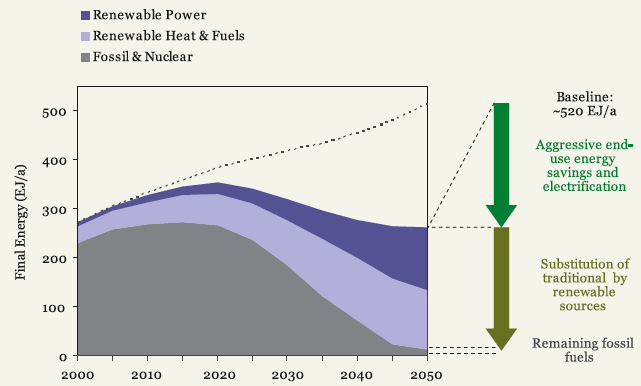
Figure 1: Ecofys projected global energy consumption between 2000 and 2050
Stanford's Mark Jacobson and UC Davis' Mark Delucchi (J&D) published a study in 2010 in the journal Energy Policy examining the possibility of meeting all global energy needs with wind, water, and solar (WWS) power. They find that it would be plausible to produce all new energy from WWS in 2030, and replace all pre-existing energy with WWS by 2050.
In Part I of their study, J&D examine the technologies, energy resources, infrastructure, and materials necessary to provide all energy from WWS sources. In Part II of the study, J&D examine the variability of WWS energy, and the costs of their proposal. J&D project that when accounting for the costs associated with air pollution and climate change, all the WWS technologies they consider will be cheaper than conventional energy sources (including coal) by 2020 or 2030, and in fact onshore wind is already cheaper.
European Union Case Study
The European Renewable Energy Council (EREC) prepared a plan for the European Union (EU) to meet 100% of its energy needs with renewable sources by 2050, entitled Re-Thinking 2050. The EREC plan begins with an average annual growth rate of renewable electricity capacity of 14% between 2007 and 2020. Total EU renewable power production increases from 185 GW in 2007 to 521.5 GW in 2020, 965.2 GW in 2030, and finally 1,956 GW in 2050. In 2050, the proposed EU energy production breakdown is: 31% from wind, 27% from solar PV, 12% from geothermal, 10% from biomass, 9% from hydroelectric, 8% from solar thermal, and 3% from the ocean (Figure 2).
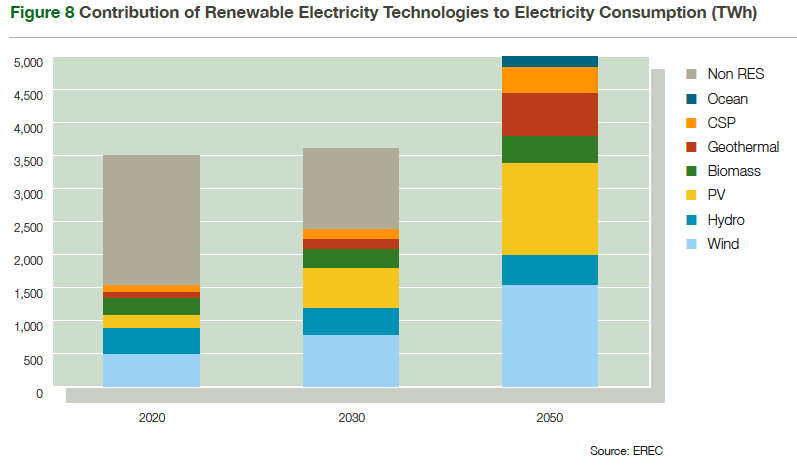
Figure 2: EREC report breakdown of EU energy production in 2020, 2030, and 2050
Northern Europe Case Study
Sørensen (2008) developed a plan through which a group of northern European countries (Denmark, Norway, Sweden, Finland, and Germany) could meet its energy needs using primarily wind, hydropower, and biofuels. Due to the high latitudes of these countries, solar is only a significant contributor to electricity and heat production in Germany. In order to address the intermittency of wind power, Sørensen proposes either utilizing hydro reservoir or hydrogen for energy storage, or importing and exporting energy between the northern European nations to meet the varying demand. However, Sørensen finds:
"The intermittency of wind energy turns out not to be so large, that any substantial trade of electric power between the Nordic countries is called for. The reasons are first the difference in wind regimes...and second the establishment of a level of wind exploitation considerably greater that that required by dedicated electricity demands. The latter choice implies that a part of the wind power generated does not have time-urgent uses but may be converted (e.g. to hydrogen) at variable rates, leaving a base-production of wind power sufficient to cover the time-urgent demands."
Britain Case Study
The Centre for Alternative Technology prepared a plan entitled Zero Carbon Britain 2030. The report details a comprehensive plan through which Britain could reduce its CO2-equivalent emissions 90% by the year 2030 (in comparison to 2007 levels). The report proposes to achieve the final 10% emissions reduction through carbon sequestration.
In terms of energy production, the report proposes to provide nearly 100% of UK energy demands by 2030 from renewable sources. In their plan, 82% of the British electricity demand is supplied through wind (73% from offshore turbines, 9% from onshore), 5% from wave and tidal stream, 4.5% from fixed tidal, 4% from biomass, 3% from biogas, 0.9% each from nuclear and hydroelectric, and 0.5% from solar photovoltaic (PV) (Figure 3). In this plan, the UK also generates enough electricity to become a significant energy exporter (174 GW and 150 terawatt-hours exported, for approximately £6.37 billion income per year).
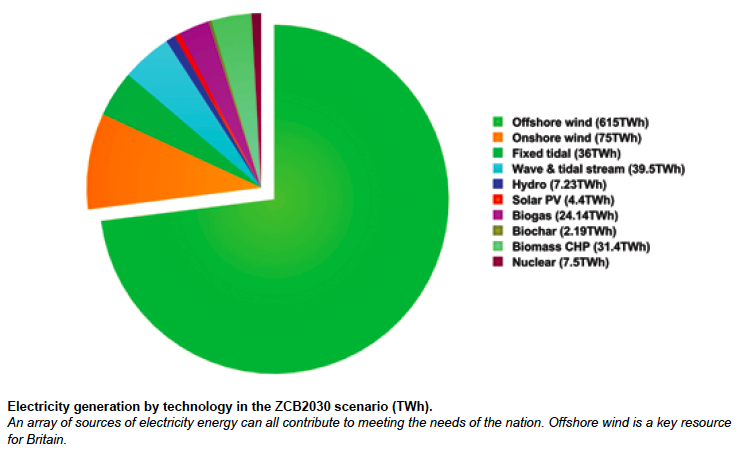
Figure 3: British electricity generation breakdown in 2030
In order to address the intermittency associated with the heavy proposed use of wind power, the report proposes to deploy offshore turbines dispersed in locations all around the country (when there is little windspeed in one location, there is likely to be high windspeed in other locations), and implement backup generation consisting of biogas, biomass, hydro, and imports to manage the remaining variability. Management of electricity demand must also become more efficient, for example through the implementation of smart grids.
The heavy reliance on wind is also plausible because peak electricity demand matches up well with peak wind availability in the UK (Figure 4, UK Committee on Climate Change 2011).
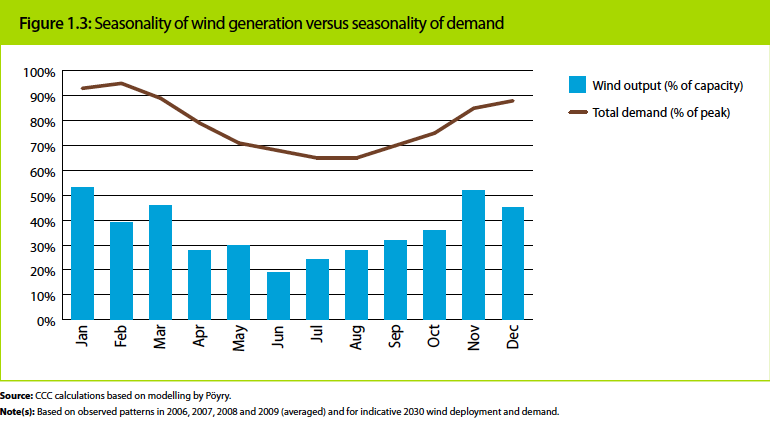
Figure 4: Monthly wind output vs. electricity demand in the UK
The plan was tested by the “Future Energy Scenario Assessment” (FESA) software. This combines weather and demand data, and tests whether there is enough dispatchable generation to manage the variable base supply of renewable electricity with the variable demand. The Zero Carbon Britain proposal passed this test.
Other Individual Nation Case Studies
Plans to meet 100% of energy needs from renewable sources have also been proposed for various other individual countries such as Denmark (Lund and Mathiessen 2009), Germany (Klaus 2010), Portugal (Krajačić et al 2010), Ireland (Connolly et al 2010), Australia (Zero Carbon Australia 2020), and New Zealand (Mason et al. 2010). In another study focusing on Denmark, Mathiesen et al 2010 found that not only could the country meet 85% of its electricity demands with renewable sources by 2030 and 100% by 2050 (63% from wind, 22% from biomass, 9% from solar PV), but the authors also concluded doing so may be economically beneficial:
"implementing energy savings, renewable energy and more efficient conversion technologies can have positive socio-economic effects, create employment and potentially lead to large earnings on exports. If externalities such as health effects are included, even more benefits can be expected. 100% Renewable energy systems will be technically possible in the future, and may even be economically beneficial compared to the business-as-usual energy system."
Summary
Arguments that renewable energy isn't up to the task because "the Sun doesn't shine at night and the wind doesn't blow all the time" are overly simplistic.
There are a number of renewable energy technologies which can supply baseload power. The intermittency of other sources such as wind and solar photovoltaic can be addressed by interconnecting power plants which are widely geographically distributed, and by coupling them with peak-load plants such as gas turbines fueled by biofuels or natural gas which can quickly be switched on to fill in gaps of low wind or solar production. Numerous regional and global case studies – some incorporating modeling to demonstrate their feasibility – have provided plausible plans to meet 100% of energy demand with renewable sources.
NOTE: This post is also the Advanced rebuttal to "Renewables can't provide baseload power".

Arguments


Can you clarify your point?
The load(s) have to be balanced with the power source(s) otherwise the grid/mains frequency starts drifting. In fact one of the key ways that a smart grid would work is buy monitoring the frequency so that intelligent appliances can alter their use of energy.
http://www.rltec.com/
According to their latest press release they did a deal with Sainsburys to put the technology in 200 supermarkets. They have also developed a fridge with Indesit.
I know another UK company are developing a fridge/freezer that can continue working for about a week without power. They're using a phase change material. The technology was originally developed for cooling vaccines in developing countries.
At least there is no excuse now for street lighting to be on during the day. I remember the old fashioned electromechanical timers used to get out of sync and lights would remain on during the day. These days light sensors have fixed that problem.
http://www.surechill.com/
Although having had a look at the vaccine fridge it is pretty bulky. I think they are working on an improved design for commercial/domestic applications.
The current systems weren't dreamt up in a few years and clearly worked out. We have large power stations, the grid and all the equipment that makes it work, all of which developed incremently, step by step.
"Hydro electric power is a great source buti am unsure about Norway use of it, and if i remember correctly they import alot from the danes and sweden."
So what??
I'm not actually sure that is true, they are pretty self sufficient and export most of their gas to the UK and Europe.
Even if it were correct, borders aren't a problem are they??
There is no specific requirement for a nation (whose boundaries is a figment of the human imagination) to be self sufficient in energy, if everyone has been happy to import and export fossil fuels, I hardly see that import and export of electricity to be a problem. Electricity isn't some magically different energy commodity.
"But being in farm and ranch country, that biomas is better used as feed stuffs than elec. generation especially in times of drought, and i suspect it is the same around the world for farms and ranches."
You have to back that up with figures. What is the efficiency of converting the energy in biomass into meat and then into energy used by the human body? Compared to converting biomass (via incineration or anaerobic digestion) into energy (electricity or heating) for general use?
@14 you say that you gradually work up to these solutions, yes, so why have these not been worked on for all these yrs. Solar & wind have been around for quite some time again i ask why have there not studys done on this in the past instead of study after study to reinforce the projections. IMHO the money would be better spent on solutions. @16 Working those farms and ranchs, i can tell you that the farmer looks at the cuttings and sees feed for his stock or to sell to the rancher that is in need, he does not look at energy conversion numbers for the elec. grid. Basic facts of farm and ranch life, not a lot of waste there. Now as i said before, trying to learn not argue numbers or phsysics, just reality as i and many others see it. If i am wrong about the tone you seem to take with me i am sorry. But what i am reading in you reply is anger at having to awnser a few questions?
No I didn't - I said Norway already has 100 % renewable electricity.
I have read that there are other issues with biomass burning (products of combustion that are pollutants). But I don't think the base problem is the CO2 itself - it is in the current natural cycle, it will rot (releasing CO2) or be burned (releasing CO2).
Obviously you can create heat from electricity, if you have enough renewable electrons, but that is rarely the case. I imagine solar is only a marginal contributor in Norway. I am not that familiar with the region - is geothermal (for heat) or ground source heat pump possible? Seasonal storage for solar thermal? Heat from compost?
You asked: 2) How can a model accuratly portray the probrabilties of wind when weather models a barly able to do it 4-5 days out, as jetstream winds much less lower level winds are to variable in speed or predictability?
Most of the answer is in SkS's "Chaos theory and global warming" and "Difference between weather and climate". Models are slowly getting better at discerning how climate will change within a region. We may not be able to predict with much accuracy if wind will be as steady in a particular region 50 years from now, but we do predict it will generally be windier.
The models don't have to know exactly what the wind is going to do, just how it behaves on average. I'm sure they have good measurements of minimum and maximum and average windspeed at the locations they're modeling.
Regarding wind turbines breaking down, I don't know the details, but I do know that research has shown they're much more reliable than coal power plants, which are down something like 10% of the time whereas wind turbines on average are down less than 3% of the time (this is off the top of my head - it might be even less).
Regarding biomass, it's putting CO2 back into the atmosphere that the plant took out, whereas burning fossil fuels is putting CO2 into the atmosphere that's been trapped for millions of years. CO2 from biomass is no concern. And there's always bio waste products available to burn.
-------------
But you have not disproved the myth.
You have presented the results of agenda driven reports based on a whole bunch of hypothetical solutions.
For example experimental solutions such as thermal solar plus storage are put forward. But the long term practicality of this solution is not proven.
The myth will only be disproven when one or more significant countries demonstrate complete success using these approaches. And there will be complete and partial failures along the way.
It should not be forgotten that for some industrial processes are completely intolerant of failure of supply so the reliability requirements for electricity generation is very high.
The tone of some of your questions comes across a bit abrasive and some of your questions suggest you have not searched this site for answers. Climate contrarians tend to ask the same old questions and raise straw-man issues which gets some folks riled up - it takes time and energy to respond to the same 'ole same-'ole. I suggest you take a deep breath, and then another; remember it is difficult to understand a person's motivation through the typed word (both yours and, in this instance from your perspective, Paul D's). I know; it has happened to me a couple of times here on SkS. On the other hand, there is consistently valuable information shared here, so I keep coming back!
You appear to be doing the straw-man dance, I fear.
If hydroelectricity and geothermal electricity (generally considered renewable energy) provide base load in Norway, Niagara Falls region, Wairakei, NZ and Iceland, etc., then the myth IS disproved. If you want to be condescending and say NZ and Norway and Iceland are not "significant" then go ahead and paint yourself into that corner. When I lived overseas, the USA was fairly insignificant!
Spain has an operating 24-hour electricity generating solar plant. The concept may have been "experimental" five years ago, but it is happening now. If you want to respond that this first plant, almost by definition, is experimental in that the design hadn't been put into practice before, then remember that in the US, nearly every nuclear plant used a new design and therefore, to a certain extent, was experimental.
Much practical work has dealt with creating reliable electricity supply. Back-up generators and gas fired plants (depending on scale of need) are regularly used, and are part of the plan for a renewable energy future. Even the best laid plans of the fossil fuel past 'allowed' two massive NY black outs.
Some people have also pointed out that bio-electricity generates CO2, & so isn't useful for this purpose. What they fail to mention is that they release no more CO2 than what they originally absorbed in the first place, thus being at least carbon neutral. On top of this, however, you have to consider that every kw-h of electricity generated from these carbon-neutral sources prevents almost 1kg of CO2 being released by the burning of fossil fuels. Of course there are other sources of bio-electricity, like turning methane producing fecal matter & trash waste into electricity & heat, or by capturing CO2, produced from existing sources of electricity, in algal biomass then converting said biomass to fuel & energy. So you see there are tons of options for generating base-load electricity that doesn't add any *new* CO2 to the atmosphere.
Known deposits of hot granite in Australia are sufficient to meet national energy needs by 2100 and continue doing so for centuries to come. Heat taken from granites is replenished by convection from hotter, deeper granites though the speed with which this occurs has yet to be demonstrated. Electricity produced from geothermal heat is base load and, like hydro, can be brought on or taken off the grid at short notice. It is therefore an ideal clean energy source. Some 30 companies are now engaged in its development.
Australia also has vast areas of sun-drenched land in relatively close proximity to population centers on which solar power stations can be built. To achieve base load status, electricity produced from solar is largely dependent on ability to store electricity or supplement is with electricity produced from other sources. Electricity storage capacity has yet to be developed so the 2 solar power stations shortly to commence construction will rely on supplementation from fossil fuel when adequate sunshine is not available.
In NSW a 150 MW PVC power station is to be built near Moree at a cost of $923m. Work commences in 2012 and it will be commissioned in 2015. During periods of inadequate sunshine, electricity produced from its 650,000 PVC panels will be supplemented by power generated from burning fossil fuels.
In QLD a 250 MW a 250 MW solar/natural gas power plant is being built which will also come on-line in 2015. It is the largest of its kind in the world and will cost $1.2 billion. Electricity will be generated by solar steam with back up from gas fired boilers ensuring base load power is available will be 85% emissions free.
Combined, these power stations will generate sufficient electricity to meet demand from 115,000 dwellings.
Solar sourced base load electricity appears to be the future for most countries which do not have easy access to geothermal. Improvement in heat storage for solar thermal plants is needed and being made. Improvement in the efficiency of PVC’s and their cost are also required and are also being made. Progress is being made with both.
The lag is in development of capacity to store electricity. Research is being undertaken into production of cheap, durable, lightweight batteries able to rapidly recharge and store sufficient energy to meet all domestic needs and extend the range of electric vehicles.
These developments make it possible for Australia to achieve zero emissions by 2050 – something every country needs to do to if average global temperature is to be limited to <2C by 2100. The limiting factor, the real battle is not with technology but with those who have a vested interest in producing and burning fossil fuels.
I rather think that Cambridge crude or some similar development will finish up as the solution (pun not necessarily intended) for both.
I very much like the idea of petrol filling stations being steadily overtaken by 'sludge' extract and refill stations across our highways. Once a refill station is established, it will need only maintenance of its electrical system to recharge extracted material. No more tankers!
And even if that's not immediately practical, I can certainly see commercial and industrial buildings, if not domestic dwellings, being fitted with suitable flow batteries. So large buildings could run entirely with their own solar PV - recharging the battery before exporting to the grid - on a routine basis.
Sorry, this is quite untrue at least in the case of nuclear. It is true that in most grids that nuclear is run at maximum capacity factor - for example over 90% in the US and South Korea. This is because there is a market for the baseload electricity they generate. I fail to see how this is wasting energy.
Things are a bit different in France due to the high percentage of nuclear in the grid. French nuclear power plants do load following by virtue of "grey control rods" that can be adjusted to reduce neutron flux in the core, lowering reactivity. Fuel (and energy) is not wasted because the rate of fission of U235 drops.
Load following is best done with plants where the fuel is reasonably new, but by appropriate staging of refueling across the whole fleet, the French grid operates perfectly well without alleged gross energy wastage. It demonstrates that even with old reactor designs, nuclear is sufficiently end efficiently flexible to power most of a national grid.
Nuclear Power in France
"But you have not disproved the myth.
You have presented the results of peer-reviewed reports based on a whole bunch of hypothetical solutions."
AT#80 "Okatiniko -thank you. So your point is that you need energy for space conditioning? "
Not only heating and cooling, but also for almost all means of transport, a bunch of industrial processes (metallurgy, fabrication of glass, cement, paper, carbo-chemistry including plastics, etc...), and, in all countries deprived of hydroelectricity, stable power generation. The only evidence that computer simulations are right is to exhibit a modern country that has succeeded in doing this without fossil fuels. There is not a single one in the world, even among those who produce 100 % renewable power. Everyone is free to believe in computer simulations : my position is only to believe in real facts.
What a load of nonsense. You don't need coal or hydro-electric power for stable power generation-or haven't you been listening? As for industrial processes, most of them are do-able with *any* kind of energy & even processes like Steel manufacture are increasingly making use of things like Arc Furnaces rather than Coal alone. Transportation can run just as easily on electricity & bio-fuels as it can on petro-chemicals. Last of all, just because something hasn't been done yet, doesn't mean its not possible. Or do you believe we should never have tried to fly?
They have! It's taken a century to get the existing energy systems to where they are now. Over that time they have evolved into something sophisticated, monitored and controlled by computer systems.
The same will happen with the next generation of systems. Parts of the existing systems will be changed. An example is the RLTec fridge technology that I mentioned previously, it is designed for a smart grid system (in which the electricity supply frequency is more likely vary), but will also work in the current system (in which the frequency is more stable). So we will see changes like this gradually build up.
That you then go on to ignore twentyfour hour power generation from solar sources among other things which show the myth to be groundless is not a triumph of empiricism over a priorism, but a refusal to allow your a priori beliefs to be weakened by empirical fact.
"The Wright brothers did not prove powered flight is possible - after all they did not fly fifty passengers across the Atlantic. Until such a flight takes place all you have is theoretical considerations. Everyone is free to believe in theoretical considerations: my position is only to believe in real facts."
This is I believe for recycling steel.
I don't believe arc furnaces are used in making fresh steel. But then maybe most steel is from recycled stock now??
The question is, how long before all the steel ends up dispersed as oxide across the planet and becomes uneconomic to retrieve?? There's a thought :-)
But electric vehicles will potentially help to smooth the fluctuations in the gird and provide baseload. Most vehicles will be charged at night, when there is most likely to be a surplass of electrcity. The batteries can also be used to supply back to the grid at peak demand if a suitable system can be put in place. Also, when batteries reach the point where they no longer hold sufficient charge to continue to be viable in the vehicle itself they have plenty of future still in provideing another source of baseload power and there are already businesses being set up to buy old batteries for this purpose.
Electric steel furnaces don't reduce the iron ore, but oxidize the extra carbon. They don't replace coke powered ironworks.
Tom : to my knowledge, only hydroelectricity can provide a stable supply among all renewable sources (Iceland has a fair amount of geothermal power too, but a lot of hydroelectricity. And volcanoes can be a little bit unpredictable....). And again, even countries swimming in renewable electricity have a rather large amount of CO2 production per capita. Explain it as you want, it's a mere fact.
Now you're free to believe in any prediction and computer simulation you want, as I said. But as far as they haven't been really implemented, they are just what lazyteenager said : hypothetical.
Oh yes, it is ! and it applies to all metallic ores as well. In principle, biomass can provide carbon , but much less than what is currently burnt through FF. Marcus, have you already asked yourself about the ultimate origin of the free energy of waste, that you use when you burn it. it's an interesting question ..
It is estimated that the UK , an area of very stable region could produce 2% of its energy use via geothermal in the south west of the country alone.
Report from DECC
Alternatively Solar Thermal alone could provide base load by the coordination between planst of when stored heat is used. It has been shown that if solar plants capable of extracting four times their peak load as energy are used, 100% of energy supply can be drawn from solar thermal plants at a cost of 8.4 cents (US) per kWh.
To extend the powered flight analogy, you are in the position of arguing powered flight is impossible as the first transatlantic passenger flights are being initiated.
With respect to steel manufacture, the carbon for alloying with iron can be provided by charcoal as readily as from coal. Consequently there is no bar to an emissions free economy on that ground.
As for any country having 100% renewable electricity, a more realistic statement (and long term goal for us) might be 99% or 95%. I give these Norwegians points for effort http://www.responsibletravel.com/holiday/3467/winter-trekking-holiday-in-norway but their legacy power is still apparently from diesel.
-------
I'm not sure what "agenda" you suggest is at play (*gasp* the get our energy from clean renewable sources agenda!), but it's irrelevant. If you dispute the accuracy of the content of the reports, then do so.
--------
Yes you got the agenda correct. At this stage these reports are feasibly studies. They ares written by enthusiasts for the idea, and good luck to them. But there is always a gap between the feasibility study and it's implementation in practice. The equivalent in the sciences is the hypothesis vs the experiment. In engineering it's the design vs the prototype vs full scale. In economics I don't know how they verify stuff but since economic reports and assessments often don't agree there must be some resolution mechanism as in "apply the policy it and seewhat actually happens".
Even being a peer reviewed paper is no guarantee that the analysis is a valid representation of the real world.
Do you have any evidence-based response at all ?
"can you please list me the number of those producing a stable power supply, without coal or hydroelectricity ?" Again with your hearing problem. By your argument we should never have flown a plane because, by your logic, if no-one has done it yet then it must be *impossible*. Iceland, though, has entirely stable Geothermal Energy &, as I've already pointed out, Micro-hydro & Bio-Gas Electricity are entirely capable of providing completely stable power without *any* need for storage-& are readily available to virtually every nation on Earth. So too can Tidal Power, Wave-power & Tidal Stream Power. The only renewable energy sources that require some kind of back-up or storage is solar & wind, but with the right back-up these two are entirely capable of providing stable power. Not that coal or nuclear are as stable as some would have us believe. Both types of power are usually highly centralized, & so need to transmit their electricity over a wide geographic area-so what happens if a sub-station blows up, or a fire or wind-storm brings down any one of the hundreds of kilometers of High Voltage Power Lines linking the power station to the consumers? What happens if the power station breaks down? These things are likely to have a much more damaging effect than if a single wind turbine breaks down, or if a single solar dish breaks down or if....well you get the picture. The point is that almost all the existent sources of renewable energy are (a) modular & (b) relatively small size-so they tend to distribute their energy over a much smaller area, & so are less prone to T&D failures. Their modular nature, as I suggested above, means the loss of a single power generation unit will *not* bring the whole system crashing down!
The fact is : there is no country with almost 100 % renewable electricity without a large part of hydropower, and it is limited by geographic conditions. And there is no country with almost 100 % renewable electricity and without CO2 production. This doesn't demonstrate it is impossible : it only demonstrates that the feasibility of "100 % renewable energy" is still to be demonstrated, and that computer simulations and peer-review reports don't demonstrate they're right.
[DB] Refrain from personalizing the discussion, please.





