



 Arguments









What does Neptune's brightening mean for global warming?
What the science says...
| Select a level... |
 Basic
Basic
|
 Intermediate
| |||
| The sun has been cooling while Neptune was warming. | |||||
Climate Myth...
Neptune is warming
In April 2007, Heidi Hammel published a study comparing Neptune's brightening to Earth's warming and solar variations. She concluded that while they don't correlate statistically, the patterns are visually compelling and planetary climate changes may be due to solar variations.
This argument is part of a greater one that other planets are warming. If this is happening throughout the solar system, clearly it must be the sun causing the rise in temperatures – including here on Earth.
It is curious that the theory depends so much on sparse information – what we know about the climates on other planets and their history – yet its proponents resolutely ignore the most compelling evidence against the notion. Over the last fifty years, the sun’s output has decreased slightly: it is radiating less heat. We can measure the various activities of the sun pretty accurately from here on Earth, or from orbit above it, so it is hard to ignore the discrepancy between the facts and the sceptical argument that the sun is causing the rise in temperatures.
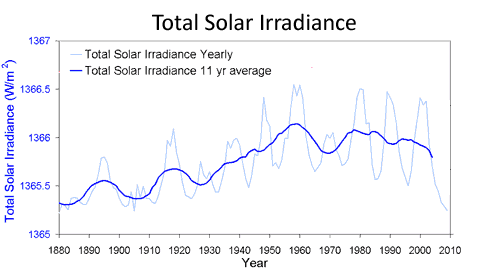
TSI from 1880 to 1978 from Solanki. TSI from 1979 to 2009 from PMOD.
But if the sun’s output has levelled off or even diminished, then what is causing other planets to warm up? Are they warming at all?
The planets and moons that are claimed to be warming total roughly eight out of dozens of large bodies in the solar system. Some, like Uranus, may be cooling. All the outer planets have vastly longer orbital periods than Earth, so any climate change on them may be seasonal. Saturn and its moons take 30 Earth years to orbit the Sun, so three decades of observations equates to only 1 Saturnian year. Uranus has an 84-year orbit and 98° axial tilt, so its seasons are extreme. Neptune has not yet completed a single orbit since its discovery in 1846.
This is a round-up of the planets said by sceptics to be experiencing climate change:
- Neptune: observations of changes in luminosity on the surface of both Neptune and its largest moon, Triton, have been taken to indicate warming caused by increased solar activity. In fact, the brightening is due to the planet’s seasons changing, but very slowly. Summer is coming to Neptune’s southern hemisphere, bringing more sunlight, as it does every 164 years.
- Jupiter: the notion that Jupiter is warming is actually based on predictions, since no warming has actually been observed. Climate models predict temperature increases along the equator and cooling at the poles. It is believed these changes will be catalysed by storms that merge into one super-storm, inhibiting the planet’s ability to mix heat. Sceptical arguments have ignored the fact this is not a phenomenon we have observed, and that the modelled forcing is storm and dust movements, not changes in solar radiation.
- Mars: the notion that Mars is warming came from an unfortunate conflation of weather and climate. Based on two pictures taken 22 years apart, assumptions were made that have not proved to be reliable. There is currently no evidence to support claims that Mars is warming at all.
- Pluto: the warming exhibited by Pluto is not really understood. Pluto’s seasons are the least understood of all: its existence has only been known for a third of its 248 -year orbit, and it has never been visited by a space probe. The ‘evidence’ for climate change consists of just two observations made in 1988 and 2002. That’s equivalent to observing the Earth’s weather for just three weeks out of the year. Various theories suggest its highly elliptical orbit may play a part, as could the large angle of its rotational axis. One recent paper suggests the length of Pluto’s orbit is a key factor, as with Neptune. Sunlight at Pluto is 900 times weaker than it is at the Earth.
Claims that solar system bodies are heating up due to increased solar activity are clearly wrong. The sun’s output has declined in recent decades. Only Pluto and Neptune are exhibiting increased brightness. Heating attributed to other solar bodies remains unproven.
Last updated on 15 September 2010 by gpwayne.







Max Plank institute link is broken (source moved).
(posted in the corrct thread this time :D )
... maybe Sromovsky 2003 link too?