





IEA CO2 Emissions Update 2011 - the Good News and the Bad
Posted on 30 May 2012 by dana1981, John Cook
This post has also been published on The Conversation, which is a website devoted exclusively to articles written by academics. SkS highly recommends The Conversation as a high quality site in general.
The numbers are just in. At a time when we need to be urgently reducing our CO2 emissions, we are now emitting more CO2 than any time in human history. However, it's not too late to turn things around.
Last year we examined the 2010 annual fossil fuel CO2 emissions report from the International Energy Agency (IEA). The news was not good - 2010 saw the largest single year increase in these emissions, growing 1.6 billion tonnes (gigatonnes [Gt]) from 2009, to 30.6 Gt (the previous record annual increase was 1.2 Gt). Energy intensity (the ratio of primary energy use to Gross Domestic Product) rose in 2010 for the first time since 1990, possibly because of relatively subuded fossil fue prices and economic stimulus funding for construction projects. For these reasons, the 2010 CO2 emissions growth may not be repeated (Jotzo et al. 2012).
The 2011 IEA estimate is now out, and includes some good news and some bad news. In 2011, global fossil fuel CO2 emissions set yet another record, increasing a further 1.0 Gt to 31.6 Gt (Figure 1). Last year, we emitted more CO2 into the atmosphere than any time in human history. However, in a valiant effort to take a glass-half-full approach, we can point out that the increase was smaller than in 2010, as Jotzo et al. expected, and only the fourth-largest annual emissions increase on record.
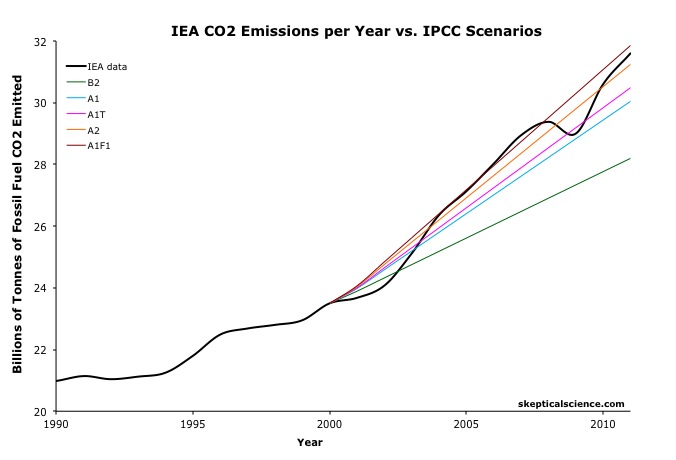
Figure 1: IEA fossil fuel CO2 emissions estimates vs. IPCC SRES emissions scenarios.
The Organisation for Economic Co-operation and Development (OECD) nations managed to decrease their emissions by 0.6% as compared to 2010, but non-OECD nation emissions increased by 1.6% last year. The largest single contribution to the increase came from China (0.72 Gt) primarly due to rising coal consumption; however, China's ratio of CO2 emissions per Gross Domestic Product also fell 15% between 2005 and 2011. Without that move towards lower carbon intensity, China's emissions in 2011 would have been 1.5 Gt higher. As IEA Chief Economist Fatih Birol noted,
"What China has done over such a short period of time to improve energy efficiency and deploy clean energy is already paying major dividends to the global environment"
CO2 emissions in the United States fell 1.7%, due primarily to a transition away from coal power to natural gas. European emissions fell 1.9% due to a slow economy and a warm winter reducing heating needs. Japan's emissions rose 2.4% due to fossil fuels replacing the nuclear energy production lost during the Fukushima disaster.
Last year in terms of both cumulative and annual emissions, we were on track with Intergovernmental Panel on Climate Chage (IPCC) Special Report on Emissions Scenarios (SRES) Scenario A2, the description of which matches what's happening in the real world fairly accurately thus far:
- Relatively slow end-use and supply-side energy efficiency improvements (compared to other scenarios).
- Delayed development of renewable energy.
- No barriers to the use of nuclear energy.
2011 emissions have now moved us slightly above the Scenario A2 track (see Figure 1), which corresponds to about 4°C global warming above pre-industrial levels by 2100.
Leading up to its forthcoming Fifth Assessment Report, the IPCC has developed new emissions scenarios called Representative Concentration Pathways (RCPs). The number associated with each RCP represents the associated greenhouse gas radiative forcing. For example, RCP 4.5 represents a 4.5 Watt per square metre (W/m2) forcing in 2100. Radiative forcing is a measure of a global energy imbalance, for example how much heat is trapped by increasing greenhouse gases. The radiative forcing from a doubling of atmospheric CO2 is about 4 Watts per square metre.
Figure 2 compares IEA emissions estimates the these RCPs.
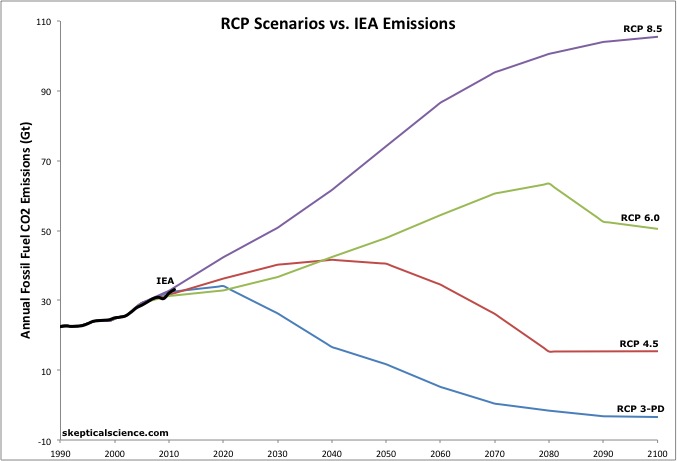
Figure 2: IEA fossil fuel CO2 emissions estimates vs. IPCC RCPs
Since the RCPs are new and account for observed CO2 emissions through 2005, the various scenarios do not diverge significantly until after 2011. Therefore, the good news is that we still have time to decide which path to take.
RCP 3-PD (3 W/m2 peak forcing followed by a decline) represents a path in which the greenhouse gas radiative forcing drops to 2.6 W/m2 by 2100. This emissions path corresponds to a global surface warming of approximately 2°C above pre-industrial levels, which is the internationally accepted "danger limit" beyond which global warming has been deemed an unacceptable risk.
In its recent report, The Critical Decade, the Australian government's Climate Commission outlined a budgetary approach to avoid surpassing the danger limit. The Commission estimated that humanity can emit not more than 1 trillion tonnes of CO2 between 2000 and 2050 to have a 75% probability of avoiding the danger limit.
Currently we are 22% of the way through the budgetary timeline, but we have emitted 328 Gt of fossil fuel CO2, burning through nearly 33% of the budget. Thus we need to change our path soon from one of rising to decreasing annual emissions. Richard Somerville and Susan Joy Hassol created the 'ski slopes' graphic, which depicts three possible scenarios to achieve the necessary emissions cuts (Figure 3).
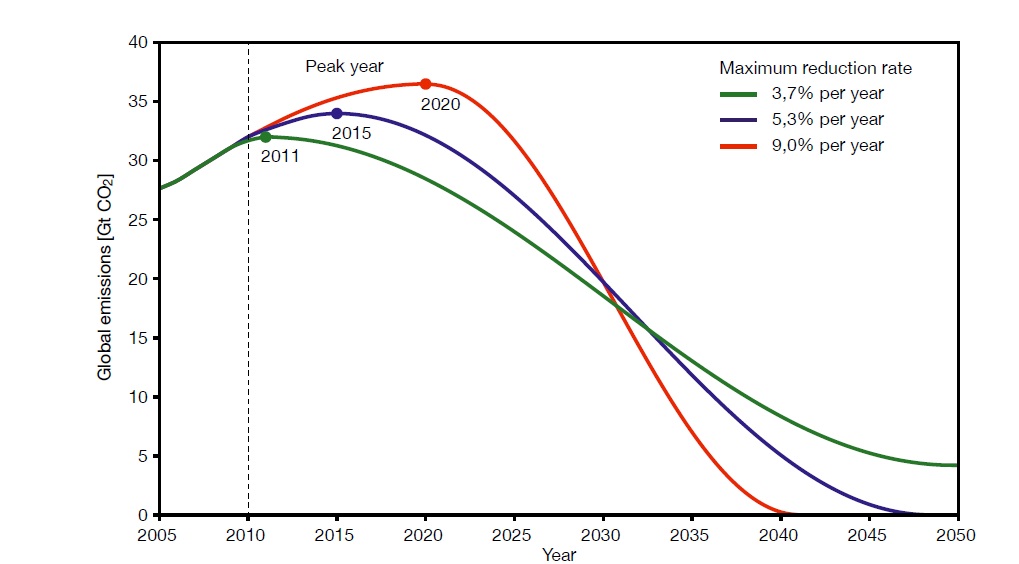
Figure 3: Three scenarios, , each of which would limit the total global emission of carbon dioxide from fossil-fuel burning and industrial processes to 750 Gt over the period 2010–2050.
The longer it takes us to reach peak emissions, the more aggressively we will have to reduce our emissions down the track. If emissions don't peak until 2020, our emissions cuts will have to be as large as 9% per year in 2030, and drop to zero net emissions in 2040.
Hence the title of the Australian Climate Commission report - the next decade is a critical one. The IEA has its own 2°C scenario, in which emissions peak at 32.6 Gt no later than 2017. Although emissions increased by 1.6 Gt in 2010 and 1.0 Gt in 2011, they can increase no more than 1.0 Gt (total, not annual increase) between 2011 and 2017 to meet the IEA scenario. The IEA notes that deploying the policies and the technologies that we need will take time to bear fruit, and that the poor infrastructure choices we make today will be with us for many years. In order to achieve the necessary emissions reductions, the IEA scenario envisages developed-country carbon taxes in the range $20-45 per tonne in 2020, rising to $95-120 for all countries by 2035.
The good news is that we are making some progress. Despite its rapid development, China's per capita emissions are still just 63% of the OECD average, thanks in large part to its efforts to improve energy efficiency and deploy clean energy. OECD emissions declined in 2011, albeit by a small amount. And there is still time to reduce our emissions sufficiently to avoid dangerous global warming.
The bad news is that time is running out, and the longer we wait, the more difficult and expensive it will be to achieve the necessary emissions cuts. The elusive binding international agreement to reduce global CO2 emissions approximately 80% by 2050 must be signed, and soon, or the necessary emissions cuts will become too steep to be practically achievable.
Arguments


Howarth et al 2012 follow up
Sorry, please feel free to delete my second comment
The conclusions of Howarth et al have been disputed by other Cornell researchers, in which they claim that the Howarth study: assumed a very high estimate for methane leakage; compared heat rather than electrical energy generation, (favouring coal); and used a short time period that did not sufficiently take into account the long term effects of CO2 compared to methane emissions.
Switching from coal to methane would slightly increase global warming until 2050 or longer
http://www.sciencedaily.com/releases/2011/09/110908124505.htm
You can track progress to the 750 Gt here.
The figures on this site are the estimated cumulative emissions from fossil fuel use, cement production and land-use change since industrialization began.
At current rates of emission it will be Sun, 6 Feb 2028.
(The site is hosted by the Oxford e-Research Centre with data provided by the Department of Physics, University of Oxford)
If one assumes that the carbon will be allocated only to the 7 billion people currently living, we can burn a whisker over 1428 tons each before we need to stop. For the 750 billion ton limit the figure is 1071 tons.
If we share the carbon equally amongst 8 billion people the figures are 1250 and 937 tones respectively, and if we generously allocate the carbon to 9 billion people it is 1111 and 833 tons of carbon per person, respectively.
Consider how much carbon the average Westerner currently uses per annum - a round figure of 25 tons or so. Consider the future generations who would be necessarily excluded from using carbon in this manner. Consider how little effort we have made thus far to wean ourselves from our carbon addiction.
Perhaps we should all be given carbon ration cards, and told to live our lives with the strict proviso that we get not a gram more than we're allocated, unless we buy it legitimately from others. This would bring cap-and-trade right to the front doorstep - now wouldn't that get people off their butts to reorganise how they energise their lifestyles?
Sadly, for many, the answer is "probably not".
So, the 'golden age' introduced by the 'new technology' of fracking could reverse the long trend of rising fossil fuel electricity costs... just as solar power was on the verge of reaching widespread grid parity.
Most of the 'new technologies' for extracting hard to get at fossil fuels come with significantly higher price tags that would have let solar overtake them... but not so fracking. There are large deposits of shale gas all around the world and now we have an inexpensive way to get at them.
Until now I thought solar grid parity was going to set a limit on CO2 accumulations. Now it seems like we're going to have to hope for some unknown new technology breakthrough, or responsible global political leadership (ha!). Otherwise the limit will be set by global warming itself in a hundred years or so when people finally respond to the increasing severity of the problem. Running out of cheap fossil fuels seems like it is off the table for decades to come... and that's very very bad news.
This is not to decry the concern CBDunkerson genuinely expresses, but it seems to me that as so often in life, we have a balancing act to perform.
The problem now is that we've gone from a situation where global 'grid parity' for solar power seemed inevitable before the end of the current decade to one where we again have an abundant cheap alternative and thus could potentially stop pursuing further improvements in solar power.
On the up side there are some places where solar grid parity has already been achieved and which cheap shale gas won't impact. Hawaii, for example, has historically gotten most of its electricity from oil because coal and natural gas are too expensive to ship over the ocean. Using oil for electricity generation is fairly expensive and Hawaii is a sunny place... so solar power dropped below grid prices in Hawaii a couple of years ago. A new boom in shale gas won't change that. So Hawaii and various other places where solar is already below grid parity will likely continue transitioning over to solar power. Hopefully that ongoing local development will be enough to continue driving down costs to the point that solar costs become cheaper than fossil fuels globally.
Thank you for your reflection about the developed nations bearing the costs of “de-carbonising” (which I hope doesn’t include vaporising you and me, given our personal carbon content), while others catch up, a proposal argued strongly on the international stage. It appears to me that you understand the point I was making, that cheap fossil fuels are lifesaving and poverty destroying for under-developed countries, at least for the present.
In your first sentence you ask “how about the little problem that changing climate will likely adversely affect the poor in many places much more strongly than those who created the problem in the first place?” Very true, and (-Snip-)
Climate change remains a threat, and many contributors to Skeptical Science are quite convinced that a major role is currently played by humans in exacerbating such change. Some others in the community at large, are not so convinced. (My language is deliberately temperate, as the polarisation that occurs through terms such as “deniers” and “alarmists”, inhibits if not prevents objective and constructive discussion.) Your argument is then necessarily based on the presumption that humans are largely responsible for current global warming. I’m not arguing here against that presumption – my main point is that we have a balancing act – and your suggestion about cost-sharing offers a constructive balancing. I have some questions about costs in my reply to CBDunkerson below.
To CBDunkerson (22.45 pm 31 May 2012):
I have gratefully used solar power for years (hot water systems), and have long thought we should capitalise on wind and sun and other renewable energies. I’ve spent only a little time looking at wind and solar scheme costs, but have been surprised at how much those technologies appear to be subsidised. Your argument is an interesting one, that we need higher costs for fossil-fuel energy, in order to achieve grid-parity with alternative sources. Evidently you share the same presumption as Scaddenp above.
I had anticipated that research on solar energy and mass production would have brought costs down far more by now. Perhaps more time is needed in research and improved manufacturing (which must also be included in whole of life costing, as we know).
Your second sentence “we do not have to choose between cheap energy and clean energy” does not seem applicable today, and in fact your further informative discussion supports that inapplicability. That is, renewable energy is both cheap and clean, only when the cost of fossil fuels rises to equivalent or greater levels. Am I misunderstanding you?
Yes, because the evidence (as supposed to the misinformation campaign) is overwhelming. Obviously all the natural factors are at work as well, but current warming (post 1975) is human. To propose otherwise requires some evidence which is sorely lacking in the published science.
As to cost, relative costs of renewable energy/nuclear power to FF vary enormously on the globe. Here, 75% of electricity is from wind/hydro/geothermal with no subsidies operating. While FF is subsidized, it is very hard to assess competitiveness. Removing all subsidies is the first and necessary step. Will that mean higher energy costs? yes, but lower taxes. Let the market sort it out. After that comes pricing carbon. This is trickier because the adaption costs for not limiting carbon are born not by the emitter but often elsewhere and by another generation. To suggest that someone else pay the true cost of your "cheap" fuel suggests a value to respect rights to me. Suggests for real solutions welcome.
No one in the 1st World is working to raise the 3rd World out of poverty by giving them cheap, easy energy. Quite to the contrary, 1st World societies are voracious for oil, while the supply is dwindling, thus continually raising the price and moving it further and further out of the reach of the poor.
The cry of "we need cheap fossil fuel energy to help the poor" is garbage.
It's just an excuse to conveniently ignore one problem by giving lip service to another, so our society can let people live their lives irresponsibly.
This is a lame, lame argument for inaction.
(a) cheap energy is needed to lift third world citizens out of poverty; and
(b) that carbon tax proposals are just a leftist conspiracy to enrich the third world at the expense of the first world, and the United States in particular.
Thanks for the information that wind/hydro/geothermal have no subsidies operating where you are. Would you let us know where that is, please? Tom Curtis’ suggestion (@ 16, 12.24 pm 1 June 2012) strikes me as an equitable approach, of carbon dioxide taxes in developed countries, while developing countries catch up.
To Sphaerica @15 (12.12 pm on 1 June 2012):
I try to separate motive from policy; a good motive behind a poor policy results in a poor policy, and a poor motive behind a good policy results in a good policy. My understanding of your post is that my statement about the need for inexpensive energy for developing nations, is false; your reason is that you distrust absolutely the motives of some or many or even all who present that view. Certainly the “cry of ‘we need cheap fossil fuel energy to help the poor’” may be hypocritical of some, but not all.
Further, while I quite accept the genuine conviction of most who argue that we humans are responsible for most recent global warming, one must accept that not all who disagree are disingenuous. I continue to discuss this issue with quite a number of people: there are those who agree, disagree, or reserve their judgment. I’ve not found any to be disingenuous.
Further in my #13 post there is an example from the Indus past, which illustrates the deleterious effects of major climate change on populations, in this case arising from non-human causes. My own view is that as well as other actions, we need to equip people better to be able to cope with climate change. Enabling them to lift themselves out of poverty is one such step.
I did not say that solar energy can only compete with fossil energy if fossil energy becomes more expensive. Indeed, I said the opposite. However, that will only be the case if we switch over to solar as our primary means of power generation. Basically, like all developing technologies, there are efficiency and economy of scale benefits driving down the costs of solar power as implementation increases. If we stop implementing solar power then the price also stops decreasing. Thus, expensive fossil fuel is not required for solar to be competitive... but cheap fossil fuel could prevent the continued solar development needed for it to be competitive. Just as cheap fossil fuel delayed the sharp decline in solar prices over the past few years for decades previously.
Also, the claim that renewable power is highly subsidized is laughable. Subsidies for renewable power are negligible in comparison to those provided to fossil fuel power.
Your understanding of what I said is completely wrongNo. It is true, but it is overstated, not to be achieved through fossil fuels, and not really a valid motive for delaying action on climate change. It's a rationalization and an excuse for delay, not a motive for sticking to fossil fuels.No. My reason is that I don't see fossil fuels today being used to improve the lives of the poor... only to build factories so that the rich can continue to get consumer goods dirt cheap while increasing the ranks of the poor in their own countries.
So the argument that the poor need cheap fossil fuels fails because it's not actually being done. Your argument amounts to "but if we got serious about helping the poor and really wanted to do it, it would be too hard without fossil fuels."
That statement is wrong in many ways.On this I agree. I don't think they all are disingenuous (though some are), but I do think the ones who are not disingenuous suffer from severe cognitive dissonance, sometimes coupled with a serious case of Dunning-Kruger.
This is evidenced by the arguments they use, the debate tactics they use, and their abject readiness to avoid facts and embrace obvious falsehoods in order to support their positions.
I think almost all of them use arguments like the one you put forth because they need to find any reason, any reason at all, to avoid changing their lifestyles, taking responsibility for their actions, and most of all intelligently recognizing the serious consequences of inaction.
Part of my serious problem with the "lift them out of poverty" argument is that it is fairly new, and is taken up by more and more deniers. Anyone who needs a subconscious reason to avoid climate change loves that one, because they think it gives them the moral high ground.
To me, it exaggerates their selfishness, because it shows that they are willing to risk suffering and hardship for others in the name of pretending to want to alleviate the suffering and hardship of others.
Sorry, Peter. That particular argument leaves me cold and makes me sick.
Yes! Well said! The contradiction of the two positions ( [1] we need cheap energy for the poor and [2] carbon taxes are efforts to give money to the poor ) is striking.
So, Peter... do you favor fossil fuel taxes on 1st world nations so that more of those resources will be used to help the poor?
Or are you counting on the free market to donate electricity and heat to the poor, just out of its basic philanthropic nature?
"one must accept that not all who disagree are disingenuous"
I was say that those who disagree are misinformed by the disingenuous and I will continue to think that unless you can show me some credible science published that says otherwise.
Such areas will be much better served by local, village and regional solar or wind in the first place. As their economic circumstances improve progressively linking up for more widespread load balancing becomes more viable.
This is a much better option than waiting for years to see if the centralised system does or doesn't eventually get transmission lines to your village. Solar power starts producing the moment you plug it in. Rather than wait for any power at all, the only waiting might be for better storage technology to manage the power you've already got.
My apologies for misunderstanding you. I think your argument here is very clear, and I agree about the factors you cite in reducing costs. Also, thanks for the comment about fossil fuel subsidies; I’ll investigate that further as I continue to look at whole of life costs for renewables. Incidentally, in comparing subsidies for fossil fuel and renewables (where you consider subsidies for the latter as negligible), do you mean total subsidy costs, or subsidy rates in proportion to energy produced?
I’m not sure whether solar can ever become a sufficient primary energy source. I’d like that to be so, but at present I have my doubts. (At the risk of setting off another explosion of discussion, I’m also interested in what research has been done into energy from thorium.)
To Sphaerica @#19 (00.08 am 2 June 2012):
Thank you for your response. You make a number of points, and I thought it better if I address each in turn.
1. Thank you for your clarification that you agree that inexpensive energy is necessary for developing nations. However, you do not think that such energy should be provided through fossil fuels, because of your understanding of their impact on climate change. Have I understood you correctly on these points?
2. Further, you “don't see fossil fuels today being used to improve the lives of the poor... only to build factories so that the rich can continue to get consumer goods dirt cheap while increasing the ranks of the poor in their own countries”. I don’t disagree with you about some motives, and this sensitive and socially-aware statement reminds me of my shock as a primary school child, standing transfixed at dioramas in the Science Museum in London – little boys of my age, crouched in very low coal mining tunnels in Wales, hauling out bags of coal during the early years of the Industrial Revolution. However, as I moved beyond those younger years, I came to realise that the standard of living of today’s western world, is a progression from that often quite horrific genesis of fossil fuel energy sources. I don’t agree that “increasing the ranks of the poor” follows automatically. There is displacement, and that really can hurt, but human societies have only flourished when they have adapted, and used imagination and intelligence to improve their capacity to survive and thrive. I find that looking at our history gives me a wider perspective.
3. You further state “So the argument that the poor need cheap fossil fuels fails because it's not actually being done.” I don’t agree that an argument fails because it is not being executed; it is the execution that fails, and that’s a critical difference. Nor do I agree that cheap fossil fuels are not being delivered to developing nations. One has but to visit or study Asia and the Indian subcontinent, to observe the progressive reduction in poverty levels. Personally, I’m shocked at the presence of smoking rubbish dumps in Asian cities, with small children fossicking for whatever they can find for recycling – please don’t think I’m heartless – I’m just observing that hard grind of social progress. I just don’t think the answers are simple, and one’s arguments carry more weight when the complexity is recognised.
4. On opposing opinion, cognitive dissonance and Dunning-Kruger (sorry, had to look that up on Wikipedia, reproduced here “The Dunning–Kruger effect is a cognitive bias in which unskilled individuals suffer from illusory superiority, mistakenly rating their ability much higher than average. This bias is attributed to a metacognitive inability of the unskilled to recognize their mistakes”) . . . all I can say is we’d really all have a problem moving ahead together, if we couldn’t objectively assess a different view to our own. In my trawling through climate change sites, I find reasoned arguments, impassioned pleas, and frequently disparaging language. The disparaging language is most unhelpful – its recipients for the most part stop listening immediately. Terms like “denier” and “alarmist” and of course far stronger ones, hinder proper discussion and persuasion on the important issues of AGW and CAGW. I think I’ve observed the Dunning-Kruger effect on both sides of the debate, but who am I to say?
5. The balance of your response addresses perceived motive. I don’t know the motives of the people to whom you are referring, as I just don’t know them. It appears you observe them collectively. Perhaps you and I are seen as part of a different collective, by those who disagree with CAGW. Previously I’ve given my view about separating motive from policy. Your final sentence shows how deeply you feel about the issue, and I recognise that; I used to think that people who couldn’t see what I saw, were being deliberately blind. When I came to recognise that they really did see things differently, my level of angst reduced substantially.
To Sphaerica @#20 (00.16 am 2 June 2012):
You pose very relevant questions, as you skewer me to the wall. I’ll respond in reverse order this time.
1. No, I wouldn’t count on the free market to be philanthropic – its history generally doesn’t support that.
2. Yes, I’d support fossil fuel taxes on 1st world nations for the sake of proven CAGW. I’m not sure how those taxes might best be provided to help developing nations; but for the interim while alternative energy sources are being developed and commissioned for them, they’ll certainly need fossil fuels, for both humanitarian and political reasons. By political, I’m thinking for example of China: the Chinese Government cannot risk stopping its modernising and urbanisation programme. It would be disastrous for millions were a war to break out over the needs for that imperative.
Thank you again for your serious reflections. As I hope you have gathered, I’m trying to be balanced and pragmatic in my approach to the issues.
To scaddenp @#21 (07.20 am 2 June 2012):
Thanks for the info on subsidies – I think New Zealand is a great place – spent a lovely month cycling down the west coast of the South Island, some years back. Great people too.
Concerning the science, I read well-argued material on both sides of the argument, and am still learning. I’m particularly interested in observational data.
To adelady @#22 (08.31 am 2 June 2012):
That’s a very good example you provide, and it’s very encouraging. I agree strongly with your point about developing energy resources in this way, pragmatically and constructively, especially at the local level. May I also refer you to my point 2 above in my response to Sphaerica? Thank you very much.
The 'in proportion to energy produced' comparison does indeed go in favor of fossil fuels.... it's just a ridiculously invalid comparison given the developing nature of solar power vs the long established use of fossil fuels. Unless you are going to pretend that solar subsidies would require the current 'subsidy dollars per unit energy' rate forever (which declining solar costs clearly indicate to be false) such a construct serves only to present a distorted result. When fossil fuels were first introduced the subsidy costs per unit energy were much higher there as well.
Solar subsidies are currently much lower than fossil fuel subsidies in total monetary figures. They are also lower than the (inflation adjusted) initial start up costs of building fossil fuel infrastructure. Finally, the total subsidy dollars which will be spent to make solar power a viable worldwide power source are vastly lower than the amounts already spent on fossil fuels or the additional amounts which will be spent if we continue to use fossil fuels through 2100... yet the total amount of energy which solar power would then be able to provide is vastly greater than all fossil fuel power past and future.
The polarisation in the CAGW debate is quite dispiriting. Perhaps it has a lot to do with the physiological human need of tribalism, at the more extreme end expressed in xenophobia, at the more cheerful end (generally), in sport. After reviewing quite a number of contrary opinions some time ago, I decided I would concentrate on data sources and some of the scientific papers in IPCC reports. I use scientific commentary from both sides of the debate, to broaden my understanding. What I have reviewed so far is only a very small part of the literature.
I imagine that many of the more substantial contrary sources have been reviewed under this site’s “Climate Myths”. There’s little value in my nominating any particular contrary sources, as that will lead to restatement of arguments, or references to their rebuttal. For data sources, I seek out clear and accurate presentations of the formal published observational data, the same data used by the IPCC.
Re CBDunkerson @18 and 27, and Eric (skeptic) @26:
Thanks to the former for your clarification. I see there’s an OECD project to analyse fossil fuel subsidies, and develop options for phasing them out.
Eric’s point about complexity is sound. Timescale is another. That prompts my recollection of a seminar I attended at a nearby university recently, on carbon dioxide emissions tax schemes. At question time I asked “If we were to find that the rate of global warming, for whatever reason, was not changing as fast or as much as we expect, or even not in the same direction, what should we do differently (to the proposals so far discussed at the seminar)?” One response from the seminar panel was that such taxes were a form of risk management (the participants were mostly economists); another expressed how excellent were that to be so (i.e. reduced, slower or nil further global warming). Neither appeared to consider the substantial impacts of such change in energy sourcing over a short period (and the focus of the seminar was on carbon dioxide pricing in the developed world). Another was more pragmatic: the response was “that is why I propose we move in small steps”. It does seem to me that the more convinced that people are about the existence and urgency of a problem, the more they propose what appear to be simple solutions, which in fact are bound to be very complex.
The first term is a non-sequiter strawman, considered derisive in scientific forums. The second postulates a false equivalence by framing the discussion as a "Debate".
In reality, those who embrace science, the scientific method and centuries of research also embrace that global warming is a fact, and that humans are the primary cause of that warming over the past 40 years, on a level of certainty equivalent to the "theory" of gravity.
Those that deny the science, the scientific method and centuries of research supporting it are bereft of position in scientific forums and are considered the functional equivalent of shaman poking at chicken entrails.
On that there is no debate.
It's a little ironic talking about fuel poverty in the US compared to rest of world when you look at the price paid.In UK US$2.07/l. In New Zealand, US$1.46/l while in the US it's US$0.99/l
Sorry, I didn’t realise CAGW was evidently pejorative, nor that I used it with zeal; I had simply thought that most scenarios predicted as a result of continuing and greater emission rates, indicated catastrophe, and that the acronym was simple and accepted use. As for the term “debate”, would you prefer the term “disagreement”? I certainly find great disagreement across the internet, as well as in discussions with those around me. Please also see my note on polarization below.
To scaddenp #31 (10.18 am 3 June 2012):
May I refer you and Daniel (above) to my Post#10 (10.34 am 3 June 2012) on polarization (Modelling the Apocalypse) on this site? I don’t see any point in citing contrary references I find of interest, because you and others can all find them readily, and have probably been through them. They are all probably refuted on this site at least, and so a continuing discussion of those would be a re-hash of the same arguments, with perhaps quite a deal of emotive disparagement thrown in. What’s the point of that?
Part of what gives me pause, are observational data, such as CRUTEM4, GISS Surface Temperatures, NOAA Global Mean Temperatures over Land and Ocean, UAH Satellite-based temperatures over the Global Lower Atmosphere, and RSS Middle Troposphere Temperatures. These are not the only official sources I peruse. I find this NOAA site interesting: http://tidesand currents.noaa.gov/sltrends/sltrends.html . I’m looking forward to more objective data from the ARGO floats, so we can see over a reasonable period what’s really happening in ocean temperatures from 2000 metres to the surface. (Ice? I’m putting it on ice for the moment, but it does appear there is a continuing decline in Arctic ice coverage, whereas it appears coverage is stable at present in the Antarctic. There’s dispute about volume, and I need to investigate that more.)
As to why ask, well because any useful discussion of the science requires that the science be read. When you say that the temperature records (which all show warming) give you pause, then you are demonstrating that you do not know what the published science expects from these records, and are believing misinformation about significance of short term changes. If you read what the science actually says (and that is what counts), then you wouldnt be rehashing same arguments.
CAGW is only used as a debating tactic, in an effort to cast the science in as a "Chicken Little" exercise. There is no point whatsoever to including the C unless you wish to subtly imply that it is something so outrageous as to not be worth consideration.
And the "disagreement," "debate," or any other faux-polite term you want to use doesn't exist, except in the minds of uneducated or ill-motivated people. The science is very, very solid, and now the only questions that remain are "when" and "exactly how much" and "what how much will actually mean."
Most of your comments seem to imply a tone of "well, yeah, the science looks interesting... but the data doesn't show enough warming yet..." Spoken like the man who jumped from the top of a skyscraper, and was heard to say every time he passed an open window, "so far, so good."
Please look up the definition of "concern troll".
Thanks for the background (from yourself and others) on the use of “catastrophic” in this context; I now understand better how the term has been used derogatively, and as I’ve noted elsewhere, the terms “alarmist” and “denier” are similarly unhelpful. My apologies to all.
On the data records, yes, I do read interpretations of the significance or otherwise of these records. However, it is indeed possible to identify some earlier statements that have been made about predicted climate change effects, which so far have not eventuated. I do accept that the latest official statements are those we should reference today, not yesterday’s.
On the issue of assessing the significance or otherwise of flat or declining temperatures, I’ll read thoughtful analyses from both sides, and continue to note progressive observational data.
To Sphaerica @37 (14.29 pm 3 June 2012):
An interesting paper noted by Chris G @7 (5.24 am 3 June 2012) “Modelling the Apocalypse” discusses the point you make about differing views on global warming. Worth reading. The analysis included the educated. Are we to conclude they are all ill-motivated?
Also, there is indeed at least one place between acceptance and disagreement on any issue – in a religious context, it is known as agnosticism. I see on sites supporting one side or the other, the tendency for like views to gather, with opposing views treated dismissively. That doesn’t help either side.
Hmm, to which papers are these predictions that refer to? Some early statements had climate sensitivity too high (for well-understood reasons), but the papers noted these assumptions and limitations so are hardly "disproved" by data.
I would still you like to describe your process for dealing with conflicting commentary. This seems to me to be the most constructive way to continue a discussion. The decision making outlined in the Chris-G nature paper (conformance to group values) is not what we want to guide our future.
Thank you for your courteous response, and for taking the time to look over the Chris-G paper. I agree very much that conformance to group values is indeed not the way to guide our future. One implication is that one must be prepared to stand up and express one’s view, regardless of its acceptability to the group, a challenge for climate change sites of every persuasion. I am encouraged by your comments.
How do I deal with conflicting commentary? Simple question, difficult answer. The hard part is not to be upset by any emotional overtones – my own, and others. Try to understand where they’re coming from. Test the reasonableness. And sometimes just wait, for more evidence. I’ve had to do this often in my life – why should I approach this very important question differently? I’m simply not prepared to rely on models as much as others are so prepared. I’ve had a little to do with them over time, and recognise their value and risks. Does that address your question?
Concerning your second paragraph, many who have made public statements about the risks of climate change have not noted sufficiently the assumptions and limitations. I really haven’t enough time to sit down and carefully document them. I'm sure they can be found on other sites. I have a life as well, as I know you do. I don’t think the problem lies primarily with the scientific papers, but I do think there have been a number of occasions when public statements referencing those papers have not reflected the original scientists’ assumptions and reservations.
May I make a comment concerning your response to Eric (#35)? Eric is clearly in a better position to confirm this, but I have lived in the USA at an earlier time (not in Virginia, but Michigan), and I can imagine that many of the people who have to travel some distances to find work, have dependent children at school, and other kinds of local ties, quite apart from financial constraints, that make relocation quite difficult. People such as those of us who have the facility and luxury of time to meet on this site, are generally far better educated and qualified to find jobs that are both convenient and relatively sustainable (in the sense you note). This is part of the balancing in viewpoint that I find useful.
In what way is this post unreasonable?
What further evidence do you require to accept the post's veracity?
The paper Chris G linked to simply says that even smart people can employ illogical thought processes. This is self-evidently true, and this site documents many examples. This does not mean, however, that their conclusions are worthy of respect. Invariably there is a flaw in their argument that invalidates their conclusion, which for whatever reason they seem incapable of appreciating, and I'm yet to see a single example that does not suffer from this.
My solution to conflicting commentary is to see if the arguments stand up to scrutiny and are supported by the evidence. Almost invariably the commentary that agrees with the mainstream scientific position passes this test -- and on the few occasions when it doesn't, it's almost always the mainstream scientific community that points it out -- while the commentary that does not agree with mainstream views also almost invariably fails the test, often in surprisingly obvious ways.
It's hard to put the claims that you have relied on to form your "agnostic" position to that test since you seem reluctant to reveal them, which in itself is surprising. If I had "well-reasoned" arguments from both sides that made it difficult for me to decide who is right, the first thing I'd do is search for existing responses to each argument from both sides (and, obviously, SkS is an invaluable resource in that regard) and, if a response did not address the argument adequately, I would say so in the appropriate location (e.g. the comment thread of one of the posts here).
If I could not find an existing response, then I'd be more than happy to bring it to people's attention -- who knows, maybe there is a paper out there that SkS has not addressed that would affect people's perception of the science? Perhaps there is some critical observational data that does not fit with the prevailing scientific theory that nobody here has noticed yet?
Hiding it under a bushel doesn't seem to do anybody any good. If they "are all probably refuted on this site at least", why not at least check to see if that is the case? Either the refutation fails to convince you, in which case you can say so and help improve the refutation (or point out its flaw), or it does convince you and you can stop relying on information that is demonstrably false. "What’s the point of that?" So you can make decisions based on sound information, or, if you are correct, so you can help others to make decisions based on sound information. Both seem like worthwhile goals.
It isnt a critical enough approach for my tastes. "Reasonable" can mean logically sound or it can mean say suggesting a middle ground on say sensitivity or simply, confirming my prejudices. A question like "are current temperatures consistent with the published science" has a yes/no unequivocal answer. The first step would be to check what the science actually says. (Eg one model result would be Keenlyside 2008 - so far not that cool). Wouldnt it be nice if the science was collated and evaluated in one place? That is what IPCC does - have you actually read the IPCC WG1. What are your ways of evaluating the trustworthiness of sources? The statements of all the science academies of the world doesnt convince you, so what matters? Do you prefer peer-reviewed papers or is fossil-fuel funded disinformation worthy of equal consideration? Oh and by the way, we depend on GCM models for constraining answers to questions like "what would 500ppm of CO2 do to the climate" in numerical terms but we dont need models to show the world is warming or that increasing GHG concentrations in the atmosphere causes warming.
"Public statements" are not science. Worse they are often just sound bites selected by the media. Is it from a press-release accompanying a published paper or just someone's opinion. As with my point above - check with the source if you dont trust the speaker but its not science unless it is based on peer-reviewed publications.
As to the response to Eric, my point was that you will have to adjust to high petroleum prices no matter what. You can do it now with bumping carbon tax and like, and help slow climate change; or you will do later when also facing climate problems. Its not primarily a climate issue. Hell, I would be happy if petroleum was untouched (my livelihood) so long as not another coal-powered station was built.
I would be horrified if it was suggested that the plight of the "fuel poor" was a reason for delaying action on climate. Its a bit rich worrying about those who can even afford to buy fuel at relatively low prices when climate change will bite the truly poor through drought and salt-invasion. I understood Eric to mean that you have to put in measures additional to carbon tax to ensure fairness which the US is well able to afford.
Recognising 'their value and risks' is what scientists themselves do. If you read journal papers or other commentaries and discussions by climate scientists, they're absolutely open about the specific purposes or limitations of various models and model components and the projects based on them.
You really do need to be more specific. Do you mean that you think that the failure to predict the collapse of Arctic sea ice could be related to the limitations of the OHC modelling underlying the earlier projections of a slower decline? Or some other specific problem in lining up observed data and modelled projections? Or are you just nervous about models because they're models?
(-Snip-)
[DB] You have previously received moderation for being off-topic. The scope of this current comment far exceeds that of the OP of this thread. You are welcome to resubmit the applicable portions on applicable threads, separately. Note also that when engaging multiple participants at SkS it is considered good form to post separate comments to them. This prevents "dog piling".
Please take the time to review the Comments Policy and ensure future comments are in full compliance with it. Thanks for your understanding and compliance in this matter.
Note that future comments constructed as this one will be summarily deleted.





