





101 responses to Ian Plimer's climate questions
Posted on 9 May 2012 by John Cook
The Australian Department of Climate Change and Energy Efficiency have put together a handy and recommended resource: Accurate Answers to Professor Plimer's 101 Climate Change Science Questions (direct link to 1.4Mb PDF). This is in response to Plimer's book How To Get Expelled From School, a compilation of climate misinformation targeted at school children. One section of the book features 101 questions that he suggests children ask their teachers. The DCCEE summarise it well:
"Many of the questions and answers in Professor Plimer’s book are misleading and are based on inaccurate or selective interpretation of the science. The answers and comments provided in this document are intended to provide clear and accurate answers to Professor Plimer’s questions. The answers are based on up-to-date peer reviewed science, and have been reviewed by a number of Australian climate scientists."
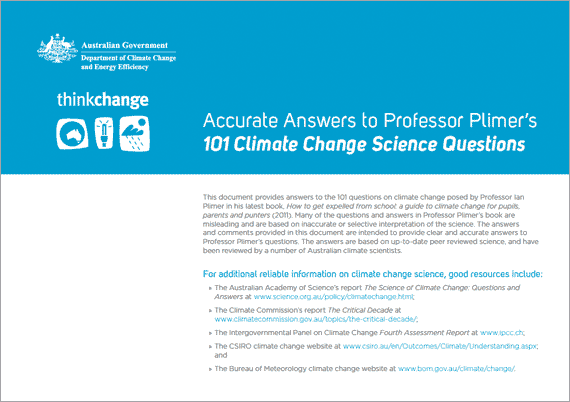
As well as a direct response to Plimer's misleading questions, the document is an interesting and useful resource in its own right. As I explain in a workshop with the Climate Literacy & Energy Awareness Network (CLEAN), responding to misinformation can be educational opportunity, a chance to put myths in proper context and explain the science. So I recommend reading through the document which explains the science behind many common climate myths.
There are also numerous references to Skeptical Science graphs and resources, as we have already tackled many of the myths propounded by Plimer. In fact, SkS content has been appearing in a number of sources of late. Most notably, weather website Wunderground have published a section on climate myths, reproducing the SkS rebuttals of the top climate myths. Apparently they tweaked some of the text where they thought they could improve on our content (I haven't got around to checking where exactly, will be interesting to check).
SkS material is also being adopted in colleges and universities, with our rebuttals and graphs included in textbooks covering on topics such as geology, climate and psychology. The Debunking Handbook has been adopted into the curriculum of a philosophy course at Portland State University and a Science Communication course at the University of Western Australia. So kudos and credit must go to the SkS team who continue to produce content of high quality and quantity, that is not only being read on the SkS website but also being reproduced by scientists, communicators and educators across the globe.
Note: an alternative response to Plimer's 101 questions is provided by Ian Enting in the document Ian Plimer’s questions deconstructed. Analysis of ‘How to get expelled from school ..”

Arguments


Climate Science Rapid Response Team website, where you are described as:
"Superbly researched and illustrated blog that examines climate change skepticism."
Going from strength to strength! Well done!
Well done indeed to both SkS and the DCCEE. (Way to use my taxes for the latter)
Paul Vincelli
I would like to check Plimer's "expected answers" to this questionaire. Does anyone know if Plimer did publish his answers? It would be interesting to compare them, just to see the talking points of his followers in the interest of easier debunking if needed.
chriskoz, the format of Plimer's book - and it is a book - is to pre-arm the kiddies with the 'correct' answers to the questions, that they then may go well-equipped to waylay their potentially errant, overworked and warmism-addled teachers with a succession of 'gotchas!' All for the greater good, of course.
Hence this counter-response from the Australian Government.
And hence I think your 'acknowledgement' is rather too kind.
Should you wish to subject yourself to the original it's available here.
(I did get a chuckle when I observed the second publication in the 'Customers who bought this product also purchased...' list! ;-) )
Interestingly, Graham Readfearn reports that review copies were refused to some news outlets.
http://www.geolsoc.org.uk/gsl/geoscientist/page11359.html
Not the society's finest hour!
I thought the answers were pretty good, though I think they could have given a clearer explanation of warming seas releasing CO2 in some questions e.g. 77
It’s essential that children learn to think, question, compare and contrast sources, and form opinions of their own in science.
The governmental response lacks detail and references - for example, in the answer to question 8, it states ‘the oceans are warming’. Yet on page 48 of the IPCC’s Climate Change 2007 is the statement ‘ Whilst the global trend is one of warming, significant decadal variations have been observed in the global time series, and there are large regions where the oceans are cooling.’ A rather more complicated picture than the government presents, isn’t it?
Then there’s the matter of oceanic pH.
The government answer to question 95 states that ‘the pH of seawater has historically remained at about 8.2 ’ This is followed by the claim that human activities have ‘caused the pH of ocean surface waters to drop by 0.11 pH units.’
There’s no reference for this, but on page 405 of Climate Change 2007 the IPCC state ‘The mean pH of surface waters ranges between 7.9 and 8.3 in the open ocean, so the ocean remains alkaline (pH>7) even after these decreases.’ The government’s use of the words ‘equivalent to 30 percent increase in acidity’ is misleading.
So how has this increase of surface ocean waters been measured? Climate Change 2007 states on p48 that ‘the overall pH change is computed from estimates of anthropogenic carbon uptake and simple ocean models.’ Computations from estimates! Mercifully, they follow this with ‘Direct observations of pH at available stations for the last 20 years also show trends of decreasing pH, at a rate of 0.02 units per decade.’ Empirical data, thank goodness.
The answer to question 68 paints a rosy picture of computer modelling, yet on p21 Climate Change 2007 gives a more realistic ‘there is still an incomplete understanding of many components of the climate system and their role in climate change. Key uncertainties include aspects of the roles played by clouds, the cryosphere, the oceans, land use and couplings between climate and biogeochemical cycles.’
I’ll be interested to see Ian Plimers’s answers to his own questions. I hope that the science teachers in Australia do their homework well!
What I get from
"Whilst the global trend is one of warming, significant decadal variations have been observed in the global time series, and there are large regions where the oceans are cooling."
is
the oceans are warming
The extra nuance in the more fleshed-out description does not alter the accuracy of the simpler one.
Finally, I find your accusation of misleading terminology in the DCCEE response to Plimer is without merit.
Any decrease in pH is necessarily an "increase in acidity" (which is why the change in ocean pH is "ocean acidification"), without regard to the final state of the system or entity in which the decrease has occured.
With a 101 questions to answer, the response is necessarily brief. If you wanted the detail, then the IPCC report would also make a good start, but good that you have found that.
"The ocean remains alkaline (pH>7)" Really? So your position is that any change in the concentration of H+ in the oceans that does not actually push the pH below 7 is harmless?
A 30% increase in H+ concentration (as evidenced by a pH change of 0.11) is unworthy of wory?
On climate modeling: Do you think a single sentence in a five year old report provides a thorough and authoritative review of the state of an important and rapidly advancing aspect of science (climate modeling)?
On the matter of ocean heat... Skeptical science will have a few important posts in upcoming weeks on this, relating to the latest research. I hope that you'll accept such findings with as much confidence as you do when quoting a 5 year old report.
Hopefully it will get their teachers doing the same, instead (-snip-).
To develop this further:
The government statement that the world’s oceans are getting warmer everywhere is contradicted by the IPCC as I’ve quoted.
Were I a school teacher, I’d be getting my class to investigate this further - for example, which oceans? Cooler by how much? Over what period of time? (-snip-)? - in other words, question, investigate and think for yourself – surely a good scientific grounding?
The same applies to oceanic pH. The claim has been made that the average pH of the oceans has increased by 0.11 – does the class think this is plausible, and why? The sort of questions I’d be getting them to look into would be: what factors affect pH? Does the pH range of the oceans vary in different parts of the world? Does it change in shallower waters, and at depth? Is there variation with temperature? How important is CO2 in the picture? Can a class experiment be devised to test issues raised?
Finally, Sphaerica : given my comments on ocean pH above, I'd need to do some investigating myself before forming an opinion. (-snip-).
Naturally I accept that advances in modelling will have been made since the FAR, and have also noted their comments on computer modelling reliability on pages 600-601.
However, (-snip-)?
[DB] This thread is about the Australian Governments 101 responses to Ian Plimer's climate questions and the scientific basis for them. It does not delve into the rationale for why Mr. Plimer takes the stance that he does. Nor does it explore the various and sundry conspiracy theories or "alternative explanations to known physics" that are based on little other than poorly-thought-out wishful thinking.
OHC is still increasing in its inexorable response to the radiative imbalance at the TOA. Use the Search function to look up Levitus 2012 from April for further info. The same for Ocean Acidification and modeling. All are off-topic on this thread.
Off-topic, conspiracy theorizing, allegations of fraud and ideological snipped.
Please construct further comments to comply with the Comments Policy as subsequent comments constructed as this one was will be summarily deleted. Thank you for your compliance and consideration in this matter.
"Were I a school teacher, I’d be getting my class to investigate this further..."
I'm a little surprised you didn't take this advice to heart before posting, because all of the questions you posed are easily answered with just a little research.
Really, Plimer was spewing nonsense, and you are reinforcing it here as if there is some grave doubt about the reality of the answers. Why? If you yourself don't understand and know the answers to the questions, why are you defending Plimer's untenable position (or attacking the response)?
You appear to be confusing or conflating linguistic accuracy with precision.
As long as there is a global-scale energy imbalance causing accumulation of energy within the world ocean (causing the ongoing increase in global oceah heat content), then the statement
The oceans are warming
is entirely accurate.
Increasing resolution and documenting or discussing temporal or spatial variation in the accumulation of ocean heat content adds to the precision of this statement but does not change its accuracy.
As far as encouraging investigation & critical thinking in the classroom goes, Plimer's How To Get Expelled From School is a decidedly inferior tool. Indeed, the way the questions are worded it appears to encourage disruption in the classroom and thoughtless contrarianism among students - rather than a spirit of critical inquiry based on reviewing theoretical, experimental and empirical findings in the sciences.
This confusion may have been aided by the fact that "oceans"can act as both a mass noun, as in the passage quoted above (in which it refers to all the water within the worlds oceans), and as a collective noun, in which usage it would refer to all of the Earth's oceans (ie, the Pacific, the Atlantic, etc). To suppose there is a contradiction between the quoted passage and the statement that the worlds oceans are warming, one must suppose that "ocean" is used as a mass known in the quoted passage, and a collective known in the statement.





