





Can you make a hockey stick without tree rings?
Posted on 2 December 2009 by John Cook
When "Climategate" first broke, I noted the skeptic preoccupation with one tiny piece of climate science while neglecting the full weight of direct observations of current global warming. That tiny piece is paleoclimatology: the reconstruction of past temperature. However, upon reflection, I may have oversold the skeptic position. The focus is on one particular method of that tiny piece: tree ring proxies. In the field of paleoclimatology, there are a variety of independent methods to determine past temperature changes: tree rings, ice cores, lake sediments, boreholes, stalagmites, etc. What do these independent methods find?
Surface temperature changes send thermal waves underground, cooling or warming the subterranean rock. Boreholes can be used to measure these changes. In Huang 2000, underground temperature measurements were examined from over 350 bore holes in North America, Europe, Southern Africa and Australia. Borehole reconstructions aren't able to give annual or even decadal variation, yielding only century-scale trends. What they find is that the 20th century is the warmest of the past five centuries. This provides independent confirmation that the Earth is warming dramatically (the blue line is the instrumental record).
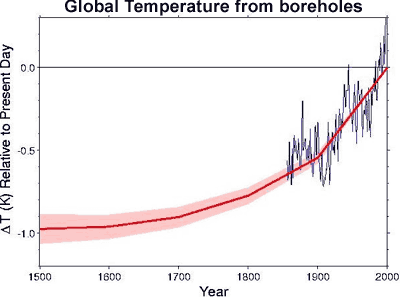
Figure 1: Global surface temperature change over the last five centuries from boreholes (thick red line). Shading represents uncertainty. Blue line is a five year running average of HadCRUT global surface air temperature (Huang 2000).
Stalagmites (or speleothems) are formed from groundwater within underground caverns. As they're annually banded, the thickness of the layers are used as climate proxies. Figure 2 shows a Northern Hemisphere temperature reconstruction from stalagmites. While the uncertainty band (grey area) is significant, the temperature in the latter 20th Century exceeds the maximum estimate over the past 500 years.
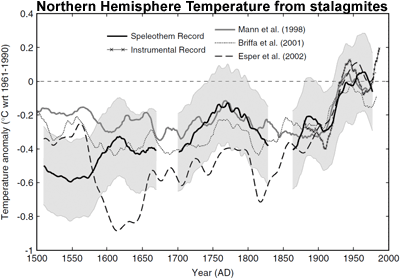
Figure 2: Northern Hemisphere annual temperature reconstruction from speleothem reconstructions shown with 2 standard error (shaded area) (Smith 2006).
Oerlemans 2005 used historical records of glacier length as a proxy for temperature. As the number of monitored glaciers diminishes in the past, the uncertainty grows accordingly. Nevertheless, temperatures in recent decades exceed the uncertainty range over the past 400 years.
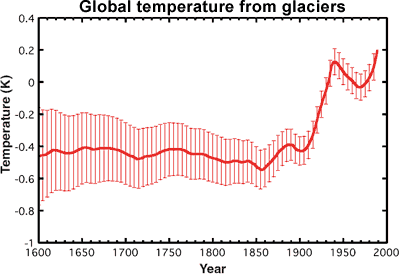
Figure 3: Global mean temperature calculated form glaciers. The red vertical lines indicate uncertainty.
Of course, these examples only go back as far as 500 years - this doesn't even cover the Medieval Warm Period. When you combine all the various proxies, including ice cores, coral, lake sediments, glaciers, boreholes & stalagmites, it's possible to reconstruct Northern Hemisphere temperatures without tree-ring proxies going back 1,300 years (Mann 2008). The result is that temperatures in recent decades exceed the maximum proxy estimate (including uncertainty) for the past 1,300 years. When you include tree-ring data, you find the same result for the past 1,700 years.
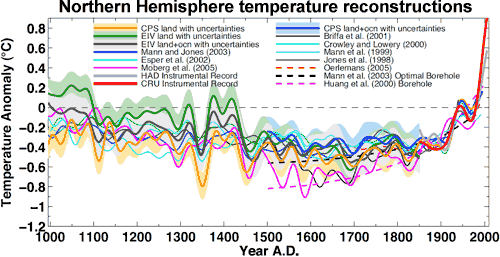
Figure 4: Composite Northern Hemisphere land and land plus ocean temperature reconstructions and estimated 95% confidence intervals. Shown for comparison are published Northern Hemisphere reconstructions (Mann 2008).
Paleoclimatology draws upon a range of proxies and methodologies to calculate past temperatures. This allows independent confirmation of the basic hockey stick result: that the past few decades are the hottest in the past 1,300 years.

Arguments


How can this type of reasoning be broadly disseminated out to the general public, as a counter to the viral spreading of "climategate". In general those who read this blog need no convincing but the information serves to deepen our conviction, thanks for all you do. There is a desperate need to reach out beyond the bounds of this site and others that support the science, beyond a preaching to the choir, as public understanding and support for mitigation declines.
I do recommend if you do post links to Skeptical Science that you take the time to read the page you're linking to and describe the page you're linking to in your own words. One of my pet peeves is comments that merely post a link without any explanation - a lazy way to discuss climate science. You show more respect for the people you're discussing with and provide more useful, enlightening discussion if you can at least give a brief description of the science you're linking to.
I'm assuming that the 1,300 figure comes from ice cores, coral, and lake sediment, which aren't depicted as separate graphs in the post. Is that accurate? Do you have separate graphs of those proxies?
http://news.mongabay.com/2009/1019-hance_sediment_core.html
Sediment Cores from a lake in the arctic show unprecedented 20th century warming and indicated that cooling should have continued...
Can a hockey stick also be made out of this? Also, is this not independent evidence for rapid 20th centuring warming in the norther hemisphere that has nothing to do with tree rings?
AL
Figure 4: The long-term cooling trend in the Arctic was reversed during recent decades. The blue line shows the estimated Arctic average summer temperature over the last 2000 years, based on proxy records from lake sediments, ice cores, and tree rings. The shaded area represents variability among the 23 sites use for the reconstruction. The green line shows the long-term cooling trend. The red line shows the recent warming based on instrumental temperatures (Kaufman 2009).
"Using modelling techniques, the Finnish team was able to extend data on solar activity back to 850 AD. The researchers found that there has been a sharp increase in the number of sunspots since the beginning of the 20th century. They calculated that the average number was about 30 per year between 850 and 1900, and then increased to 60 between 1900 and 1944, and is now at its highest ever value of 76."
http://physicsworld.com/cws/article/news/18692
commenting on:
#I G Usoskin et al. 2003 Phys. Rev. Lett. 91 211101 #
Since the peak in sunspots circa 2000 there has been a steep and lasting decline in solar activity and an observable decline/flatline in T trends.
We have glaciers melting for 250 yrs, yet AGW caused them to melt the last 35 yrs? As a rational person I say if they receded for 200 yrs w/o AGW how can we possibly even mention AGW as a cause of glacier melting, and sorry, I get very skeptical of anything you would say, if you blame glacier melting on AGW. (although soot contamination as a real factor makes good sense to me for both glaciers and the artic)
Is this the kind of "direct observation" you are talking about? Same thing goes for African droughts, etc etc etc. In fact, every nook and cranny I look into, I usually find the same natural variability and historical anecdotes to prove my "common sense".
http://www.appinsys.com/GlobalWarming/GW_4CE_Glaciers.htm
Of course other people might look at things differently when they START with the premise that man is at fault and then work backwords, as the IPCC clearly state in their founding mandate.
Proud to Be A Skeptic, but I'm no Denier.
This is yet another proxy record that suggests some past climate variability that is overwhelmed by changes in the last 40 years. Climate appears to be sensitive to even modest forcing (as the proxy records show), and there is no denying that CO2 results in a significant net radiative perturbation. Certainly this is a cause for concern.
A case in point is glacier recession. There's little doubt that Alpine glacier maximum was in the mid 18th century as you indicate. The earth (at least the Northern latitudes, and especially Europe, where most anecdotal, and more scientific observational evidence, comes from) was coolish in the so-called Little Ice Age. This was a prolonged period of low solar activity and highish volcanic activity. Glaciers advanced.
Some of the recovery from the LIA was natural recovery from natural negative forcing (sun returned to "normal", volcanic activity lessened). Quite a bit of it was anthropogenic resulting from a rather significant rise in atmospheric CO2 from ~280 ppm in the late 18th century to 300 ppm by 1900 and 320 ppm by 1960. It's easy to determine (knowing what we know about the quantitiative relationship between atmospheric CO2 change and earth temperature change) that this will have made a large, and likely dominant contribution to the warming from the early 19th century to the mid 20th century.
And after that it's a question of degree and quantitation that can only be addressed by a non-anecdotal analysis.
You mention the Alps, so we could look at those beautiful mountains. A detailed study of Alpine glaciers was published by the World Glacier Monitoring Service in Zurich a couple of years ago. This shows that the rate of Alpine glacier retreat has followed the temperature trend with rather slow glacier retreat as the N hemisphere warmed v. slowly following the LIA, and then faster as the anthropogenic contribution to warming kicked in. The latest (post 1970's) bout of warming has seen Alpine glacier recession retreat rather remarkably. I know this from first hand since I try to spend a holiday each year in the Alps or the Pyrenees. The changes can be rather remarkable, even in the anecdotal sense of a personal observation...
Haeberli W et al. (2007) Integrated monitoring of mountain glaciers as key indicators of global climate change: the European Alps Annals of Glaciology 46,150-160
Abstract: The internationally recommended multi-level strategy for monitoring mountain glaciers is illustrated using the example of the European Alps, where especially dense information has been available through historical times. This strategy combines in situ measurements (mass balance, length change) with remote sensing (inventories) and numerical modelling. It helps to bridge the gap between detailed local process-oriented studies and global coverage. Since the 1980s, mass balances have become increasingly negative, with values close to -1 m w.e. a(-1) during the first 5 years of the 21 st century. The hot, dry summer of 2003 alone caused a record mean loss of 2.45 m w.e., roughly 50% above the previous record loss in 1998, more than three times the average between 1980 and 2000 and an order of magnitude more than characteristic long-term averages since the end of the Little Ice Age and other extended periods of glacier shrinkage during the past 2000 years. It can be estimated that glaciers in the European Alps lost about half their total volume (roughly 0.5% a(-1)) between 1850 and around 1975, another 25% (or 11% a(-1)) of the remaining amount between 1975 and 2000, and an additional 10-15% (or 2-3% a(-1)) in the first 5 years of this century.
While the borehole and glacier reconstructions for the last 100 or so years(when we supposedly have good temperature measurements) are more or less consistent with one another, the actual temperature measurements (at least as referenced in Mann above) are much higher ~0.5C increase as opposed to closer to 1C for the temp reconstructions(the two of which don't agree with one another too closely incidentally).
Unless you think that the temp reconstructions are badly biased, you are then forced to conclude that the proxies are(they can't both be right). If the proxies are biased, then reconstructions based on them can't be relied on.
Cheers, :)
It is somewhat disappointing that the examples you provide generally do not go back through the MWP (those that do seem to involve tree-rings, which I do not trust, or involve composites, which I do not trust). Could you point me to single-modality, non-tree-ring proxies that examine this period, and that do not suffer from a modern divergence problem? Preferably, they should be regional, to assess claims that the MWP was confined to Europe or the northern land mass. The ideal proxy would be one that matched historical accounts of the MWP.
I am not making any point here - I am genuinely curious, and just starting to look at the evidence in view of recent CRU controversies.
Regards,
Leto.
what you are asking is strange. Scientists tried hard to collect as many different proxies as possible to avoid problems any single proxy type may have. Different proxy types also tend to be geografically located in different environments, so using more proxy types guarantee a better coverage.
If you for some reason do not trust tree rings, i'd suggest to look at reconstructions where just tree rings have been dropped while keeping all the other.
If you look, for example, at the data of the Arctic from the paper linked by John in comment #5, they used 4 tree rings data sets out of 23 total. One might anticipate that their influence will be modest.
I've seen somewhere the comparison of reconstructions with and without tre rings, but i can't remember where; i can't help you more.
CRU controversy or not, we all (and the scientists in first place) always try to have more evidence. The more the evidences the more we trust the findings.
But even if one thinks that there's not enough evidence, one is not scientifically allowed to ignore (or worst throw away) what as already been done.
Here is another good source for what may have caused the warming in the early part of the 20th century:
http://tamino.wordpress.com/2008/10/19/volcanic-lull/
Peace
http://www.co2science.org/data/mwp/regions/nhemis.php
try here -
http://joannenova.com.au/2009/12/fraudulent-hockey-sticks-and-hidden-data/
an excellent graphic representation of the MWP.
Warning, Jo is a strong sceptic, so though the graphic is of immense value, her writing style is quite brunt
"Excellent post" by JoNova? Really?
Have you seen this or this?
Point - counterpoint.
Brilliant reply. I will delve deeper into those two pages later,
Thanx!
PS - just to let you know, I find the volume on MOST of these blogs a bit to loud. Like panning for gold, you have to dump about 99.7% of the raw material to filter out the gold. Though both sides do have some funny ad hommien attacks, in my experience, the truth is found in the quieter moments.
"The above observational and modeling results suggest
the following intrinsic mechanism of the climate
system leading to major climate shifts. First, the major
climate modes tend to synchronize at some coupling
strength. When this synchronous state is followed by an
increase in the coupling strength, the network’s synchronous state is destroyed and after that climate emerges in a new state. The whole event marks a significant shift in climate.
It is interesting to speculate on the climate shift
after the 1970s event. The standard explanation for the post- 1970s warming is that the radiative effect of greenhouse gases overcame shortwave reflection effects due to aerosols [Mann and Emanuel, 2006]. However, comparison of the 2035 event in the 21st century simulation and the 1910s event in the observations with this event, suggests an alternative hypothesis, namely that the climate shifted after the 1970s event to a different state of a warmer climate, which may be
superimposed on an anthropogenic warming trend.
from:
"A new dynamical mechanism for major climate shifts"
GEOPHYSICAL RESEARCH LETTERS, VOL. 34, L13705, doi:10.1029/2007GL030288, 2007 (Tsonis et al 2007)
which describes the results of treating climate as a chaotic networked sytem using observed data for such events and modelling the results.
The model indicates a synchronisation roughly every 10yrs...1910..20..30..40..50.. but shift in climate state occurs only if the result is an increase in coupling strength - which happened in 1910, 1940 and 1970 - and in each case the result was an increase in temperature.
No. That's what rethoric, politics or court room arguments are about.
1) Joanne Nova did not do her research or did so without due diligence.
or
2) Joanne Nova is intentionally misleading the general public.
So Tsonis et al have converted the qualitative suggestions of their 2007 paper into a quantitative analysis of the contribution of these effects to 20th century warming [*]. They conclude that these effects made a significant contribution to early 20th century warming, and a small contibution to warming since 1960 (perhaps 0.1-0.15 oC) with zero contribution to warming since around 1985. The nett contribution to 20th century warming from the effects you are describing is (according to Tsonis et al) close to zero (perhaps 0.05 oC).
So the scientists whose earlier work you are rather over-embellishing to support a notion, simply don't agree with you. Their earlier qualitative analysis idicates that cyclic ocean regime changes can have temporary small effects on surface temperature. A quantitative analysis establishes that the nett effects of these are small, and that their contribution to the marked warming since the early 80's is close to zero.
[*] K. L. Swanson, G. Sugihara and A. A. Tsonis (2009) Long-term natural variability and 20th century climate change Proc. Natl. Acad. Sci. 106, 16120-16123
(see Figures 2 and 3 and text).
It’s easy to download Moberg et al’s data, e.g. from the NOAA paleodata repository here:
http://www.ncdc.noaa.gov/paleo/globalwarming/moberg.html
If one plots the data (try it yourself), you’ll see that your friend “Jo” has done some odd things to it. S/he has applied some unspecified smoothing that has accentuated/broadened some of the spikes in the earlier part of the record and attenuated the spike in the mid 20th century, and shifted all the data upwards by a few tenths of a degree for some reason. In fact the spikes are simply noise. The major spike around 990 AD lasts only for about 7 years, up and down, and is obviously noise. Likewise with the spikes around 1020 and 1110 AD, although the reconstruction is consistent with a real N. hemisphere MWP that slowly reached a temperature around 0.2 – 0.3 oC warmer than the preceding and following period, but quite a bit cooler than now.
Moberg’s reconstruction puts the MWP temperature at around the same temperature as the mid 20th century global temperature. Remember that Moberg et al is a Northern hemisphere reconstruction. One needs to be careful in comparing a smoothed record with a real, unsmoothed instrumental record. However we know that the earth surface really has warmed by around 0.5 oC since the middle of the 20th century and by around 0.7 oC in the N. hemisphere (if one thinks it’s appropriate to compare like with like).
Lets look at the different methods
1) Boreholes show on evidence of LIA.
2) The stalagtite graph shows a temperature peak in 1700's.
3) The glacier record shows no 1700's temp minima (glacier maxima) followed by slow climb to 1900's. This is very strange as one method used to confirm the LIA (glacier treat) now seems to be refutting it's existence.
Do we have to abandon the LIA idea to accept this data?
Re "abandon the LIA", there seems to be a common notion kicking around that climate scientists are trying to talk down past climate change. This is decidedly not the case. On the contrary, as Dana Royer puts it: "the geologic record contains a treasure trove of 'alternative Earths' that allow scientists to study how the various components of the Earth system respond to a range of climatic forcings." For this reason, periods of dramatic climate change like coming out of the Last Glacial Maximum are of strong interest to climate scientists. These periods indicate that the climate is sensitive to radiative forcing which in turn tells us that the climate is sensitive to the current very strong radiative forcing from CO2.
Phillipe, point taken. Bad use of grammer. Should have been a bit more precise. One of the papers that Tom pointed to, if my quick look was somewhat close to right, seems to show a new way to analyze the data. This is what I meant, science grows with every new discussion. Sometimes the new ways are right, sometimes wrong, but from this we gain valuable knowledge. Will try to slow down my thoughts in the future to be more clear.
LOL Chris, my friend Jo! Not quite, but I would bet that you would have a great discussion with someone that seems that passionate! I visit about 12 different blogs during the week, and try to keep them even - yes/no/maybe-so. The main thing is to have a bit of time to let your critical thinking sift through the "junk" from all sides. I found it interesting that Prof. Mann has "allowed" the MWP to at least be shown in his latest paper. His explanation is intriquing to say the least. But again, I have not had time to go as deep as my depth of understanding will allow me. This silly thing called life keeps getting in the way!
Thank-you for the link to Moberg and your explanation. I can see a BIG pot of coffee is going to be consumed in the near future.
does last glacial maximum = LIA ??
If you set out to find the LIA in the borehole, stalagmite and glacial data presented above you really couldn't find it. If that data can't identify this 'period of dramatic climate change' why should we trust it to identify any period of dramatic climate change.
I don't see how we can defend this data as a climate proxy and believe in the LIA. We have to throw away one or the other.
Their misrepresentation of the 1997 Huang/Pollock/Shen (HSP1997) borehole data is a truly dismal piece of cherrypicking; the misrepresenter has declined to point out that Huang/Pollock/Shen (HPS) have already pointed out that their 1997 data is completely unsuitable for comparing the temperatures of the MWP with current temperatures[**]. They have recently concluded that their borehole reconstruction indicates that the MWP was around 0.5 K cooler than current temperatures.[*]
So the borehole data is entirely consistent with all the other scientific data and analysis.
[*]S. P. Huang and H. N. Pollack P.-Y. Shen (2008) A late Quaternary climate reconstruction based on borehole heat flux data, borehole temperature data, and the instrumental record Geophys. Res. Lett. 35, L13703, doi:10.1029/2008GL034187
Abstract: We present a suite of new 20,000 year reconstructions that integrate three types of geothermal information: a global database of terrestrial heat flux measurements, another database of temperature versus depth observations, and the 20th century instrumental record of temperature, all referenced to the 1961–1990 mean of the instrumental record. These reconstructions show the warming from the last glacial maximum, the occurrence of a mid-Holocene warm episode, a Medieval Warm Period (MWP), a Little Ice Age (LIA), and the rapid warming of the 20th century. The reconstructions show the temperatures of the mid-Holocene warm episode some 1–2 K above the reference level, the maximum of the MWP at or slightly below the reference level, the minimum of the LIA about 1 K below the reference level, and end-of-20th century temperatures about 0.5 K above the reference level.
-------------------------------------------------
[**]HSP describe carefully in their 2008 paper why their 1997 paper (HSP 1997; used by the misrepresenter that you linked to) can’t be used to compare MWP with current temperatures. The data in HSP 1997 contains no data for the 20th century, because of concern in the large number of boreholes analyzed that the top 100 metres of depth might be contaminated by non-climatic influences. The end of the record in HSP1997 defines the estimated temperature around the turn of the end 19th century. The data in John Cook’s Figure 1 (Huang 2000) is from a set of boreholes that have passed a quality control for eliminating non-climatic contributions, and this approaches is extend much further in HSP2008 cited just above.
sgking: As you seem to accept Jo Nova as an authority on this, maybe you would care to get an explanation from her why she uses the 1997 Huang/Pollack paper in the post, with no mention of their later work? If she has found errors in those later papers, it would be very interesting to know.
I would also like to know your own reflection on this. Since you are referring to that blog post here, you must have made some assessments.
For instance, changes in the SOI can cause changes in precipitation, increases in precipitation cause cooling and increased precipitation means (see Wentz et al. 2007 How Much More Rain will GLobal Warming for a discussion of the precipitation, temperature and WV effects of El Ninos.
Cheers, :)
the best way to help is to answer their letters to the editor garbage in your local paper.remember though to make your reply interesting and use lay terms . the use of logic rather than ad infinitum scientific opinion also can be very usefull. simple and to the point ,,,
Chris, the Moberg paper in my opinion is top drawer, the only critique I have, is I wish that they would not lay the instrumental on top of the original data. My eyes are not as good as they use to be.
Tom, the second paper you put up was to me what science should be, a constructive argument about anothers' work. thank-you.
Since you don't seem to have much respect for "my friend" JoNova, how this paper then, by Loehle...
http://www.ncasi.org/publications/Detail.aspx?id=3025
any hidden agendas here that I should know about?
Thanx
There is a lot of material here on Skeptical Science, too, if my fuzzy memory serves.
There was a program on PBS regarding mankind and our evolution. To summarize, our precursor was nethanderals. The great ice age gradually forced the nethanderals further south as a consequence of impact of great droughts. Further, statements (not in this program) have been made to effect, the CO2 levels during this period were 100s of times greater than the CO2 level today. (One wonders what brand of SUVs the nethanderals were driving?) Yet, there was an ice age.
Anyhow, the survivors ended up on eastern mid-Africa. Out of the survivors, came us, the homosapiens (shades of Darwin). Indeed, our genes have nethanderal traces.
The next item that is relevant to this issue of warming is the reaction time of influences. Just because you give your car gas, it doesn't mean that in 1 second you will be going 60 mph. Likewise, how long does it take for a car going 60 mph to stop. Let alone the other issue of relaxation time. i.e., once the influence is removed, how long does it take to go back to the previous level.
To continue, I think that the next few winters are going to be interesting regarding the CO2 hypothesis. So far, this winter is starting up as a cold one, even though there have been forecasts of a warmer NE.
To summarize, I think that that the CO2 people still have to make their argument. Certainly, their postings and data manipulations have not given a lot of people the feeling that their science is objective.
This is because proxy records tell us what temperature has been in the past, not what's causing the temperature changes. But as you say, attribution is indeed the central issue of global warming - I would go so far as to say the hockey stick controversy serves as a distraction from the more crucial observations that rising CO2 levels are causing an enhanced greenhouse effect which is the main contributor to global warming.
The issue of relaxation time is also an important point that is rarely discussed. In an earlier post, we examined the whole concept of climate time lag and "warming in the pipeline".
There is also a detailed examination of the argument that CO2 has been higher in the past.
And look at that word again from a good source. It's Neanderthal.
http://www.arctic.ucalgary.ca/main/documents/media_release_pdfs/Analysis%20of%20isotopes%20in%20tree%20rings%20can%20reveal%20past%20climate%20events.pdf
Thanks for the response. I will look at the material in more detail, but I have already heard a lot from the anti-AGW (skeptical) camp. I am familar with the whole Yamal saga, which is part of the reason I do not trust tree rings.
I am somewhat surprised I have not had any reply from the pro-AGW camp pointing me to one unambiguous non-tree proxy that fits the 'global hockey stick with local European MWP' pattern. This is, after all, supposed to be the scientific consensus, or so I'd been told.
Is there such a proxy? I would have thought, from the title of this thread, that such proxies did exist. Reconstructions based on combined data don't carry the same evidential weight for me, I'm afraid. I'm not saying data can't be combined but there is always room for human subjectivity and confirmation bias to creep into the combination process.
I repeat, I am not not trolling to make a point here. I would just like to know if there is any firm ground to stand on before launching into my own analysis of the more complex statistical methods.
Leto.
My very personal opinion: Gather trustwothy anectdotal data, and proceed from there in whatever manner you have statistical justification for. If there were one proxy series of the type you are asking for, we would have known by now, I think.
I can give you a couple of examples from Norway. In Halvdan Svartes saga, it is told that he drowned (about 880 CE) in Røykensvik in late winter when the ice broke under horse and sledge because of cattle being watered out on the ice and their droppings making the ice rotten.
That means it can not have been much warmer than now, but not much colder either.
In Eigils saga (ca 950 CE), Eigil Skallagrimson is ordered by king Håkon to take a trip to Vermland (now Sweden) to collect taxes. It seems to be about this time of year, and the saga tells us that the winter roads are cleared ('breyttir vegar'). Well, I can tell you, they are not frozen, so there is no way you can use those tracks right now, I happen to live along them. That piece of information indicates temperatures around or slightly below the 2000-2009 mean.
This is all in line with the present consensus in Norway, that medieval temperatures were 0.5-1 oC higher than the 1961-1990 mean, which means about what we experience now.
No amount of proxy reconstructions is going to change the historical record, and I guess quite a lot of good information is still to be gathered from careful analysis of anecdotal evidence. And the 'precision' you get from proxy reconstructions is most often illusionary. Just compare the different reconstructions.
Another question: why does the Mann graph show a 0.8+ degree warming after de mid-century pause? Shouldn't it be some 0.5ºC?
Here's your answer to that.
The Yooper





