





An Interactive History of Climate Science
Posted on 31 May 2011 by John Cook
For years, I've been casually accumulating a database of peer-reviewed climate papers. A few months ago, some Skeptical Science contributors began brainstorming creative ways to visualise this database - a kind of visual sequel to Naomi Oreskes' famous Science paper on consensus. Paul D decided to take it a step further and began programming a Javascript visualisation that very cleverly packs an incredible amount of information into a single, user-friendly graphic. The visualisation displays the number of climate papers published each year, sorted into skeptic/neutral/pro-AGW categories (more on these categorisations shortly). What really blew me away is the slider at the bottom - drag it from left to right to observe the evolution of climate science research from Joseph Fourier in 1824 to the flood of research in 2011.
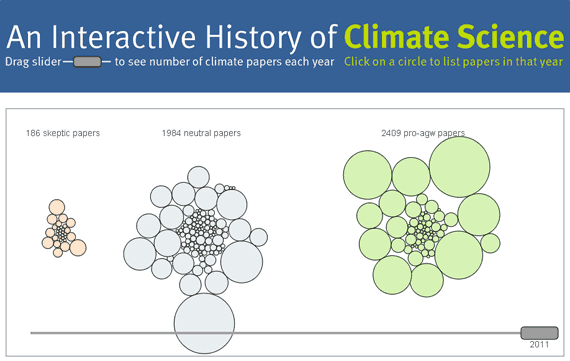
How the Interactive History of Climate Science works
The Interactive History of Climate Science displays the number of climate papers published in each year from 1824 to 2011. Each year is represented by a circle with the size of the circle determined by the number of papers. By moving the slider, you change the "current year" - more years are shown as you slide from left to right. The visualisation begins with the slider parked in 1824 when Joseph Fourier first published General remarks on the temperature of the terrestrial globe and the planetary space.
Mouseover any circle and a small box displays the year and number of papers published in that year. Here's the cool part - click on any circle and all the papers published that year are displayed beneath the visualisation with a link to the paper. In one succinct visualisation, Paul D has managed to cram in an incredible amount of information, with links to thousands of climate papers. It captures the ethos of Skeptical Science - multiple layers of information with both a user-friendly version for the layperson and a more detailed layer allowing deeper exploration.
How the papers are categorised
We took a different approach to Naomi Oreskes' Science paper who sorted her papers into "explicit endorsement of the consensus position", "rejection of the consensus position" and everything else (neutral). In the case of Skeptical Science, the backbone of our site is our list of climate myths. Whenever a climate link is added to our database, it is matched to any relevant climate myths. Therefore, each link is assigned "skeptic", "neutral" or "proAGW" whether it confirms or refutes the climate myth.
This means a skeptic paper doesn't necessarily "reject the consensus position" that humans are causing global warming. It may address a more narrow issue like ocean acidification or the carbon cycle. For example, say a paper is published examining the impacts of ocean acidification on coral reefs. If the paper finds evidence that ocean acidification is serious, the paper is categorised as pro-AGW and added to the list of papers addressing the "ocean acidification isn't serious" myth.
There are a large number of neutral papers. Neutral does not mean to say each paper was unable to resolve the climate myth. Sometimes, a paper is relevant to a number of climate myths and the results are mixed as to whether it endorses or rejects all the myths. In many cases, the paper doesn't directly set out to directly resolve the myth or the paper has a regional emphasis rather than global. Some papers are about method development more than obtaining a final result. Papers that met any of these criteria are often categorised as neutral.
So yes, categorisation can get a little complicated and there'll be a blog post shortly discussing these issues in more detail. I'm starting to think Naomi's approach was the better way to go!
How we built the database of peer-reviewed papers
The database of peer-reviewed papers is a crowd sourced effort. Special credit must go to Ari Jokimäki and Rob Painting who both submitted thousands of papers to the database (the horse race between the two was fascinating to watch). Ari runs AGW Observer, a blog that keeps track of peer-reviewed climate papers, so he had a huge collection at his fingertips. I also highly recommend his Twitter account which announces new climate papers on a daily basis and there's been a continuous flow of papers in the Skeptical Science Daily Climate Links email.
How you can join the crowd sourcing effort
You can help by joining the crowd sourcing effort. To add peer-reviewed papers, you can use our web based form or the Skeptical Science Firefox Add-on. I'd suggest using the Firefox Add-on - if you can get into the habit of adding any climate links as you browse around, you'll make this data collecting geek very happy! Check out how you're doing by comparing how many papers everyone has submitted (I'll probably revamp this page, add some more features and extra layers of information).
We consider this visualisation a first step, not a final destination. While we have over 4000 papers in the database, that is just the tip of the iceberg with many more papers yet to be added. As well as build the number of papers, we'd like to experiment with different ways of displaying the papers. In addition to the visualisation, you can also view all the papers grouped by skeptic/neutral/proAGW and grouped by which climate myths they address. But I'm sure there are other creative ways this data could be displayed (eg - by using the categories each paper falls under, it should be possible to determine which papers fall under Naomi Oreskes' "reject/endorse the consensus" categorisation). I'm sure there will be much discussion on the issue of categorisation and how it can be more robust and clearly defined.
If you have any ideas on how this information could be organised and displayed, post a comment here and we'll discuss it further (Paul D's visualisation could have gone in many different directions). As with any social media phenomenon, anything is possible when a community starts brainstorming.
Note - the short URL to An Interactive History of Climate Science is http://sks.to/history

Arguments


I moved the mouse over the circle, and the amount of papers on that year appeared. But when I clicked on it, nothing else happened. Is it just me?
Overall I think that Oreske's method is simpler, clearer and more relevant to the discussion. If you want tu pursue this type of classification, maybe you could filter by argument. So the graph could tell you, for each argument, how many papers are for, and how many against.
For instance, Fourier's 1824 paper is listed as 'pro AGW'... but the concept of AGW wasn't even suggested until Arrhenius in 1896. I can sort of see this as 'pro AGW' in that Fourier detected the existence of additional warming which we now call 'the greenhouse effect', but he thought it was most likely due to cosmic rays... which we would now call a 'skeptic' argument. It could be said that Fourier's paper 'supported basic AGW principles' and the things it got wrong were reasonable mistakes at the time (in contrast to arguing cosmic rays NOW)... but it's a fine line.
The other thing is that I have to wonder how complete the database is in regards to failed ideas in the early years. There were unquestionably alot of papers on the glacial cycle which suggested all kinds of causes having nothing to do with greenhouse gases. Again, taken a certain way it could be argued that as the AGW theory was not well known (or yet extant) at the time these papers were not 'skeptical' of it per se... but that inherently introduces a paradigm where papers would be classified as 'skeptical' more often as AGW theory became more established.
Still, a great resource... and these definitional issues fall away as we get closer to the present and the most up to date science. Indeed, I'd love to be able to exclude years and thus easily see just what 'each side' has put out in the past few years.
I've dropped a heads up to Info is Beautiful.
I would tend to think that those that have been grouping these papers are more careful than that. Did you go to the page that has the papers (so on) sorted by argument? There is an option to only filter down to peer reviewed papers, were you sure to click on that?
I think a different metric is needed. Maybe "supports current understanding" or "supports climate myths".
I am not saying it is easy.
I've read in Sks, Climate Progress and elsewhere that some scientific papers specifically skeptical about one or another AGW topic have been demonstrated in subsequently published papers to have serious errors, making the skeptical paper's existence (or at least part of it) moot. As I read into CBDunkerson's comment above (#9), all sorts of papers get left behind by developing science. I'm sure there are recently published pro AGW papers that have been effectively refuted by subsequent publications (undoubtedly also pro AGW papers). Could the database identify at least the most grievous of such subsequently refuted or "left behind" papers? Perhaps little circles showing publication years of subsequently refuted papers? Perhaps footnotes by the actual paper titles identifying "partially refuted by subsequent literature" or "substantially refuted by subsequent literature."
I'm curious about the 1960 CO2 concentrations paper (pro AGW) Table 1 with some hand written numbers and checkmarks!
Perhaps add a red circle to the bundle when papers are refuted by subsequent research? That'd be interesting to see where all the red dots ended up, and how big they were.
And creating a guest account with read-only privileges ?
Double dip science in progress.
Some are likely to use the same graphic and say "Look! There is a substantial number of papers that argue against AGW. Hardly a consensus!"
It would be very useful to be able to identify refuted and erroneous papers and even remove them from the graphic as well. This would also reflect the actual nature of scientific consensus: that it is not merely majoritarianism.
1. Providing a link to a published paper which explicitly refutes the evidence/ conclusions after publication of the relevant item should be fairly straightforward. A little red dot, per paper rather than per refutation, in the relevant circle would be handy.
2. Some egregiously wrong papers which ignore or try to override others' well-accepted work could also have some indication (with a pale pink dot?) / link to a list of published works which contradicted the paper before it was ever written.
3. The thorny problem. Many truly dreadful papers are not refuted in formal papers by others after publication because the competent scientists just can't be bothered (again, and again, and again). But there are letters and similar critical responses where bad papers somehow made it into reputable journals. No idea how this might be incorporated.
http://www.nytimes.com/interactive/2009/12/07/science/20091207_CLIMATE_TIMELINE.html
However it has a similar groupings of events, with a greater density in modern times.
http://www.americanthinker.com/2010/09/climatism_redoubling_misguided.html
"This systematic desensitization of the metropolitan populace to high heat and humidity over time can be attributed to a suite of technologic, infrastructural, and biophysical adaptations, including increased availability of air conditioning"
So it's saying that people buy AC units. I don't see why would this be relevant to global warming.
"Evaluations of global surface temperature histories, after accounting for urban warming biases and other influences, indicate that the globe has warmed approximately 0.67°C since 1900.(...)Furthermore, based upon scenarios of future increases in greenhouse gas emissions, climate models estimate a globally averaged temperature rise of 1.4–5.8°C between now and the year 210"
So even if it's irrelevat to the assessment of the reality of AGW, it implicitly accepts the consensus opinion.
(link: http://www.ncbi.nlm.nih.gov/pmc/articles/PMC1241712/pdf/ehp0111-001712.pdf)
...I'm a bit "skeptical" about the numbers. Specifically, they don't seem to square very well with the numbers in Peterson (2008) -- as pointed out in severa SkepticalScience posts (see here, for example: http://www.skepticalscience.com/christy-crock-1-1970s-cooling.html). Petereson found a total of 71 peer-reviewed publications on the topic of global warming and climate change in the 15-year period 1965-1979.
Yet according to the graphic in this post, the year 1975 alone had 240 publications. Something seems askew...
1. the numbers in the interactive graphic are cumulative. There are only 4 "pro-AGW papers" for 1975 in the graphic.
2. "global warming" and "climate change" are restrictive designators for climate-science related research. If you use a less restrictive designator (e.g. "climate") there are lots of potentially relevant papers from 1975. For example of the 164 hits from a ISI Web of Science search for topic "climate" (year=1975), the following papers are likely to be relevant, and this list is only from the first 40 out of 164 hits:
PARAMETERIZATION OF CLIMATE - GLACIER - RELATION
Author(s): HOINKES H, STEINACKER R
Source: RIVISTA ITALIANA DI GEOFISICA E SCIENZE AFFINI Volume: 1 Pages: 97-104 Supplement: Suppl. I Published: 1975
THEORY OF ENERGY-BALANCE CLIMATE MODELS
Author(s): NORTH GR
Source: JOURNAL OF THE ATMOSPHERIC SCIENCES Volume: 32 Issue: 11 Pages: 2033-2043 Published: 1975
EFFECTS OF CHANGING SOLAR CONSTANT ON CLIMATE OF A GENERAL CIRCULATION MODEL
Author(s): WETHERALD RT, MANABE S
Source: JOURNAL OF THE ATMOSPHERIC SCIENCES Volume: 32 Issue: 11 Pages: 2044-2059 Published: 1975
CARBON DIOXIDE CLIMATE CONFUSION
Author(s): SCHNEIDER SH
Source: JOURNAL OF THE ATMOSPHERIC SCIENCES Volume: 32 Issue: 11 Pages: 2060-2066 Published: 1975
Title: LONG-TERM CYCLES IN VARIATION OF ATMOSPHERIC RADIOCARBON, RELATED TO CHANGES IN HOLOCENE CLIMATE
Author(s): MCFADGEN BG
Source: SEARCH Volume: 6 Issue: 11-1 Pages: 509-511 Published: 1975
Times Cited: 1
NONSPHERICAL AEROSOLS AND CLIMATE
Author(s): CHYLEK P, COAKLEY JA, GRAMS GW
Source: TRANSACTIONS-AMERICAN GEOPHYSICAL UNION Volume: 56 Issue: 12 Pages: 997-997 Published: 1975
CLOUD PARAMETERS FOR CLIMATE STUDIES
Author(s): COAKLEY JA
Source: TRANSACTIONS-AMERICAN GEOPHYSICAL UNION Volume: 56 Issue: 12 Pages: 997-998 Published: 1975
ROLE OF DESERTS ON GLOBAL CLIMATE
Author(s): ELLSAESSER HW
Source: TRANSACTIONS-AMERICAN GEOPHYSICAL UNION Volume: 56 Issue: 12 Pages: 998-998 Published: 1975
WEATHER AND CLIMATE MODIFICATION - HESS,WN
Author(s): SEWELL WRD, FOSTER HD
Source: HUMAN ECOLOGY Volume: 3 Issue: 4 Pages: 289-291 Published: 1975
CLIMATE OUTLOOK - VARIABLE AND POSSIBLY COOLER
Author(s): LANSFORD H
Source: SMITHSONIAN Volume: 6 Issue: 8 Pages: 140-& Published: 1975
RECENT SECULAR VARIATIONS IN MID-ATLANTIC WINTER EXTRATROPICAL STORM CLIMATE
Author(s): RESIO DT, HAYDEN BP
Source: JOURNAL OF APPLIED METEOROLOGY Volume: 14 Issue: 7 Pages: 1223-1234 Published: 1975
CLIMATE RESPONSE AND FLUCTUATION DISSIPATION
Author(s): LEITH CE
Source: JOURNAL OF THE ATMOSPHERIC SCIENCES Volume: 32 Issue: 10 Pages: 2022-2026 Published: 1975
NUMERICAL EXPERIMENT ON EFFECTS OF REGIONAL ATMOSPHERIC POLLUTION ON GLOBAL CLIMATE
Author(s): KOENIG LR
Source: JOURNAL OF APPLIED METEOROLOGY Volume: 14 Issue: 6 Pages: 1023-1036 Published: 1975
APPLICATION OF SOIL DUST OPTICAL-PROPERTIES IN ANALYTICAL MODELS OF CLIMATE CHANGE
Author(s): RUSSELL PB, GRAMS GW
Source: JOURNAL OF APPLIED METEOROLOGY Volume: 14 Issue: 6 Pages: 1037-1043 Published: 1975
I found multiple papers that were assigned to 2011 to be years and sometimes decades earlier:
http://www.sciencedirect.com/science/article/pii/S0273117797004997
http://resources.metapress.com/pdf-preview.axd?code=t341350850360302&size=largest
http://ruby.fgcu.edu/courses/twimberley/EnviroPhilo/ProgressReport.pdf
And that is only the first couple of dozen cites. You have others that duplicates and some that not even peer reviewed. I would like to give a more complete list but I am afraid I will get caught in the spam filter.
I know that moderators on this site do not consider Energy and Environment a peer reviewed journal but yet here they are being listed:
http://www.eike-klima-energie.eu/uploads/media/EE_21-4_paradigm_shift_output_limited_3_Mb.pdf
Some of the papers do appear in professional journals but are opinion articles entirely unrelated to any science. For example here is a opinion piece found in a Law Review Journal:
http://ojs.ubvu.vu.nl/alf/article/view/127/233
Others are double wammies of being not only decades out away from 2011 but are cited twice. I noticed that the duplicated were done within a week of each other:
http://www-eaps.mit.edu/faculty/lindzen/127co2~1.pdf
http://eaps.mit.edu/faculty/lindzen/cooglobwrm.pdf
http://eaps.mit.edu/faculty/lindzen/dsttrotrov.pdf
http://www.dvgu.ru/meteo/library/19955332865.pdf
I am not being thorough here at all. I am just beginning to recognize that the multiple submissions that occurred on the same date such as 2011-9-15 warrant being clicked on.
http://www.c3headlines.com/peer-reviewed-studies/
Another Energy and Environment paper from 2010 listed in 2011:
http://multi-science.metapress.com/content/c47t1650k0j2n047/?p=7857ae035f62422491fa3013c9897669&pi=4
And again more inappropriate year cites:
http://www.mendeley.com/research/climate-change-detection-attribution-trends-longterm-geologic-data/
I will stop now but please consider that is just a perusal of the year 2011. I have not even begun to look at 2012 submissions.





