Are we heading into a new Ice Age?
The skeptic argument...
We're heading into an ice age
"One day you'll wake up - or you won't wake up, rather - buried beneath nine stories of snow. It's all part of a dependable, predictable cycle, a natural cycle that returns like clockwork every 11,500 years. And since the last ice age ended almost exactly 11,500 years ago…" (Ice Age Now)
What the science says...
| Select a level... |
Basic
|
Intermediate
| |||
| Worry about global warming impacts in the next 100 years, not an ice age in over 10,000 years. | |||||
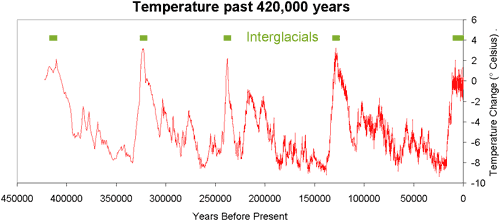
According to ice cores from Antarctica, the past 400,000 years have been dominated by glacials, also known as ice ages, that last about 100,000. These glacials have been punctuated by interglacials, short warm periods which typically last 11,500 years. Figure 1 below shows how temperatures in Antarctica changed over this period. Because our current interglacial (the Holocene) has already lasted approximately 12,000 years, it has led some to claim that a new ice age is imminent. Is this a valid claim?
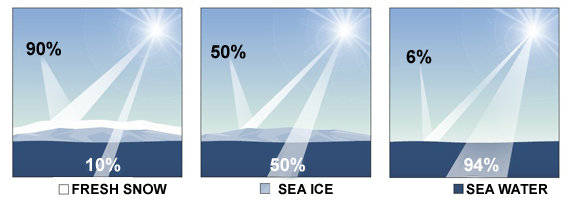
To answer this question, it is necessary to understand what has caused the shifts between ice ages and interglacials during this period. The cycle appears to be a response to changes in the Earth’s orbit and tilt, which affect the amount of summer sunlight reaching the northern hemisphere. When this amount declines, the rate of summer melt declines and the ice sheets begin to grow. In turn, this increases the amount of sunlight reflected back into space, increasing (or amplifying) the cooling trend. Eventually a new ice age emerges and lasts for about 100,000 years.
So what are today’s conditions like? Changes in both the orbit and tilt of the Earth do indeed indicate that the Earth should be cooling. However, two reasons explain why an ice age is unlikely:
- These two factors, orbit and tilt, are weak and are not acting within the same timescale – they are out of phase by about 10,000 years. This means that their combined effect would probably be too weak to trigger an ice age. You have to go back 430,000 years to find an interglacial with similar conditions, and this interglacial lasted about 30,000 years.
- The warming effect from CO2 and other greenhouse gases is greater than the cooling effect expected from natural factors. Without human interference, the Earth’s orbit and tilt, a slight decline in solar output since the 1950s and volcanic activity would have led to global cooling. Yet global temperatures are definitely on the rise.
It can therefore be concluded that with CO2 concentrations set to continue to rise, a return to ice age conditions seems very unlikely. Instead, temperatures are increasing and this increase may come at a considerable cost with few or no benefits.
Last updated on 1 September 2010 by Anne-Marie Blackburn.

Arguments


Basic
Intermediate


Maximiliano Herrera has compiled data on met stations that set new high or low records every year since 2002.
So far, in 2010 there have been 337 warm records versus 13 cool records.
In 2009, the ratio was 80 (warm) to 15 (cool).
In 2008, it was 40 (warm) to 18 (cool).
In 2007, it was 133 (warm) to 9 (cool). And so on...
Your comment "It is my opinion that the greatest danger we face is epistemic relativism. Might does not make right. Majority opinion does not determine truth. Observe to formulate opinions ad infinitum. Don't opinionize to formulate what you can and cannot observe." is highly ironic. Rather than being convinced by the objectively straightforward warming trend, you rely on anecdote, cherry-picking, and appeals to emotion.
"And a correction to my previous post. No nations, to my knowledge, have set all-time record cold temperatures in 2010, not one."
And the experts concur with CBDunkerson's thoughts on noctilucent clouds:
Here is some information
In which they state:
"First sighted in 1885 in Northern high latitudes, noctilucent, or night shining clouds occur in the summer in the mesosphere, which is the coldest part of the atmosphere. Cloud formation is possibly hastened by increasing amounts of carbon dioxide in the atmosphere. While CO2 is thought to contribute to global warming on Earth, it actually cools the high atmosphere. In recent years, noctilucent clouds have begun appearing closer to the equator."
And some more here. In which they say:
"Ironically, greenhouse gases like CO2 that warm Earth's lower atmosphere also cool the upper atmosphere, possibly enhancing conditions for ice crystal formation, said Rusch, lead scientist for the Cloud Imaging and Particle Size experiment, or CIPS"
That is about half of this year. I could go back more but I think of the above you will fine at least two that are fairly reputable that list record cold temperatures in different nations.
Mr. Bostrom, that paper I commented on earlier also states that the extent of the noctilucents has never exceeded as when they were first noticed. That is convenient for his argument that they play no significance in climate change but it is absolutely false. You don't see the data though in his paper as he only takes a slice, less than 36% the time they have been observed.
Mr. Murphy, I stand corrected. I see the notices that last year or maybe the year before then, England had its coldest winter in at least 30 years and some reports say more than 100 years.
I cannot continue with this. I do have a life and this is a message board and as such it is linear and people can post more than their proven worth.
I will leave you with one suggestion, don't trust the summaries written up by prominent scientists or organizations. The internet gives you a good start at going and looking at the evidence yourself. There are strong, violent and intolerant forces at work that have been swaying public and private opinions for generations and they continue to play a dominant role, IMHO.
Regardless, as Ned showed nicely @101, record highs are far outpacing record minima.
Yes, and I have a life too. Tuning you out then.
I give up. You just do not understand the comparison between, say, a 'record since records began', and 'a record this year'. You seem to see the word 'record' and think that is everything. It isn't : what you are so excited about is called 'weather'.
As for "some reports say more than 100 years", prove it. It's not worthwhile anyone bothering to check anything you type out anymore.
Finally, and most bizarrely, you suggest that we shouldn't "trust the summaries written up by prominent scientists or organizations" - while you trust media reports and headlines; think the internet allows you to be an expert in whatever you feel like, and end up with conspiracy theories.
You have nothing, I'm afraid, but you think you have everything.
JMurphy is right and I was wrong. England did not receive an all time record cold winter recently. Actually it was the coldest in anywhere from 30 to 140 years according to numerous posts and findings.
it is stated "Unambiguous observations of NLC go back to the summer of 1885,when NLC appeared above western Europe with a brightness and latitudinal extent which has never been reached again."
As far as I can tell from the NASA graph I post above, their first siting was surpassed in the 1950s as well as the 1960s for the extent of that graph. Why does the pdf misrepresent the situation? How come it only considers its hypothesis that noctilucents play no role in climate change on less than a third of the time they have been observed? Isn't the fact that there is no record of them being observed prior to the industrial revolution of significance?
I'm posting some references about what we know about the glacial cycle, from the proxy temperature record extracted from the ice cores, in hopes that someone will be able to provide me with better ones. I remain dismayed at how hard it is to find accurate descriptions of the glacial cycle.
Over the past 800,000 years, we've had at least 8 glacial cycles, each about 100,000 years long, consisting of roughly 90,000 years of advancing ice followed by roughly 10,000 years of warmth. Sometimes, the warm period has been up to 23,000 years long.
http://www.sciencemag.org/cgi/content/abstract/289/5486/1897
http://www.sciencemag.org/cgi/content/full/289/5486/1897
This National Geographic web page mentions that the highest and lowest temperatures obtained from analysis of the ice cores spanning the past 800,000 years occurred during our most recent glacial cycle. The hottest temperature was 4.5 degrees Celsius warmer than today. That was 130,000 years ago.
http://news.nationalgeographic.com/news/2007/07/070705-antarctica-ice.html
It seems interesting to me that record high and low temperatures, and the glacial maximum, for the past 800,000 years were set during this most recent glacial cycle! According to some sources, we're about 14,000 years into this warming phase.
Given that the maximum temperature during the last warming phase was about 4.5 C warmer than today, it seems likely that we'll continue to see much warmer temperatures and sea levels during this warm phase, just due to the natural glacial cycle.
This source gives a history of the science behind our understanding of the past glacial cycles.
http://www.aip.org/history/climate/cycles.htm
It seems to show that the end of this warm period is fairly near.
Chris Shaker
So far, I have not been able to find a graph of the derivative of the glacial cycle temperature record. Would that not be interesting to show the rate of change during the warming phases, and compare this one to previous ones?
Chris Shaker
the comparison you're asking for does not make much sense to me. The glacial cycles are driven by orbital variations and we should be in a cooling phase. Also, glacial terminations are quite slow events and we do not expect rapid changes.
Anyways, using DomC data (divided by two to account for polar amplification) my crude estimate of the largest warming rate during the last glacial termination is of the order of 0.002 °C/yr. Now we're running about 10 times faster.
I see obviously false references at places like Factoidz, claiming that there have only been four glacial cycles in the history of the world.
I started reading about what the ice cores have taught us about the glacial cycle. Temperature proxy records derived from deuterium measurements. At least 800,000 years of ice core records detailing the 100,000 year glacial cycle, composed of 90,000 years of cold and ice and only 10,000 years of warmth, on average.
http://news.nationalgeographic.com/news/2007/07/070705-antarctica-ice.html
http://www.sciencemag.org/cgi/content/abstract/289/5486/1897
http://www.sciencemag.org/cgi/content/full/289/5486/1897
If you're going to tell me that man's CO2 has become the dominant factor in the climate, you need to be able to describe where we would be in the glacial cycle without it. IE - what is the delta caused by CO2?
As far as I can determine, over the past 14,000 years of the warming phase, most of that warming has been from the natural forces of the glacial cycle.
How does this warm phase look different from the previous seven warm phases? Is there a graph comparing the shape of them?
Taking the derivative of the temperature waveform to get the rate of change of the temperature waveform would be one way to compare the warm phases from the glacial cycle?
As a failed electrical engineer (computer scientist), I see these graphs of the temperature records of the glacial cycle, and start wondering how they could be analyzed to predict where they would go into the future, with and without man's CO2.
I did find several articles about research using spectral analysis of the glacial cycle
Spectral Analysis of Climate Data, by P. Yiou, E. Baert, and M.F. Loutre
http://www.nosams.whoi.edu/PDFs/papers/surveysingeo_time_series.pdf
Evidence for decoupling of atmospheric CO2 and global climate during the Phanerozoic eon JaÂn Veizer*, Yves Godderis2 & Louis M. FrancËois
http://mysite.science.uottawa.ca/idclark/courses/Veizer%20Nature%202001.pdf
"The Predictability of Glaciation Cycles"
http://www.igsoc.org/annals/5/igs_annals_vol05_year1984_pg213-214.pdf
Chris Shaker
Can you please tell me what time frame is this referring to?
You've found a typo in the Intermediate Version -- John, this should refer to Figure 4.
"Figure
3examines the climate response to various CO2 emission scenarios."An excellent summary of CO2 emissions is available here. Although the cumulative emissions graph in their Figure 8 goes back to 1750, the caption states that one half of the 270 Gt as of the year 2000 was released from fossil fuel consumption since 1974. Tack on the last 10 years and we're well over the quoted 300 Gtons cumulative. See USEIA emissions data tables for the numbers.
But, I'm having trouble making sense out of the Sicily paper as it relates to the EIA data.
Here is the problem I am having: according to the EIA, between 1980 and 2006, globally, humans have cumulatively emitted over 600 Gton C from the "Consumption and Flaring of Fossil Fuels". (http://www.eia.doe.gov/pub/international/iealf/tableh1co2.xls). Roll in the link that you sent and we are up to 663 Gton C by 2008. Assuming an average increase in anthropogenic CO2 emission per year of 2%, and that puts us at a cumulative 725 Gton C for the last 30 years.
If we want to say that global warming started in 1895 (http://www.time.com/time/magazine/article/0,9171,983504,00.html) due to the flaring of fossil fuels - (assuming a constant of a 2% increase per year (which may or may not be reasonable)) then we had to be well beyond 1000 Gton C by the year 2000 (this excludes the first 145 years of the industrial revolution).
So, how is it that the Sicily paper has us at cumulative of only 270 Gton C between 1750 and 2000? Am I not comparing apples and apples here? If I've made an error, I hope you can help me see where I went wrong.
Thank you.
The difficulty is the conversion from carbon to CO2 is a factor of 3.664: 1 gram C = 0.083 mole CO2 = 3.664 gram CO2. Not quite apples and oranges, but still important.
When you divide 650.7 Gtons CO2 (world cumulative from 1980-2008 from the tables here) by 3.664, you obtain 177.6 Gtons carbon, which is the same order of magnitude as 'half of 337 Gtons carbon since the mid-70s.' Someone here very patiently explained this to me the first time I found the same sort of inconsistency; I hope I've paid that forward for you.
I did a breakdown of the carbon numbers by identifying segments with reasonably constant slope:
As a result, it hardly seems like anything prior to early part of the 20th century is worth bothering over.
To tack onto muoncounter's execellent comment to you at 120 above, there's these quotes from Dr Toby Tyrrell of the University of Southampton's School of Ocean and Earth Science at the National Oceanography Centre, Southampton, appearing in Science Daily: and The Yooper
Daniel (121) - I guess I have to start with questioning whether or not stopping an ice age is necessarily bad. Since it is rather difficult to grow things, like food, in ice - it is a bit obvious (at least to me) that a warmer globe is better than a cooler globe.
So, the real argument would be against a rapidly warming globe. Assuming that CO2 in fact causes the globe to warm, causing glaciers to melt and frozen tundra to unfreeze - then a SLOW release of CO2 would be necessary to allow the increased water and vegetation to act as carbon sinks and absorb the increasing CO2.
Based on my primitive understanding of the Carbon cycle - I must respectfully disagree with Dr. Tyrrell.
muoncouter (120) - I would like to express my sincerest gratitude for your explanation, as it clarified the error of my ways. At first, I felt pretty silly thinking that the "C" in "Gton C" meant "carbon dioxide" - I've since discovered that this seems to be a common misconception. In fact, "carbon" is often used in reference to "carbon dioxide" - as in "carbon sink".
However, I am now more frustrated than I was before.
Last year, POTUS made the following statement:
"… this legislation is paid for by the polluters who currently emit the dangerous carbon emissions that contaminate the water we drink and pollute the air that we breathe."
Now, I have a solid piece of carbon hanging around my neck - in today's vernacular it is called a diamond. I can guarantee you (and I'm not even going to offer up a study to prove I'm right) that diamonds are NOT contaminating the water we drink and polluting the air that we breathe.
So, now I'm noticing that the discussions about global warming interchange accumulated atmospheric carbon and carbon dioxide emissions. Here is an example:
"Humankind is releasing CO2 at a rate of about 7 Gton C per year from fossil fuel combustion, with a further 2 Gton C per year from deforestation. Because the atmospheric CO2 concentration is higher than normal, the natural world is absorbing CO2 at a rate of about 2 or 2.5 Gton C per year into the land biosphere and into the oceans, for a total of about 5 Gton C per year."
http://www.realclimate.org/index.php/archives/2006/11/how-much-co2-emission-is-too-much/
But, Carbon is not a greenhouse gas - Carbon Dioxide is. Without the O2 part - why would carbon have any impact on the temperature of the globe?
Or, to make a short story long: why do we care about the amount of Carbon as a stand alone element vis-a-vis global temperatures?
YES! Rate is everything. Arguing about what would be a global optimal temperature would be tough. The problem is change faster than we can adapt in things like food production and infrastructure upon which we have become dependent.
Re: use of "carbon". Well diamonds and such are not emissions. CH4 and CO2 are. While there might be an undesirable shorthand in common use, any document that matters on emission levels, is usually in terms of CO2e (CO2 equivalents).
You seem to be suggesting that if an ice age is coming, some beneficial greenhouse warming due to CO2 (let's lose the 'assuming CO2 does cause warming') would be a good thing. The first problem with this is the obvious: Who says an ice age is coming?
I congratulate you for your personal chunk of face centered carbon crystals; hope it is of respectable carat weight. The issue is indeed atmospheric CO2; roughly 50% of the 30 Gtons CO2 we are releasing from fossil fuel combustion each year stays in the atmosphere and the globally measured concentration now increases by more than 2 ppm by volume per year.
I'm sure some of the others here can enlighten us why C and CO2 seem to be used semi-interchangeably. Until then, remember to multiply by 3.664.
Technically we are still in an ice age (defined as the existence of continental ice sheets in any such form), so we actually are in what is called an interglacial period. Of super-sized form.
Glaciated conditions typically form through draw-down of atmospheric concentrations of CO2, as seen here:
Given that the residential lifetime of CO2 in the atmosphere is on the millennial timescale, we can be safe in assuming no glaciers bugging temperate latitudes anytime soon.
We have known about the GHG effect of CO2 for nearly two centuries - this is well-understood and not seriously questioned by any competent scientist anywhere. Google Tyndall, Arrhenius or Fourier sometime.
As far as a slow release of CO2, that would be nice. But it in no way reflects the reality of what is actually happening. There simply is no comp in the paleo record for such a quick rise in CO2 concentrations in the atmosphere (other than during the PETM). So past periods of climate change occurred over much longer periods than what is happening today. Past periods of rapid climate change were always accompanied by many mass-extinctions (during periods when CO2 concentrations changed more slowly than today. Except during the PETM...).
You can certainly disagree with Dr. Tyrrell and his understanding of the carbon cycle all you want. My money's on Dr. Tyrrell.
As far as growing crops in a rapidly changing climate, that is easier said than done. Aridity of agricultural soils has gone from 8% in the 60s to over 21% as of 2001. Projections show greater than 50% aridity by 2035 and over 70% by 2052. Evapotranspiration of the soil is decreasing (soils are drying out) while humidity has increased by 4% (the equivalent extra volume of Lake Erie is now floating in the air, waiting to dump on someone).
So what does that mean? Less rainfall events and drier soils; when it does rain, the "gas tanks" are greater, so more moisture falls (once-in-a-thousand year rainfall events start fall every century then every decade) in shorter burst, yielding more runoff and more erosion and flooding. And more crop damage.
Global warming = Droughts, famines. In a world struggling to feed its existing populace, what will people do in 20 years when half the food is being produced for another 2 billion more people to feed than today's totals?
muoncounter can answer whatever scaddenp didn't above.
The Yooper
Daniel, I appreciate all of the information you provided here and would like to challenge you on your definition of a "competent scientist".
Remember Michael Mann's "hockey stick graph" - the one trotted out by Al Gore and the IPCC as proof positive that AGW exists? If in fact the Earth is warming - why did Mann feel the need to concatenate two different data sets? If I wanted to prove that sports scores have been increasing over the last 100 years and I take baseball scores for the first sixty years and plot them - then I take basketball scores for the last 40 years and tack them on the end of my graph, would my graph be taken seriously?
Supporting articles here and here.
Distressingly, this is the same IPCC that "misread" the year the Himalayan glaciers were "likely to disappear" due to global warming:
Mr Cogley says it is astonishing that none of the 10 authors of the 2007 IPCC report could spot the error and "misread 2350 as 2035".
IPCC error
Equally distressing is the suggestion that they may have done so on purpose. IPCC error intentional
Here's a question I literally cannot find an answer to: How many scientist work for the IPCC and what are their names? I've heard 1000, I've heard 2000 - yet, I cannot find a comprehensive list of the people involved in promoting AGW.
On the other hand, here is a list of over 31,000 scientist that think AGW is a bunch of bunk. All their names are listed - right there. (I know, I know - they were ALL bought off by Big Oil.)
Petition Project
There has been some chatter on this site about not looking at thermometer reading to assess the global warming situation (too bad nobody mentioned that to Michael Mann) - I've been told to look at the sea ice extent. So, I have - it has increase for the last three years. The counter to this point is that the ice is thin - but, of course young ice is thin. The point is that the extent has NOT receded in the last three years. Now, how can that be with all of that accumulated, globe warming carbon?
Sea Ice Extent
Also, if accumulated CO2 definitively causes the globe to warm, why did they think the globe was cooling for the 30 years prior to the 1970s?
But, this, I think, is the primary question: since CO2 will increase as the globe warms (due to melting, CO2 containing glaciers), why should I assume that CO2 CAUSES global warming?
Sure the globe has been warming (for the last 10,000 years), sure there is more CO2, but what if you have your cause and effect relationship inversed?
Let me take the "31,000 scientists" issue first. We are all aware of the Oregon Petition. What you are ignoring about it is that figure requires a denominator to have any meaning at all. The petition defines "scientist" as anyone with a BS or equivalent. That encompasses nearly 30,000,000 people in the US alone. You can likely double that number or more looking outside the US. So, even at best you are presenting a figure that is about 1/10th of one percent.
If you poll actual working climate scientist who are currently working in this field you get quite the opposite number. Doran 2009 shows that 97% of climate scientists believe that climate change is real.
"Remember Michael Mann's "hockey stick graph" - the one trotted out by Al Gore and the IPCC as proof positive that AGW exists? If in fact the Earth is warming - why did Mann feel the need to concatenate two different data sets?"
You should read further on this website (by using the 'Search' box in the top left) but I will start you out : Go here, here, here and here.
If no-one else can be bothered to point you in the right direction for your other misinformed points (and I wouldn't blame anyone else for not wanting to go over all this again), I will return to this later.
Because it's basic physics?
Actually, the globe has not been warming for the past 10,000 years. If you look at the Holocene optimum we've been slightly cooling over that period. It's only in the past 100 years that we've reversed that trend.
Honestly, this site provides information that responds to everything you've said here much better than I can in a short post. I would urge you to take some time to read some of the articles and follow the cited sources.
Sorry, but that's just flat wrong. Someone has been feeding you some bogus information.
See SkS articles here, here and here, among others; also Arctic sea ice falls to third-lowest extent; downward trend persists
To summarize: You have taken issue with this statement I made earlier: Am I correct?
Proceeding as if so; granted its been some 25 years since my college days, but it's my understanding that the GHE is basic physics, taught in high-schools these days. Please correct me if I'm wrong on that.
It doesn't change the fact that the GHE is basic physics; numerous videos are available on Youtube attesting to and demonstrating that fact that you can replicate in your home by you, if so inclined. I think I'll go out right now to ascertain how performable this is for the GHE; wish me luck...
PS: To make the moderators life here a little easier, please keep in mind the topic of the thread you post questions on. For example, this thread is about "Are we heading into a new Ice Age?". For question other than the focus of this thread, such as your references to the Oregon Petition or Climategate, please use the search function in the upper left of each page to find a more appropriate thread to post those concerns on.
Comments deemed off-topic will be deleted.
Thanks in advance!
The Yooper
Thank you,
Chris Shaker
As to worrying about the next ice age... The milankovitch forcing that drives ice age is due to change in forcing that is about 0.25W/m2 per hundred years at 65N. Globally, its maybe a tenth of that. By comparison, anthropogenic GHG is about 3.7W/m2 over last 100 years on a GLOBAL scale. Ie the +ve anthropogenic forcings far exceeds the negative milankovich forcing. Estimate are that we arent going to see an ice age for 50,000 years.
We're supposed to believe that the glacial cycle has magically stopped working just because the CO2 level is elevated."
This from over in 1500 year cycle borders on the offensive. You will find no science published that asserts milankovich cycles arent continuing. Only that what causes the ice age is just one of the forcings affecting climate and its being trumped by high CO2 - just as it was when world had more CO2. Do think the milankovich cycles werent operating "magically" to use your word, at times before we had ice caps?
"I hate to be reiterating an old point but its all about rate. The transition into and out of ice age is extremely slow by human terms. (around 10,000 years). The rate of warming we are creating is by comparison very fast. Rates of change that overwhelm species capacity to adapt are the danger."
It seems that these claims are incorrect. Natural systems have caused huge and rapid temperature change in the recent past.
http://www.scientificamerican.com/article.cfm?id=ice-core-reveals-how-quickly-climate-can-change
"Following this abrupt shift, as much as 20 degrees Fahrenheit (10 degrees Celsius) of warming occurred over the subsequent decades—a change that ultimately resulted in at least 33 feet (10 meters) of sea-level rise as the ice melted on Greenland."
http://www.sciencedaily.com/releases/2008/06/080619142112.htm
"The ice core showed the Northern Hemisphere briefly emerged from the last ice age some 14,700 years ago with a 22-degree-Fahrenheit spike in just 50 years, then plunged back into icy conditions before abruptly warming again about 11,700 years ago. Startlingly, the Greenland ice core evidence showed that a massive "reorganization" of atmospheric circulation in the Northern Hemisphere coincided with each temperature spurt, with each reorganization taking just one or two years, said the study authors."
Note that the Woolly Mammoth, giant sloth, and Sabre tooth tiger went extinct during one of the most recent temperature excursions, only 12,900 years ago.
Chris Shaker
I think this implies that the cores are sampled for analysis every so many mm?
Chris Shaker
From the literature I've read, the Vostok and Epica cores were sampled every 0.5 to 2 meters, depending upon the depth (I don't recall offhand the spacing intervals from Greenland cores). The final several hundred meters of the Vostok core was deemed unusable due to heat penetration upwelling from Lake Vostok lying underneath the borehole at that point.
The larger sampling interval actually carries with it fewer questions about the resulting resolution, due to the spacing involved. More frequent sampling might yield more data, but the resulting data would not necessarily add anything new.
Changes in CO2 and temps in the paleo record occurred much more slowly than what we are physically measuring today.
The Yooper
This is a reply to your comment over on the 'It's a 1500 year cycle' thread:
----------------------------------------------------------------------------------------------------------
Re: cjshaker And your source for that claim would be...?
You may want to actually read up on models. Suggested starting points can be found here, here, here, here and here.
The Yooper
Changes in CO2 and temps in the paleo record occurred much more slowly than what we are physically measuring today.
We do not know that. At least the ice core record does not tell us anything about the swiftness of past changes. Or do you have other, undisclosed data sources to support your valiant claim?
Here is the Historical CO2 Record from the Vostok Ice Core. As you can see the difference between Age of ice and Mean age of air in it is anywhere between 1879 and 6653 years (at depth 506.4 m and 3119.51 m respectively).
Therefore it takes several millennia for carbon dioxide to get enclosed in Antarctic ice. With such a heavy smoothing the present spike or anything comparable to it is rendered invisible.
In general it is a grave error to conclude from the fact you can't see an invisible thing that it does not exist either.
How is that physically possible? "On average, the transformation of névé into glacial ice may take 25 to 100 years."
Once the ice is fully frozen, why would there be any further aging of the air? How credible are these reported age discrepancies between ice age and air age?
It is explained here. Basically it's because ice is cold & accumulation rate is low. Bubbles are enclosed only near the firn-ice transition zone, about 90 m below surface.
I am not sure however, that gas diffusion is stopped as soon as bubbles get enclosed. There's a microscopically thin boundary layer between ice grains where impurities get concentrated and supercooled liquid water is retained even at temperatures well below freezing.
And your source for that claim would be...?
Re: cjshaker
>"I think the bottom line is that climate modelers don't really understand the glacial >cycle, nor how it really works."
I make that claim because of articles like this one, which appear to show poor ability to predict the glacial cycle using models
http://www.igsoc.org/annals/5/igs_annals_vol05_year1984_pg213-214.pdf
And this one, which attempts to use spectral analysis to predict future behavior of the glacial cycle
http://www.nosams.whoi.edu/PDFs/papers/surveysingeo_time_series.pdf
Chris Shaker