



 Arguments









Does ocean cooling prove global warming has ended?
What the science says...
| Select a level... |
 Basic
Basic
|
 Intermediate
| |||
|
The most recent ocean measurements show consistent warming. |
|||||
Oceans are cooling
“Ocean heat touches on the very core of the AGW hypothesis: When all is said and done, if the climate system is not accumulating heat, the hypothesis is invalid.
[…]Now that heat accumulation has stopped (and perhaps even reversed), the tables have turned. The same criteria used to support their hypothesis, is now being used to falsify it.” (William DiPuccio)
In 2008, climate change sceptic Roger Pielke Sr said this: “Global warming, as diagnosed by upper ocean heat content has not been occurring since 2004”. It is a fine example of denialist spin, making several extraordinary leaps:
-
that one symptom is indicative of the state of an entire malaise (e.g. not being short of breath one day means your lung cancer is cured).
-
that one can claim significance about a four year period when it’s too short to draw any kind of conclusion
-
that global warming has not been occurring on the basis of ocean temperatures alone
So much for the hype. What does the science say about the temperature of the oceans – which, after all, constitute about 70% of the Earth’s surface? The oceans store approximately 80% of all the energy in the Earth’s climate, so ocean temperatures are a key indicator for global warming.
No straight lines
Claims that the ocean has been cooling are correct. Claims that global warming has stopped are not. It is an illogical position: the climate is subject to a lot of natural variability, so the premise that changes should be ‘monotonic’ – temperatures rising in straight lines – ignores the fact that nature doesn’t work like that. This is why scientists normally discuss trends – 30 years or more – so that short term fluctuations can be seen as part of a greater pattern. (Other well-known cyclic phenomena like El Nino and La Nina play a part in these complex interactions).
Looking at the trend in ocean heat, this is what we find:
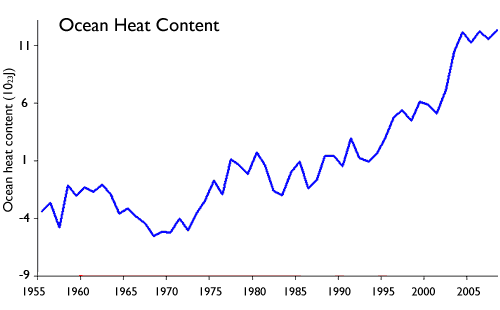
Source: Levitus 2009
There are, however, disputes about the accuracy of Argo buoys and expendable measuring devices dropped into the sea, and the reporting of temperatures down to only 700 metres. How do scientists resolve these kind of disputes – bearing in mind that such disputes are the very stuff of science, the essence of true scepticism? One way is to find more data sources – different ways of measuring the phenomenon in dispute. By using results from seven different teams of scientists, all using different tools and methods, we are able to see a clear trend. And while there is variation between team results due to the differences in technique and measurement methods, one thing they all agree on: long term, temperatures are going up.
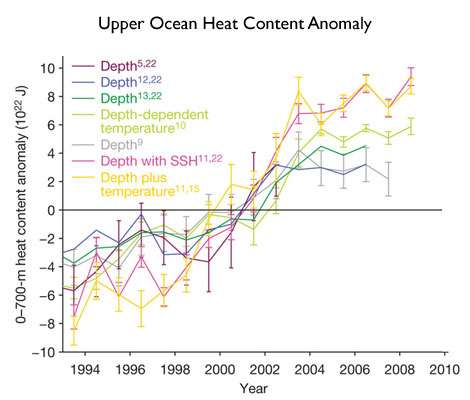
Source: Lyman 2010
The reaction of the oceans to climate change are some of the most profound across the entire environment, including disruption of the ocean food chain through chemical changes caused by CO2, the ability of the sea to absorb CO2 being limited by temperature increases, (and the potential to expel sequestered CO2 back into the atmosphere as the water gets hotter), sea-level rise due to thermal expansion, and the amount of water vapour in the atmosphere.
While there is a great deal we don’t know about how the oceans behave, we do however know that it’s safer to discuss all aspects of climate change using multiple sets of data, rather than just one, as Pielke Sr did. If ocean heat is a guide, then global warming is still on track to cause great disruption if we don’t modify our actions to reduce the release of anthropogenic CO2.
Claims that global warming is not happening on the basis of short-term ocean temperatures are not supported by the evidence.
Basic rebuttal written by GPWayne
Last updated on 1 August 2013 by gpwayne. View Archives

 Well, if ISCCP data are considered reliable, nothing like that has happened. There was a sharp decrease of some 4 W m-2 in net incoming flux at TOA between 2000 and 2002. Since then it is practically flat. Therefore reconstruction of OHC history before ARGO is suspect.
Sometimes you should use your own head. No amount of peer reviewed literature could save you that effort.
#87 Riccardo at 06:43 AM on 5 April, 2010 in same thread wrote:
"you're dangerously falling into a grim denialism. You do not bother to verify you claims and let other people do the dirty job to make your denialism apparent. It's a bit boring"
Now. I kindly request our host to comment on this attitude. According to the site's Comments Policy "Comments using labels like 'alarmist' and 'denier' are usually skating on thin ice". A couple of other points come to mind as well. John, I would rather not ask you to delete that comment, as it also includes a false claim I'll comment on shortly, but it definitely deserves one of those green boxes.
#87 Riccardo at 06:43 AM on 5 April, 2010
"Your claim about the jump in the deployment of Argo floats in 2003 which you immagine is the cause of the jump in OHC is blatantly false. Check youself (pag.4)."
Riccardo, you are referring to this image:
Well, if ISCCP data are considered reliable, nothing like that has happened. There was a sharp decrease of some 4 W m-2 in net incoming flux at TOA between 2000 and 2002. Since then it is practically flat. Therefore reconstruction of OHC history before ARGO is suspect.
Sometimes you should use your own head. No amount of peer reviewed literature could save you that effort.
#87 Riccardo at 06:43 AM on 5 April, 2010 in same thread wrote:
"you're dangerously falling into a grim denialism. You do not bother to verify you claims and let other people do the dirty job to make your denialism apparent. It's a bit boring"
Now. I kindly request our host to comment on this attitude. According to the site's Comments Policy "Comments using labels like 'alarmist' and 'denier' are usually skating on thin ice". A couple of other points come to mind as well. John, I would rather not ask you to delete that comment, as it also includes a false claim I'll comment on shortly, but it definitely deserves one of those green boxes.
#87 Riccardo at 06:43 AM on 5 April, 2010
"Your claim about the jump in the deployment of Argo floats in 2003 which you immagine is the cause of the jump in OHC is blatantly false. Check youself (pag.4)."
Riccardo, you are referring to this image:
 First things first. I have not claimed there was a jump in deployment. What I did claim, there is a jump in OHC reconstruction and at the same time instrumentation went through a huge change.
However, as you may notice, there is indeed a jump in Pacific ARGO deployments during 2003.
First things first. I have not claimed there was a jump in deployment. What I did claim, there is a jump in OHC reconstruction and at the same time instrumentation went through a huge change.
However, as you may notice, there is indeed a jump in Pacific ARGO deployments during 2003.

 This jump is due to lack of ARGO floats in southern Pacific (to a lesser extent in southern Atlantic as well) during early 2003. The gap was filled in by December 2003, but it took another four months to get a reasonable distribution by random drift.
As for the number of active ARGO floats, it went like this:
2002-04 465
2003-04 797
2003-07 832
2003-08 860
2003-12 1023
2004-04 1158
2004-07 1257
2004-11 1500
2005-04 1788
2005-05 1871
2006-05 2451
2006-11 2743
2007-11 3070
2008-05 3111
2009-07 3319
The histogram shows the annual number of profiles collected, the blue line is the number of active floats.
This jump is due to lack of ARGO floats in southern Pacific (to a lesser extent in southern Atlantic as well) during early 2003. The gap was filled in by December 2003, but it took another four months to get a reasonable distribution by random drift.
As for the number of active ARGO floats, it went like this:
2002-04 465
2003-04 797
2003-07 832
2003-08 860
2003-12 1023
2004-04 1158
2004-07 1257
2004-11 1500
2005-04 1788
2005-05 1871
2006-05 2451
2006-11 2743
2007-11 3070
2008-05 3111
2009-07 3319
The histogram shows the annual number of profiles collected, the blue line is the number of active floats.
 Compare the distributions above to current status:
 It is only the Number 5 December 2004 issue of Argonautics Newsletter that declares:
"Uses of Argo data
Perhaps the most important feature is that the array is now global and this permits us to start to address important scientific issues and to make the data useful to operational centres"
You can see how sparse OHC data really are prior to ARGO:
It is only the Number 5 December 2004 issue of Argonautics Newsletter that declares:
"Uses of Argo data
Perhaps the most important feature is that the array is now global and this permits us to start to address important scientific issues and to make the data useful to operational centres"
You can see how sparse OHC data really are prior to ARGO:
 All other sources of OHC data also diminished dangerously by the year 2002. It is slide 6 in the Leviticus presentation:
 Caption: The number of 4°x2° boxes that meet the observation criteria as a function of time for both MBT and XBT comparisons based on computations from WOD data.
 Figure S9 from Levitus et al. 2009. Yearly time series of ocean heat content (10E+22 J) for the 0-700 m layer from this study and from Domingues et al. [2008] and Ishii and Kimoto [2008]. Linear trends for each series for 1969-2008 given in the upper left portion of the figure. Reference period is 1957-1990.
You still haven't given any evidence that pre-ARGO OHC data are "unreliable". Since that claim contradicts the results of multiple peer-reviewed studies showing long-term increases in OHC, one would demand very convincing evidence, but you provide no evidence at all, merely assertions.
I think we can conclude that the oceans have in fact been warming over the past half-century. This should be no surprise, since oceans cover more than half the planet, and the surface and atmosphere are also warming.
Figure S9 from Levitus et al. 2009. Yearly time series of ocean heat content (10E+22 J) for the 0-700 m layer from this study and from Domingues et al. [2008] and Ishii and Kimoto [2008]. Linear trends for each series for 1969-2008 given in the upper left portion of the figure. Reference period is 1957-1990.
You still haven't given any evidence that pre-ARGO OHC data are "unreliable". Since that claim contradicts the results of multiple peer-reviewed studies showing long-term increases in OHC, one would demand very convincing evidence, but you provide no evidence at all, merely assertions.
I think we can conclude that the oceans have in fact been warming over the past half-century. This should be no surprise, since oceans cover more than half the planet, and the surface and atmosphere are also warming.
 The huge divergence between reconstructions in 2003-2004 is clearly noticeable. If such problems occur in recent years, why would one believe any of it?
Also, the choice of 1969-2003 as reference interval is nothing else but cherry picking.
The huge divergence between reconstructions in 2003-2004 is clearly noticeable. If such problems occur in recent years, why would one believe any of it?
Also, the choice of 1969-2003 as reference interval is nothing else but cherry picking.
 Anyway. Even by eyeballing (and disregarding lack of significance) the trend between 1959-2001 is 0.2 × 10²² J/year perhaps. It translates to a 0.12 W/m2 net "forcing" at TOA on average during this 42 years long interval.
On the other hand according to the Mauna Loa record, CO2 has increased from 315.98 ppmv to 371.07 ppmv. If we accept the estimated sensitivity of 3.7 W/m2 for carbon dioxide doubling given in IPCC AR4 WGI 2.3.1 as a reference point, it should mean a 0.86 W/m2 increase in "forcing" by the year 2001 relative to 1959.
Log CO2 being almost linear, average should have been 0.43 W/m2. More than 70% of it is nowhere to be found. And not even feedbacks are taken into account yet. With them the effect measured is barely more than 10% of the radiative imbalance projected by IPCC.
The artificial jump of 2003 introduced by Levicus at al. would not improve the situation much. It would make the figure above 15-20% perhaps (of expectations based on mainstream climate science).
Either OHC history reconstructions are useless or theory misses some strong negative feedback.
Anyway. Even by eyeballing (and disregarding lack of significance) the trend between 1959-2001 is 0.2 × 10²² J/year perhaps. It translates to a 0.12 W/m2 net "forcing" at TOA on average during this 42 years long interval.
On the other hand according to the Mauna Loa record, CO2 has increased from 315.98 ppmv to 371.07 ppmv. If we accept the estimated sensitivity of 3.7 W/m2 for carbon dioxide doubling given in IPCC AR4 WGI 2.3.1 as a reference point, it should mean a 0.86 W/m2 increase in "forcing" by the year 2001 relative to 1959.
Log CO2 being almost linear, average should have been 0.43 W/m2. More than 70% of it is nowhere to be found. And not even feedbacks are taken into account yet. With them the effect measured is barely more than 10% of the radiative imbalance projected by IPCC.
The artificial jump of 2003 introduced by Levicus at al. would not improve the situation much. It would make the figure above 15-20% perhaps (of expectations based on mainstream climate science).
Either OHC history reconstructions are useless or theory misses some strong negative feedback.

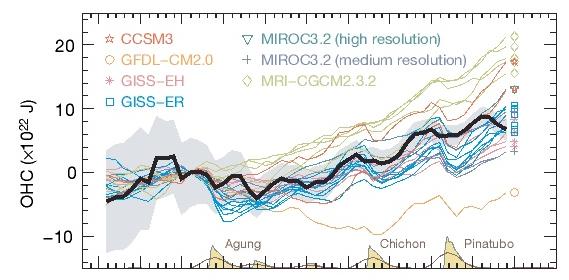 That seems to show their observations falling nicely in the middle of the ensemble of models, which is hard to reconcile with a trend that's only 24% to 41% of what would be predicted from forcings. Unfortunately at the moment Nature's website seems to be down so I'll have to go back and reread Domingues later to see how they explain this.








Climate Myth...