



 Arguments







The End of the Hothouse
Posted on 16 December 2011 by John Mason
A new study links major atmospheric CO2 drop to the onset of Antarctic glaciation, 33.7 million years ago
Forty million years ago, Antarctica had a pleasantly mild climate, its mountains and shores flanked by swathes of woodland in which a diverse mammalian fauna flourished. Today, it is one of the most inhospitable places on Earth. Throughout this time, the continent has remained in pretty much the same place, straddling the South Pole. It follows that a drastic climatic change must have occurred, but how?
That has been the subject of much research over the years and a good picture has gradually emerged. Now, a new paper in the journal Science has clarified the role of rapidly-declining atmospheric carbon dioxide levels in the temperature-plunge that saw the rapid onset of Antarctic glaciation, 33.7 million years ago. The fall in CO2 concentration was from 1000-1200 ppm down to 600-700ppm, at which point it was cool enough to allow glaciers to start to form. That our current emissions path takes us beyond the latter levels by 2100 means that we are heading straight towards a planet that may no longer sustain polar ice-caps, resulting in a steady melt and relentless sea-level rise that will duly threaten every coastal city in the world. We'll see what the research found out in a moment, but first let's take a quick look at the Cenozoic Era, the geological timespan during which the glaciation of Antarctica began.
The Cenozoic Era: 65.5 million years ago (MA) to the present day
The Cenozoic is subdivided into seven periods of geological time: from oldest to newest the Palaocene (65.5-55.8 MA), the Eocene (55.8-33.9MA), the Oligocene (33.9-23.03MA), the Miocene (23-5.3MA), the Pliocene (5.3-2.6MA), the Pleistocene (2.6MA-11,784 thousand years ago) and the Holocene, from then until the present day. It saw one of Earth's periodic transitions from the Hothouse climate (very warm; no polar ice-caps) to the Icehouse, the latter typified by the geologically recent glacial/interglacial cycles.
The early Cenozoic had a positively balmy climate, including the Paleocene-Eocene Thermal Maximum (PETM on the graphic below). The PETM featured such extreme warmth that subtropical flora and fauna occurred in some Polar regions, as evidenced in the fossil record. During the middle to late Eocene, global temperatures cooled, but around the Eocene-Oligocene boundary they literally fell off a cliff. This was the point at which glaciation rapidly initiated in Antarctica. Through the rest of the Oligocene and into the Miocene, temperate conditions saw Antarctic glaciation advancing and retreating, before the temperature-decline in the late Miocene and Pliocene led down into the Icehouse of the Pleistocene.
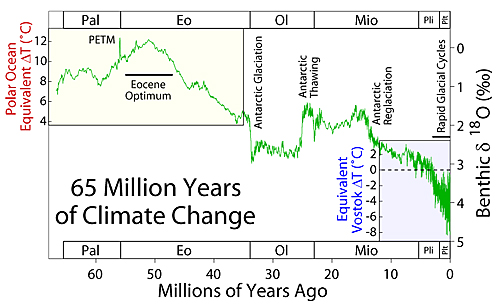
Above: The Cenozoic climatic trend (green line): figure prepared by Robert A. Rohde (citations via the link).
The cause of the precipitous end-Eocene fall in temperatures has been the subject of much research. The strata dating from this time have been mapped, analysed and their fossil fauna and flora described on an ongoing basis. The new paper in Science has added yet another piece to the jigsaw, refining the use of what was previously a problematic CO2 proxy - something whose properties can be calibrated with CO2 concentration at the time - and reaffirming the role of CO2 as Planet Earth's atmospheric thermostat.
However, the new study has also been doing the rounds in the skeptic sector of the Blogosphere. Typically, and unsurprisingly, the professional-skeptic spin on the paper has involved variations of the following theme: "so the Antarctic was a frozen hell at 600ppm and we are nowhere near that, so what's all the fuss about?"
Ahem.
The first Golden Rule when a new paper comes out is to read it, so let's take a look and see what it actually says. Here's the Abstract - the brief summary of the work that all scientific papers begin with:
Abstract
Earth’s modern climate, characterized by polar ice sheets and large equator-to-pole temperature gradients, is rooted in environmental changes that promoted Antarctic glaciation ~33.7 million years ago. Onset of Antarctic glaciation reflects a critical tipping point for Earth’s climate and provides a framework for investigating the role of atmospheric carbon dioxide (CO2) during major climatic change. Previously published records of alkenone-based CO2 from high- and low-latitude ocean localities suggested that CO2 increased during glaciation, in contradiction to theory. Here, we further investigate alkenone records and demonstrate that Antarctic and subantarctic data overestimate atmospheric CO2 levels, biasing long-term trends. Our results show that CO2 declined before and during Antarctic glaciation and support a substantial CO2 decrease as the primary agent forcing Antarctic glaciation, consistent with model-derived CO2 thresholds.
What does that mean? We can now delve into the paper itself for the meat to put on the bones.
Glaciation always leaves calling-cards
Firstly, due to their very nature, glacial episodes on Earth always leave behind their distinctive geological calling-cards. The onset of mid-Cenozoic glaciation in Antarctica, ~33.7 million years ago, is no exception in this respect. Initiation of this abrupt climatic change is marked by a sudden shift in deep-sea oxygen isotope values and also by two strong signals in the local sedimentary rock sequence: firstly, the sudden introduction of sediments with a glacio-marine origin and secondly a change in in the types of clay-minerals present that identifies a shift in the predominant type of weathering of the rocks of the continent, from chemical dissolution of minerals to a physical erosion regime. So we have known for a long time that Antarctica went from being ice-free to having a system of glaciers, we know that this happened around the Eocene-Oligocene boundary and we know that, geologically-speaking, this change happened rather quickly.
So how did it cool so quickly?
The abrupt cooling episode that led to the appearance of Antarctica's glaciers has been the subject of much research and there have been a number of proposed mechanisms, involving changing concentrations of greenhouse gases, orbital variations and changes to oceanic currents in various combinations.
Brief mention should also be made of the slightly fainter sun at the time: as a main sequence star, the sun has been brightening at a rate of ca. 10% per billion years of geological time, so that 33.7 million years ago it would have been about 0.3% less bright than at the present day. However, this variability clearly occurs over a very long timescale, so that it would not cause a sudden and drastic climate event.
CO2 values in the Hothouse climate of the Eocene (and indeed over the preceding millions of years) were significantly higher (1000-1500ppm) than any relatively recent levels (180-280ppm respectively in glacial-interglacial cycles and ~390ppm and rising in the Industrial Age of today). However, the exact timing, nature and causes of the Cenozoic CO2 decline have remained somewhat elusive. Reconstructions have been attempted by examining the chemistry of alkenones in marine sediments. Alkenones are organic compounds of the ketone family that are in most cases highly resistant in nature. They are produced by a particular class of phytoplanktonic algae and their stable carbon isotope ratios have been used in palaeoclimatology as a method of estimating atmospheric CO2 levels (Pagani, 2002).
Alkenone-based CO2 reconstructions for the period of cooling that led to the onset of Antarctic glaciation have to date been a little problematic. They do indicate that the large CO2 decline occurred in several steps during late Eocene-early Oligocene times from the Hothouse high of 1000-1500ppm. However, a previous attempted reconstruction showed an increase in CO2 at the time of the cooling and a large decline occurring 2-3 million years after maximum ice-sheet expansion (Pagani et al, 2005). This was found to be at odds with a separate proxy based on boron isotopes (Pearson et al, 2009) which indicated a C02 decline consistent with the Eocene-Oligocene boundary cooling, a subsequent weak rebound then a continued decline. It was also quite at odds with modelled estimates for the CO2 threshold - the level below which a rapid onset of Antarctic glaciation was likely to occur. Why?
The existing, problematic alkenone-based CO2 record is based on samples taken from a variety of environmental settings. In cases where they were obtained from poorly-stratified, nutrient-rich waters, the new paper suggests, it was possible that the samples did not accurately reflect the atmospheric CO2 concentration. In this new study, the authors examined regional differences in CO2-alkenone estimates from six well-separated localities around the globe, representing a range of environmental conditions, in order to investigate the problem further.
The paper goes on to describe in considerable detail how the issues with alkenones as proxies may be addressed, based on biochemistry work with cultures of the alkenone-producing algae in which physical and nutritional conditions could be varied and the results noted. The research led to the understanding that it was in fact very difficult to glean useful reconstructions from high southern latitudes (i.e. the seas around Antarctica) because of uncertainty with respect to these critical physical and nutritional conditions around the Eocene-Oligocene boundary. This was because the rather different geography at the time would have affected ocean circulations - and hence those physical and nutritional constraints - in that particular area, in an unpredictable manner. However, it was found that the uncertainties were greatly reduced at low-latitude sites - of which, in this study, there were two - in the Atlantic Ocean a little south of the Equator. It is upon these two sites, therefore, that the new attempt to reconstruct atmospheric CO2 was focused.
The sites yielded a reconstruction that revealed a persistent and substantial CO2 decline that began approximately two million years before the start of the rapid cooling and continued through and just beyond the event. A slight rise occurred in the mid-Oligocene before a long-term decline then set in towards Miocene times. The decline over the period 35.5-32.5 million years ago was from an initial high of 1000-1200ppm down to 600-700ppm in just three million years. This is consistent with the boron-based study and, importantly, is also consistent with the modelled estimates for the threshold CO2 level required for rapid glaciation in Antarctica (e.g. DeConto et al, 2008). In other words, it is consistent with what the physics would expect.
Other recent research has suggested that the development of the Circum-Antarctic Oceanic Current through the remainder of the Oligocene contributed to the further cooling of the continent due to thermal isolation (Anderson et al, 2011), so that by the Miocene the only vegetation left on Antarctica was localised areas of wooded tundra: some time after 12.8 million years ago this, too, had vanished as the great ice-sheets expanded. In addition, there is the positive feedback of albedo-rise once extensive permanent ice and snow are present, which would also favour further cooling. However, the take-home point of this study is that sharply-falling CO2 levels had the leading role in abruptly transitioning the global climate from the Hothouse to one in which it was cool enough for Antarctic glaciation to commence.
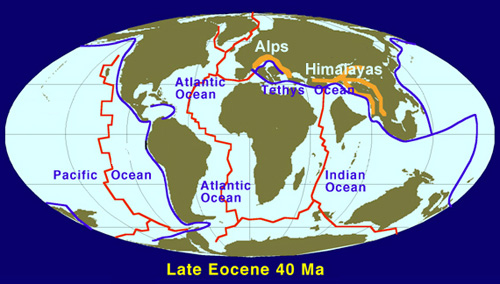
Above: The late-Eocene world. Image courtesy of Ron Blakey of CP Geosystems.
Where did the CO2 go?
What processes would have been responsible for the strong CO2 drawdown event that led to this cooling? Burial of organic matter is one way of removing a lot of carbon from the system. This goes on all of the time. Chemical weathering of silicate minerals is another significant and ever-present carbon-sink. But here, we are dealing with a specific event in which a large amount of CO2 was taken out of the system - a carbon cycle "hiccup", if you like.
The Hothouse of the early Cenozoic was accompanied by very widespread tropical to sub-tropical weathering of silicate minerals but at the same time there was also the Alpine-Himalayan Orogeny (mountain-building episode), which commenced in Palaeocene-Eocene times and continued into the Miocene. The massive increase in mechanical erosion as mountain ranges rise leads to two enhanced carbon sinks: firstly a massive increase in surface area available to weathering agents, amongst which dissolved CO2 in rainwater is a lead player (think of the surface area of a lump of rock weighing a kilogram compared to the surface area of a kilo of sand scattered over the ground), and secondly a massive increase in particulate flux i.e. sediment getting swept down rivers - which in turn leads to rapid burial in sedimentary basins, including burial of organic carbon. So as a candidate bulk sink of carbon, it is certainly worthy of further consideration. Large phytoplanktonic algal blooms are another possibility - the mid-Eocene also saw the "Azolla event", a massive bloom of a freshwater fern over the then isolated and highly stratified Arctic Ocean, conditions in which dead organic matter was preserved and buried (e.g. Brinkhuis & Schouten, 2006). Did similar events occur elsewhere in the final years of the last Hothouse Earth?
The implications of this research
The graphic below depicts atmospheric CO2 concentrations, as observed at Mauna Loa from 1958-2008 (black dashed line) and projected from 2008-2100 under the six IPCC scenarios. Given that current emissions are in line with the A1F1 scenario, there seems a high risk of crossing the 600ppm threshold by later this century if the situation remains unmitigated. What does this mean in practice, with respect to the recent paper?
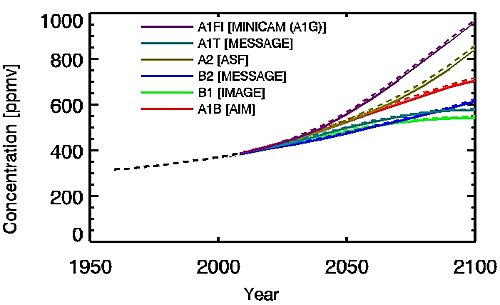
Source: http://www.ipcc-data.org/ddc_co2.html
The Pagani et al (2011) reconstruction suggests that a significant and rapid episode of CO2 drawdown occurred just before and during the cooling that led to the onset of Antarctic glaciation, and the drawdown took CO2 levels to 600-700ppm - below the modelled threshold value for the initiation of Antarctic glaciation. The converse of this is that, in an ice-free world, atmospheric CO2 levels much above 600-700ppm would not favour temperatures low enough for the development of glaciers in that continent.
Heading into a future with CO2 levels in the high hundreds of PPM therefore seems unfavourable for the long-term survival of the ice-sheets of Antarctica. In this context, it is important to remember that the current study deals with the onset of glaciation in Antarctica - as set out above, the extensive ice-sheets came later in the Oligocene and Miocene when CO2 levels were lower still, the Circum-Antarctic Current had fully developed and albedo had increased massively. Skeptical Science has already covered land-ice loss from Antarctica here: the current rate of loss is 100-300Gt/year. Arguments, generated by professional climate change skeptics, that Antarctica is gaining ice are thus off-target: the continent is losing land-ice, whose melting leads to sea-level rise. Fluctuations in sea-ice (which is what these skeptics have seized upon) do not affect sea-levels: indeed, they are to be expected as the input of massive amounts of fresh water from melting land-ice dilutes surface sea-water salinity, thereby raising its freezing-point and promoting sea-ice growth - for the time being.
In conclusion, we are already into a world where the long-term survival of parts of the ice-sheets is not favoured: the further towards the high hundreds of ppm CO2 we head the further we head into a world that does not favour any Antarctic land-ice, although of course to melt all that ice would likely take many centuries. That is no comfort when considering the ecological, humanitarian and economic effects of a steady sea-level rise of several tens of metres over that time, submerging all of our coastal cities one after another. If that's not worth making a fuss about then what is?
Paper under discussion in this post:
Pagani, M., Huber, M., Liu, Z., Bohaty, S.M., Henderiks, J., Sijp, W., Krishnan, S. & DeConto, R.M. (2011): The Role of Carbon Dioxide During the Onset of Antarctic Glaciation. Science, 334, 1261-1264









[DB] Link to non-science blog snipped.
[DB] "The snippet that was politely cut showed the science of solubility of CO2 in water, it was just inconvenient science."
Actually it was just giving publicity to a non-science website, as was politely delineated before.
"The level of CO2 drops for no particular reason"
Now you posit magic.
Please note that posting comments here at SkS is a privilege, not a right. This privilege can be rescinded if the posting individual treats adherence to the Comments Policy as optional, rather than the mandatory condition of participating in this online forum. Please take the time to review the policy and ensure future comments are in full compliance with it. Thanks for your understanding and compliance in this matter.
[DB] "I don't understand your rules"
Comments constructed to comply with the Comments Policy and also on-topic for the thread on which they are placed receive no moderation.
"I don't alway understand this stuff"
Understandable. There was a time when I was just starting out in this field & knew little about it.
There are over 4,700 threads here at SkS on virtually every conceivable topic related to climate science. If you have questions on things related to climate science, please use the Search function in the upper left corner of every page here to find a related post. If you still have questions after reading it, place those questions there.
"Perhaps I should find a site that has more tolerance for lack of understanding."
The dialogue in the comments threads here at SkS rely upon science and peer-reviewed evidence to support positions. Comments lacking substance or citations to said peer-reviewed evidence amount to opinion. As such, little attention to them is typically given unless they also do not comply with the Comments Policy.
Comments and questions framed in compliance with the Comments Policy and also on-topic for the thread on which they are placed are given ample tolerance for a lack of understanding.
Should this site not fit your commenting style then others exist that should accomodate you.